
What if the "wait and see" approach is actually the hardest path for your family to take? Many parents worry they're overreacting to a missed milestone, yet they still feel a quiet tug of concern about their child's development. If you've been searching for answers about qualifying for early intervention services, you've likely encountered confusing terminology and complex state requirements that feel more like barriers than bridges. It's natural to feel overwhelmed, but your intuition is a powerful tool that deserves professional support and validation.
This guide replaces that uncertainty with a clear, supportive roadmap for your family. We'll explore California's specific 25% developmental delay threshold and the multidisciplinary steps involved in a professional assessment. You'll also discover how to connect with local experts in Santa Clara County and the San Andreas Regional Center to ensure your child receives the right care at the right time. Our goal is to provide the clarity you need to move forward with confidence, turning a stressful process into a path of hope and growth.
Key Takeaways
- Learn why the first three years represent a critical window for brain development and how timely support fosters lifelong growth.
- Gain a clear understanding of the specific criteria for qualifying for early intervention services, including California's 25% developmental delay threshold.
- Discover how a multidisciplinary evaluation team looks at the "whole child" to provide a comprehensive picture of their speech, social-emotional, and cognitive health.
- Find out how to navigate the local California Early Start system through the San Andreas Regional Center (SARC) in Santa Clara County.
- Explore the next steps for accessing specialized screenings for Autism, Down syndrome, and other developmental needs to help your child thrive.
What is Early Intervention and Why Does It Matter?
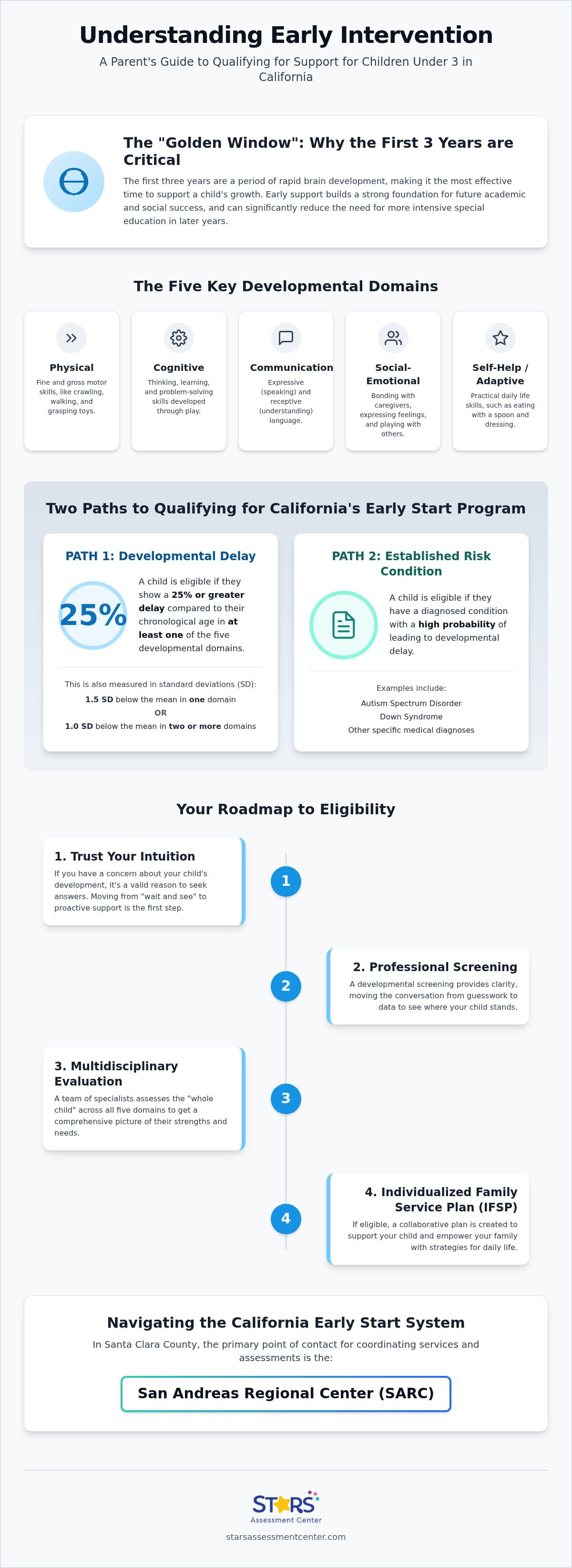
The first three years of a child's life represent a unique period of rapid growth and brain development. Understanding What is Early Intervention helps parents see it as a specialized support system designed specifically for infants and toddlers. This period is often called the "Golden Window" because the brain is at its most receptive state. When a child receives support during these early stages, we can effectively bridge developmental gaps before they widen. The process of qualifying for early intervention services begins with a simple shift in perspective: moving from worry to action.
At the heart of this support system is the Individualized Family Service Plan (IFSP). This isn't just a clinical document; it's a collaborative roadmap that supports the entire family unit. The goal is to empower you with strategies to help your child thrive in their daily environment. Research consistently shows that providing early support can significantly reduce the need for more intensive special education services in later school years. By acting now, you are building a stronger foundation for your child's future academic and social success.
The Five Key Developmental Domains
To understand if your child might benefit from support, specialists look at five specific areas of growth. Each domain plays a vital role in a child's ability to interact with the world around them:
- Physical development: This includes reaching for toys, crawling, and eventually walking, as well as fine motor skills.
- Cognitive skills: This focuses on how a child thinks, learns, and solves problems through play.
- Communication: This involves both expressive language (speaking) and receptive language (listening and understanding).
- Social-emotional development: This covers how a child bonds with caregivers, expresses feelings, and begins to play with others.
- Self-help/Adaptive skills: These are the practical milestones of daily life, such as learning to eat with a spoon or helping with dressing.
When to Start Thinking About Eligibility
Many parents feel a quiet tug of concern when they notice their child isn't meeting milestones at the same rate as their peers. It's common to hear advice to "wait and see," but being proactive is almost always the better choice. Trusting your parental intuition is the first step in the journey toward qualifying for early intervention services. A professional developmental screening birth to three provides the first layer of clarity. It moves the conversation from guesswork to data, giving you a clear picture of where your child stands and what specific supports might help them reach their full potential.
The Two Paths to Qualifying for Early Intervention Services
Understanding the criteria for qualifying for early intervention services can feel like learning a new language. However, the process is designed to be inclusive, ensuring that children who need support receive it as early as possible. In California, there are two primary ways a child under age three can become eligible for the Early Start program. Whether your child has a noticeable delay in meeting milestones or a specific medical diagnosis, the goal remains the same: to provide resources that foster growth during these formative years.
A vital part of this process is "informed clinical opinion." This allows specialists to use their professional expertise to determine eligibility even if a child's test scores are right on the edge of the requirements. It ensures that we look at the "whole child" rather than just a set of numbers. If you are feeling uncertain about your child's progress, a multidisciplinary developmental assessment can help determine which path to eligibility is most appropriate for your family.
Qualifying via Developmental Delay
The most common way children qualify is through a measurable developmental delay. As of June 30, 2022, California moved to a standardized 25% developmental delay threshold. This means that if a child is functioning at a level 25% below their chronological age in one or more of the five key domains, they are eligible for services. Specialists often use "standard deviations" to measure this. Typically, a delay of 1.5 standard deviations in one area, or 1.0 in two or more areas, meets the state criteria. If your child's scores are borderline, the assessment team will use their clinical judgment to see if the delay still significantly impacts daily life.
Qualifying via Established Risk Conditions
The second path to eligibility is through an "established risk condition." These are medical diagnoses that have a high probability of resulting in developmental delays. When a child has one of these conditions, they often bypass the need to prove a specific percentage delay because the need for support is already recognized. Common qualifying conditions include Autism, neurological disorders, and chromosomal abnormalities. For example, a specialized Down syndrome assessment can lead to immediate service access, helping families start their journey without delay. While state rules vary, reviewing the eligibility for ECI services in other regions shows a consistent national focus on using medical records to fast-track support for children with known diagnoses.
The Multidisciplinary Evaluation: Your Roadmap to Eligibility
The term "multidisciplinary" might sound like another layer of bureaucratic jargon, but it is actually the most supportive way to view your child's growth. Rather than relying on a single specialist, this approach brings together a team of experts to look at the "whole child." This collaborative method is the gold standard for qualifying for early intervention services. By combining different professional perspectives, the team ensures that no strength is overlooked and no challenge is missed during the assessment process.
A typical team includes experts such as speech and language pathologists, developmental specialists, and social-emotional experts. You aren't just an observer in this process; you are the most important member of the multidisciplinary team. Your knowledge of your child's daily habits, preferences, and struggles provides the context that standardized tests alone cannot capture. The evaluation transitions smoothly from natural play-based observation to more structured tasks, ensuring the team sees your child at their most comfortable and authentic.
The Stars Assessment Program Approach
Our multidisciplinary team focuses on providing gentle, family-centered evaluations for children from birth to age three. We place a specialized focus on social-emotional and communication domains, recognizing that these are often the first areas where families notice a need for extra support. For families in San Jose and throughout Santa Clara County, we act as a bridge between the initial concern and the clarity of a professional finding. We help you interpret the data so you can feel empowered rather than overwhelmed by the results.
What to Expect During the Evaluation
Preparation is key to a successful assessment day. We recommend bringing your child's favorite snacks and a few familiar toys to help them feel at home in the evaluation space. During the session, specialists will engage your child in play, using bubbles, blocks, or books to observe how they problem-solve and interact with others. This play-based approach allows us to gather accurate data without causing stress for your little one. After the observation, we hold a review meeting to discuss the findings together. This is your time to ask questions and understand how these results impact the process of qualifying for early intervention services.
Navigating the California Early Start System
California's Early Start program serves as the state's specific response to federal requirements for infants and toddlers. For families in our area, the San Andreas Regional Center (SARC) acts as the primary gateway for qualifying for early intervention services. This agency coordinates with local providers to ensure children from birth to age three receive the support they need. In California, eligibility is specifically tied to a 25% developmental delay in one or more areas, a standard updated in June 2022 to ensure consistency across the state.
The journey usually begins with a referral. This can come from a pediatrician, a childcare provider, or even a parent's self-referral. Once SARC receives this information, they assign a service coordinator to guide you through the next steps. This process culminates in the creation of an Individual Family Service Plan (IFSP) if your child is found eligible. The IFSP is a dynamic document that outlines the specific services your child will receive and the goals your family hopes to achieve.
Local Resources in Santa Clara County
Families living in San Jose, Milpitas, Gilroy, and Morgan Hill have access to a robust network of support. While SARC manages the overall case, private assessment centers often partner with the system to provide high-quality evaluations. Understanding the nuances of the local system is vital, especially when determining whether your child needs an autism screening vs evaluation. Screenings offer a quick look at potential risks, while a full evaluation provides the diagnostic depth required for specific service qualifying. If you're ready to take the first step, you can schedule a multidisciplinary developmental assessment to get the clear data you need for the Regional Center process.
Timeline and Rights for California Families
California law protects your family with strict timelines to ensure children don't wait too long for help. The 45-day rule is a critical safeguard. From the moment you make a referral, the Regional Center has exactly 45 days to complete the evaluation, determine eligibility, and hold the first IFSP meeting. This prevents bureaucratic delays from eating into that precious window of brain development. Every day counts when it comes to early growth.
You should also remember that your right to an initial evaluation is protected. Under the Early Start program, assessments and service coordination are provided at no cost to families, regardless of income. If you ever disagree with an eligibility decision, procedural safeguards are in place. These allow you to request a second opinion or a due process hearing to ensure your child's needs are accurately represented and addressed.
Next Steps: How the Stars Program Supports Your Journey
You've done the heavy lifting of researching and observing; now it's time to find a partner who can provide the clarity your family deserves. The Stars Assessment Program is designed to be a "safe harbor" for families in San Jose and the surrounding Santa Clara County communities. We specialize in comprehensive developmental assessments tailored specifically for children birth to age three. Whether you're concerned about social-emotional delays or seeking expert screenings for Autism or Down syndrome, our team is here to listen and guide you through the process of qualifying for early intervention services.
We believe that an assessment should be a bridge to support, not a source of stress. Our multidisciplinary team focuses on seeing the "whole child" in an environment that feels comfortable and welcoming. Once the evaluation is complete, we don't just hand over a list of scores. We sit down with you to explain the findings and discuss how they impact your child's daily life. This guidance is vital for transitioning from a set of results to the actual services that will help your child thrive within the California Early Start system.
Why Choose a Specialized Assessment Center?
Deep expertise in the birth-to-three age range is essential because development moves so quickly during these years. A general practitioner might miss the subtle nuances that a specialist trained in early childhood growth will catch. For instance, a Santa Clara County toddler speech evaluation can pinpoint specific communication needs that might otherwise be labeled as a simple "delay." Our commitment to cultural sensitivity and family partnership ensures that we respect your family's unique background and values while we work together to support your child's potential.
Requesting Your Child’s Evaluation
Initiating the process with Stars Assessment Program is a straightforward step toward peace of mind. To get started, it's helpful to have your pediatrician's notes and any milestone checklists you've been keeping ready. These documents provide a helpful baseline for our team. When you're ready, reach out to us to schedule a multidisciplinary developmental assessment. Having a clear developmental picture is the most effective way to move forward with confidence. You'll no longer have to wonder if you're "overreacting"; instead, you'll have the data and professional support needed for qualifying for early intervention services and securing your child's future growth.
Empowering Your Child’s Future Through Early Support
The first three years of your child’s life are a unique time of growth, and being proactive is the best way to support their long-term potential. We’ve explored how the "Golden Window" of brain development makes timely action so important for infants and toddlers. You now have a clearer view of how the multidisciplinary evaluation works and how the California Early Start system supports families throughout Santa Clara County. Remember that qualifying for early intervention services isn't a test to pass or fail; it's a doorway to the specialized resources your child deserves.
Our multidisciplinary team of specialists is dedicated to serving San Jose and the surrounding communities with specialized Autism and Down syndrome screenings. If you’re ready for professional clarity and a supportive roadmap, we invite you to begin your child’s journey with a comprehensive developmental assessment at Stars Assessment Program. You don’t have to navigate this path alone. We are here to provide the safe harbor and expert guidance your family needs to help your little one reach every milestone with confidence.
Frequently Asked Questions
How do I know if my child qualifies for early intervention in California?
In California, a child qualifies if they show a 25% developmental delay in at least one of the five key domains or have an established risk condition. These domains include cognitive, physical, communication, social-emotional, and adaptive skills. For infants and toddlers under 36 months, this threshold ensures that those who need help receive it early. A multidisciplinary team uses standardized testing and clinical observation to determine if your child meets these specific state requirements.
Is there a cost for the early intervention evaluation?
There is no cost to families for the initial evaluation, assessment, or service coordination within the California Early Start program. Federal and state laws ensure that every child has access to these diagnostic services regardless of a family's income level. While some therapeutic services later might be covered by private insurance, the process of qualifying for early intervention services through your local Regional Center is provided as a public service to support early development.
What is the difference between a developmental delay and a disability?
A developmental delay means a child is reaching milestones later than their peers, while a disability often refers to a lifelong condition or a specific medical diagnosis. In the context of early intervention, both can lead to eligibility. A delay might be temporary with the right support, whereas an established risk condition, like Down syndrome, provides a clear path to services because the impact on development is well-documented by medical research.
Can my child qualify for services if they only have a speech delay?
Yes, a child can qualify for support even if they only experience a delay in speech and language. If the evaluation shows a 25% delay in the communication domain, your child is eligible for services through the Early Start program. Speech delays are one of the most common reasons families seek help. Addressing these challenges early can prevent future frustrations with learning and social interaction as your child prepares for preschool and beyond.
What happens if my child is found ineligible for services?
If your child is found ineligible, the Regional Center will often provide referrals to other community-based resources and programs. You might be encouraged to monitor your child's progress and request a new evaluation in six months if concerns persist. It's also your right to request a second opinion or a due process hearing if you disagree with the decision. We often help families understand these results and explore alternative paths for support.
How long does the qualifying process take from start to finish?
The process of qualifying for early intervention services is protected by a strict 45-day timeline in California. From the moment you or a professional makes a referral to the Regional Center, the agency has exactly 45 days to complete the evaluation and hold the initial IFSP meeting. This law ensures that children don't lose precious time during their most critical developmental window. The goal is to move from initial concern to active support as quickly as possible.
Do I need a doctor’s referral to get an early intervention assessment?
You do not need a doctor's referral to begin the assessment process for your child. While many pediatricians do make referrals, parents have the right to contact the San Andreas Regional Center directly if they have concerns about their child's growth. Your intuition as a parent is a valid reason to seek an evaluation. Simply call your local office to start the intake process and share the specific milestones that have caused you concern.
What is an IFSP and how is it related to qualifying for services?
An IFSP, or Individualized Family Service Plan, is the roadmap created once a child is found eligible for services. It's a collaborative document that outlines your child’s current developmental levels, the specific goals your family wants to achieve, and the services that will be provided. Unlike later school plans, the IFSP focuses on the whole family unit. It ensures that the support provided fits naturally into your daily routines and home environment.


