
What if your toddler's most overwhelming meltdowns aren't signs of defiance, but their only way of communicating a developmental need? When persistent tantrums, communication struggles, or social withdrawal leave you wondering whether your child is moving through a typical phase or a developmental delay, it's easy to feel isolated. Finding a clear, compassionate toddler behavioral assessment San Jose families can rely on shouldn't add to your stress, especially when clinical jargon and complex local systems feel intimidating.
You don't have to worry that an evaluation will merely assign a label to your child. At its best, an assessment provides reassuring clarity, unlocking timely support and actionable early intervention tailored to your family dynamic. This guide outlines how to choose the right toddler behavioral and developmental assessment in Santa Clara County, what to expect during the evaluation process, and how to connect with trusted local resources to support your child's ongoing growth.
Key Takeaways
- Learn how to distinguish everyday toddler frustration from persistent social-emotional challenges that benefit from early evaluation.
- Understand how a multidisciplinary toddler behavioral assessment San Jose specialists provide offers a complete picture across communication, emotional, and cognitive growth.
- Discover the essential qualifications to look for in a local provider, prioritizing dedicated birth-to-three experience and gentle, play-based observation.
- Explore what happens during an evaluation session and how to prepare your child for a calm, comfortable experience.
- Learn how assessment findings open clear, supportive pathways to Santa Clara County resources, including California Early Start and San Andreas Regional Center.
Recognizing When Your Child Needs a Toddler Behavioral Assessment
Every toddler experiences moments of big frustration. When a two-year-old throws a spoon because they want another cracker, they are practicing self-expression and testing limits. However, when emotional distress becomes an everyday barrier rather than an occasional storm, parents often wonder where typical development ends and a deeper developmental need begins. Seeking a toddler behavioral assessment San Jose families trust isn't about looking for faults. It's about understanding how your child experiences their world so you can offer the right support before age three, when young brains are uniquely adaptable. Research into early childhood intervention models shows that responsive support during these formative years builds the strongest foundation for lifelong social-emotional health.
Typical Toddler Tantrums vs. Concerning Behavioral Patterns
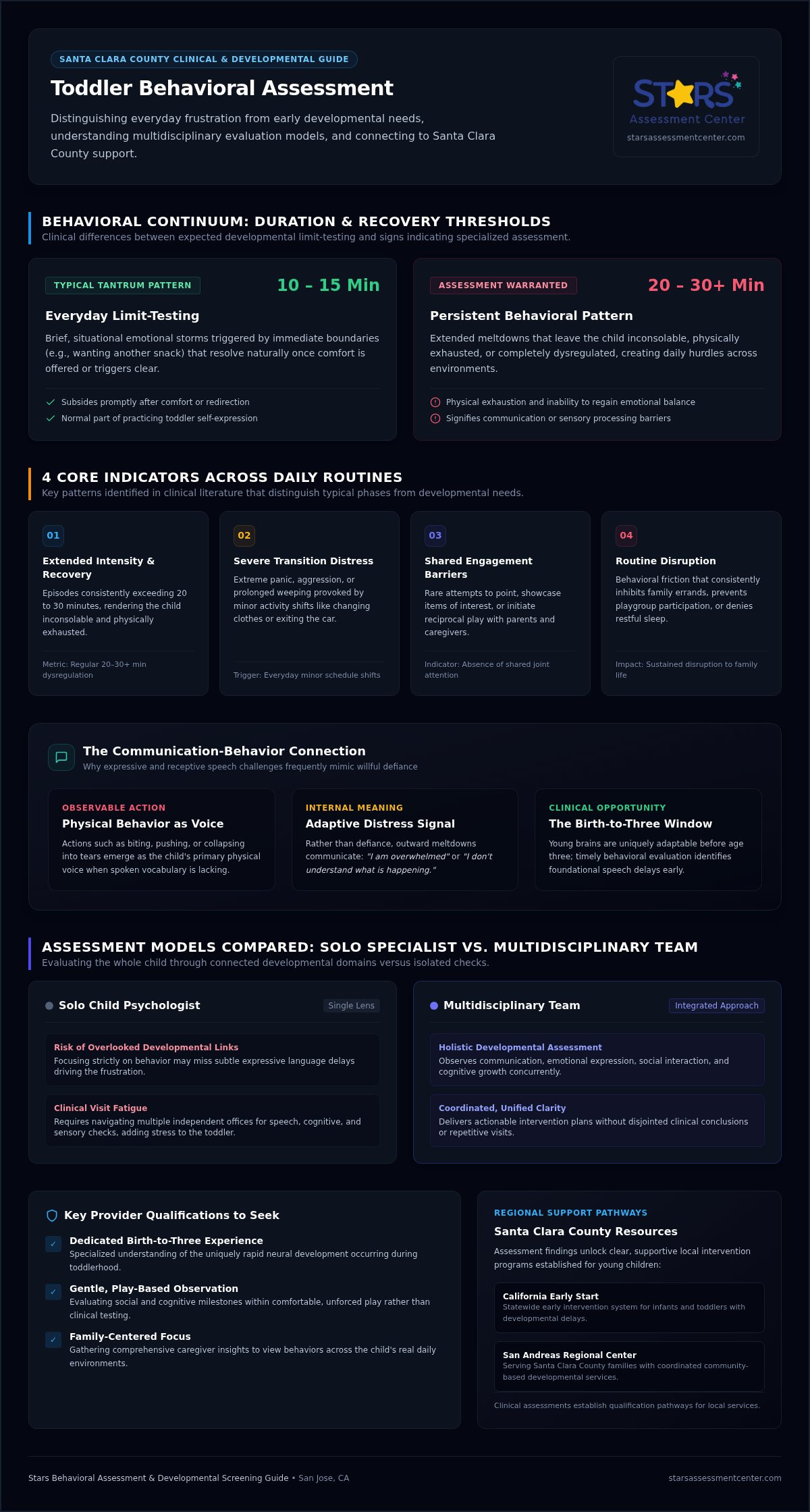
Occasional meltdowns are an expected part of growing up. What separates typical developmental frustration from an underlying challenge is the frequency, intensity, and recovery time of each episode. A typical tantrum usually subsides within ten to fifteen minutes once the immediate trigger passes or the child receives comfort. By contrast, persistent behavioral challenges often present distinct patterns across daily routines:
- Extended intensity and recovery: Meltdowns that regularly exceed twenty to thirty minutes, leaving the child inconsolable, physically exhausted, or completely dysregulated.
- Severe transition distress: Extreme panic, aggression, or prolonged weeping triggered by minor shifts in activity, such as changing clothes or leaving the car.
- Shared engagement barriers: Rare attempts to point, show objects of interest, or initiate reciprocal play with parents and caregivers.
- Routine disruption: Behavioral friction that consistently prevents the family from running everyday errands, attending playgroups, or achieving restful sleep.
The Connection Between Communication Delays and Toddler Behavior
Young children feel intense emotions long before they possess the spoken vocabulary to explain them. When a toddler cannot find the words to express their needs, their physical behavior becomes their primary voice. Biting, pushing, or collapsing into tears often represents an adaptive attempt to say, "I am overwhelmed," or "I don't understand what is happening."
These communicative struggles frequently mimic willful defiance, causing parents unnecessary distress. In reality, the child is often struggling with receptive or expressive speech delays that leave them feeling misunderstood. Pursuing a toddler behavioral assessment San Jose providers conduct helps determine whether communication barriers or social-emotional sensitivities are driving outward behaviors. You can also review our guide to early childhood developmental screening to learn more about foundational milestones and growth indicators.
Comparing Assessment Models: Child Psychologist vs. Multidisciplinary Team
When you decide to seek guidance, you will likely encounter two primary clinical paths: consulting a solo child psychologist or working with a collaborative multidisciplinary team. Toddler development does not happen in separate compartments. A child's emotional expression is tied directly to how they process language, interact socially, and understand their environment. Opting for a multidisciplinary toddler behavioral assessment San Jose specialists conduct gives families a complete picture, ensuring that specific behaviors aren't viewed in isolation. Established developmental and behavioral screening tests show that early growth domains are deeply interconnected, making a team-based perspective especially valuable for children under age three.
The Limitations of Single-Specialist Behavioral Evaluations
A solo child psychologist brings meaningful expertise to emotional and diagnostic questions. However, evaluating a young toddler through a single lens has real limitations:
- Overlooked developmental links: A practitioner focused solely on behavioral patterns may miss underlying expressive language delays that drive frustration.
- Clinical visit fatigue: Taking a toddler to multiple independent offices for separate behavioral, speech, and developmental checks increases stress, often triggering uncharacteristic meltdowns during observation.
- Fragmented care plans: Receiving isolated reports from disconnected providers leaves parents with the exhausting task of reconciling conflicting advice.
The Benefits of a Multidisciplinary Developmental Evaluation
A multidisciplinary evaluation coordinates several developmental specialists during a unified, gentle observation session. Rather than sitting behind a desk, clinicians interact with your toddler through guided floor play, observing how social-emotional responses, communication, and cognitive reasoning work together in real time.
This cooperative model ensures subtle communicative barriers aren't misattributed to behavioral defiance. Most importantly, your family walks away with a single, integrated summary detailing clear strengths and actionable next steps. If you are exploring comprehensive options for an infant or toddler, learning about the multidisciplinary developmental assessments at Stars Assessment Program can help you find clarity in a supportive, family-centered environment.
How to Choose a Toddler Assessment Provider in San Jose
Finding the right clinical partner in the South Bay requires looking beyond general directory listings. Evaluating an infant or toddler demands distinct developmental expertise that differs significantly from assessing school-age children. When selecting a provider for a toddler behavioral assessment San Jose families should focus on four essential pillars:
- Specialized early experience: Confirm that the clinical team specializes in evaluating infants and children under age three.
- Play-based observational tools: Verify that clinicians assess social-emotional milestones through floor play rather than stressful testing tables.
- Collaborative partnership: Choose an evaluation center that treats caregivers as integral partners whose daily observations carry significant weight.
- Local system integration: Ensure the team understands how to format findings to interface smoothly with Santa Clara County resources and the California Early Start program.
Key Questions to Ask Prospective San Jose Providers
Before scheduling an appointment, contact prospective clinics to understand their philosophy and approach. Practical questions to ask include:
- Which developmental instruments do you use? Look for standard, evidence-based tools designed specifically for toddlers, such as the Bayley Scales or Vineland Adaptive Behavior Scales.
- What is the parent's role during the session? Compassionate providers invite you directly into the observation room so your toddler feels safe and supported.
- How do your reports translate to local services? Providers should understand local regional center guidelines so your evaluation unlocks practical community support without delays.
Ensuring Cultural and Family-Centered Competence
San Jose is home to diverse communities with unique linguistic and cultural backgrounds. Standardized checklists cannot capture the full context of your toddler's world if they ignore your family's home language, daily routines, and caregiving traditions.
Seek out a team that listens attentively to your home observations and honors your family dynamic. Compassionate providers explain every finding in warm, everyday language rather than confusing clinical shorthand, ensuring you leave with confidence and a clear path forward.
What to Expect During Your Toddler Evaluation Experience
Walking into a clinical setting with a young child can feel daunting, especially when emotions are already running high. Knowing what happens step by step helps transform apprehension into a constructive, positive experience. A high-quality toddler behavioral assessment San Jose clinicians provide is not a rigid pass-or-fail test. Instead, it is a warm, observational partnership structured to understand how your child learns, communicates, and engages with others during everyday interactions.
Preparing for the Evaluation Appointment
Setting up your child for success starts before you arrive at the clinic. A few practical adjustments help ensure specialists observe your toddler at their best:
- Coordinate with daily rhythms: Book appointments during your toddler's peak alert windows, avoiding usual nap times or hunger slumps.
- Pack familiar comforts: Bring preferred snacks, a favorite lovey, or an engaging toy to help them settle into a new environment.
- Reframe the visit gently: Talk about the appointment as a fun playdate where friendly helpers want to share games, blocks, and books.
The Play-Based Observation Environment
Once you step inside, you will notice child-friendly spaces designed with soft rugs, accessible toys, and low tables. Rather than asking toddlers to sit still for formal questions, evaluators use interactive play routines to observe spontaneous developmental behaviors. Clinicians present activities like rolling balls, stacking rings, and reading picture books to note how your child responds to their name, initiates joint engagement, and self-regulates during minor play frustrations.
Caregivers remain nearby throughout the entire session. Your presence provides emotional security, and your insights give vital context to the team's observations. To understand how these comprehensive sessions differ from quick developmental questionnaires, read our breakdown on screening versus evaluation for toddlers.
Receiving and Understanding the Comprehensive Assessment Report
Following the observation, the assessment team meets with you to discuss their observations in plain, supportive terms. You will receive a unified developmental report highlighting your child's emerging strengths alongside identified social-emotional or communicative growth areas.
Rather than labeling your toddler, this comprehensive summary serves as a practical blueprint. It clarifies what is driving specific behavioral reactions and recommends supportive strategies you can start using at home immediately. When you are ready to take that next step with a compassionate, multidisciplinary team, you can schedule an evaluation with Stars Assessment Program to gain clear answers and reliable support for your child's journey.
Connecting Assessment Results to Santa Clara County Resources
A comprehensive developmental report is more than a summary of observations; it is the master key to unlocking local early intervention. In California, developmental support for children under age three is coordinated through the state's Early Start program. Having clear documentation from a multidisciplinary toddler behavioral assessment San Jose parents can trust removes the guesswork, streamlining eligibility determinations so your child receives timely, personalized support during their most critical developmental window.
Working with San Andreas Regional Center (SARC)
For families residing in Santa Clara County, San Andreas Regional Center (SARC) serves as the primary gateway for state-funded early intervention services. Under California law, regional centers must evaluate eligible infants and toddlers and finalize an Individualized Family Service Plan (IFSP) within 45 days of referral. A clear, thorough evaluation report dramatically speeds up this process by providing the objective clinical evidence SARC intake coordinators need.
To prepare for regional intake, keep your child's birth records, medical history, and clinical evaluation documentation easily accessible. An objective evaluation is especially valuable if you suspect early autism signs or developmental delays, as it ensures your service coordinator understands your toddler's precise communication and social-emotional profile from day one.
Partnering with Stars Assessment Program
Navigating county systems feels far less overwhelming when you have an experienced, compassionate clinical ally by your side. As part of Stars Behavioral Health Group, an employee-owned organization founded in 1988, the team at Stars Assessment Program specializes in multidisciplinary evaluations for infants and toddlers birth to three years old across Santa Clara County.
Rather than functioning like a detached testing clinic, our specialists walk alongside your family as reassuring partners. We evaluate communication, social-emotional development, and cognitive milestones to create a unified roadmap that opens doors to community resources. If you are ready to replace worry with practical clarity, reach out to Stars Assessment Program to schedule an evaluation and support your child's ongoing growth.
Empowering Your Toddler's Growth with Clarity and Care
Every persistent tantrum, pause in communication, and social hesitation is your child's way of asking for understanding. Working through these early developmental questions can feel overwhelming, but you don't have to carry that worry alone. Choosing a comprehensive toddler behavioral assessment San Jose families rely on transforms uncertainty into constructive support, honoring your toddler's unique strengths while identifying exactly how to help them thrive across every domain.
As part of Stars Behavioral Health Group, an employee-owned organization supporting families since 1988, our multidisciplinary team specializes exclusively in evaluations for children birth to age three. We deliver thorough assessments closely aligned with Santa Clara County early intervention standards, giving you the practical insights and reassurance you need. Connect with our compassionate assessment team today to take the next confident step toward understanding your child and helping them flourish.
Frequently Asked Questions
What is involved in a toddler behavioral assessment in San Jose?
A toddler behavioral assessment San Jose families attend involves play-based developmental observations, parent interviews, and social-emotional screenings. Specialists watch how your child interacts, handles transitions, and communicates while playing with blocks, books, or toys. The clinical team also gathers detailed developmental history from caregivers to understand daily routines, sleep habits, and communication patterns at home, ensuring an accurate, whole-child perspective.
How do I know if my toddler's tantrums require a professional evaluation?
Professional evaluations are recommended when tantrums regularly last longer than twenty to thirty minutes, occur multiple times daily, or involve physical aggression toward self or others. While occasional frustration is completely typical, concerning patterns include inconsolable distress over routine daily shifts, persistent sleep disruption, or minimal shared engagement during calm moments. When behavioral challenges routinely disrupt family life, an assessment offers reassurance and clarity.
Can a toddler under age three be accurately evaluated for behavioral concerns?
Yes, toddlers under age three can be reliably evaluated using validated, age-appropriate developmental and social-emotional assessment tools. Specialists don't expect young toddlers to sit still or answer formal testing questions. Instead, trained clinicians observe natural interactive floor play, joint attention, and emotional recovery patterns. Evaluating early helps identify whether behaviors stem from communicative delays, sensory sensitivities, or developmental conditions during this responsive growth period.
What is the difference between a private child psychologist and a multidisciplinary evaluation?
A solo child psychologist typically examines emotional, behavioral, and diagnostic patterns through a single clinical perspective, whereas a multidisciplinary evaluation examines the whole child across multiple interconnected developmental domains. In a multidisciplinary setting, developmental specialists assess speech, communication, social-emotional health, and cognitive skills together. This coordinated approach ensures that speech delays aren't mistaken for behavioral noncompliance, producing one unified, practical report for parents.
How does an assessment help my child qualify for California Early Start or SARC services?
A comprehensive evaluation provides the objective clinical documentation required by San Andreas Regional Center (SARC) to establish Early Start eligibility. Under California regulations, regional centers must evaluate eligible children and complete an Individualized Family Service Plan within 45 days. Submitting a detailed multidisciplinary toddler behavioral assessment San Jose clinicians prepare clarifies your child's specific developmental needs, preventing administrative delays and accelerating authorization for state-funded early intervention services.
Will a behavioral assessment result in an immediate clinical diagnosis for my toddler?
Not necessarily; many evaluations simply identify specific developmental growth areas, communication gaps, or temporary social-emotional delays rather than a lifelong disorder. The primary goal is to understand what drives your toddler's outward reactions, not to assign a limiting label. When clinical conditions like Autism are identified, receiving clear answers allows families to secure tailored therapeutic support right away, turning uncertainty into a concrete plan for growth.
How should I prepare my child for their assessment appointment?
Prepare your child by scheduling the evaluation during their peak alert hours and framing the visit as a fun, gentle playdate. Avoid booking appointments during usual nap times or right before meals. Pack preferred snacks, a change of clothes, and a familiar comfort toy to help them settle into the room. Remind yourself that clinicians expect toddlers to have big feelings, so there is no need to coach your child beforehand.


