
What if the most important appointment for your baby's future doesn't feel like a medical exam at all? For many parents in San Jose, the transition from a clinical genetic diagnosis to a Down syndrome evaluation for infants feels like stepping into the unknown. It's completely natural to feel overwhelmed by the complexity of the California Early Start system or anxious that your child will be treated like a case file rather than a person. You want more than just a list of delays. You're looking for a roadmap that celebrates your child's strengths while providing the right support.
In this guide, you'll discover exactly what to expect during a multidisciplinary evaluation and how to access expert, compassionate support in Santa Clara County. We'll walk through the specific roles of the assessment team, explain the 45 day timeline mandated by the state, and show you how this process transforms a diagnosis into a dedicated plan for growth. You aren't alone in this journey. We're here to help you find clarity and a community that treats your family like a priority, not a patient number.
Key Takeaways
- Learn the difference between a genetic diagnosis and a developmental assessment so you can focus on your baby's functional needs.
- Discover why a multidisciplinary team approach is the best way to see the "whole child" during those first three critical years.
- Find out how to navigate the Down syndrome evaluation infants in Santa Clara County receive to qualify for Early Start services.
- Get clear on how screening and diagnostic tests differ from the comprehensive evaluations that actually shape your child's therapy goals.
- See how a family-centered assessment provides a clear roadmap for development while validating your concerns as a parent.
What is a Down Syndrome Evaluation for Infants?
When you first hear the words Down syndrome, your mind might race with questions about what comes next. A Down syndrome evaluation for infants is a comprehensive, supportive process designed to look at your baby’s growth across several areas. It isn't just a list of medical checks. Instead, it’s a holistic look at physical, cognitive, and communicative development that helps us understand your child's unique personality and potential.
In California, this process serves as the primary gateway to Early Start services. Because Down syndrome is considered an "established risk condition," your baby is automatically eligible for support. The evaluation helps build the specific plan that will guide your family through the first three years of life. It moves your family from a place of uncertainty toward a structured path of support and growth.
Genetic Diagnosis vs. Developmental Assessment
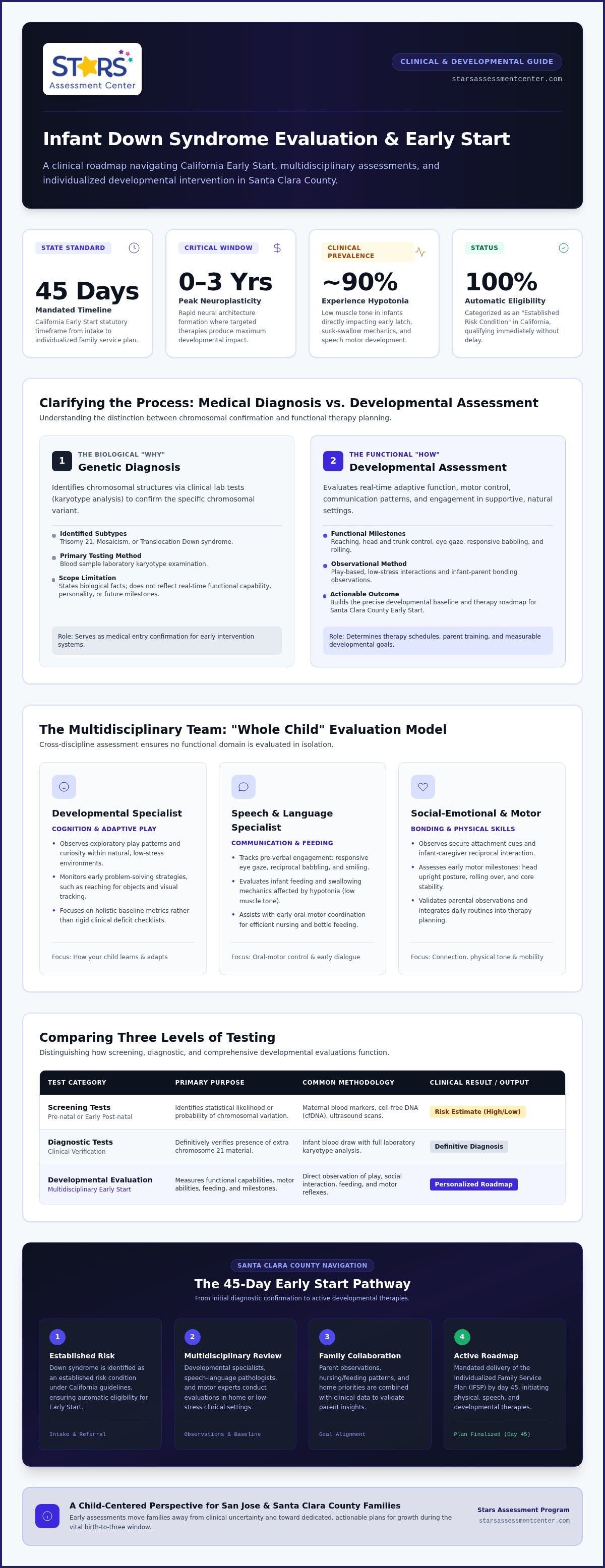
It's helpful to understand that a genetic diagnosis and a developmental assessment are two different tools. A genetic diagnosis, often confirmed through a blood test called a karyotype, explains the "why." It identifies whether the condition is Trisomy 21, Mosaic, or Translocation Down syndrome. While this information is important for medical history, it doesn't tell the whole story of who your baby is. The diagnosis is a medical fact, but it doesn't define your child's future abilities.
The developmental evaluation focuses on the "how." We look at how those genetic factors impact daily milestones like rolling over, making eye contact, or babbling. We observe how your baby interacts with their environment and with you. A developmental assessment serves as a vital baseline that maps your child's unique developmental path for future growth.
Why Early Evaluation is Essential
The first three years of life represent a window of incredible neuroplasticity. During this "birth to three" stage, an infant's brain is rapidly forming connections, making it the most critical time for a Down syndrome evaluation for infants. By identifying specific needs in speech, motor skills, and social-emotional health early on, we can provide the right support when it has the greatest impact. Early intervention doesn't just help the baby; it empowers the whole family.
Early assessments also offer you, the parent, immediate and actionable clarity. Instead of wondering if your child is meeting milestones, you receive a clear picture of their strengths. This reduces anxiety and replaces confusion with a proactive plan. It ensures your family feels like you're in a safe harbor rather than drifting through a complex medical system. You'll leave the evaluation with a better understanding of how to support your baby's next steps.
The Multidisciplinary Team: Who Evaluates Your Child?
A single perspective isn't enough to capture the full picture of your baby's potential. This is why we embrace a "whole child" philosophy. Understanding the Down syndrome evaluation infants receive is the first step toward personalized support. While screening and diagnostic tests for Down syndrome identify the presence of an extra chromosome, our team identifies the specific ways your child interacts with the world. We believe that by combining different areas of expertise, we can create a more accurate and compassionate roadmap for your family.
The developmental specialist plays a central role in this process. They don't just use checklists; they observe play and cognitive patterns in a natural, low-stress environment. By watching how your baby reaches for a toy or solves a simple problem, they gain insights into how your child learns. This approach ensures that the evaluation feels like a supportive partnership rather than a cold medical exam. If you're ready to start this journey, you can connect with our local specialists to learn more about the process.
The Role of Speech and Language Specialists
Communication starts long before your baby says their first word. Our speech and language experts evaluate early pre-verbal signals like eye gaze and responsive babbling. They also play a vital role in assessing feeding and swallowing mechanics. Since roughly 90% of infants with Down syndrome experience hypotonia, or low muscle tone, this can impact how they nurse or take a bottle. Understanding these physical factors early helps us support your baby's oral-motor development. For more details on how we support early communication, see our Santa Clara County Toddler Speech Evaluation Guide.
Social-Emotional and Physical Observations
Your baby's relationship with you is the foundation of their growth. We carefully observe social-emotional health, looking at how your infant interacts with caregivers and their surroundings. This includes assessing gross and fine motor milestones in a gentle, play-based setting. We look at head control, rolling, and early grasping while keeping the atmosphere calm and encouraging. This thorough Down syndrome evaluation infants undergo ensures that no stone is left unturned. The final multidisciplinary report provides your pediatrician with a comprehensive view of your child's progress. It ensures everyone on your medical team is aligned with your goals. This collaborative effort builds a safe harbor for your family as you move forward together.
Comparing Screening, Diagnostic, and Developmental Tests
Understanding the different layers of testing helps clear away the confusion that often follows a new diagnosis. Many families begin their journey with Down syndrome screening and diagnostic tests during pregnancy. These initial steps are designed to calculate risk and probability. While screening provides a percentage of likelihood, diagnostic tests like a postnatal karyotype confirm the presence of an extra chromosome. These medical milestones are essential for health planning, but they don't yet paint a picture of your child's personality or specific needs.
A Down syndrome evaluation for infants takes the process a step further by measuring the real-world impact on growth. Instead of looking at a lab result, we look at how your baby moves, listens, and communicates. Most families find they need all three types of testing at different stages. The medical tests provide the diagnosis, but the developmental evaluation provides the roadmap for daily life. It’s the difference between knowing a condition exists and knowing how to support the child living with it.
What Happens After the Diagnosis?
Once the medical diagnosis is in hand, the focus shifts from "what is the condition" to "how do we help." This transition often marks the move from a sterile hospital setting to a warm community assessment center. It's a pivotal moment where clinical facts meet your family's daily reality. For a deeper look at this transition, explore our Early Childhood Developmental Screening guide. It explains how these assessments bridge the gap between a genetic diagnosis and the start of active, meaningful support.
The Play-Based Evaluation Model
We believe that an evaluation shouldn't feel like an exam. Our play-based model uses toys, games, and gentle interactions to see what your baby can do when they're comfortable. This approach allows specialists to identify "splinter skills," which are unique strengths your child might have in specific areas. By evaluating in a low-pressure environment, we significantly reduce "white coat syndrome" for both the baby and the parents. It allows your child’s true abilities to shine through, giving us an accurate baseline for their Individualized Family Service Plan (IFSP). This method ensures the process is a positive experience that focuses on what your child can achieve.
How to Get an Evaluation in Santa Clara County
Accessing support shouldn't feel like a bureaucratic maze. In California, the Early Start program ensures that every child under three with an established risk condition receives the care they need. For families in our community, the journey usually begins at the San Andreas Regional Center (SARC). This agency serves San Jose, Salinas, and the surrounding regions, acting as the primary point of contact for intake and service coordination. Under state and federal regulations, the entire process from your initial referral to the completion of the Down syndrome evaluation infants require must happen within 45 calendar days. This mandate ensures your baby doesn't lose precious time during these critical early years.
When you prepare for your first appointment, it helps to have your medical records and birth history ready. These documents provide the assessment team with a clear context for your child's growth. Once SARC processes the intake, they often refer families to a specialized partner like the Stars Assessment Program to conduct the actual multidisciplinary evaluation. The Down syndrome evaluation infants receive through this system is provided at no out-of-pocket cost to families, regardless of income. This partnership ensures that your child receives a high level of expertise in a setting that feels like a safe harbor. If you have questions about starting this process, you can contact us to begin your assessment journey today.
Step-by-Step Referral Process
The path to an evaluation is straightforward, but it helps to have a guide. First, discuss your concerns with your pediatrician in San Jose or Milpitas. While you don't need a doctor's order to self-refer to SARC, having your pediatrician's support can be helpful. Second, contact SARC to begin the intake process. You can self-refer by calling them directly or sending an email. They'll assign a service coordinator to help organize your baby's file. Finally, you'll schedule the multidisciplinary developmental assessment. This is where our team of specialists observes your baby's strengths and needs to create a personalized roadmap for the future.
Local Resources for South Bay Families
We understand that every family's needs are different, especially in a diverse region like Santa Clara County. Whether you live in Gilroy, Morgan Hill, or Santa Cruz, local resources are available to support you. We prioritize culturally sensitive care to ensure every family feels heard and respected. For a deeper look at how these local services connect, read our Down Syndrome Early Intervention guide. It provides a localized look at the support systems available right in your backyard, helping you move forward with confidence and peace of mind.
The Stars Assessment Program: A Family-Centered Approach
We understand that discovering your child's developmental path requires more than just clinical expertise. It demands professional warmth, deep empathy, and a true sense of partnership. At Stars Assessment Program, we don't look at your baby as a medical diagnosis. Our multidisciplinary team focuses entirely on creating a personalized roadmap that highlights your infant's unique possibilities. By combining our specialized knowledge with your deep understanding of your child, we build an evaluation process that feels supportive rather than clinical.
This collaborative method forms the heart of our "Safe Harbor" philosophy. We believe in validating your concerns as a parent while providing a gentle, nurturing environment for your baby. We believe a comprehensive Down syndrome evaluation infants undergo should never be a source of stress. Instead, it should be a clarifying milestone that connects your family to the right early intervention services. Once the evaluation is complete, we help you seamlessly transition into the next steps of the California Early Start system.
What Makes the Stars Process Different?
Our program stands out because we focus exclusively on the critical birth-to-three population. This specialization means every team member understands the unique milestones and vulnerabilities of infancy. We bring deep expertise to every Multidisciplinary Developmental Assessment and Social-Emotional Assessment we provide. Because we are an employee-owned organization, our team has a personal dedication to the local community. We live and work in the same South Bay neighborhoods as the families we serve, which drives our commitment to providing culturally sensitive, high-quality care.
Getting Started with Your Baby’s Evaluation
Taking the first step can feel daunting, but you don't have to walk this path alone. If you suspect your child needs support, or if you've recently received a genetic diagnosis, reaching out early makes a meaningful difference. Our team is here to listen, guide, and support you through every stage of the Down syndrome evaluation infants receive in our program. You can easily connect with us through your San Andreas Regional Center service coordinator or reach out to our team directly. Please take a moment to learn more about our Multidisciplinary Assessments and discover how we can partner with your family to build a brighter tomorrow.
Building a Bright Future for Your Family
Finding out your baby has a developmental delay feels like a heavy weight, but you now have the roadmap you need to move forward. You understand that a developmental assessment is more than a medical check; it’s the bridge connecting clinical facts to your child’s daily life. By prioritizing the Down syndrome evaluation infants need through the Early Start system, you’re ensuring your baby gets specific support during their most critical years of growth.
Since 1988, our employee-owned organization has served families in San Jose, Santa Clara, and Salinas with a multidisciplinary team of specialists who treat your family with warmth and respect. We aren't just a service provider; we’re your dedicated partner in this journey. You don't have to walk this path alone. We’re here to be your safe harbor and help your child reach their full potential.
Request a Compassionate Developmental Evaluation for Your Infant to begin building your personalized roadmap today. We look forward to celebrating every milestone your little one achieves right alongside you.
Frequently Asked Questions
Is a Down syndrome evaluation the same as a genetic test?
A developmental evaluation is different from a genetic test because it focuses on your child's functional abilities rather than their chromosomal makeup. While a genetic test confirms the presence of an extra 21st chromosome, the Down syndrome evaluation infants receive at our center measures how they move, learn, and interact. It provides the practical data needed to create a therapy plan, whereas a genetic test simply provides the underlying medical reason for potential delays.
How long does a multidisciplinary evaluation for an infant take?
Most multidisciplinary evaluations for infants take between 90 minutes and two hours. We schedule these sessions to allow for plenty of breaks and transitions, ensuring your baby stays comfortable and engaged. Our specialists use this time to observe play, social interactions, and physical movements in a relaxed setting. We move at your child's pace because a rushed assessment doesn't provide an accurate picture of their true strengths and needs.
Can my baby get an evaluation if they haven’t been officially diagnosed yet?
Yes, your baby can receive a developmental evaluation even without a formal genetic diagnosis. If you notice your child isn't meeting milestones in areas like motor skills or communication, you can request an assessment through the San Andreas Regional Center. In California, infants qualify for Early Start services if they show a 25% delay in one or more developmental domains, regardless of whether a specific genetic condition has been named yet.
What are the early signs of developmental delay in infants with Down syndrome?
Early signs of delay often include hypotonia, which is low muscle tone that makes it harder for babies to hold their head up or roll over. You might also notice challenges with feeding or a lack of early pre-verbal signals, such as responsive babbling or sustained eye contact. Identifying these patterns through a Down syndrome evaluation infants undergo helps our team target specific supports that encourage physical and communicative growth during the first three years.
Does insurance or the Regional Center cover the cost of the evaluation?
Under California’s Early Start program, the cost of a multidisciplinary developmental evaluation is fully covered by the Regional Center. There is no out-of-pocket cost to families in San Jose or Santa Clara, regardless of your income or insurance status. This ensures that every child under age three can access the expert assessments they need to begin early intervention services without financial barriers standing in the way of their progress.
How do I prepare my baby for a developmental assessment?
Preparing for an assessment is mostly about keeping your baby comfortable. We recommend scheduling the appointment during a time when your child is usually well-rested and fed. It’s helpful to bring a few familiar toys and their favorite snacks to help them feel at home in our center. Since our evaluations are play-based, you don't need to coach your baby. Just being there as a supportive presence is the best way to help.
What happens if the evaluation shows my child is meeting their milestones?
If your child is currently meeting their milestones, the evaluation serves as a vital baseline for future monitoring. Because Down syndrome is classified as an established risk condition in California, your child remains eligible for Early Start services even if they don't show a significant delay today. We work with you to create a plan that supports their continued growth and ensures they stay on track as developmental demands increase over time.
How often should an infant with Down syndrome be re-evaluated?
Infants in the Early Start program typically receive a formal re-evaluation once a year as part of the Individualized Family Service Plan review. However, your service coordinator and specialists monitor your baby's progress much more frequently. If you notice new concerns or if your child makes significant leaps, we can adjust the plan sooner. This ongoing check-in process ensures the support evolves as quickly as your baby does.


