
A flagged milestone is never a verdict on your child's future; it is an early roadmap for targeted support. Even so, hearing that your toddler might be falling behind can feel heartbreaking. It is completely natural to replay everyday moments in your head, spiraling into late-night guilt and questioning whether you somehow caused your child's struggle. You didn't. When you are coping with a possible developmental delay diagnosis, the sudden emotional weight, confusing screening scores, and unfamiliar clinical terms can leave any parent feeling drained and disoriented.
You don't have to carry this uncertainty alone. This guide offers compassionate emotional reassurance alongside practical steps so you can face your child's developmental evaluation with steady confidence. We'll clarify the critical difference between a brief pediatric screening and a comprehensive diagnostic assessment, then lay out an actionable plan to help you access early intervention programs, community resources, and specialist care tailored to your family's needs.
Key Takeaways
- Reframe early developmental concerns as valuable pathways toward tailored resources rather than permanent limitations for your child.
- Learn effective emotional grounding techniques for coping with a possible developmental delay diagnosis while keeping family life calm and connected.
- Differentiate clearly between brief developmental screenings and play-based, multidisciplinary assessments that evaluate the whole child.
- Discover practical ways to document everyday milestones and behaviors to advocate effectively during clinical appointments.
- Gain a clear understanding of early intervention frameworks and regional center systems designed to support infants and toddlers under age three.
Navigating the Emotional Impact of a Potential Developmental Delay
Hearing a pediatrician mention that your toddler may not be meeting typical benchmarks can stop your world in its tracks. A flood of shock, acute anxiety, and anticipatory grief often follows. You might find yourself mourning the predictable path you had envisioned for your child. These heavy feelings are entirely normal parental responses, not a sign of weakness or detachment. When you are coping with a possible developmental delay diagnosis, understanding your own emotional reaction is the vital first step toward restoring calm.
Much of the initial panic softens when you reframe what an evaluation actually represents. A diagnosis is not a lifelong limitation or a rigid forecast of your child's potential. Instead, it serves as a functional key that unlocks specialized developmental resources, community services, and targeted therapies during a critical window of early neurodevelopment. Children develop across complex biological timelines; developmental differences stem from neurological and genetic factors rather than anything you did or failed to do. To protect your peace of mind while awaiting answers, step away from late-night search engines and alarmist social media forums, which often amplify worst-case scenarios without offering genuine clarity.
Processing Uncertainty and the Fear of the Unknown
Parents often face a subtle form of ambiguous loss as familiar parenting expectations shift into clinical uncertainty. While a broader developmental disability diagnosis involves lifelong adaptations, early childhood delays often represent an evolving picture that benefits immensely from prompt support. Resist the urge to project ten or twenty years down the road. Focus entirely on today's tangible interactions, and remember that your child remains the exact same playful, loving individual they were before a clinical term was introduced.
Moving Past Guilt and the Comparison Trap
Comparing your toddler's milestone timeline to siblings, playground peers, or curated online video clips only fuels unproductive guilt. Effective strategies to ground yourself include:
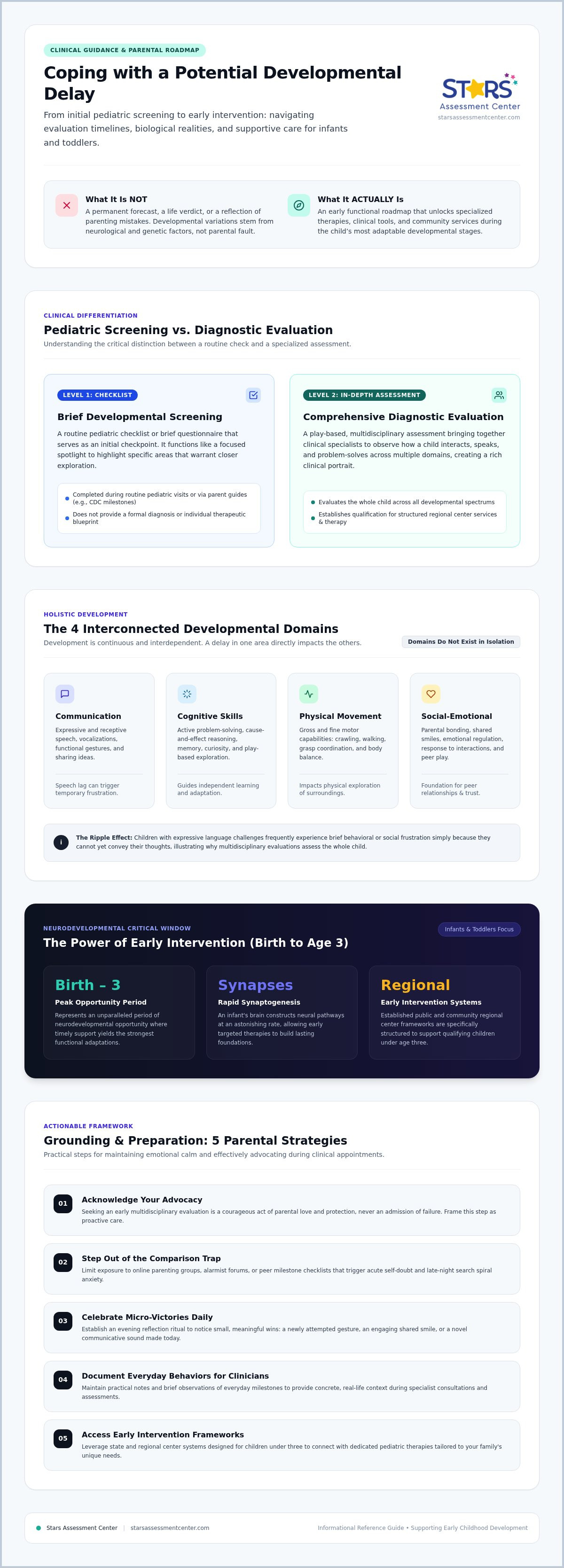
- Acknowledge your advocacy: Seeking an early multidisciplinary evaluation is an act of deep parental love, not an admission of failure.
- Limit social comparisons: Step back from parenting groups where milestone checklists trigger acute self-doubt.
- Celebrate micro-victories: Establish an evening reflection ritual to notice new gestures, shared smiles, or subtle communicative attempts your child accomplished today.
By centering on small, daily milestones, coping with a possible developmental delay diagnosis shifts from an overwhelming ordeal into a grounded, compassionate journey of family growth.
What a Possible Developmental Delay Diagnosis Really Means
A developmental delay is a measurable gap between expected childhood milestones and the skills an infant or toddler currently displays. While every child follows a personal growth timeline, clinical delays differ fundamentally from temporary developmental pauses. An isolated delay might involve a slight lag in walking or talking, whereas persistent challenges usually signal that structured, specialized support is needed. Because development is holistic, these domains don't exist in isolation. Communication, cognitive problem-solving, physical movement, and social-emotional bonds continuously influence each other. A child working through expressive speech challenges, for instance, may experience brief social frustration simply because they can't easily share their ideas.
Screening vs. Comprehensive Developmental Evaluation
Many parents first encounter developmental discussions after a routine pediatrician checklist. A brief questionnaire functions like a spotlight, identifying areas that warrant closer exploration. If you are reviewing milestone guides like the CDC's Concerned About Your Child’s Development? portal, remember that an early childhood developmental screening is merely an initial checkpoint. In contrast, a comprehensive multidisciplinary evaluation brings together specialists to observe how your child communicates, plays, and problem-solves across multiple domains, creating a rich and balanced clinical portrait.
Why Early Identification Matters for Developing Brains
The birth-to-three window represents an unparalleled period of neurodevelopmental opportunity. Rapid synaptogenesis occurs during these early years, meaning an infant's brain builds neural pathways at an astonishing rate. Timely support harnesses this natural neuroplasticity, allowing young children to build adaptive communication and social pathways with remarkable efficiency.
When coping with a possible developmental delay diagnosis, treating this stage as an empowering step forward helps restore family calm. Gentle, play-based assessments through community partners like Stars Assessment Program can clarify your child's unique learning profile and connect your family with vital early enrichment before minor hurdles grow larger.
Practical Coping Strategies for Everyday Family Life
Living in the shadow of milestone checklists and upcoming clinical appointments can quickly destabilize household life. When coping with a possible developmental delay diagnosis, restoring order begins with the basic rhythm of your day. Predictable meal, play, and nap routines offer essential emotional anchors. They reassure toddlers who thrive on consistency, and they protect parents from decision fatigue during an already demanding season. Alongside steady routines, prioritizing restorative caregiver practices is vital. Protecting simple daily habits, whether a quiet morning walk or twenty minutes of undisturbed rest, replenishes the physical and emotional reserves you need to care for your child.
Strengthening Your Partnership and Family Unit
Parenting partners rarely process developmental uncertainty at identical speeds. One parent may immediately seek out research and clinical literature, while the other needs quiet time to process grief and shock. Neither reaction is wrong. To stay aligned as a unified team:
- Institute a therapy-free buffer: Schedule a brief daily check-in devoted entirely to your adult partnership, keeping diagnostic topics off the table.
- Share administrative duties: Divide logistical loads evenly so one caregiver manages communication logs while the other coordinates appointment schedules.
- Practice mutual patience: Acknowledge that emotional coping styles fluctuate, giving each other space on difficult days.
Communicating with Friends and Extended Family
Well-meaning relatives often compound parental anxiety with unsolicited remedies, dismissive comments, or intrusive questions. You don't owe anyone granular clinical details. Protect your emotional energy with a clear, scripted response: "We're collaborating with early developmental specialists to evaluate their progress, and our primary focus right now is supporting their growth through play."
When friends or family ask how to help, steer them away from speculative medical advice and toward practical assistance. Invite them to drop off dinner, run errands, or spend fun time with an older sibling. Channeling their good intentions into tangible support creates a steady circle of care while coping with a possible developmental delay diagnosis.
Preparing for Developmental Evaluations Without Fear
Walking into a specialist clinic can trigger deep apprehension. Many parents imagine a sterile clinical examination or a rigid pass-fail test. In reality, early developmental evaluations for infants and toddlers are gentle, play-based observations designed to meet children where they are. Evaluators simply engage your child with puzzles, bubbles, blocks, and floor play to observe how they communicate, problem-solve, and explore. Ensuring your toddler is well-rested, comfortable, and fed before the visit removes unnecessary sensory strain and allows their natural personality to shine.
Documenting Observations and Functional Milestones at Home
Clinicians only see a brief snapshot during an appointment, making your everyday home observations indispensable. Brief video clips captured on your smartphone offer authentic insight into home communication attempts, social gestures, or physical balance that might not emerge in a new environment. When social-emotional or communicative differences are present, understanding the differences between an autism screening vs evaluation for toddlers helps you anticipate the interactive, observational play methods specialists rely on.
Key Questions to Ask Your Evaluation Specialists
Transforming your role from a stressed observer into an active collaborator is an essential part of coping with a possible developmental delay diagnosis. Arrive with a written notebook to keep discussions grounded in your family's daily reality. Consider asking:
- Functional application: How do these clinical observations translate into practical play and communication routines at home?
- Inherent strengths: Which developmental domains showed the strongest resilience and potential for rapid progress?
- Collaborative care: What communication strategies or daily adjustments will help our child navigate transitions with less frustration?
- Next steps: What structured specialist evaluations or community-based early enrichment models do you recommend exploring next?
Approaching evaluation day as an opportunity to understand how your child perceives the world restores your sense of agency. If you are seeking clarity for an infant or toddler under age three across Santa Clara County, Santa Cruz, or Salinas, connect with the Stars Assessment Program to schedule a gentle multidisciplinary developmental assessment.
Connecting with Early Intervention and Community Support
Federal policy guarantees that families do not have to walk this path in isolation. Under Part C of the Individuals with Disabilities Education Act (IDEA), every state operates an early intervention system designed specifically for infants and toddlers from birth to age three. These public frameworks ensure developmental evaluations to determine eligibility come at no cost to parents. Accessing these community networks transforms persistent worry into structured, professional advocacy. Coping with a possible developmental delay diagnosis becomes far more manageable once you realize a dedicated system of providers exists to champion your child's growth.
Navigating California Early Start and Regional Centers
California administers its early intervention services through the Early Start program and a network of 21 regional centers. Parents have the legal right to refer their infant or toddler directly to their local regional center; you do not need to wait for a physician referral or formal medical diagnosis to initiate intake. If your child qualifies, a coordinator collaborates with your family to build an Individualized Family Service Plan (IFSP). This living document outlines functional developmental goals, tracks progress, and authorizes funded community services. For families seeking clarity on communication milestones in our area, reviewing a Santa Clara County toddler speech evaluation guide offers helpful local insight into clinical expectations.
The Value of a Multidisciplinary Assessment Partner
Understanding a child's complete developmental profile requires looking beyond a single skill. Multidisciplinary evaluations assess cognitive, communication, physical, and social-emotional growth simultaneously. This synchronized, whole-child approach provides an accurate picture, especially when exploring specialized developmental conditions such as Down syndrome, autism, or complex social-emotional difficulties.
Partnering with dedicated community teams serving Santa Clara County, Santa Cruz, and Salinas creates a direct bridge to regional center resources. Gentle, play-centered assessments strip away clinical stress, giving you actionable answers and a predictable path forward. When coping with a possible developmental delay diagnosis, surrounding your household with compassionate professionals ensures your child receives the targeted enrichment they deserve during their most adaptable years.
Taking Your Next Gentle Step Forward
Facing developmental uncertainty can test any caregiver's heart, but you don't have to walk this path alone. Early identification is never a verdict on your toddler's potential. Instead, it simply unlocks targeted enrichment during their most flexible developmental window. When coping with a possible developmental delay diagnosis, shifting your mindset from worry to proactive advocacy empowers your entire household.
Our dedicated multidisciplinary team focuses exclusively on infants and toddlers under age three. By conducting whole-child evaluations across cognitive, speech, physical, and social-emotional domains, we help transform clinical questions into clear, gentle answers. With deep community experience supporting families across Santa Clara, Santa Cruz, and Monterey counties, we are here to walk beside you with warmth and clinical expertise. Schedule a Compassionate Developmental Evaluation Today to give your child the supportive foundation they deserve.
Frequently Asked Questions
What should I do immediately after receiving a developmental screening concern?
Take a deep breath and contact your local early intervention agency or a multidisciplinary clinic to schedule a comprehensive evaluation. Document your toddler's daily behaviors with short notes or quick videos showing their communicative attempts and frustrations. Remember that an initial screening only highlights areas that warrant closer exploration, not a formal diagnosis. Engaging early guidance gives your child the strongest opportunity to build adaptive skills during their first three years.
Does a developmental delay diagnosis mean my toddler will have lifelong disabilities?
No, a developmental delay does not automatically mean your child will face lifelong challenges. Delays simply reflect a measurable gap between expected milestones and current functional skills. When coping with a possible developmental delay diagnosis in early childhood, early interventions tap directly into rapid infant neuroplasticity. Many toddlers make remarkable progress with targeted developmental support, while others continue receiving individualized enrichment tailored to their evolving strengths.
Can my child outgrow a developmental delay without formal therapy interventions?
While some minor variations resolve naturally, relying on a "wait and see" mindset risks missing an essential window of brain growth. The neural pathways formed before age three adapt faster than at any other developmental stage. Timely evaluations and play-based intervention strategies help guide this development proactively, ensuring your toddler receives the right support before subtle communicative or social differences turn into larger learning hurdles.
How do I pay for early childhood developmental evaluations in California?
Under federal IDEA Part C legislation, developmental evaluations to establish early intervention eligibility are provided at no direct cost to families. In California, regional centers serving areas like San Jose, Gilroy, and Salinas coordinate these initial assessments. Private insurance and state healthcare programs may also fund independent evaluations through specialized community clinics, ensuring financial barriers do not prevent infants and toddlers under age three from receiving clarity.
What is the difference between developmental delay and autism spectrum disorder?
A developmental delay describes a lag in reaching typical physical, speech, or cognitive milestones according to expected timelines. Autism Spectrum Disorder (ASD), however, is a specific neurodevelopmental condition characterized by distinct patterns in social interaction, sensory processing, and communication. While a delay involves pacing, autism reflects a unique way of experiencing and processing the world. Comprehensive multidisciplinary assessments help clinicians distinguish whether your toddler has an isolated delay or a broader developmental profile.
How do I explain my toddler's developmental evaluation to skeptical grandparents?
Reassure family members by framing the evaluation around proactive care rather than something being "wrong." You might say, "Every child develops on their own timeline, and we want to understand their unique learning style so we can support them best through everyday play." Remind them that early childhood assessments are gentle, play-centered observations designed to help toddlers communicate and connect, not clinical labels that define their entire identity.
What happens during a multidisciplinary developmental evaluation for infants?
Evaluators use gentle, play-based interactions rather than stressful clinical testing. A collaborative team of developmental specialists observes your toddler stacking blocks, exploring toys, and reacting to sounds to evaluate cognitive, communicative, physical, and social-emotional domains. When coping with a possible developmental delay diagnosis in communities like Santa Clara, Santa Cruz, or Morgan Hill, programs like Stars Assessment Program partner with parents to ensure the session feels natural, safe, and family-centered.


