
You’ve spent hours watching your toddler play, noticing the small ways they interact with the world and perhaps wondering if they’re reaching milestones on time. It's a journey filled with love, but it can also bring up questions that feel heavy to carry alone. The multidisciplinary evaluation process for toddlers is designed to turn those questions into a clear, supportive roadmap for your child's growth. Instead of a cold clinical exam, think of this as a collaborative gathering where experts join your family to celebrate your child’s strengths while identifying where they might need extra help.
We understand that an evaluation can feel overwhelming, especially when you're worried about labels or confusing specialist roles. You want what's best for your little one, and the uncertainty is often the hardest part. This guide walks you through every stage of the assessment, from meeting the team to understanding California’s Early Start eligibility. You'll learn who will be in the room, how we create a comfortable environment, and how these insights empower you to be your child's strongest advocate. By the end, you'll see this process not as a hurdle, but as a steady path toward the bright future your child deserves.
Key Takeaways
- Learn how the multidisciplinary evaluation process for toddlers brings different specialists together to look at your child's development as a whole.
- Discover who will be in the room and how a collaborative team approach ensures you receive consistent, clear guidance for your family.
- Understand why play-based assessments are used to create a low-stress, natural environment where your child can truly shine.
- Gain clarity on how California determines Early Start eligibility, helping you feel more confident and empowered when interpreting your child's results.
- See how community-oriented support in Santa Clara County provides a steady ally for families navigating the early intervention system.
Demystifying the Multidisciplinary Evaluation Process for Toddlers
Hearing the term "multidisciplinary evaluation" can feel a bit clinical and intimidating when you're already concerned about your child's growth. At its heart, however, the multidisciplinary evaluation process for toddlers is simply a way to ensure your little one receives the most comprehensive support possible. This isn't a single doctor's appointment or a quick checkup. Instead, it's a collaborative gathering that involves at least two different professionals from distinct disciplines working together to understand your child's unique needs.
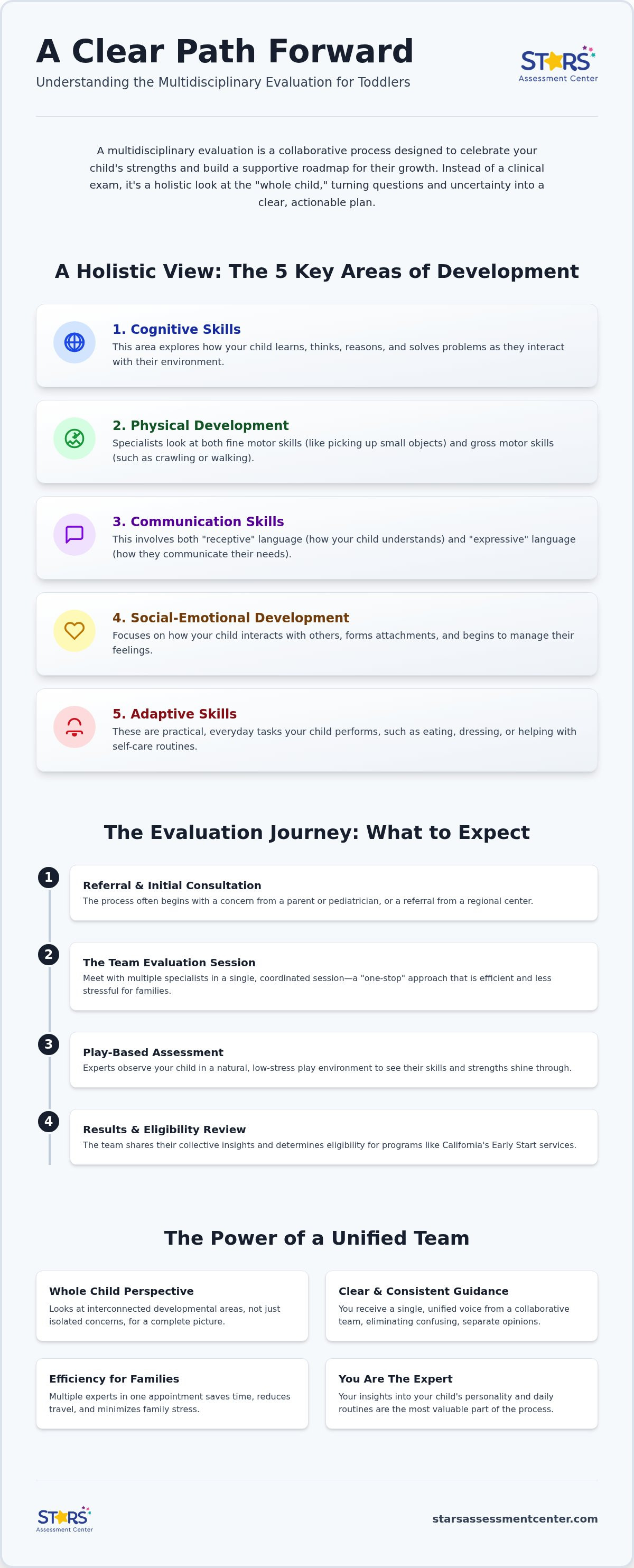
A multidisciplinary evaluation is a holistic snapshot of a child’s growth across five key domains.
For children under the age of three, this collaborative approach is considered the gold standard. During these early years, developmental areas are deeply interconnected. For example, a delay in communication might influence how a child plays with others, or a physical challenge might impact their ability to explore and learn. By looking at the "whole child" rather than focusing on one isolated concern, we can create a much more accurate and supportive path forward.
The Five Domains of Childhood Development
The evaluation team looks at five specific areas to get a complete picture of your child's current strengths and challenges. These include:
- Cognitive skills: This area explores how your child learns, thinks, and solves problems as they interact with their environment.
- Physical development: Specialists look at both fine motor skills, like picking up small objects, and gross motor skills, such as crawling or walking.
- Communication: This involves both "receptive" language, which is how your child understands what's said to them, and "expressive" language, or how they communicate their needs.
- Social-emotional development: This domain focuses on how your child interacts with others, forms attachments, and begins to manage their feelings.
- Adaptive skills: These are the practical, everyday tasks your child performs, such as eating, dressing, or helping with self-care routines.
When is a Multidisciplinary Evaluation Recommended?
It's natural to wonder if your toddler is simply following their own timeline or if they've encountered a developmental hurdle. While every child grows at their own pace, certain "red flags" might suggest that a closer look is beneficial. Pediatricians often recommend an assessment if they notice a child isn't meeting specific milestones or if a parent expresses concerns about social interaction or speech.
Many families come to us through a referral from the San Andreas Regional Center. This process is a vital part of Early childhood intervention services, which focus on the critical window from birth to age three. During this time, a child's brain is incredibly adaptable. Identifying needs early through the multidisciplinary evaluation process for toddlers allows families to access the right tools and resources during the years when they can make the most significant impact on a child's future success.
The Evaluation Team: Who Will Be Supporting Your Family?
Entering the multidisciplinary evaluation process for toddlers can feel like a big step, but you don't have to walk this path alone. You're joining a team of dedicated allies who are here to provide clarity and support. At the Stars Assessment Program, our team works as a cohesive unit. Because we're an employee-owned organization, every specialist you meet is deeply invested in our mission of helping families thrive. This collaborative structure is designed to be a "safe harbor" for parents, offering a unified voice rather than a collection of confusing, separate opinions.
One of the greatest benefits of this team approach is efficiency. Instead of scheduling four different appointments across the county, you'll meet with multiple experts in a single, coordinated session. These specialists communicate with each other in real time, sharing observations to ensure that the advice you receive is consistent and clear. Most importantly, we recognize you as the primary expert on your child. While we bring professional expertise, your insights into your child's daily routines and personality are the most valuable pieces of the puzzle.
Key Specialists You Might Meet
Depending on your child's specific needs, your evaluation team will include a variety of experts. Developmental Specialists focus on the big picture of growth, observing how your child learns through play. Speech-Language Pathologists (SLPs) look closely at communication, including how your child understands language and how they express themselves, even without words. Since we specialize in social-emotional health, you'll also meet Social-Emotional Specialists who help us understand your child's temperament and how they build relationships with the people they love.
Our team also includes psychologists or behavioral experts. These professionals are skilled at identifying early autism signs or other neurodivergent traits. By having these diverse perspectives in the room at once, we can build a complete and nuanced understanding of your child's development from birth to age three.
The Value of a Shared Perspective
A team approach is vital for identifying what we call "scattered skills." It's common for a toddler to excel in one area, like physical movement, while needing extra support in another, like social interaction. When specialists work together, they can see how these different areas influence one another. This leads to a more accurate picture than any single professional could provide on their own. If you have concerns about your child's growth, our multidisciplinary developmental assessments offer the thorough answers you're looking for.
In a diverse community like Santa Clara County, including San Jose, Milpitas, and Gilroy, cultural sensitivity is a cornerstone of our work. Our team is committed to understanding your family's unique background and values. We ensure that the evaluation process is respectful, inclusive, and tailored to the specific context of your child's life. This shared perspective doesn't just result in a report; it creates a supportive roadmap designed specifically for your family.
Step-by-Step: What to Expect During the Assessment
Moving from a quick developmental screening to a full assessment can feel like a significant transition. While a screening acts as a brief "temperature check," the multidisciplinary evaluation process for toddlers is a deep dive into your child's unique world. We want this experience to be as stress-free as possible for your family. Most sessions last between 90 minutes and two hours, allowing us plenty of time to get to know your little one without rushing. To help your child feel settled, we recommend bringing along familiar items like a favorite toy, a comfort blanket, and plenty of snacks. The evaluation is designed to feel like a play session for the child while providing deep data for the experts.
Stage 1: The Parent Interview and History
The process begins with a conversation because you are the most important member of the team. We'll spend time discussing your child's birth history, medical milestones, and any specific concerns that keep you up at night. This is your time to share the small details that only a parent knows, from how they prefer to be comforted to their favorite ways to play. We don't just look at data; we integrate your daily observations into our formal report. This ensures that your family’s priorities and goals for your child’s future remain the heart of our assessment.
Stage 2: Observation and Standardized Tools
During the second stage, we use "Play-Based Assessment" to see your child in action. This involves watching how they interact with bubbles, blocks, and various age-appropriate toys in a natural environment. While it looks like simple fun, our team is carefully tracking social-emotional milestones and physical coordination. We also utilize respected standardized tools, such as the Bayley Scales of Infant and Toddler Development or the M-CHAT for autism screening. These tools help us measure growth accurately while your child stays engaged and happy in a low-stress setting.
Stage 3: The Post-Evaluation Discussion
We know that waiting for answers is often the hardest part for parents. That's why we include a post-evaluation discussion before you even leave our center. The team will sit down with you to share their initial impressions and answer your immediate questions. While it takes a few weeks to finalize the comprehensive written report, we want you to walk out the door with a clear understanding of the next steps. Our mission is to ensure every family leaves with a sense of clarity and hope rather than just a collection of data points. You'll have a better grasp of the multidisciplinary evaluation process for toddlers and, more importantly, a plan for how to move forward together.
Interpreting Results and Determining Eligibility for Services
Receiving the final report can feel like a mix of relief and anxiety. After the multidisciplinary evaluation process for toddlers is complete, our team sits down to translate observations into a clear, actionable plan. It's helpful to remember that "educational eligibility" for California's Early Start services is different from a medical diagnosis. A medical diagnosis identifies a specific condition, while educational eligibility determines if your child’s current developmental level warrants support services funded by the state. This distinction is important because it focuses entirely on how we can help your child thrive right now.
In 2026, California adjusted its eligibility threshold to make support more accessible for families. A child is now typically eligible for services if they demonstrate a developmental delay of at least 25% in one or more of the five key areas of development. Sometimes, standardized scores don’t tell the whole story. Your child might have been tired during the session, or their skills might be right on the edge of the threshold. This is where "Informed Clinical Opinion" becomes essential. Our experts use their professional judgment and deep experience to advocate for services even when the numbers are borderline, ensuring no child who needs help falls through the cracks.
Understanding Your Child’s Developmental Profile
Your report is a map of how your child interacts with the world, and we're here to help you read it without feeling overwhelmed. We make sure to celebrate "Splinter Skills," which are specific areas where your child is actually thriving despite challenges in other domains. Recognizing these strengths gives us a foundation to build upon. For families seeking support for Down syndrome or significant communication delays, the report identifies the exact types of specialized tools that will be most effective for your child's unique profile.
Next Steps: Accessing Early Intervention in San Jose
The San Andreas Regional Center (SARC) uses these evaluation results to determine the frequency and type of therapy your child receives. Within 45 days of your initial referral, a team will work with you to create an Individualized Family Service Plan (IFSP). This plan is a living document that outlines whether your child will receive home-based or center-based services. If you're ready to take the next step toward clarity, you can learn more about our multidisciplinary developmental assessments to see how we can support your family's journey. Our goal is to ensure you move from the assessment phase to the support phase with total confidence.
The Stars Assessment Program: Compassionate Care in Santa Clara County
Choosing the right partner for your child's developmental journey is a significant decision. At the Stars Assessment Program, we're dedicated to supporting families across San Jose, Milpitas, Gilroy, and the surrounding Santa Clara County communities. We don't view ourselves as just a clinical service; we're a community-oriented advocate that has been helping children flourish since 1988. Because we're an employee-owned organization (ESOP), every member of our team has a personal stake in your child’s success. This structure fosters a level of dedication and heart that you won't find in a typical bureaucratic environment.
Our "Safe Harbor" approach is designed to lower the stress levels for both you and your little one. We've traded cold, clinical settings for a warm and welcoming environment where your child can feel comfortable enough to truly be themselves. Our multidisciplinary evaluation process for toddlers is designed to be a gentle bridge between your initial concerns and the specialized services that help your child reach their full potential. We're here to provide the clarity you need and the hope you deserve.
A Local Resource You Can Trust
For over three decades, we've been a steady ally for families navigating the early intervention system. Our deep roots in the San Jose community allow us to partner effectively with local pediatricians and organizations to ensure your child receives seamless care. We understand the unique needs of families in our region, from the busy streets of Milpitas to the growing communities in Salinas and Morgan Hill. Cultural sensitivity isn't just a buzzword for us; it's a core value that guides how we interact with every family we serve.
Getting started is often the hardest part, but we make the referral and screening process as straightforward as possible. Whether you're coming to us through a recommendation from your doctor or reaching out on your own, we'll guide you through each step with patience and reliability. We're here to answer your questions about the multidisciplinary evaluation process for toddlers and help you understand how to access the resources available in our county.
Your Ally in Early Childhood Growth
We're passionate about the birth-to-three window because we know it's the most critical time for a child's development. Our specialists focus exclusively on this age group, making us experts in the unique milestones of toddlerhood. We don't just hand you a report and send you on your way. Instead, we provide a clear roadmap and act as a bridge to the intervention services your child may need, ensuring you never feel lost in the process.
The journey toward understanding your child's needs is one of the most important things you'll ever do. You don't have to do it alone. Our team is ready to stand by your side as a knowledgeable mentor and a compassionate guide.
Schedule a consultation with the Stars Assessment Program team today.
Empowering Your Family’s Path Forward
Taking the first step toward a developmental assessment is a brave act of love for your child. The multidisciplinary evaluation process for toddlers is designed to replace uncertainty with a clear, supportive roadmap tailored to your little one’s unique needs. By bringing together a collaborative team of experts who value your input as the primary expert, we ensure that every child from birth to age three receives the holistic care they deserve. We focus on identifying strengths and providing the specific tools needed to foster your child's progress and confidence.
As an employee-owned organization with over 35 years of developmental expertise, the Stars Assessment Program is committed to being your steady ally. Our specialized multidisciplinary teams are here to guide you through every milestone with patience and professional warmth. You don't have to navigate these questions alone; we're here to help you turn concern into a concrete plan for growth. Begin your child’s journey toward support with a Stars Assessment. Your child has a bright future ahead, and we're honored to help you find the way.
Frequently Asked Questions
How long does a multidisciplinary evaluation take for a toddler?
A typical session usually lasts between 90 minutes and two hours. This timeframe allows our team to observe your child in a relaxed, play-based setting without making them feel rushed or overwhelmed. We understand that toddlers have short attention spans, so we move at their pace. This duration ensures we gather enough data across all developmental domains while keeping the environment comfortable and engaging for your little one.
Do I need a referral from my pediatrician to get an evaluation?
While a referral from your pediatrician is a common starting point, you can also contact the San Andreas Regional Center directly if you have concerns. Pediatricians often notice developmental red flags during well-child checkups and recommend the multidisciplinary evaluation process for toddlers to provide a deeper look. Regardless of how you start, our team works closely with your child's doctor to ensure a coordinated approach to their growth and support.
Will my child be diagnosed with autism during this process?
The primary goal of this evaluation is to determine eligibility for early intervention services rather than providing a standalone medical diagnosis. However, our team includes specialists who are highly skilled in identifying early signs of autism or other neurodivergent traits. If the assessment indicates your child may be on the spectrum, we will discuss those findings with you clearly and help guide you toward the next steps for a formal medical confirmation if needed.
What is the cost of a multidisciplinary evaluation in Santa Clara County?
Under the federal Individuals with Disabilities Education Act (IDEA) Part C, initial developmental evaluations to determine eligibility for the Early Start program are provided at no cost to families. This means that if your child is referred through the public early intervention system in Santa Clara County, the assessment is free. Our program partners with the regional center to ensure that financial barriers never stand in the way of a child receiving help.
What should I bring to my child’s assessment appointment?
To help your child feel at ease, please bring familiar items that make them feel safe and happy. This might include a favorite stuffed animal, a comfort blanket, and a variety of snacks or a drink. Since the multidisciplinary evaluation process for toddlers relies on natural play, having toys they already love can help them show us their typical skills. Don't forget any specific equipment they use, such as glasses or hearing aids.
Can I be in the room with my child during the evaluation?
Yes, we absolutely encourage you to be in the room with your child throughout the entire session. You are the primary expert on your child's life, and your presence provides the safe harbor they need to explore and interact with our team. We may ask you to play alongside them or answer questions about their typical behaviors at home. Your active participation is a vital part of creating a complete profile.
What happens if my child is "cranky" or won’t play during the session?
We work with toddlers every day and fully expect that they might have off moments, tantrums, or periods of shyness. Our specialists are experts in play-based assessment and know how to gently engage a child who is feeling overwhelmed. If your child is exceptionally tired or ill on the day of the appointment, we can always pause or reschedule. We focus on capturing their true potential, even if it takes a little extra patience.
How long after the evaluation will we receive the results?
You will receive initial impressions and a brief discussion of our findings before you leave the center on the day of the evaluation. Following the session, our team collaborates to write a comprehensive formal report, which is typically finalized within a few weeks. In California, the entire process from the initial referral to the development of an Individualized Family Service Plan (IFSP) is required by law to be completed within 45 days.


