
Imagine sitting on the floor with your two year old, watching them play, and feeling a small, persistent tug of worry because they aren't meeting the milestones you expected. You might wonder if you're overthinking things or if your child simply needs a little extra time to blossom. It's completely normal to feel protective and perhaps a bit anxious about the idea of a "label." However, a professional toddler cognitive assessment San Jose isn't about putting your child in a box; it's about opening doors to the right support during the vital birth to three window.
We understand the confusion that often comes with terms like "screening" versus "full assessment," especially when trying to coordinate with the San Andreas Regional Center (SARC). This guide will provide the clarity you need to move forward with confidence. You'll learn how a multidisciplinary team evaluates your child's current developmental level and helps create actionable steps for growth. By the end of this article, you'll have a clear roadmap to help your toddler thrive, supported by partners who truly value your family's unique journey.
Key Takeaways
- Understand why a toddler cognitive assessment San Jose is a gentle, play-based discovery process rather than a high-stakes test for your child.
- Learn to identify critical early milestones, such as understanding cause and effect, that provide insight into your toddler's thinking and problem-solving skills.
- Discover the value of a multidisciplinary team approach, which brings together various specialists to ensure a comprehensive view of your child’s development.
- Get a clear roadmap for navigating the California Early Intervention system and accessing free assessments through the San Andreas Regional Center (SARC).
- Find out how a culturally sensitive and multilingual environment can provide a "safe harbor" for families seeking clarity and support for their child's growth.
What is a Toddler Cognitive Assessment?
When you hear the word "assessment," you might picture a quiet room and a stack of test papers. For a child under three, that couldn't be further from the truth. A specialized toddler cognitive assessment San Jose is a gentle, observation-based process where specialists watch how your child interacts with their environment. It focuses on the foundations of cognitive development, looking at how a child’s brain begins to categorize information, remember patterns, and solve simple problems.
For children in the birth to three window, this process is entirely play-based. Specialists use colorful blocks, puzzles, and interactive games to see how a child processes the world around them. This specific age range is critical because of neuroplasticity, which is the brain's incredible ability to grow and adapt in response to new experiences. Catching a delay early means we can use that natural growth to provide the most effective support possible.
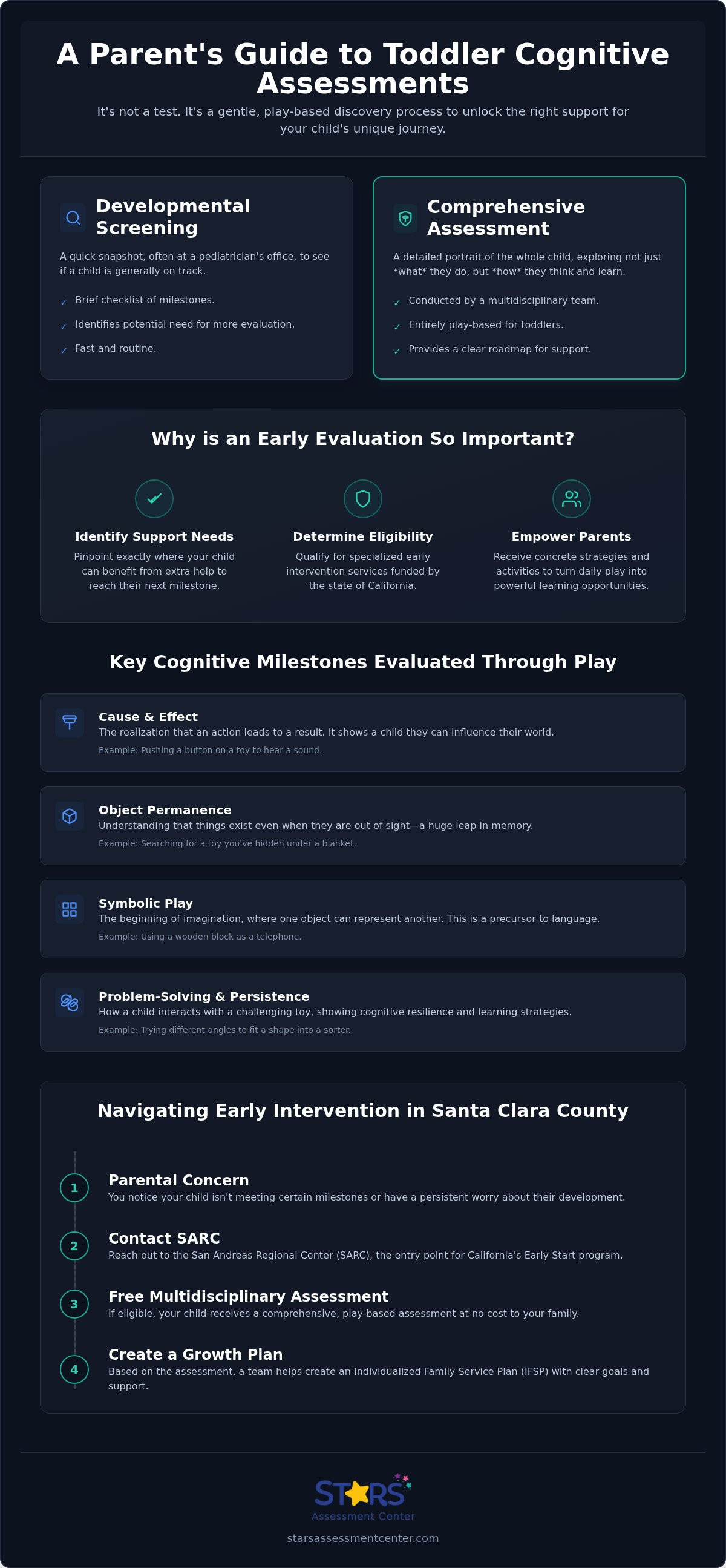
It's also helpful to understand how this differs from the quick screenings you might receive at a pediatrician's office. A screening is like a snapshot; it's a brief checklist designed to see if a child is generally on track. A comprehensive multidisciplinary evaluation is more like a detailed portrait. It involves a team of experts looking at the whole child to understand not just what they are doing, but how they are thinking and learning.
The Purpose of Early Evaluation
The primary goal of an evaluation is to move beyond "wait and see" and toward "here is the plan." By identifying a child's unique strengths alongside their challenges, we can create a clear roadmap for their growth. This process serves three main functions:
- Identifying Support Needs: We pinpoint exactly where a child might need a little extra help to reach their next milestone.
- Determining Eligibility: In California, this evaluation helps determine if your child qualifies for specialized early intervention services funded by the state.
- Empowering Parents: You receive concrete strategies and home-based activities that turn daily play into powerful developmental opportunities.
Cognitive vs. Intelligence Testing
Parents often worry about their child being assigned an IQ score at such a young age. We don't use traditional IQ scores for toddlers because their skills are changing too rapidly for a single number to be meaningful. Instead, we focus on adaptive functioning. This looks at how a child uses their skills to navigate daily life, like figuring out how to reach a toy or following a simple two-step direction. In toddlerhood, cognitive ability is measured by how a child explores their world and solves simple problems through play. This approach ensures we are looking at your child's potential rather than just their performance on a specific day.
Key Cognitive Milestones Evaluated in San Jose Toddlers
Watching your child play is more than just a sweet moment; it's a window into their developing mind. During a toddler cognitive assessment San Jose, specialists look for specific building blocks that signal a child is learning how to think and reason. One of the first things we observe is "Cause and Effect." This is the simple yet profound realization that an action leads to a result, like a toddler pushing a button to hear a sound or dropping a spoon to see where it lands. It shows they are beginning to understand how they can influence the world around them.
Another foundational skill we evaluate is "Object Permanence." This milestone occurs when a child understands that things continue to exist even when they are out of sight. If your toddler searches for a toy you've hidden under a blanket, they are demonstrating a significant leap in memory and mental representation. As they grow toward age two, we look for "Symbolic Play." This is the beginning of imagination, where a child might use a wooden block as a phone or pretend to feed a doll. It shows they can use one object to represent another, which is a precursor to language and complex thought.
Problem-Solving and Persistence
How a child interacts with a challenging toy tells us a lot about their cognitive resilience. We observe whether they try different angles to fit a shape into a sorter or if they look to a caregiver for guidance. This process includes imitative learning, where a child copies your actions, such as pretending to stir a pot or "reading" a book. Following simple, one-to-two step directions is another key indicator of how they process and store information. If you're concerned about these areas, reaching out for a multidisciplinary developmental assessment can provide the clarity you need.
Social-Emotional Overlap
Cognitive skills and emotions are deeply intertwined. Often, a child who feels frustrated by a difficult task may experience a behavioral outburst because they lack the problem-solving tools to finish it. We also look for "Joint Attention," which happens when a child points at a dog in the park and looks back at you to make sure you see it too. This shared experience is a vital part of both social and cognitive growth. You can explore this connection further in our guide on Understanding Social Emotional Milestones in Infants. These benchmarks are central to the eligibility criteria for California's Early Start Program, ensuring every child in Santa Clara County has the opportunity to thrive.
The Multidisciplinary Approach: Why a Team Matters
When you seek a toddler cognitive assessment San Jose, you aren't just looking for a score; you're looking for answers that help you understand your child’s unique world. A multidisciplinary approach means a team of specialists, including speech pathologists, cognitive experts, and social-emotional specialists, works together to evaluate your child. This team-based method is vital because development doesn't happen in silos. Skills in one area often lean on skills in another, and seeing how they connect is the key to providing the right support.
A single-perspective evaluation can sometimes miss the "why" behind a developmental delay. For example, if a toddler isn't following a simple direction, it might look like a cognitive lapse. However, a team can determine if the root cause is actually a language processing delay, a social-emotional barrier, or a specific cognitive hurdle. At Stars Assessment Center, we embrace a "whole child" philosophy. We gather all these expert observations to build one cohesive family plan. Instead of receiving disconnected reports, you get a single, clear roadmap that treats your child as the complex, wonderful individual they are.
Specialized Screenings within the Evaluation
During a comprehensive evaluation, we integrate specific tools to provide deeper clarity for your family. This includes understanding the nuances of Autism screening vs. evaluation for toddlers. For children with Down syndrome, our developmental assessments focus on specific growth trajectories rather than just identifying a delay. We also pay close attention to how speech and language skills impact cognitive results. Often, a child's ability to communicate can mask their true cognitive potential, and our team is trained to see past those barriers to find the strengths underneath.
Benefits for Parents
One of the most significant benefits of a team approach is the reduction of "referral fatigue." We know how exhausting it is to spend months driving to different offices across Santa Clara County, repeating your story to new doctors every time. By getting all your answers in one place, you save time and gain a much more accurate, synchronized picture of your child’s development. A multidisciplinary team ensures that no part of a child’s development is viewed in isolation, providing a 360-degree view of their growth. This holistic view lowers stress for the whole family and ensures that the support we recommend is as effective as possible.
Navigating Early Intervention in Santa Clara County
Understanding the system of support in California can feel overwhelming, especially when you're already concerned about your child’s growth. In our region, the San Andreas Regional Center (SARC) serves as the primary gateway for families seeking help. Whether you live in San Jose, Milpitas, Gilroy, or Morgan Hill, SARC is responsible for coordinating services for children under three who may have developmental delays. It's important to know that you don't need a doctor's referral to start this process; as a parent, you have the right to self-refer if you have concerns.
One of the most reassuring aspects of California's Early Start program is that a toddler cognitive assessment San Jose is provided at no cost to families. As of 2026, California has made these services even more accessible by lowering the eligibility threshold. A child now qualifies for support if they show a developmental delay of at least 25% in one or more areas, such as thinking, communicating, or social skills. Once a referral is made, the law requires the entire process, from the initial evaluation to the creation of a support plan, to be completed within 45 days. This ensures your child gets the help they need without unnecessary waiting.
The Referral Process
Moving from a "gut feeling" to a formal plan happens in a few clear steps. First, many parents start by noticing a delay and discussing it with their pediatrician. However, you can also contact SARC directly or reach out to a specialized partner for a multidisciplinary developmental assessment. After the initial contact, a service coordinator will help determine if a full evaluation is necessary. If your child meets the criteria, the team will transition from the assessment into an Individualized Family Service Plan (IFSP), which acts as a personalized roadmap for your child's specific goals and services.
What to Bring to Your San Jose Assessment
Preparation can help lower your stress and provide the evaluation team with a clearer picture of your child's daily life. We suggest gathering the following items for your appointment:
- Medical History: Bring any previous screening results from your pediatrician or specialist reports.
- Home Observations: Videos of your child playing, eating, or interacting at home are incredibly helpful for seeing "natural" behaviors.
- Your Questions: Write down your primary concerns and specific examples of behaviors that worry you.
Having these details ready ensures that the toddler cognitive assessment San Jose captures the full scope of your child's abilities. Remember, you're the expert on your child, and your input is the most valuable part of the entire evaluation process. Our goal is to work alongside you to turn those observations into a clear path forward.
The Stars Experience: A Safe Harbor for Your Child’s Growth
Entering a clinic for a toddler cognitive assessment San Jose can feel like a heavy step for any parent. At Stars Assessment Center, we've designed our environment to be the opposite of a cold, clinical office. We see ourselves as a "safe harbor" where your concerns are met with professional warmth and deep empathy. Our space is built for play because we know that’s where your child is most comfortable and where their true abilities shine. We don't just look at the data; we look at the child and the family behind the milestones.
Because San Jose is such a diverse community, we prioritize cultural sensitivity and multilingual support in everything we do. We believe that every family deserves to be understood in their own language and respected within their own cultural context. Our specialists are trained to support you emotionally throughout the evaluation day. We know that hearing about developmental delays can be overwhelming, so we're here to listen, validate your experience, and ensure you never feel like just another appointment on a calendar.
Our commitment to your family doesn't end when the evaluation is over. We don't simply hand over a technical report filled with jargon and wish you luck. Instead, we provide a clear, actionable path forward. We explain the findings in everyday language and help you understand exactly what the next steps look like for your child’s growth. You’ll leave our center with more than just answers; you’ll leave with a partner who is deeply invested in your child's success.
Empowering Parents as Partners
We believe that you are the most important person in your child’s developmental journey. That’s why we treat parents as equal partners in the assessment process. Your "parental gut feeling" isn't just a hunch; it's a valid clinical observation that helps us see the full picture. We provide the training and support you need to carry out developmental strategies at home, turning daily routines into opportunities for progress. For more specific information on communication milestones, you can explore our Santa Clara County Toddler Speech Evaluation Guide.
Scheduling Your Evaluation
If you've been carrying the weight of uncertainty, it's time to find the clarity you deserve. Reaching out for a toddler cognitive assessment San Jose is a brave first step toward supporting your child’s future. We serve families across San Jose, Salinas, and the greater Santa Clara County with a focus on the critical birth to three window. Our team is ready to have a compassionate initial conversation with you to discuss your concerns and explain how we can help. Don't wait for the worry to grow; schedule a compassionate developmental evaluation today and let us help you build a roadmap for your child's growth.
Empowering Your Child’s Developmental Journey
Choosing to seek a toddler cognitive assessment San Jose is an act of love and proactive care. You've learned that this process isn't about stressful testing; it's about understanding how your child interacts with their world during the vital birth to three window. By moving away from the "wait and see" approach, you're giving your child the best opportunity to thrive. Our expert multidisciplinary team looks at the whole child, ensuring that every strength and struggle is understood in context.
Whether you're navigating the California Early Start program or simply looking for clarity, you don't have to do it alone. We're here to provide a safe harbor for your family, offering multilingual and family-friendly support. You've now got the tools to identify key milestones and the knowledge to navigate local resources with confidence. We're ready to partner with you to unlock your child's full potential.
Request a Compassionate Developmental Evaluation for Your Toddler today. Let's work together to create a clear roadmap for your child's growth and celebrate every new milestone they reach.
Frequently Asked Questions
How do I know if my toddler needs a cognitive assessment?
You might notice your child isn't reaching milestones like understanding cause and effect or engaging in simple problem-solving. If your gut tells you something is off, or if your pediatrician suggests a screening, it's a good time to look into a toddler cognitive assessment San Jose. Early intervention is most effective when started during the birth to three window. Trusting your instincts as a parent is always the right first step toward clarity.
What is the difference between a cognitive delay and a learning disability?
A cognitive delay refers to a child under three not reaching developmental milestones at the expected rate across thinking and problem-solving domains. A learning disability is typically diagnosed in school-aged children and refers to specific challenges with academic skills like reading or math. In the toddler years, we focus on foundational growth. Identifying a delay early allows us to provide support before it impacts later academic learning as they grow.
Is a cognitive assessment for a 2-year-old accurate?
Yes, but it looks very different from testing for older children. For a two year old, accuracy comes from observing play-based interactions and adaptive skills in a natural environment. We don't look for a static IQ score; instead, we measure how the child explores their world and solves simple problems. This provides a reliable snapshot of their current developmental level and helps our team create a tailored support plan for their unique growth.
How long does a multidisciplinary developmental evaluation take?
A comprehensive evaluation typically takes a few hours, though the exact time varies based on your child's needs and comfort level. Because we use a team-based approach, multiple specialists observe your child simultaneously or in sequence during a single visit. This efficiency helps prevent "referral fatigue" for families. Following the assessment, the California Early Start program requires the entire process, including the service plan, to be finished within 45 days.
Will my child be "labeled" after a cognitive assessment?
The goal of an assessment is to provide a roadmap for support, not to define your child with a permanent label. In the birth to three window, we use developmental descriptions to help access state-funded services and specialized therapies. Choosing a toddler cognitive assessment San Jose is a tool for empowerment that opens doors to the resources your family deserves. These descriptions are often fluid and can change as your child grows and learns.
Can my child get a free developmental assessment in San Jose?
Yes, every child in California is entitled to a no-cost multidisciplinary evaluation if there is a suspected delay. You can access these services through the San Andreas Regional Center (SARC), which serves the San Jose area. This includes the initial screening, the full assessment, and the coordination of services. Our team works closely with the regional center system to ensure families in Santa Clara County receive timely and compassionate care for their children.
What happens if the assessment shows a developmental delay?
If a delay of at least 25% is identified, your child will qualify for California's Early Start services. We'll work with you to create an Individualized Family Service Plan (IFSP) that outlines specific goals and the support needed to reach them. This might include speech therapy or social-emotional support. The focus is always on providing actionable steps you can take at home to encourage your child's natural development and help them reach their potential.
How do I prepare my toddler for an assessment appointment?
The best way to prepare is to keep your child’s routine as normal as possible so they're well-rested and fed. Since the evaluation is play-based, you can tell them they're going to play with some new friends and toys. Bringing familiar snacks, a favorite toy, and any videos of them playing at home can also help the team see their typical behaviors. Your presence and calm energy will help them feel safe and comfortable.


