

What if noticing a possible speech delay is not a reason to panic, but a helpful first step toward understanding your child? If you’re thinking, “I think my 2 year old has a speech delay,” it’s natural to feel unsure about what’s typical, whether to wait, or whether you’ve missed something. Your concern doesn’t diagnose a delay, and it doesn’t mean you caused one. It is a reason to observe and ask for guidance.
At age two, children communicate in different ways and at different paces. Speech refers to the sounds and words a child says; language is how they understand and share ideas. Looking at both gives you a clearer picture than counting words alone.
This article explains communication signs to notice, what details to share with your child’s healthcare provider, and how an evaluation can help clarify your child’s needs. You’ll also find practical next steps, including when to seek professional guidance rather than simply waiting and wondering.
Key Takeaways
- If you’re thinking, “I think my 2 year old has a speech delay,” use that concern as a reason to gather observations and seek guidance, not to diagnose your child.
- Use CDC milestones as a conversation aid, and notice more than spoken words: short phrases, understanding, gestures, and shared attention all provide context.
- Keep brief examples of how your child communicates, including what they say or gesture and when communication seems easier or harder.
- Discuss your observations with your child’s healthcare provider. Similar communication signs can have different explanations, including factors a professional may assess, such as hearing.
- A speech and language or multidisciplinary developmental evaluation can help build a fuller picture of communication and other areas of development for children under three.
Worried About Your 2-Year-Old’s Speech? What the Concern Can Mean
Noticing that your two-year-old communicates differently from other children can bring up questions. You might wonder whether they’ll catch up, whether something is getting in the way, or whether to raise the concern now. If you’re thinking, “I think my 2 year old has a speech delay,” remember that a concern is a starting point for understanding, not a conclusion about your child.
Children develop communication skills at different rates, and one quiet day or missed response doesn’t tell the whole story. Look for patterns across familiar routines, such as playing, mealtimes, getting dressed, and sharing a book. Your child may communicate more easily with familiar people or when relaxed. These everyday details can help you describe what you notice without trying to interpret it on your own.
What is the difference between speech and language?
Speech is how a child produces sounds and words, including how clearly others can understand them. Language is the meaning they understand and communicate. Expressive language is sharing ideas through words, gestures, signs, or other communication. Receptive language is understanding words, requests, and what others communicate.
These skills can develop differently. A child may understand familiar requests but use few spoken words, or use words that are difficult for others to understand. Those examples don’t establish a delay. They show why it can be useful to describe both what your child communicates and what they seem to understand. The overview of Speech Delay offers additional background, but it can’t assess an individual child.
Why can a parent’s concern be worth discussing?
You know your child in the context of daily life. Rather than focusing on one isolated moment, notice what happens repeatedly and in different situations. For example, does your child use a gesture, sound, or word to ask for a favorite toy? How do they respond to a familiar request? Do they communicate differently during play than when tired or in a busy room?
A developmental concern is a reason to ask questions; a clinical diagnosis requires an individualized professional assessment. This article can help you decide what to notice, but it can’t determine whether your child has a speech or language delay. An assessment considers a fuller picture than a short description online.
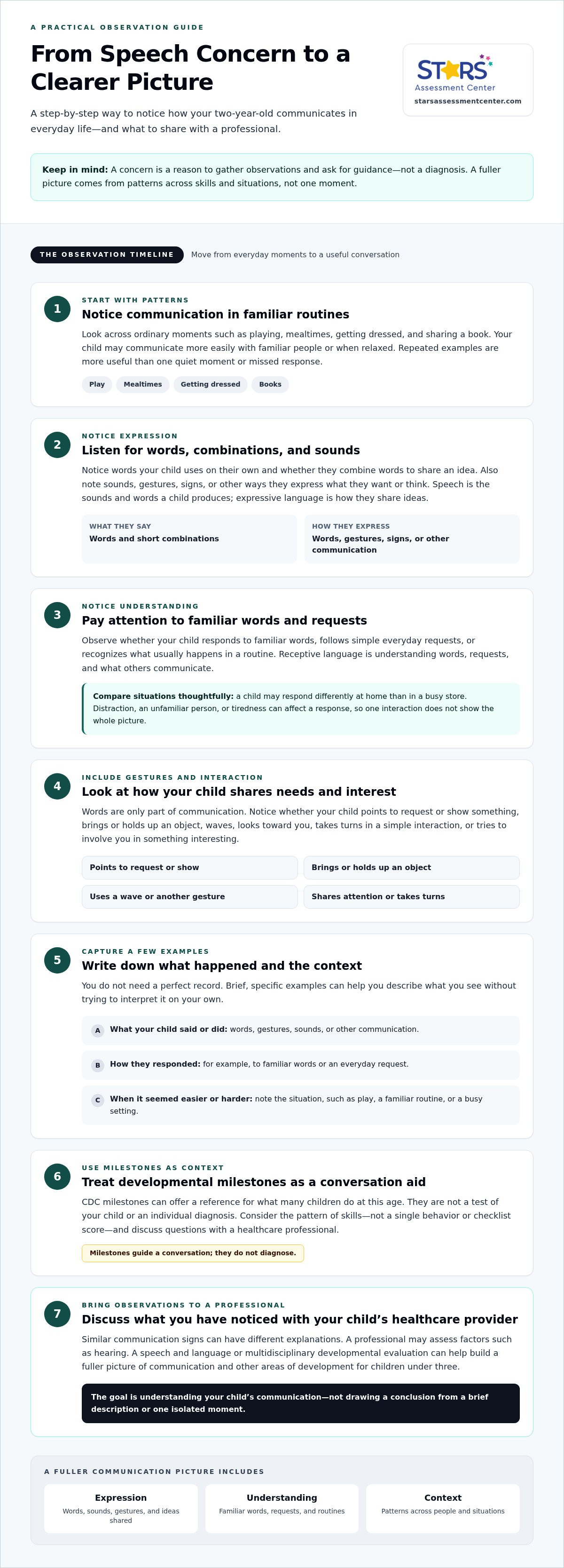
Before speaking with your child’s healthcare provider, jot down a few specific examples. Include the words or gestures you’ve observed, how your child responds to everyday communication, and situations where it seems easier or harder for them to express themselves. You don’t need a perfect record. A few clear examples can make the conversation more useful.
Asking for guidance isn’t labeling your child or assuming something is wrong. It’s a caring way to better understand how they communicate and whether further support or evaluation may help.
Which Communication Skills Should You Notice Around Age Two?
At age two, look beyond how many words your child says. Notice how they combine communication skills during ordinary moments: asking for a snack, responding to a familiar direction, showing you a toy, or sharing excitement during play. The CDC’s developmental milestones can offer a useful reference for what many children do at this age, but they aren’t a test of your child or a diagnosis.
Milestones are conversation guides, not individual diagnoses. A child’s communication is best understood through a pattern of skills, not one moment or a checklist score. The CDC encourages families to track development and discuss questions with a healthcare professional. For more background, the NIDCD Speech and Language Milestones page describes speech and language development from birth through age five.
How do spoken words and understanding fit together?
Some children understand more than they can say. Notice whether your child responds to familiar words, follows simple everyday requests, or recognizes what usually happens in a routine. Also listen for words they use on their own and whether they put words together to share an idea, such as asking for more or naming something they see. These observations help describe both understanding and expression.
Observe in more than one situation. Your child might follow “bring me your shoes” while getting ready at home but not respond to the same request in a busy store. Distraction, an unfamiliar person, or tiredness can affect how a child responds. One interaction doesn’t show the full picture; repeated examples across familiar routines are more useful to share.
What can gestures and interaction tell you?
Words aren’t the only way toddlers communicate. Notice whether your child points to request something or show you what caught their attention, brings or holds up an object to share it, waves, or uses another gesture. Pay attention to whether they look toward you, take turns in a simple interaction, or try to involve you in something interesting.
Look at how your child communicates needs and shares interest using sounds, words, gestures, or facial expressions. For example, they might reach toward a cup, point to a passing bus, or make a sound while looking between you and a toy. Record what you see without treating any single behavior as proof of a particular condition.
- What words or short combinations does your child use spontaneously?
- How do they respond to familiar words, requests, or routines?
- What gestures do they use to ask, show, greet, or share interest?
- Does communication change with the setting, activity, or people nearby?
If you’re thinking, “I think my 2 year old has a speech delay,” these examples can help you describe your concern clearly to your child’s healthcare provider. Families in San Jose can also learn about speech and language evaluations for children under three.
Speech Delay, Hearing, or Another Developmental Difference?
Communication concerns can look similar for different reasons. A child may use few spoken words, have difficulty understanding what’s said, or communicate more through gestures. Those observations alone can’t tell you why. If you’re thinking, “I think my 2 year old has a speech delay,” try not to guess at a cause from one sign. A qualified professional can consider your child’s communication and broader development to understand what support may help.
Could hearing differences affect communication?
Hearing is one area a professional may consider when a child has communication concerns. If you’ve noticed a change in how your child responds to sounds, or have questions about their hearing history, share that with their healthcare provider. A child responding to some sounds doesn’t establish that hearing is typical in every situation, just as missing a response once doesn’t establish hearing loss. Avoid drawing conclusions from isolated moments.
Describe what you notice: whether your child responds when you speak nearby, follows familiar spoken requests, or reacts differently in quiet and noisy settings. These details provide context for a professional, who can advise on appropriate next steps. They aren’t a way to test hearing at home.
Does a speech concern mean autism or another diagnosis?
No. A speech concern by itself can’t identify autism or another specific developmental condition. Children communicate in different ways, and similar signs may have different explanations. Professionals consider communication alongside other observations, such as how a child understands others, shares interest, interacts, and manages everyday activities. A thoughtful evaluation looks at the whole child rather than treating one behavior as a conclusion.
For parents who want to understand screening and evaluation, this autism screening and evaluation guide explains the difference. A screening can indicate whether further assessment may be useful; it doesn’t confirm a diagnosis. If concerns extend beyond speech, an early childhood developmental screening guide can help you think about questions to raise with your child’s healthcare provider.
Bring observations rather than a theory about what they mean. You might note that your child uses gestures to ask for things, seems to understand familiar routines, or communicates differently with family than with unfamiliar people. The CDC 2-Year-Old Milestones can be a reference for discussing development, but it can’t explain the reason for an individual child’s communication pattern.
An assessment can help clarify a child’s communication profile and whether other areas of development should be considered. It gathers a fuller understanding, rather than making a diagnosis based on this article. Asking questions early is a supportive step toward guidance, whatever the explanation turns out to be.
What Can You Do Now If Your 2-Year-Old Is Not Talking Much?
If you’re thinking, “I think my 2 year old has a speech delay,” you don’t need to wait until you’re certain before bringing it up. Start by noticing how your child communicates in everyday life, gathering a few examples, and discussing your concerns with their healthcare provider. You’re not expected to work out the cause yourself.
Keep your observations simple. Jot down a word or gesture your child used to ask for something, how they responded to a familiar request, or whether they communicated differently during play than in a busy setting. Look for patterns over time, not a perfect record or a performance on demand.
- Observe: Notice communication during ordinary routines, such as meals, play, getting dressed, and looking at books.
- Write down examples: Record what your child says, sounds out, gestures, seems to understand, or tries to communicate.
- Talk with their healthcare provider: Share what you’ve noticed and ask what next steps may fit your child’s needs.
- Follow the guidance you receive: Keep track of recommendations and ask questions if you’re unsure what to do next.
What should you write down before a conversation?
A short note on your phone or paper is enough. Include words and sounds your child uses, gestures such as pointing or waving, and attempts to get your attention or share something. Add examples of what they seem to understand in familiar situations, such as responding to a routine request. Note which languages are used at home, who spends time with your child, and any changes caregivers have observed.
Whenever possible, describe what happened rather than interpreting it. For instance, write “pointed to the cup and vocalized” instead of “couldn’t ask for a drink.” You can also note the setting, who was present, and whether your child was tired, engaged, or distracted. These details help a provider understand the context around a communication moment.
Who can help you decide on a next step?
Your child’s pediatric healthcare provider is a good person to talk with about developmental concerns. They can discuss your observations and guide you toward appropriate next steps. A speech and language evaluation can look more closely at how your child communicates and understands language. The right path depends on your child’s situation and professional guidance, not on a single checklist or online article.
To learn how an evaluation may clarify your child’s communication profile, explore Stars’ speech and language evaluation. Stars evaluates children under three, and its multidisciplinary developmental assessment can consider communication alongside other areas of development. There’s no need to arrive with a diagnosis. Your notes and questions are a useful place to begin.
How a Speech and Language Evaluation Can Help Families in the Stars Service Area
When questions about communication persist, an evaluation can offer a clearer picture of how your child shares and understands ideas. Stars Assessment Program provides speech and language evaluations for children under three, as well as multidisciplinary developmental assessments. The goal is to understand a child’s profile, not to draw conclusions from a parent’s concern or a single milestone.
What can an evaluation help clarify?
A speech and language evaluation can describe your child’s communication strengths and areas that may benefit from further attention. It considers how your child communicates and understands language, giving families a more informed basis for discussing possible next steps. Findings don’t promise a particular diagnosis, service eligibility, treatment, or outcome. They can help replace uncertainty with a more individualized understanding of your child’s needs.
Communication is one part of development. When a broader view is appropriate, Stars’ multidisciplinary developmental assessment considers communication alongside cognitive, physical, and social-emotional development. Looking across these areas can provide context for what you’re noticing, including how communication relates to your child’s interactions and everyday experiences. The assessment is intended to build understanding of the child as a whole.
For a local overview of what families may consider when seeking support, the Santa Clara County toddler speech evaluation guide offers additional context. Whether you’re concerned about a few words, how your child understands you, or the way they connect with others, a professional evaluation can help organize those questions without assuming the answer in advance.
How can local families take a gentle next step?
You don’t need to arrive with a diagnosis or perfectly organized notes. Your questions and everyday observations are a helpful starting point. Share what your child communicates, what they seem to understand, and whether you’ve noticed changes or differences across routines. If you’ve already spoken with your child’s healthcare provider, bring any guidance or questions from that conversation.
Stars serves families in San Jose, Santa Clara, Santa Cruz, Salinas, Milpitas, Gilroy, and Morgan Hill. If you’re in one of these communities and thinking, “I think my 2 year old has a speech delay,” learning about assessment can be a calm next step. You can explore what may help you better understand your child’s communication without needing to decide on a diagnosis first.
Learn about assessment support for your child.
Take the Next Step With Confidence
If you’re still thinking, “I think my 2 year old has a speech delay,” you don’t have to solve every question today. Let your concern guide a conversation and help you decide what support would be useful. Your child is more than a milestone, and seeking clarity is an act of care, not a judgment about your parenting or your child’s future.
Use what you’ve noticed to start that conversation, then take things one step at a time. An evaluation can offer a clearer understanding of your child’s communication and broader development, helping you consider next steps with more context. You don’t need to arrive with certainty or have all the answers before exploring support.
Stars Assessment Program offers developmental assessment support for families who want to better understand their child’s needs. Learn about Stars Assessment Program and consider whether an evaluation feels like a helpful next step for your family.
Your thoughtful attention and willingness to ask questions can help your child feel understood and supported as they grow.
Frequently Asked Questions
Is it normal for a 2-year-old not to talk much?
Children develop at different rates, but a concern about your child’s communication is worth discussing. Notice whether they seem to understand familiar phrases, use gestures to get your attention, or try to communicate through sounds and actions. A quiet moment around new people may not reflect how they communicate at home. If your concern persists, talk with your child’s healthcare provider rather than using a milestone list to diagnose them.
How many words should a 2-year-old say?
The CDC’s current milestone for age two is that a child says at least two words together, such as “more milk.” The CDC lists saying about 50 words as a milestone by 30 months, not age two. These milestones describe skills most children demonstrate by a certain age; they aren’t a pass-or-fail test or diagnosis. Consider your child’s whole communication picture and discuss individual concerns with a qualified professional.
Can a 2-year-old understand more than they can say?
Yes. Receptive language means understanding messages, while expressive language means sharing them. These abilities may develop at different rates, so a child might follow a familiar instruction but use few spoken words to respond. Notice both sides: what your child appears to understand and how they communicate choices or needs. Strong understanding doesn’t rule out a communication need, so raise questions about either area with their healthcare provider.
Could hearing problems cause a speech delay?
Hearing is one factor professionals may consider when a child has communication concerns, but a parent can’t determine hearing ability from a few responses at home. For example, responding to a favorite song doesn’t answer every question about hearing speech in different settings. Share what you’ve noticed, along with any hearing concerns or history, with your child’s healthcare provider. They can guide appropriate next steps without assuming a cause.
Does a speech delay mean my child has autism?
No. Speech or language concerns alone don’t diagnose autism. If there are questions about development, professionals consider a broader pattern of communication and behavior to decide whether further assessment may help. Asking about an evaluation isn’t labeling your child; it’s a way to seek clearer information. Share what you’ve observed and ask what kind of assessment makes sense for your child.
Should I wait to see if my 2-year-old catches up?
Rather than trying to predict whether your child will catch up, discuss a persistent concern with their healthcare provider. Starting a conversation doesn’t commit your family to a diagnosis or intervention. It helps you understand what your child may need now. Before the visit, note a few examples of communication during ordinary activities, such as choosing a snack or asking for help, so the provider has concrete context.
What should I do if I think my 2-year-old has a speech delay?
If you’re thinking, “I think my 2 year old has a speech delay,” write down examples of words, gestures, understanding, and communication during daily routines, then share them with your child’s healthcare provider. Ask whether a speech and language evaluation may be appropriate. Stars Assessment Program evaluates communication and broader development for children under three. Its service area includes San Jose, Santa Clara, Santa Cruz, Salinas, Milpitas, Gilroy, and Morgan Hill.


