

What if support for your toddler doesn’t have to come from just one place? When you’re looking for local resources for parents of special needs toddlers, it can be difficult to know whether to start with a developmental assessment, early intervention, childcare, or family support. You can begin with the question that matters most right now, even if you don’t yet know what a particular behavior means or which program may fit.
In Santa Clara County and nearby communities, different resources address different needs. This guide explains what each type of support can do, how California Early Start and Regional Centers fit into the picture, and how to prepare for a conversation about your child’s development. An assessment can help clarify strengths and areas where support may help, while family, childcare, and community resources play their own roles.
For infants and toddlers under age three, a multidisciplinary developmental assessment can look at areas such as communication, physical development, cognition, and social-emotional growth. Stars Assessment Program provides assessments for families in San Jose, Santa Clara, Santa Cruz, Salinas, Milpitas, Gilroy, and Morgan Hill. Understanding what an assessment can tell you, and how it relates to other local pathways, can make the next step feel more manageable.
Key Takeaways
- Start among local resources for parents of special needs toddlers by identifying whether your immediate question is about development, early intervention, family support, or childcare.
- Understand how California Early Start and San Andreas Regional Center fit into local support pathways for eligible infants and toddlers.
- Compare resources by what they can help with, so you can choose a practical starting point for your family.
- Use everyday observations and a simple follow-up plan to discuss your questions without relying on labels or assumptions.
- Learn how a developmental assessment can describe your toddler’s strengths and areas where support may help.
Local Resources for Parents of Toddlers with Special Needs: Where to Begin
If you have questions about your toddler’s communication, movement, learning, or interactions, seeking information is a reasonable first step. You don’t need a diagnosis or a complete plan before exploring local resources. Try writing down the question you want answered: for example, whether you’re looking for a closer look at development, guidance about early intervention, family connection, or childcare information.
“Local resources” can mean several things. A developmental assessment helps describe a child’s skills and areas of concern. Early intervention is a support pathway for eligible young children. Family education and peer groups can offer information and connection, while childcare resources help families explore care and inclusion options. These supports have different purposes, so identifying your immediate need can make it easier to choose where to start.
Early support may include services designed to encourage a child’s development in everyday routines. For a general overview of early childhood intervention and its aims, families can explore this reference. A developmental assessment can contribute useful information, but it does not replace community, family, or childcare support.
Which kinds of local support can help a toddler’s family?
Developmental resources focus on understanding or supporting a child’s growth. Family and peer resources offer information, shared experiences, and help thinking through possible next steps. Childcare resources focus on finding care that fits a family’s needs, and family education can help caregivers understand development and support skills during daily activities.
These options can work alongside one another. A caregiver with questions about a toddler’s communication might seek an evaluation and also look for parent guidance or childcare information. There is no required sequence. Start with the concern that feels most pressing, then consider whether another type of support would be useful as well.
Why can resources differ between nearby cities?
Program boundaries don’t always match city or county lines, and different resources may serve different areas. Stars Assessment Program provides assessments for families in San Jose, Santa Clara, Santa Cruz, Salinas, Milpitas, Gilroy, and Morgan Hill. Other resources may have their own service areas and referral pathways, so a city name alone does not identify which programs or processes apply to a family.
When you’re exploring a specific public program, use its current service-area and referral information. This is especially useful if you live near a boundary, are comparing resources based in different parts of the region, or are moving between nearby communities. A resource may be close to home but follow a separate intake pathway.
For families in San Jose, Santa Clara, and surrounding communities, a practical first step is to name the type of help you want: developmental information, family connection, childcare, or guidance about where to begin. Then focus on resources that serve your location and your child’s age group. Starting with one clear question can make a complex system easier to navigate while leaving room to connect with other supports later.
How California Early Start and Regional Center Supports Fit Together
Early Start and Regional Centers are related parts of California’s early-support landscape, but neither is the same as a developmental assessment. Knowing the difference can help you choose a sensible next step without feeling you have to understand every part of the system first. San Andreas Regional Center is a relevant local organization for families in the broader area; the pathway that applies depends on a child’s location and circumstances.
What does California Early Start do for eligible toddlers?
California Early Start is the state’s early intervention program for eligible infants and toddlers. It connects families with an early-support pathway while a child is very young. Eligibility and available services depend on current program rules and individual circumstances, so families can learn about the process while they are still working out what they’ve noticed.
The California Department of Developmental Services provides current information about the California Early Start program, including eligibility and referral guidance. Use the department’s current information to understand how to begin and what requirements apply. A developmental concern does not by itself establish eligibility.
What role can a Regional Center play for local families?
Regional Centers are a separate pathway for people with developmental disabilities and their families. San Andreas Regional Center is relevant to families in this region, but its service boundaries and intake routes are specific to the program. Use its current official information to identify the pathway for your location rather than relying on a nearby city name alone.
A Regional Center pathway is not interchangeable with a clinical or multidisciplinary developmental assessment. An assessment describes a child’s development and areas that may need support; Regional Center processes address their own eligibility and support pathways. Families can learn about both, keeping in mind that an assessment does not guarantee a particular outcome through another program.
Early intervention supports development, family navigation helps caregivers understand possible routes, and a developmental assessment offers a closer look at a child’s strengths and needs. Keeping these purposes distinct can help you explain what you’re looking for. For instance, you may want to understand a toddler’s communication and learn which local pathway can explain possible supports. Those questions can be explored in parallel, depending on your family’s circumstances.
When looking for local resources for parents of special needs toddlers, it can help to separate three questions: What have we noticed? Are we looking for an assessment, an intervention pathway, or help understanding the system? Which current program serves our location? Write down a few examples from everyday routines, such as how your child communicates during play or responds to familiar instructions. Concrete examples can make conversations with programs more focused.
Stars Assessment Program provides multidisciplinary developmental assessments for infants and toddlers under age three, considering cognitive, physical, communication, and social-emotional development. If you want a clearer picture of your child’s development, learn about a multidisciplinary developmental assessment as one part of planning your family’s next steps.
Compare Local Family, Childcare, and Developmental Resources by Need
Different resources answer different questions, and families may use more than one. Compare each option by its purpose, then use the relevant organization’s current information for eligibility, boundaries, and program details. Family connection or childcare can be valuable without taking the place of a developmental evaluation or early intervention.
Early Start
May help with: Exploring California’s early intervention pathway for eligible infants and toddlers.
Practical starting point: Review current state guidance. The CDC Early Intervention resources can also help families find state-specific information.
Regional Center
May help with: Learning about a separate regional pathway for developmental disability services and supports.
Practical starting point: Use the Regional Center’s current information to identify the service area and referral process for your location.
Family-led support
May help with: Peer connection, shared experience, family education, and understanding possible next steps.
Practical starting point: Family Voices is a national network with state and local connections. Its current affiliate information can help families find relevant connections and language-access options.
Head Start
May help with: Early learning and family support in a program setting, depending on local offerings and eligibility.
Practical starting point: Explore current Head Start options serving your area. A program can support learning and routines, but it isn’t a developmental assessment.
Childcare
May help with: Finding care that fits a family’s schedule and a toddler’s daily needs.
Practical starting point: Childcare.gov offers general information about disability-related childcare. In Santa Clara County, the Child Care Resource and Referral Program can help families locate childcare and preschool programs by phone at 669-212-KIDS (5437). Use current program information when considering care options.
Developmental assessment
May help with: Understanding a toddler’s development and identifying strengths or areas of concern.
Practical starting point: Explore an assessment when you want a clearer picture of communication, physical, cognitive, or social-emotional development. It provides information about development; it doesn’t replace family support or childcare.
Where can parents find family-to-family support and information?
Talking with another caregiver can make an unfamiliar process feel less isolating. Family-led organizations may offer practical insight into navigating services and reassurance from people with related experiences. Family Voices provides a national connection point, though it is not a directory of every local service. Its current affiliate information can help you look for connections relevant to your community.
How can childcare and Head Start support a toddler?
Childcare and Head Start can offer a setting for toddlers to learn, practice routines, and build relationships while meeting family needs. They are care and educational settings, not substitutes for formal developmental assessment or early intervention. When comparing local resources for parents of special needs toddlers, consider what each option addresses: developmental questions, family connection, or a care arrangement. This helps you seek complementary support without expecting one program to meet every need.
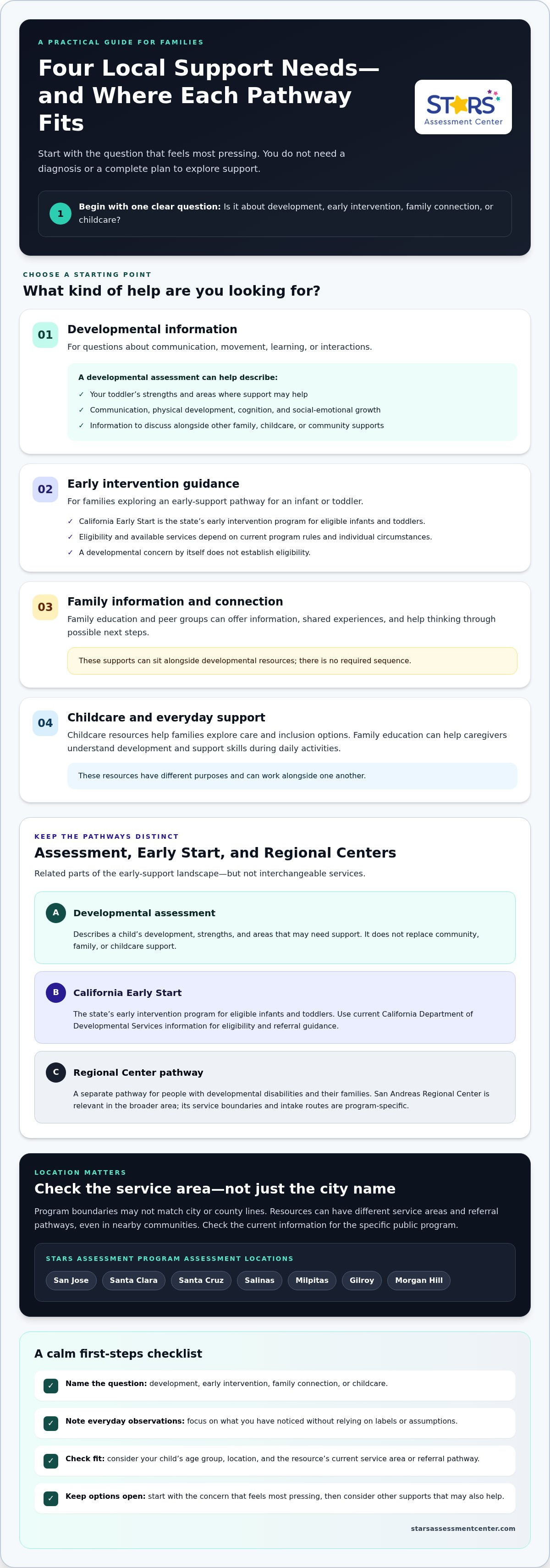
A Calm First-Steps Checklist for Finding Support Near You
You don’t need to know a program’s name before asking a question. A few everyday observations can help you explain what you’ve noticed and decide what kind of support to explore first. Use this checklist as a flexible guide, not a test your family has to pass before reaching out.
- Describe the question in your own words. You might be wondering about how your toddler communicates, moves, plays, or connects with others. It’s fine if the concern feels broad or you’re not yet sure what it means.
- Notice what happens in daily routines. Think about mealtimes, play, getting dressed, or time with familiar people. Note what you see, including what seems easy for your child and what seems challenging.
- Choose a resource category to explore. Consider whether you’re looking for developmental information, an early-support pathway, family connection, or childcare guidance. If you’re unsure, describe your question and ask the program what its resource is designed to address.
- Keep track and follow up. Note whom you contacted, when you reached out, what they said, and any next action. If you haven’t heard back, a brief follow-up can help keep your question moving.
Clear observations can help you explain your questions without needing to label what’s happening. For example, “My toddler points to ask for a snack but rarely uses words during play” gives a concrete picture to discuss. It doesn’t diagnose a concern or predict which support will be appropriate.
What information should parents gather before reaching out?
If it’s useful, jot down examples of communication, play, movement, social interaction, and everyday routines. You might note how your toddler asks for help, explores toys, moves around the home, or responds to familiar people. Questions about development and relevant health or developmental history can also help guide a conversation. These notes are optional preparation, not a prerequisite. You can seek information before you’ve gathered everything or know which pathway fits.
How can families organize local next steps without feeling overwhelmed?
Choose one immediate question and one resource category to explore first. If you’re unsure about communication, for example, start by asking where to learn more about your child’s development. Keep names, dates, responses, and follow-up tasks together in a notebook, phone note, or simple document. You don’t have to contact every program at once or follow a set sequence. Each family’s path can look different, and it’s fine to take one manageable step at a time.
If a clearer picture of development would help you decide what to ask next, explore a developmental assessment for infants and toddlers under age three. An assessment can offer information about communication, physical, cognitive, and social-emotional development, while family and community resources continue to play their own important roles.
How a Developmental Assessment Can Add Clarity for Families
It can be hard to know what a toddler’s behaviors mean when you’re watching development unfold day by day. A developmental assessment offers a structured way to understand a child’s strengths and areas that may need more attention. For families exploring local resources for parents of special needs toddlers, it can provide useful information to bring into conversations with community programs and other supports.
An assessment isn’t a verdict or a promise of eligibility for another service. It is one source of information that can help parents make sense of developmental questions and consider possible next steps. Family observations matter, too. Everyday examples can help connect assessment findings to what a child does during play, communication, movement, and familiar routines.
What can a multidisciplinary developmental assessment help clarify?
A multidisciplinary assessment considers more than one area of development, rather than viewing a child through a single skill or concern. It can include cognitive, physical, communication, and social-emotional development. Looking across these areas can help clarify where a child is showing strengths and where further understanding or support may be helpful.
This information can give families a clearer basis for discussing concerns and deciding what to explore next. An assessment does not replace community resources or determine whether a child will qualify for Early Start, Regional Center support, or another program. Each pathway has its own process. An assessment describes development, while program decisions are made through the relevant program’s criteria and procedures.
When might a family consider an assessment through Stars Assessment Program?
Parents may consider an assessment when developmental questions persist or when they want a broader understanding of how their toddler is growing. Stars Assessment Program provides multidisciplinary developmental assessments for infants and toddlers under age three. Its offerings include social-emotional assessments and speech and language evaluations, as well as specialized screenings for Autism and Down syndrome.
These assessments can help families better understand areas such as communication, physical development, cognition, and social-emotional growth. They can also help parents put questions into words and think about what information may be useful in conversations with other resources. Assessment is one part of a support network, alongside family-led support, childcare, and early intervention, which each serve different roles.
If you’re considering an assessment, learn about developmental assessment support. Explore assessment for young children and consider whether this kind of developmental information may be helpful for your family.
Take One Clear Step Toward Understanding Your Toddler
You don’t have to map out every service or make every decision today. Choose the question that matters most to your family, then take one manageable step toward an answer. For parents exploring local resources for special needs toddlers in San Jose, Santa Clara, Santa Cruz, Salinas, Milpitas, Gilroy, or Morgan Hill, that step might be learning about assessment, writing down questions for a conversation, or continuing to connect with community support.
A developmental assessment can offer a clearer view of a child’s strengths and areas where support may help. Stars Assessment Program provides multidisciplinary developmental assessments for infants and toddlers under age three, considering cognitive, physical, communication, and social-emotional development. This information can help families better understand their child while remaining one part of a broader support network.
If learning more about assessment feels like a helpful next step, learn about developmental assessment support. Explore the assessment services Stars provides and take a step toward understanding your toddler’s development.
Frequently Asked Questions
Can I look for support for my toddler before they have a diagnosis?
Yes. You can ask questions and explore support options while you’re still learning about your toddler’s development. A diagnosis isn’t the only reason to seek information or consider an assessment. For example, you might describe a concern about how your child communicates during meals or responds to familiar routines. Eligibility for specific programs depends on their current requirements and your child’s circumstances, so use the relevant California program’s current information. These can be useful first steps when exploring local resources for parents of special needs toddlers.
How do I find out which Regional Center serves my family?
Use current California Regional Center information to identify the service boundary for your home address. San Andreas Regional Center is locally relevant, but nearby communities may follow different pathways, so don’t rely on a city name alone. This matters for families in San Jose, Santa Clara, Milpitas, Gilroy, Morgan Hill, Santa Cruz, or Salinas. Use the official boundary and contact information that apply to your household when learning about a referral.
What happens when a toddler turns three and still needs support?
Support pathways may change as a child approaches age three, so it can help to ask about transition planning ahead of the birthday. Early intervention and preschool-age services have different processes, and the next steps depend on the child and current program rules. If your toddler already receives support, ask the current team what information or planning may be useful. For current timelines and options, consult official California guidance rather than assuming services continue automatically.
Can a toddler receive developmental support without a confirmed disability?
Yes. Families can seek information when they have developmental questions, even before they know whether a disability is present. An assessment may help describe a child’s strengths and areas of concern, but it doesn’t guarantee eligibility for a particular program. For instance, a parent wondering about speech or social interaction can explore an assessment. Each program has its own current criteria for the services it provides.
Are family support resources available in languages other than English?
Some family-serving organizations provide language access or materials in languages besides English, but options differ by organization and location. Family Voices offers information for families from culturally and linguistically diverse communities, and local organizations may have additional resources. Look for current information about interpretation, translated materials, and accessible communication. Families deserve information they can understand, so it is reasonable to ask what language support is available.
Can childcare help support a toddler with developmental needs?
Childcare can provide opportunities for play, routines, learning, and social connection, while developmental assessment and other supports address different needs. Whether a setting is a good fit depends on the child and the program’s options. Childcare.gov is a general place to learn about disability-related childcare information. A family in San Jose, for example, might explore care options while separately seeking guidance about a developmental question. Childcare and assessment can complement each other, but they aren’t interchangeable.


