

What if a quiet first birthday calls for a closer look, not panic or dismissal? If my 1 year old is not babbling, it’s understandable to wonder whether to wait, speak with the pediatrician, or seek an evaluation. Babbling can sound like repeated syllables such as “ba-ba” or “ma-ma,” but children communicate in different ways. No single behavior tells the whole story, and asking for guidance doesn’t label your child.
This article explains what babbling may look like around age one and what else to notice, including how your child responds to their name, uses gestures, and tries to copy sounds. You’ll also learn how to organize your observations and why it can help to discuss hearing and communication concerns with your child’s pediatrician rather than relying on advice to simply wait.
A developmental assessment can consider communication alongside other areas of your child’s development, giving you a fuller picture. We’ll outline practical next steps and explain how families with children under three in Santa Clara County and nearby communities, including San Jose, Santa Clara, Santa Cruz, Salinas, Milpitas, Gilroy, and Morgan Hill, can access assessment support through Stars Assessment Program.
Key Takeaways
- If my 1 year old is not babbling, that observation alone can’t explain their overall development.
- Notice communication across everyday interactions, including sounds, gestures, understanding, and responses to people.
- Recording specific examples and changes can help you describe your concerns clearly when discussing next steps.
- A developmental assessment can consider communication alongside other areas of growth, offering a fuller picture of your child’s strengths and support needs.
My 1-Year-Old Is Not Babbling: What Does That Observation Mean?
It can feel unsettling when your child is nearing their first birthday and you haven’t heard the sounds you expected. If my 1 year old is not babbling, that’s a reasonable concern to raise, but it isn’t a diagnosis. One observation can’t show the full picture of a child’s development. Communication includes more than vocal sounds, and children’s skills emerge at different paces.
Babbling is a baby’s play with speech-like sounds, often combining consonants and vowels into repeated syllables. The CDC’s 2022 “Learn the Signs. Act Early.” checklist for 9 months describes babies making varied sounds, including “mamamama” and “babababa.” These examples can clarify what parents mean by babbling, but they aren’t a sound-by-sound test for a first birthday.
Developmental milestones offer general guidance about skills children commonly show by certain ages. They aren’t deadlines or diagnostic thresholds, and a checklist can’t assess a child on its own. The CDC’s 9-month sound examples are an age-related reference, not a rule that every child must babble in a specific way by that point. If you remain concerned, discuss it rather than dismissing it.
What babbling may sound like around the first birthday
You might hear repeated syllables such as “ba-ba” or “da-da,” or a mix of changing sounds during play. A child may experiment with their voice before using a sound consistently. Babbling and meaningful words are different: babbling is playful sound-making, while a meaningful word is used consistently to refer to a person or thing. Children don’t all follow an identical sequence. For a broader overview of the stages of babbling, see this summary of how babbling can develop.
Why one milestone does not tell the whole story
Communication develops as a pattern across sounds, gestures, understanding, and interactions with other people. A quiet moment, or even a quiet stretch, doesn’t reveal a child’s intelligence or predict their future. Comparisons with siblings, other children, or social media stories can add worry without giving you an assessment of your child. Your observations matter, especially if you continue to have concerns.
Babbling is one part of communication, not a measure of a child’s worth, ability, or potential. Notice what your child does during ordinary routines, including whether they make other sounds or communicate in other ways. If you’re unsure how to interpret what you’re seeing, share your observations with a healthcare professional or assessment service so they can be considered in context.
Look Beyond Babbling: Other Communication Clues to Notice
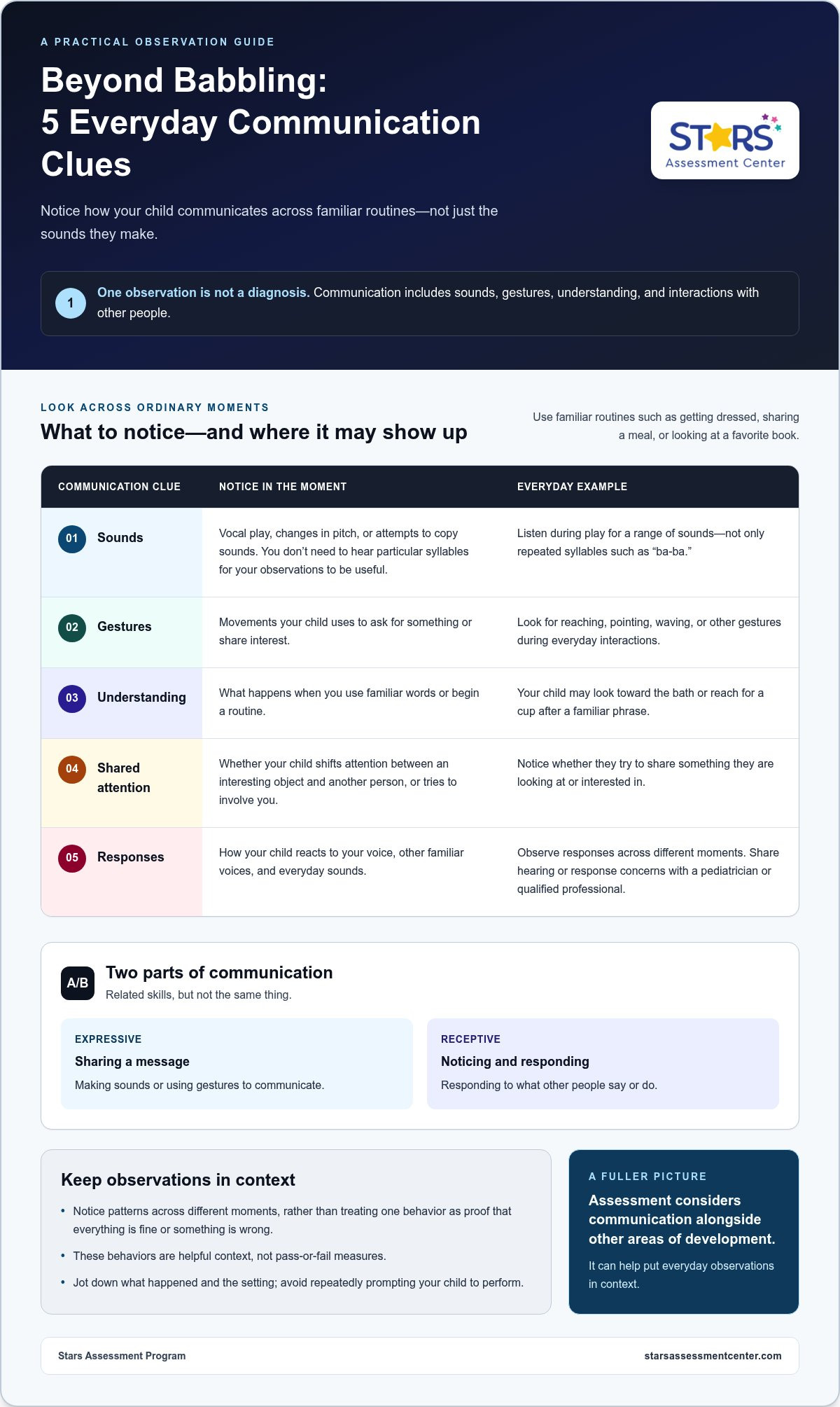
If my 1 year old is not babbling, it may help to notice how they communicate in other ways, too. You don’t need to turn playtime into a test. Pay attention to small moments during familiar routines, such as getting dressed, sharing a meal, or looking at a favorite book.
Communication includes expressive skills, such as making sounds or using gestures to share a message, and receptive skills, which involve noticing and responding to what others say or do. These areas are related, but they aren’t the same. A child may show understanding in daily routines while using few sounds, or make sounds without yet using them to communicate a clear message.
- Sounds: Notice vocal play, changes in pitch, or attempts to copy sounds. You don’t need to hear particular syllables for your observations to be useful.
- Gestures: Look for reaching, pointing, waving, or other movements your child uses to ask for something or share interest.
- Understanding: Notice what happens when you use familiar words or begin a routine. For example, your child may look toward the bath or reach for a cup after a familiar phrase.
- Shared attention: See whether your child sometimes shifts attention between an interesting object and another person, or tries to involve you in what they’re noticing.
- Responses to people and sounds: Observe how your child reacts to your voice, other familiar voices, and everyday sounds around them.
Gestures, shared attention, and understanding
These behaviors can offer helpful context, but none is a pass-or-fail measure. A child might point to request a toy but not often point to share interest, or respond to familiar routines in one setting more than another. Eye contact, gestures, or responding to their name cannot individually rule a condition in or out. Consider what you notice across different moments, rather than treating one behavior as proof that everything is fine or that something is wrong.
Sounds, responses, and everyday interaction
Listen for a range of sounds, not just repeated syllables, and notice whether your child seems to respond to voices and environmental sounds. Hearing can affect communication, so share concerns about your child’s responses or hearing with their pediatrician or another qualified professional. A hearing concern deserves attention alongside questions about communication.
A communication assessment considers multiple behaviors and everyday interactions, not babbling alone. To make your observations useful, jot down what happened and the setting, without repeatedly prompting your child to perform. That context can help a professional understand your child’s communication as a whole. Stars Assessment Program’s multidisciplinary developmental assessment considers communication alongside other areas of development.
Should You Wait and See? When a Babbling Concern Deserves Attention
Children do develop at different rates, but that doesn’t mean you have to dismiss a concern or wait until a particular birthday to ask about it. If my 1 year old is not babbling is on your mind, raising the question with your child’s healthcare provider or an assessment service is a reasonable next step. Seeking guidance doesn’t mean you assume your child has a diagnosis. It means you want help understanding what you’re noticing.
A professional can consider your child’s communication in context, including what you’ve observed over time and whether you have concerns in other developmental areas. An assessment gathers information; it doesn’t define your child’s identity, intelligence, or potential. It can offer clarity about current strengths and whether further support or follow-up may be helpful.
Reasons to raise the concern sooner
Consider discussing your concerns if you consistently notice little vocal communication, have questions about how your child responds to sounds, or see other communication or developmental differences. You don’t need to wait for a milestone date to ask questions. Share what you’ve noticed and when it tends to happen. A healthcare professional can help you decide whether hearing or communication should be explored further.
Also mention any loss of a skill your child previously used, such as no longer making sounds, using gestures, or communicating in other familiar ways. A change in previously acquired skills is different from a skill that is emerging slowly and deserves prompt professional discussion. This does not point to a specific cause by itself, but it is important information for a professional to consider.
Babbling alone does not establish autism or any other diagnosis. Likewise, one reassuring behavior cannot rule a condition out. A careful conversation focuses on the child’s overall pattern, not a single sound or sign.
What reassurance can, and cannot, tell you
Children do vary, and stories about a sibling or another child may offer comfort. But anecdotes can’t assess your child’s hearing, communication, or development. If reassurance leaves you still concerned, it’s okay to ask again or seek a fuller discussion. You know your child’s everyday routines, and sharing specific examples can help a professional understand why something feels different to you.
Screening and assessment gather information; they don’t label a child or determine their future. A screening can indicate whether a closer look may be useful, while a developmental assessment can consider several areas together. For a clearer explanation of screening, explore this early childhood developmental screening guide. You can ask questions before you’re certain what your observations mean.
What to Do Next: A Simple Plan for Talking About Babbling
Having a concern doesn’t mean you need to arrive at a conversation with a conclusion. A few notes from ordinary moments can help you explain what you’re seeing and ask for useful guidance. If my 1 year old is not babbling is the worry you’re carrying, start with a simple plan and adjust it to what feels manageable.
- Observe during everyday routines. Notice how your child communicates during play, meals, dressing, or familiar songs. Look for sounds, gestures, responses, and interactions without repeatedly prompting them to perform.
- Record a few examples. Write down what happened, when it happened, and who was with your child. Include changes you’ve noticed over time, without trying to interpret them as a diagnosis.
- Share your concern plainly. You might say, “I have noticed very little babbling and would like guidance.” Then describe what your child does to communicate, what they seem to understand, and how they engage with people or favorite activities.
- Discuss suitable next steps. Ask what follow-up may help, including whether hearing or communication should be explored. Share relevant developmental and hearing history, and bring any questions you want answered.
How to record useful everyday observations
Keep notes brief. For example: “During breakfast, she reached toward her cup when I asked if she wanted water,” or “He made a few sounds while playing with Dad.” Note whether a behavior happens often, occasionally, or seems to have changed. If you’re comfortable and it feels appropriate, a short video of a natural interaction may help you describe what you’ve observed. You don’t need to create a recording or keep a detailed diary for your concern to be worth discussing.
How to describe your concern clearly
Use everyday language rather than developmental terms. After sharing your opening concern, mention whether your child uses gestures, responds to familiar words or sounds, and enjoys back-and-forth play. Give examples of what you see, as well as what you haven’t observed. If you’re preparing for a conversation about a possible evaluation, this Santa Clara County toddler speech evaluation guide can help you understand what to expect.
You’re not responsible for teaching your child to speak or testing their communication at home. Your role is to share what you notice; a professional can help consider those observations and discuss appropriate next steps. For a broader look at communication alongside other developmental areas, learn about developmental assessments for children under three through Stars Assessment Program.
How a Developmental Assessment Can Help Families in Santa Clara County
If you’re concerned about your child’s babbling, an assessment can help place that observation in a wider developmental picture. Stars Assessment Program provides multidisciplinary developmental assessments for children under three, including infants and toddlers in San Jose, Santa Clara, Santa Cruz, Salinas, Milpitas, Gilroy, and Morgan Hill. The goal is to understand how your child is communicating and developing, not to draw a conclusion from one behavior.
For parents thinking, “my 1 year old is not babbling,” an assessment doesn’t have to begin with a diagnosis in mind. It offers a structured way to share your questions and learn more about your child’s individual strengths and support needs. The assessment process considers multiple areas of development together, giving communication context rather than treating it as an isolated skill.
What a multidisciplinary assessment considers
Stars Assessment Program’s multidisciplinary specialists consider communication alongside cognitive, physical, and social-emotional development. This broader view can help describe how different skills appear in a child’s development. The focus isn’t babbling alone. Specialists gather information across developmental areas to understand the child’s individual profile and help families make sense of what they’ve noticed.
For example, your questions about sounds can be considered alongside how your child communicates in other ways and how they’re developing in other areas. Looking across domains doesn’t mean that a concern in one area predicts a particular diagnosis or outcome. It helps build a fuller understanding of the child, including strengths and areas where more support or follow-up may be useful.
Finding local developmental guidance
Stars Assessment Program provides infant and toddler developmental assessments for families in Santa Clara County and nearby communities, including San Jose, Santa Clara, Santa Cruz, Salinas, Milpitas, Gilroy, and Morgan Hill. A multidisciplinary perspective can help families with broader questions about development. For questions related to autism, a screening and evaluation guide can explain the distinction between screening and assessment.
An assessment is not a label for your child’s identity or potential. It’s an opportunity to bring together your observations and learn more about communication in the context of development as a whole. You can share what you’ve noticed, ask questions, and understand the next steps that may be appropriate for your family. No single outcome should be assumed from a concern about babbling alone.
If you’re wondering what your child’s communication may mean, learn about developmental assessment support through Stars Assessment Program. A calm conversation about your concerns can be a helpful first step toward understanding your child’s development.
Take the Next Step at Your Own Pace
If “my 1 year old is not babbling” is still on your mind, you don’t have to decide what it means before asking for guidance. Your observations are a starting point, not a verdict. Sharing them with someone who can consider your child’s development in context may help you feel clearer about what to do next.
For some families, learning about an assessment is a useful next step. Stars Assessment Program works with children under three, considering communication alongside cognitive, physical, and social-emotional development. This broader perspective helps families explore their questions without reducing a child to one milestone or behavior.
Take things one step at a time. Learn more about how Stars Assessment Program supports families with developmental assessments and contact the program to discuss assessment support for your child. Asking a thoughtful question is a caring way to support your child.
Frequently Asked Questions
Can bilingual exposure cause a 1-year-old not to babble?
No. Hearing and learning more than one language does not, by itself, explain away a persistent communication concern. The American Speech-Language-Hearing Association advises considering a child’s communication across the languages they hear and use, rather than focusing on only one. When you discuss your concerns, describe which languages are spoken at home, who uses them, and during which routines. That context can make the conversation more useful.
Does not babbling at 1 year mean my child has autism?
No. Limited babbling alone cannot diagnose autism. An evaluation considers a broader developmental pattern, including communication, interaction, and behavior, rather than one sound or moment. Eye contact or any other individual behavior cannot confirm or rule out autism. If you’re concerned, share what you notice across play and daily routines with a qualified professional. Asking for individualized guidance is a way to learn more, not to assume a diagnosis.
Can a child hear loud sounds and still have a hearing concern?
Yes. Reacting to a loud door or a barking dog doesn’t establish that a child hears speech sounds clearly or responds consistently in every situation. Home observations can be helpful to share, but they can’t determine how well a child hears. If responses to sounds seem inconsistent or communication is a concern, talk with your child’s healthcare provider about whether assessment by an appropriate hearing professional may be a suitable next step.
Should I wait until my child’s 18-month checkup to mention that they are not babbling?
No. If my 1 year old is not babbling, you can raise the concern when you first notice it rather than waiting for an 18-month visit. Share a couple of specific examples, such as sounds you hear during play or a change you’ve noticed, and ask what next step may fit your child. Families in San Jose and nearby communities can also discuss concerns with Stars Assessment Program, which provides developmental assessments for children under three. Asking opens a conversation; it doesn’t mean you’ve decided there’s a condition.
What if my 1-year-old used to babble but has stopped?
A loss of communication skills your child previously used is different from a skill that’s developing slowly, so discuss the change promptly with a qualified professional. Write down when you first noticed it and what changed, such as fewer sounds during play or less vocalizing across familiar routines. Mention any other changes you’ve observed, too. You don’t need to identify a cause before seeking individualized guidance.
Do squeals or vowel sounds count as babbling?
Squeals and vowel sounds are vocalizations, but they may not be what developmental guidance describes as babbling. The CDC’s 9-month milestone examples include repeated sounds such as “mamamama” and “babababa,” which combine consonants and vowels. Children’s sounds vary, so a checklist of syllables can’t assess communication by itself. If you’re unsure how to describe what you hear, note a few examples and share them with a professional.


