
If you’ve found yourself thinking, “I'm worried about my 18 month old's development,” it can be hard to know whether a skill is emerging at its own pace or whether it’s time to seek guidance. Milestone lists can offer helpful examples, but they don’t tell the whole story of your child.
Your observations matter, and you don’t need certainty before starting a conversation. This guide offers practical ways to notice everyday skills, prepare questions, and understand what a developmental assessment can and can’t tell you.
At Stars Assessment Program, assessments for children under 3 years are play-based, child-led, and include parents. Results are explained in clear, simple language, with guidance on possible next steps. This is not a diagnostic assessment. An assessment may help inform eligibility for Early Start, a program, when applicable. Early Start developmental assessments are provided at no cost to families. No referral needed. Families can contact Stars directly. Assessment in your preferred language. If something does not feel right, you do not have to wait for certainty to act.
Key Takeaways
- If you’re thinking, “I'm worried about my 18 month old's development,” everyday observations can help start a conversation, but one observation alone doesn’t establish a delay.
- Notice skills across speech and language, cognitive, motor, social-emotional, adaptive, vision and hearing screening.
- Milestone examples offer context, not a pass-or-fail test, and can’t determine your child’s individual needs.
- Prepare for a conversation by recording specific examples from play, meals, transitions, and communication, along with questions and relevant context.
- A developmental assessment can offer a clearer picture and possible next steps. This is not a diagnostic assessment.
Worried About Your 18-Month-Old’s Development? Start With What You Notice
If you’re thinking, “I'm worried about my 18 month old's development,” your concern deserves a thoughtful response. A missed milestone, a quiet day, or a difference you notice in one situation doesn’t, by itself, prove that your child has a developmental delay. Your observations are valuable because you see your toddler across familiar people, places, and routines. That context can make a conversation about development more useful.
Development includes connected skills. Communication, movement, play, and social interaction all shape how a child takes part in everyday life. A toddler may show strengths in some areas and need support in others. A developmental assessment offers a structured way to understand a child’s skills and possible support needs. This is not a diagnostic assessment, and it does not reduce a child to a label.
What can prompt a parent to seek guidance?
Families may request an assessment when a child hasn’t developed a skill they expected, seems to have difficulty communicating, moves differently during everyday activities, or interacts in ways that raise questions. Premature birth, NICU care, medical complications, or a diagnosed condition may also lead a family to seek a closer understanding of development. These details provide context; they don’t determine what a child needs on their own.
You don’t need a diagnosis, a particular level of concern, or proof that something is wrong to request an assessment. No referral needed. Families can contact Stars directly. If something does not feel right, you do not have to wait for certainty to act.
Why one observation does not tell the whole story
A toddler might use gestures while spoken words are still emerging, or confidently explore a familiar room but feel hesitant in a new setting. One moment can’t show the full range of a child’s skills. Notice what happens over time and in ordinary routines, such as play, meals, or transitions. Patterns and specific examples are more useful than rigid comparisons with another child.
Milestone information can offer context, but it isn’t a pass-or-fail test for an individual child. For a broader overview of child development stages, remember that general descriptions can’t determine a child’s unique needs. Early childhood developmental screening can support a conversation, but a checklist alone can’t provide an individual assessment.
A child-centered assessment considers speech and language, cognitive, motor, social-emotional, adaptive, vision and hearing screening. Activities are play-based, flexible, and child-led, with parents present. Results are explained in clear, simple language, followed by guidance about possible next steps. Assessment in your preferred language.
What Development Looks Like Across Six Areas at 18 Months
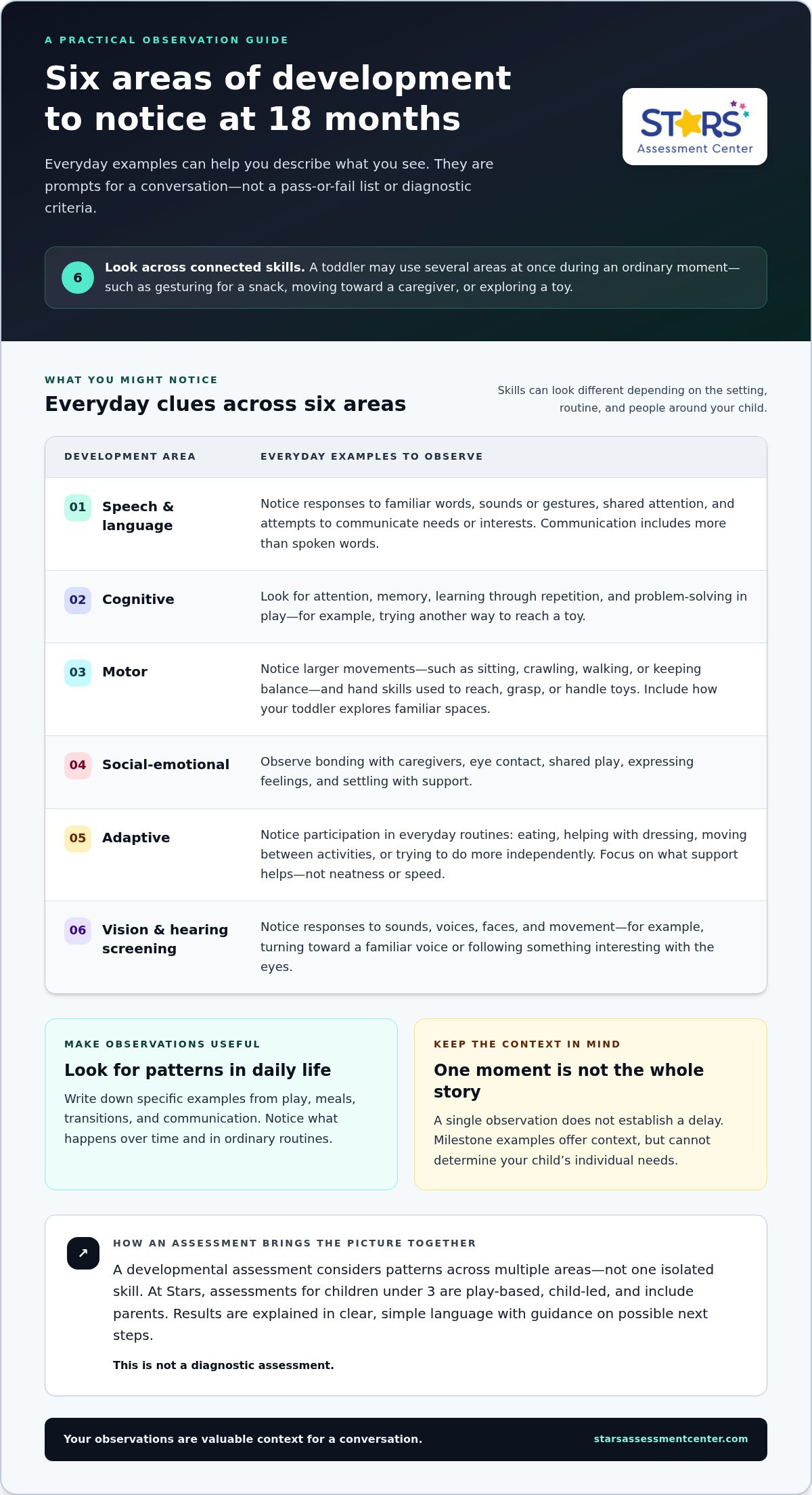
Development isn’t one skill or a single milestone. To build a fuller picture, a developmental assessment looks across six areas: speech and language, cognitive, motor, social-emotional, adaptive, vision and hearing screening. These areas connect in daily life. A toddler might gesture to ask for a snack, move toward a familiar caregiver, or explore how a toy works, using several skills in one moment.
The examples below are prompts for noticing, not a pass-or-fail list or diagnostic criteria. Children show skills in different ways, and what you see can vary with the setting, routine, and people around them. The CDC 18-Month Milestones offers examples across several developmental domains, but a milestone reference can’t determine an individual child’s needs.
Communication, learning, and everyday routines
Speech and language includes more than spoken words. Notice how your toddler responds to familiar words, uses sounds or gestures, shares attention, and tries to communicate needs or interests. Cognitive skills may show up as attention, memory, learning through repetition, or problem-solving during play, such as trying another way to reach a toy.
Adaptive skills are everyday actions that help a child take part in routines. Notice how your toddler approaches eating, helps with dressing, moves from one activity to another, or tries to do more independently. The aim isn’t to judge how neatly or quickly a task happens. It’s to understand how your child participates and what support makes the routine easier.
Movement, connection, vision, and hearing
Motor development includes larger movements, such as rolling, sitting, crawling, walking, and keeping balance, as well as hand skills used to reach, grasp, or handle toys. A child’s movement history and current ways of exploring are useful context. Notice what your toddler chooses to do and how they move through familiar spaces.
Social-emotional development can be seen in bonding with caregivers, eye contact, shared play, expressing feelings, and settling with support. Vision and hearing screening considers responses to sounds, voices, faces, and movement. You might notice whether your toddler turns toward a familiar voice or follows something interesting with their eyes. These observations don’t establish a vision or hearing concern on their own, but they can help guide a conversation.
A developmental assessment considers patterns across multiple areas, not one isolated skill. If you’re thinking, “I'm worried about my 18 month old's development,” sharing examples from play and daily routines can help make your concerns easier to discuss. Stars’ assessment for children under 3 years is child-led, play-based, and completed with parents present. This is not a diagnostic assessment. Results are explained in clear, simple language, with guidance about possible next steps. Assessment in your preferred language. If you’d like support understanding your child’s development, you can learn about a developmental assessment.
Milestones, Individual Differences, and When to Seek More Guidance
Milestone lists can help you notice skills and think of questions, but they can’t show the whole picture of your toddler’s development. A skill may appear in one setting and not another, and a child may communicate or solve problems in ways a checklist doesn’t capture. Use examples as a starting point, not as a score.
Your toddler follows a familiar direction during play, points to share interest, or uses a sound or gesture to ask for help.
It describes what happened in that moment. By itself, it can’t confirm that development is on track or determine whether support is needed.
Your child seems to understand familiar words but uses few spoken words, or communicates more readily at home than in a new setting.
It offers useful context about communication. It doesn’t rule out a concern or explain the child’s full communication profile.
A milestone seems to be taking longer to emerge, or a skill varies across routines and days.
It gives you something specific to discuss. A checklist alone can’t determine an individual child’s needs.
Milestone checklists can guide questions, but they cannot diagnose a child. A developmental assessment looks more closely at skills and patterns across areas. It is structured and observational, and can help clarify what a family may want to explore next.
Understanding speech is only one part of communication
Receptive language means understanding messages, such as familiar words or simple directions. Expressive communication means sharing a message. Spoken words are one way to do that; gestures, sounds, facial expressions, and interactions with caregivers also matter. If your toddler seems to understand but isn’t yet using many words, that observation is worth sharing. Understanding language is useful context, but it doesn’t by itself rule out a developmental concern.
When a concern is worth discussing
Consider seeking guidance if a concern persists, communication or other skills seem to affect everyday interaction, or routines such as play, meals, or transitions are difficult for your child. You can describe what you notice to your child’s healthcare professional and ask what next steps may be appropriate. A developmental assessment can add information, but it doesn’t replace healthcare guidance, diagnosis, or treatment.
If you’re thinking, “I'm worried about my 18 month old's development,” you don’t need to wait until you can name a cause or feel certain. Families can request an assessment without a diagnosis or a particular level of concern.
How to Prepare for a Helpful Conversation About Your Toddler
A little preparation can make it easier to explain what you’re seeing without having to interpret it on your own. You don’t need a perfect record or a complete picture. A few specific examples, including what your toddler enjoys and where you have questions, can guide a useful conversation. If you’ve been thinking, “I'm worried about my 18 month old's development,” start with everyday moments you already notice.
Try this simple sequence:
- Notice. Pay attention to skills and interactions during play, meals, communication, and transitions.
- Record examples. Jot down what happened, where it happened, who was present, and what seemed to help.
- Identify questions. Note what you’d like to understand, such as whether a pattern is worth exploring or what support may be helpful.
- Share context. Include your child’s strengths, changes you’ve noticed, relevant routines, and situations where a skill seems easier or harder.
What to observe and write down
Keep notes concrete and brief. Instead of writing “doesn’t communicate,” describe a moment: “At snack time, she reached toward the cup and made a sound when I held it up.” Add the setting and your child’s response. You might note how your toddler plays, moves around familiar spaces, interacts with caregivers, manages routines, or responds to voices, sounds, and faces.
Include what’s going well, too. Perhaps your child enjoys a familiar game, uses a gesture to get your attention, or takes part in dressing. Balanced notes show both strengths and questions, rather than framing your toddler only around a concern.
How to talk about a concern without diagnosing
Use phrases such as “I have noticed…” or “I’m wondering about…” rather than trying to name a condition. For example: “I’ve noticed he often leads me by the hand when he wants something. What might that tell us about how he communicates?” You can also ask which observations would be useful to keep tracking and what next steps could help clarify your questions.
You can seek guidance before you feel certain something is wrong. A developmental assessment can help organize observations across areas and explore possible support needs. This is not a diagnostic assessment, and it doesn’t replace professional diagnosis or treatment. In a Stars assessment, parents are present and activities are child-led. Results are explained in clear, simple language. Assessment in your preferred language.
A toddler development and screening guide can provide background as you prepare, but your own examples are valuable because they reflect your child’s routines and experiences. If you’d like help understanding what to do next, request a developmental assessment.
What a Child-Led Developmental Assessment Can Help You Understand
An assessment offers a structured way to look at your child’s development and discuss what may help next. It isn’t a test your toddler has to “pass.” Parents are present, and activities are play-based, flexible, child-friendly, and child-led. The visit follows your child’s pace and interests.
What families can expect from the assessment
The process has five parts. Each helps build a fuller picture and gives you space to share what you’ve noticed:
- Initial consultation: Share what brought you to the assessment and the questions you hope to explore.
- Developmental review: Discuss your child’s background, everyday routines, strengths, and areas you’re curious about.
- Structured assessment: Through child-friendly activities and observations, consider speech and language, cognitive, motor, social-emotional, adaptive, vision and hearing screening.
- Parent discussion: Talk through what was observed and add context from your experience at home and in familiar routines.
- Next-step guidance: Review the results and possible ways forward based on your child’s profile and your family’s questions.
An activity can be adjusted if your child’s attention or comfort changes. There’s no expectation that a toddler will respond the same way throughout an assessment. The length depends on the child’s age and attention, and the assessment is structured and paced to the child.
Results are explained in clear, simple language, so you can understand what was observed and ask questions. The assessment may help inform eligibility for Early Start, a program, when applicable, but it can’t guarantee eligibility or determine every future need. It doesn’t replace professional diagnosis or treatment. Instead, it can help families understand development and consider possible next steps.
Where to begin in Stars’ service area
Stars Assessment Center provides developmental assessments for children under 3 years in Santa Clara, Santa Cruz, and San Benito counties. Families searching from San Jose, Santa Clara, Santa Cruz, Salinas, Milpitas, Gilroy, or Morgan Hill can use these observations to prepare questions; Stars’ service area is Santa Clara, Santa Cruz, and San Benito counties. No referral needed. Families can contact Stars directly if they notice a concern or want help understanding their child’s development. Assessment in your preferred language.
Early Start is a program that may be informed by the assessment. Early Start developmental assessments are provided at no cost to families. Requesting an assessment is a family’s choice, and it doesn’t mean you’ve already decided what your child’s observations mean.
If you’ve been thinking, “I'm worried about my 18 month old's development,” reaching out can be a gentle next step, even if you’re still sorting through questions. Contact Stars Assessment Program to begin a conversation about an assessment. Call (844) 700‑9889 or visit 6910 Santa Teresa Blvd., Suite 200, San Jose, CA.
Let Your Concern Open the Door to Support
If you’re thinking, “I'm worried about my 18 month old's development,” you don’t need every answer before taking a next step. Asking for guidance can help you understand what may help your child and family. This is not a diagnostic assessment, and it doesn’t replace professional diagnosis or treatment.
Stars’ child-led assessment includes parents, with results explained in clear, simple language and guidance on possible next steps. Assessment in your preferred language. No referral needed. Families can contact Stars directly. Early Start is a program that may be informed by the assessment, and Early Start developmental assessments are provided at no cost to families.
If you’re ready to talk through your questions, Contact Stars Assessment Center. You can begin with what you’ve noticed and take things one step at a time. Your observations can help guide the conversation about what comes next.
Frequently Asked Questions
Can my child be assessed if they were born prematurely or received NICU care?
Yes. Families may request an assessment for a child under 3 years whether or not the child was born prematurely or received NICU care. You can share relevant history, such as breathing support after birth, medical complications, or developmental changes you’ve noticed. This is not a diagnostic assessment, and it doesn’t replace conversations with your child’s healthcare professional. The information can help build a clearer picture of development and possible next steps.
Does understanding what I say mean my 18-month-old’s speech is developing typically?
Not necessarily. Understanding familiar words is one part of communication. Spoken words, sounds, gestures, facial expressions, and other ways of sharing messages are also relevant. Notice whether your child follows familiar directions, points or reaches to communicate, or tries different ways to get your attention. These observations can help a conversation, but none alone establishes whether development is typical or identifies a delay.
What happens if my toddler stops doing something they used to do?
Write down what skill changed, when you first noticed, and whether it happens in particular situations. For instance, note if a familiar word, gesture, or movement no longer appears during a routine where you used to see it. Share a concern about lost skills promptly with your child’s healthcare professional. An assessment may add developmental context, but this is not a diagnostic assessment and does not replace medical care.
What should I write down before discussing my child’s development?
Capture a few specific moments rather than trying to create a complete record. You might note how your child asks for a favorite snack, joins a familiar game, responds to a caregiver, or handles a change in routine. Include what seems easier or harder, any recent changes, and skills your child enjoys or uses confidently. Add your questions and relevant developmental history. You don’t need to interpret the notes or assign a label.
Can an assessment help if my toddler has a medical or genetic condition?
Yes. Families may request an assessment for a child under 3 years regardless of diagnosis or how noticeable a concern seems. Sharing how a condition relates to communication, play, movement, or daily routines can provide useful context. The assessment considers speech and language, cognitive, motor, social-emotional, adaptive, vision and hearing screening. This is not a diagnostic assessment, and it can’t guarantee program eligibility. Early Start is a program that may be informed by the assessment. Early Start developmental assessments are provided at no cost to families.
Is it worth seeking guidance if I am not sure there is a delay?
Yes. You can ask questions or request an assessment without a diagnosis or certainty that a delay is present. If you’re thinking, “I'm worried about my 18 month old's development,” your observations are a reasonable place to begin. No referral needed. Families can contact Stars directly. Results are explained in clear, simple language and may offer reassurance or guidance about possible next steps.


