

What if your baby’s communication is growing in ways a milestone list doesn’t capture? A coo, a turn toward your voice, or a gesture can all offer clues about how your child connects and communicates. It’s understandable to wonder whether these everyday moments count, especially when infant speech and language milestones can seem like a rigid checklist.
Milestones are guides for noticing development, not pass-or-fail tests. Babies develop at different paces, and communication includes more than spoken words: sounds, gestures, eye contact, and understanding matter, too. This age-by-age checklist can help you notice skills during daily routines, understand typical variation, and consider a supportive next step if you have concerns.
If something does not feel right, you do not have to wait for certainty to act. Stars Assessment Program offers structured, play-based developmental assessments for children under 3 years to help families understand observed development and discuss next steps. This is not a diagnostic assessment. Results are explained in clear, simple language. Assessment in your preferred language.
Key Takeaways
- Use infant speech and language milestones as prompts to notice communication over time, not as a scorecard for your baby.
- Look for patterns in how your infant responds, makes sounds, shares attention, and uses gestures during familiar routines.
- Keep brief notes about what you observe, when it happens, and what questions you would like to discuss.
- Stars Assessment Center offers structured, play-based developmental assessments for children under 3 years, covering speech and language, cognitive, motor, social-emotional, adaptive, vision and hearing screening.
- This is not a diagnostic assessment. Assessment in your preferred language, with results explained in clear, simple language.
What Infant Speech and Language Milestones Can, and Cannot, Tell You
It’s easy to compare infants, especially when another baby seems to be making sounds or responding in ways yours isn’t yet. Communication also develops unevenly. For example, a child may show interest in voices before using many sounds. That difference can raise questions, but it does not tell the whole story. Everyday interactions provide more context than a single moment or comparison.
Speech is the sounds a child makes and, later, the words they use; language is understanding and sharing meaning. Communication includes both, along with gestures, facial expressions, attention, and responses to voices. A baby may communicate by looking toward a familiar voice, shifting expression, or taking a turn in a sound-making exchange. These are examples to notice, not requirements to check off. For a broader overview of infant language development, you can explore how communication grows over time.
Why communication milestones are guides, not deadlines
Milestone lists describe skills many children show during broad developmental periods. They can help you observe and raise useful questions, but they are not a schedule every infant follows in exactly the same way. Milestones guide observation and do not diagnose a developmental delay.
One skill you have not noticed does not establish a child’s developmental status. Instead of testing your infant, watch for patterns across ordinary moments, such as feeding, play, or settling together. Notice what happens naturally and how your baby responds to people and sounds around them.
What counts as early communication?
Early communication can include listening and responding, vocal play, gestures, shared attention, and emerging understanding. You might notice your baby looking toward a voice, pausing when you speak, or making a sound after you make one. A facial expression or movement can also be part of an exchange.
These moments may vary with the situation. A baby might respond differently when tired, focused on a toy, or hearing a familiar voice in a quiet room. Think of these examples as ways to notice communication, not performances your infant must repeat on demand.
To make observations more useful, consider the context: who was nearby, what was happening, and how your baby responded. You do not need to score or test anything. Infant speech and language milestones are most helpful when they give you a shared way to describe what you’re seeing and guide questions if you want support understanding your child’s development.
Birth to 6 Months: An Infant Speech and Language Milestones Checklist
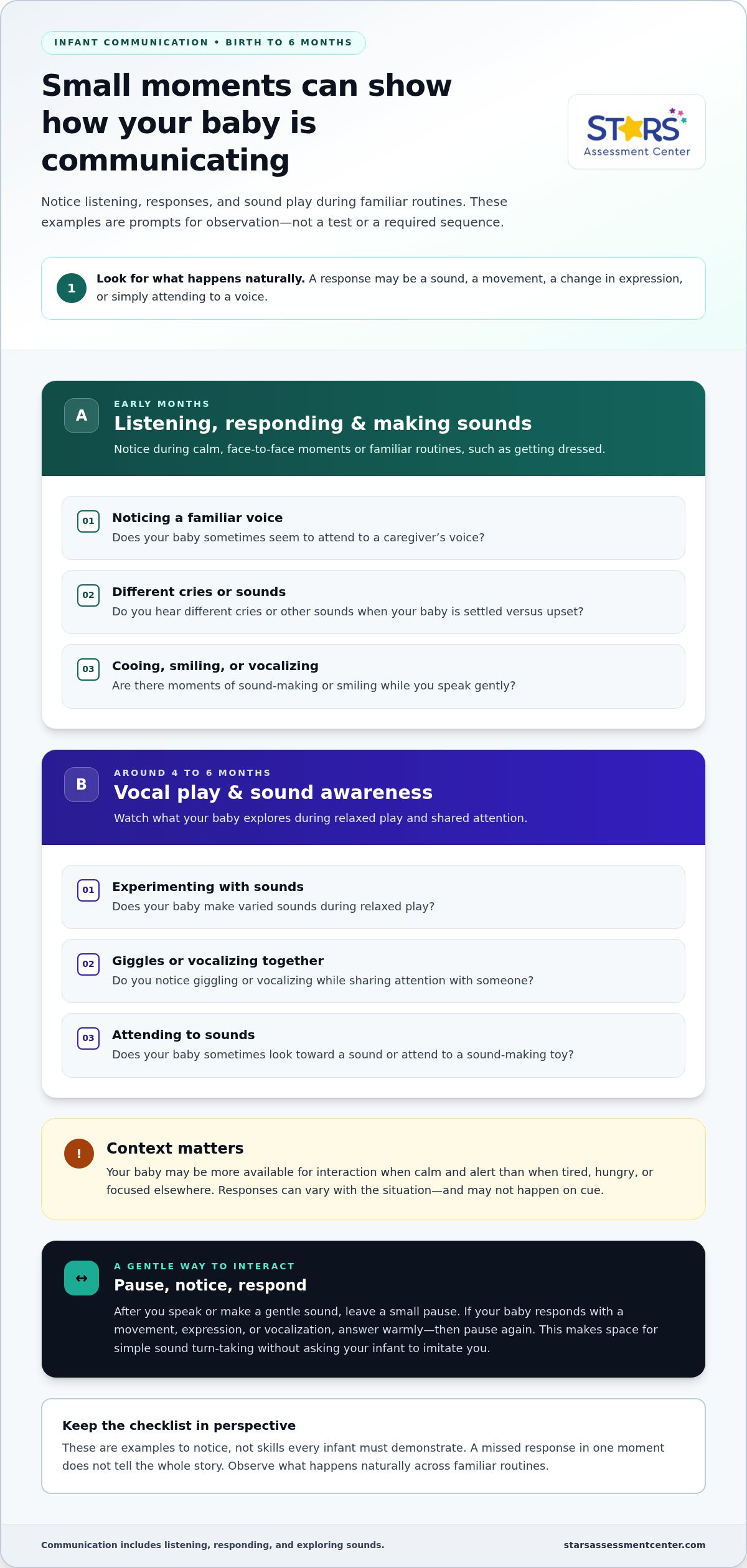
In the first six months, communication is often quiet and subtle. Your baby may not respond the same way every time, and a missed response in one moment does not tell the whole story. Use this checklist to notice what happens during familiar routines, not as a list of skills every infant must demonstrate. These infant speech and language milestones focus on how your baby listens, responds, and explores sounds.
Early communication includes listening, responding, and experimenting with sounds. The examples are possibilities, not a test. For additional age-based guidance, the ASHA Communication Milestones resource offers a reference for observing communication as it develops.
Early months: listening, responding, and making sounds
During calm, face-to-face moments or familiar routines, such as getting dressed, notice whether your baby seems to attend to a caregiver’s voice. A response might be quieting, changing facial expression, or making a sound. A sudden sound may also catch their attention, though responses can differ depending on what else is happening.
- Does your baby sometimes seem to notice a familiar voice?
- Do you hear different cries or other sounds in different states, such as when your baby is settled or upset?
- Are there moments of cooing, smiling, or vocalizing while you speak gently?
These observations do not need to happen on cue. A baby may be more available for interaction when calm and alert than when tired, hungry, or focused elsewhere. Notice what happens naturally instead of repeating a sound or action to see whether your infant responds.
Around 4 to 6 months: vocal play and sound awareness
As your baby grows, you may notice more vocal play during interaction. They might giggle, make varied sounds, or vocalize while you talk or play together. Some infants look toward a sound or show interest in a toy that makes noise. These are examples to watch for, not a required sequence or a promise that every baby will respond alike.
- Does your baby experiment with sounds during relaxed play?
- Do you notice giggling or vocalizing while sharing attention with someone?
- Does your baby sometimes look toward a sound or attend to a sound-making toy?
Try leaving a small pause after you speak or make a gentle sound. If your baby responds with a movement, expression, or vocalization, answer warmly, then pause again. This creates space for simple sound turn-taking without asking your infant to imitate you.
If you have questions about what you’re noticing, Stars Assessment Center offers structured developmental assessments for children under 3 years. Learn about developmental assessment support. This is not a diagnostic assessment. No referral needed. Families can contact Stars directly. Assessment in your preferred language.
7 To 12 Months: Gestures, Babbling, and Understanding
As your baby approaches their first birthday, communication may become more varied. Some messages come through sounds or early words; others show up in gestures, attention, or the way your infant responds to familiar people. These infant speech and language milestones are useful to observe during play and daily routines, not skills to demand on cue. A baby may show a skill in one setting and not another.
Gestures and understanding are communication milestones alongside spoken words. Looking, reaching, and sharing attention can help you notice how your baby is connecting with you, even before words are clear.
Understanding familiar words, voices, and simple requests
Notice whether your baby sometimes looks toward a familiar voice or responds when you say their name. They may also glance toward a familiar person or object when you name it. This does not require a spoken answer. A simple request, such as “give it to me,” may make more sense when you gesture or hold out your hand. These are possible observations, not a test of understanding.
Babbling, gestures, and taking turns
Babbling may include repeated consonant-vowel sounds, such as “ba-ba” or “ma-ma.” Your baby might also try to imitate a sound you make. Reaching, pointing, waving, showing an object, or giving it to you can communicate interest or invite interaction. Responding to these attempts with words, attention, or a gesture lets your baby know you’re engaged.
Use the three categories below to notice communication in context. You might observe something during a meal, play, or a familiar daily activity. Not every example will appear each time.
- Understanding: Your baby sometimes looks toward a voice, responds to their name, or notices a familiar word, person, or object. They may respond to a simple request when the situation or a gesture helps make its meaning clear.
- Sounds or words: You hear repeated babbling, varied sounds, or attempts to copy a sound. Your baby may use a sound consistently to get your attention or share an interest.
- Gestures or interaction: Your baby reaches, points, waves, shows or gives an object, or looks between you and something they want you to notice. They may take turns with sounds or gestures during play.
Try following your baby’s attention. If they point toward a toy, name it and pause. If they babble, answer with a sound or a few words, then give them a moment to respond. A turn can be a look, movement, sound, or gesture; it does not need to be a clear word.
To keep observations practical, note what was happening and how your baby communicated, rather than counting words or repeating prompts. A familiar name might get a response during quiet play but not while your infant is focused on something else. The setting, your baby’s attention, and the gesture or voice you use all help describe the moment. These details can make questions about your child’s communication easier to discuss.
How to Interpret Infant Milestones Without Turning Them Into a Test
A checklist can help you put words to what you’re seeing, but it captures observations at a particular point in time. It cannot account for every interaction or establish a diagnosis. Your infant may communicate differently depending on attention, comfort, who is nearby, or what’s happening around them. Use infant speech and language milestones as prompts for curiosity, not a scorecard.
There’s no need for your child to demonstrate every listed skill at an exact age. One example you have not noticed does not, by itself, explain your child’s development. Rather than repeatedly testing for a response, pay attention to communication as it happens naturally. A pattern across different routines can offer more useful context than a single moment.
When a milestone difference deserves a conversation
If a communication skill remains unclear, seems to change, or you’re concerned about how your infant responds and connects, it’s reasonable to talk through your observations and questions. You do not have to reach a conclusion from a checklist first. Sharing what you’ve noticed can help clarify what support or next step may be appropriate, without assuming that one sign confirms a condition.
If something does not feel right, you do not have to wait for certainty to act. Seeking guidance is a way to understand your child’s development, not a statement that something is wrong.
How to prepare useful observations
Brief notes can make a conversation easier, especially if a behavior happens inconsistently. You do not need a formal log or a tally. Jot down a few examples in your own words and include the situation, so someone supporting your family can understand what you mean.
- Sounds: Note vocal play, babbling, or sounds your infant uses to get your attention, and what was happening at the time.
- Gestures and interaction: Record gestures such as reaching, pointing, waving, or showing, along with how others responded.
- Responses and understanding: Describe what you notice when your baby hears a familiar voice or word, including whether a gesture or the setting seemed to help.
- Your questions: Write down concerns about hearing, interaction, or understanding in the words you naturally use.
These notes aren’t a way to grade your child. They’re a memory aid that can help you describe repeated patterns, differences across settings, and questions you’d like answered. If you’re looking for context on what a speech evaluation may involve, the Santa Clara County Toddler Speech Evaluation Guide may help you prepare for that conversation.
For families who want help understanding observed development, Stars Assessment Center provides structured, play-based developmental assessments for children under 3 years. Results are explained in clear, simple language. Learn about a developmental assessment. No referral needed. Families can contact Stars directly. Assessment in your preferred language.
A Supportive Next Step: Infant Developmental Assessment at Stars
If you have questions after observing your baby’s communication, an assessment can offer a fuller picture of development and help you consider next steps. Stars Assessment Center provides structured, play-based developmental assessments for children under 3 years. The process is child-led and paced to the child’s age and attention. Parents are present throughout, and activities adapt to the child’s comfort and attention.
The assessment considers six areas: speech and language, cognitive, motor, social-emotional, adaptive, vision and hearing screening. Results are explained in clear, simple language so families can understand what was observed and discuss possible next steps. No cost to families. Assessment in your preferred language.
What happens during a Stars developmental assessment?
The steps provide a general sense of how the process moves from family questions to a discussion of observations. Each assessment is structured and paced to the child, and its length depends on the child’s age and attention.
- Initial consultation: Share what you’ve noticed and the questions you’d like to explore.
- Developmental review: Discuss your child’s development and relevant observations from everyday routines.
- Structured assessment: A child-led, play-based process explores the six developmental areas listed above.
- Parent discussion: Talk through the observations with your child present throughout the assessment.
- Next-step guidance: Review the results together and discuss possible next steps in clear, simple language.
Families who want to learn more about how developmental screening can support conversations about a child’s growth may also find Early Childhood Developmental Screening: A Parent’s Guide to Growth and Support useful. Screening and an assessment can help families understand development; neither turns a checklist into a diagnosis.
Local access and what families can expect next
Stars Assessment Center serves families in Santa Clara County, Santa Cruz County, and San Benito County. Families reading in San Jose, Santa Clara, Santa Cruz, Salinas, Milpitas, Gilroy, and Morgan Hill can use this checklist to notice questions about their child’s development. No referral needed. Families can contact Stars directly by calling (844) 700-9889 or using the online request form.
The assessment may help inform eligibility for Early Start, a program for infants and toddlers with developmental delays or disabilities. An assessment does not guarantee eligibility. Early Start developmental assessments are provided at no cost to families. Stars Assessment Center is located at 6910 Santa Teresa Blvd., Suite 200, San Jose, CA.
Milestone lists can help you notice questions about infant speech and language milestones, while an assessment looks at a broader picture of your child’s observed development.
Take the Next Step With Confidence
You do not need to have every answer before asking for support. Your observations and questions are a meaningful place to begin, and a conversation can help you decide what would feel helpful for your family. If you’re still wondering about your child’s infant speech and language milestones, you can take a next step at a pace that feels right.
Stars Assessment Center offers developmental assessments for children under 3 years through a child-led, play-based process, with parents present throughout. No cost to families. Assessment in your preferred language, with results explained in clear, simple language. It can help you understand observed development and discuss possible next steps.
You know your child in a way no checklist can capture. Trust what you notice, and remember that seeking guidance is a caring step forward.
Frequently Asked Questions
Is it normal for infants to reach speech and language milestones at different times?
Yes. Infants can develop communication abilities on different timelines, and infant speech and language milestones are guides rather than deadlines. One skill, such as responding to a familiar sound, may be easier to notice than another. Look for patterns across routines and interactions instead of judging one moment alone. If a concern continues, seek individualized guidance; a checklist can’t determine whether an infant has a developmental delay.
Can an infant communicate before saying recognizable words?
Yes. An infant can communicate before recognizable words emerge. A coo, facial expression, reaching toward a caregiver, or looking between a person and a toy may convey attention or interest. These are examples, not skills every child must show in the same way. Notice exchanges during routines, such as a diaper change or play. If something concerns you, share what you’ve observed and ask for guidance.
How can I encourage my infant’s speech and language development during the day?
Build communication into things you already do. Talk gently as you prepare a bottle or get your baby dressed, respond to a sound or gesture, then pause to leave room for a reply. Share a simple book by naming a picture, or sing a familiar song together. Keep these moments enjoyable, not like lessons. They support interaction, but do not replace individualized assessment if you have concerns.
What is the difference between speech and language in infants?
Speech is the production of sounds and, later, words. Language is understanding and communicating meaning. Before clear words emerge, an infant’s communication may include listening, vocal sounds, gestures, and responses to people or familiar routines. For example, a baby might make a sound to continue an interaction. A checklist can help you describe what you notice, but it can’t determine whether a child has a developmental delay.
Can hearing affect how an infant responds to speech and sounds?
Hearing is relevant to how an infant notices voices and other sounds, but a milestone checklist can’t assess hearing. If you’re concerned because your baby’s responses seem inconsistent or unclear, note what you observed and the setting, then share those details with someone who can discuss your questions. A single behavior doesn’t prove a hearing problem. Your questions are worth discussing, even if you’re unsure what an observation means.
Does a speech and language assessment diagnose a developmental condition?
Stars Assessment Center’s developmental assessment observes areas including speech and language to help families understand observed development and discuss possible next steps. No referral needed. Families can contact Stars directly to request an assessment for their child under 3 years.
Do I need a referral to request an assessment at Stars?
No referral needed. Families can contact Stars directly. Assessments are for children under 3 years in Santa Clara, Santa Cruz, and San Benito counties. No cost to families. Assessment in your preferred language. Requesting an assessment is optional and does not guarantee eligibility for any program. Families can reach out when they have questions, without needing to decide on their own what an observation means. Request an assessment for your child, or call (844) 700-9889.


