

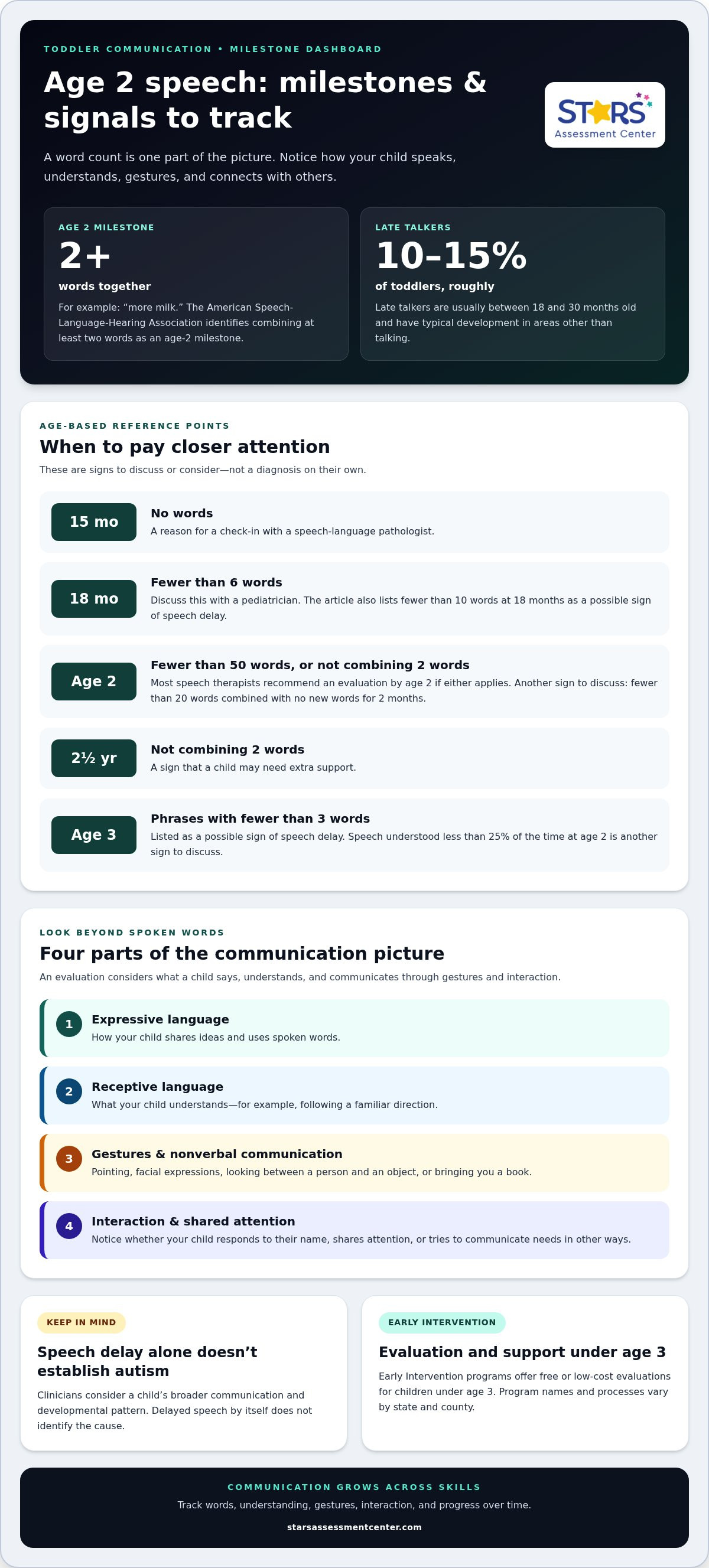
Not talking at age 2 is a reason to pay attention, even though children develop language at different rates. If you’re wondering, “is it normal for a 2 year old not to talk,” the key milestone is whether your child is beginning to put words together: according to the American Speech-Language-Hearing Association, children at age 2 should say at least two words together, such as “more milk.”
It’s understandable to feel concerned when your toddler isn’t using many words, especially when you’re comparing their progress with other children. A difference in speech doesn’t, by itself, tell you why a child is communicating less, but noticing the signs and seeking guidance can help you understand what support may be useful.
This article explains typical speech milestones around age 2, what may distinguish a late talker from a child who needs further evaluation, and how communication signs can relate to broader development, including autism. You’ll also find practical ways to encourage talking at home and learn when an assessment may help clarify your next steps.
Key Takeaways
- Compare your child’s communication with age-based milestones, including how they understand language as well as the words they say.
- Look at the broader pattern of communication and development, not speech alone, when deciding whether to seek guidance.
- Everyday routines, shared books, and responsive conversation can create more opportunities for your toddler to communicate.
- Notice how your child uses gestures, shares attention, and connects with others alongside their speech development.
- A professional assessment can help clarify your child’s strengths and communication needs, and identify a useful next step.
Is Your Child a Late Talker, or Is It Something More?
A late talker is usually between 18 and 30 months old and has typical development in areas other than talking. Roughly 10-15% of toddlers are late talkers. Some begin catching up by age 3, but a child’s progress can vary. Not combining two words by about two and a half years of age is a sign they may need extra support.
How is speech delay evaluated in toddlers? An evaluation considers what a child says, understands, and communicates through gestures and interaction. A speech-language pathologist may ask parents about development and observe the child during play. Most speech therapists recommend an evaluation by age 2 if a child doesn’t use at least 50 words or combine two words into phrases. At 15 months, having no words is a reason for a check-in with a speech-language pathologist; at 18 months, fewer than six words should be discussed with a pediatrician.
Early Intervention can help families of children under age 3 access evaluations and support. These programs offer free or low-cost evaluations for children under age 3. An evaluation can clarify whether a child’s communication needs attention and what support may fit. It also looks beyond a word count, helping distinguish an expressive language concern, difficulty using words, from receptive language concerns, difficulty understanding what others say.
Parents can look for Early Intervention or toddler learning programs available in their state or county. In the United States, local program names and processes vary, so families can start with their county’s early childhood or public health services. Private insurance coverage depends on the plan and the service; an Early Intervention evaluation and private speech services may have different coverage rules. A family can review its plan’s speech and developmental assessment benefits to understand those distinctions.
Early support gives parents clearer information and practical ways to encourage communication during daily routines. For example, an evaluator may help a family notice whether a toddler points, responds to simple directions, or tries to communicate needs without words. These observations can guide next steps and help track progress over time. Speech delay alone doesn’t establish autism; clinicians consider a child’s broader communication and developmental pattern. Many late-talking children may not catch up by age 5 without support from a speech therapist, so discussing concerns early can help families understand their options.
What is a speech delay?
A speech delay means a child’s spoken communication is developing differently than expected for their age. Looking at both talking and understanding helps show which skills may need attention.
Expressive and Receptive Language Delays
Expressive language is how a child shares ideas, while receptive language is what they understand. A toddler may use few spoken words yet understand familiar requests, or may also have difficulty following what others say.
These patterns matter because speech and language are related but distinct skills. For example, a child who points toward a cup and follows “bring me your shoes” communicates and understands in ways a word count alone won’t capture. An assessment considers both.
Signs of Speech Delay
Possible signs include fewer than 10 words at 18 months, speech understood less than 25% of the time at age 2, or phrases with fewer than 3 words at age 3. By 18 months, toddlers usually use words with purpose, such as calling for a parent or asking for a familiar item.
Progress over time also matters. Fewer than 20 words at age 2, combined with no new words for two months, may signal a need to discuss development. Notice whether your child uses gestures, responds to simple directions, or tries new ways to communicate. These examples help describe strengths and concerns clearly.
Possible Causes of Delayed Talking
There isn’t one explanation for every speech delay. A child may have more difficulty expressing words, understanding language, or developing communication alongside other skills. Autism may also involve communication differences, but delayed speech alone doesn’t identify the cause.
That’s why an evaluation looks at the whole communication picture, not just how many words a child says. Parents can share examples from home, such as whether their child follows familiar directions or uses gestures to request help. A medical professional may use those observations alongside developmental history to decide what further assessment could clarify.
Speech and language skills can develop unevenly, so the difference between understanding and speaking is useful information. If you’re concerned, discuss your child’s communication and progress with their pediatrician; an assessment can help identify which skills need support.
What Are Typical Speech Milestones at Age 2?
At age 2, communication includes spoken words, understanding, gestures, and shared attention. Milestones offer a guide, while a child’s skills may vary across these areas.
Nonverbal Communication and Pre-Language Skills
Nonverbal communication includes gestures, facial expressions, pointing, and looking between a person and an object. These skills show how a toddler shares attention and communicates needs, even before using many spoken words.
Notice what happens during familiar routines. Your child might point to a snack, bring you a book, or look toward a named toy. Also observe whether they respond to their name and follow simple directions. These examples help describe communication beyond spoken language.
By age 2, children should say at least two words together, such as “more milk,” according to the American Speech-Language-Hearing Association. A milestone checklist is a starting point, not a complete picture. Gestures and attempts to connect can provide useful context when discussing your child’s communication.
Understanding and Using Language
Receptive language is what a child understands, while expressive language is what they communicate through words and other forms. Comparing both helps show whether a toddler understands more than they can say or has difficulty with both skills.
For instance, a child may follow “get your shoes” but use few spoken words. Another may say familiar names yet struggle to follow simple directions. At age 2, many children know around 50-100 words, and parents understand their speech about 50% of the time. These milestones help frame observations, rather than define a child by one skill.
A speech and language evaluation can assess how a child understands and uses language, including speech, gestures, and interaction. A multidisciplinary developmental assessment considers development across several areas, including speech and language, cognitive, motor, social-emotional, adaptive, vision and hearing screening. This can help clarify which skills may need support.
Consider an evaluation if your 2-year-old isn’t combining words, uses few words, or has difficulty understanding familiar directions. Discussing these observations with your pediatrician can help identify an appropriate next step. Early Intervention programs offer free or low-cost evaluations for children under age 3. Parents can look into programs available in their state or county, especially when communication concerns affect daily routines.
At-home strategies to encourage talking
A toddler may talk less for different reasons, including differences in communication development or skills that need closer assessment. Autism can involve communication differences, but delayed talking alone doesn’t establish autism. An assessment can help families understand a child’s development and possible next steps. This is not a diagnostic assessment.
Should a 2-year-old who is not talking have a hearing test? Discuss hearing with your pediatrician, since hearing is relevant to how children learn speech and language. The pediatrician can consider your child’s communication and medical history when deciding whether hearing assessment is an appropriate next step.
At home, create easy, low-pressure chances for your toddler to communicate. During a snack, pause before handing over the cup and give your child time to gesture, vocalize, or try a word. Respond warmly to any attempt, then model a short phrase such as “more water.” This connects sounds and words with what your child wants.
- Follow your child’s focus. If they point to a dog, say “dog” or “big dog,” then pause for a response.
- Add words to play. During blocks, describe one action at a time: “up,” “block up,” or “fall down.”
- Offer simple choices. Hold up two snacks and name each one, giving your toddler time to point or answer.
- Share a book. Reading one book a day exposes children to 78,000 extra words per year. Pause at a picture and name what you see.
- Use daily routines. During dressing, say “sock on” or “shoes off,” pairing words with actions your child can see.
These moments support learning, but they don’t replace an assessment when communication concerns persist. Keep brief notes about new words, sounds, gestures, and how your child responds to directions. For example, record whether your toddler tried a new word during play or followed a familiar request. Specific examples can make an assessment more useful.
Share any concerns about autism or other developmental differences directly with the pediatrician. Parents may notice developmental differences six months or more before professionals confirm them. Describe what you see in everyday settings, such as how your child communicates during play or responds when you call. Early discussion can help clarify which assessment or support may be appropriate, including speech therapy when indicated.
Autism and communication signs
A language delay can have different explanations, and limited speech alone doesn’t identify autism. A fuller picture includes how a child communicates, connects with people, and responds during everyday interactions.
Notice patterns during play, meals, and other familiar routines. Does your child point to share something interesting, look toward you when you speak, or use gestures to get help? Do they respond to their name or take turns in a simple game? These observations don’t diagnose a disorder, but they give useful details to discuss in an assessment.
Communication is more than vocabulary. Consider whether your child combines sounds, gestures, facial expressions, and words to express a need or share attention. A toddler might bring you a toy but not look toward you, or guide your hand toward a snack instead of pointing. One example alone doesn’t explain a child’s development; repeated patterns across situations offer more context.
Other developmental differences can appear alongside a language delay. Notice whether your child shows interest in interacting, imitates simple actions, or adjusts communication during play. These examples can help show whether concerns focus mainly on spoken language or involve broader development. Autism is one possibility to explore, not a conclusion based on late talking alone.
Parents may notice developmental differences six months or more before professionals confirm them. Keeping brief notes can make those observations easier to share. Record what happened, where it happened, and how your child responded. For instance, write down whether your toddler looked toward you after pointing at a toy, followed a familiar direction, or tried to get your attention another way.
A speech-language pathologist can assess communication and language skills, while a broader developmental assessment can consider a child’s development across areas. Parents can discuss concerns with their pediatrician and describe specific examples rather than relying only on a word count. If autism is a concern, an autism-focused assessment can help clarify the child’s developmental profile and support needs.
Early discussion can help families understand the next steps, whether the concern involves speech, social communication, or both. A child may catch up in vocabulary, but continued attention to communication patterns remains useful. If you’re seeing differences beyond talking, explore an autism assessment to learn how a developmental evaluation can help clarify your child’s needs.
Stars Assessment Program: Social-Emotional Assessment
Stars Assessment Program offers a Social-Emotional Assessment to help families understand a child’s social-emotional development and interactions. If limited talking occurs alongside concerns about connection, shared attention, or emotional development, an assessment can offer a broader view of your child’s strengths and needs.
A Speech and Language Evaluation focuses on communication skills, while a Multidisciplinary Developmental Assessment considers development across several areas. Stars Assessment Program also offers Autism assessment. These options can help families understand what developmental information may be useful when speech milestones or communication signs raise questions.
You don’t need to wait until every concern is clear before seeking guidance. Contact Stars Assessment Program to discuss an assessment for your child.
Choose a Clear Next Step for Your Child
If you’re still wondering whether it is normal for a 2 year old not to talk, let that concern be a reason to seek clarity, not a judgment about your child or your parenting. You can bring questions, everyday observations, and the communication moments that feel important. A thoughtful assessment can help turn those observations into a clearer understanding of your child’s strengths and support needs.
Stars Assessment Program offers a Speech and Language Evaluation, Multidisciplinary Developmental Assessment, and Social-Emotional Assessment. The right focus depends on the questions you want help answering, whether they involve spoken communication, broader developmental skills, or social-emotional development. An assessment is a way to better understand your child, not a label that defines them. Results are explained in clear, simple language. This is not a diagnostic assessment.
When you’re ready to discuss what you’ve noticed, contact Stars Assessment Program. You’re taking a caring step toward understanding how to support your child’s communication and growth.
Frequently Asked Questions
Why is my 2-year-old or 3-year-old not talking?
Children may talk later for different reasons, and an age milestone alone can’t identify the cause. A child may have difficulty expressing words, understanding language, or communicating in ways that affect several developmental areas. For example, one toddler may understand familiar routines but use few spoken words, while another may also struggle to follow directions. Sharing specific observations with a pediatrician can help clarify what to assess.
When do children usually start talking?
Most babies say their first words around 12 months, but early language grows gradually rather than appearing all at once. A first word might be “up” when a child wants to be picked up or “ball” while playing. By age 2, communication typically includes combining words, and by age 3, children often use short sentences. If progress concerns you, note how your child communicates across familiar routines.
How do I know if my toddler needs speech therapy?
A Speech and Language Evaluation can help describe your toddler’s communication skills and areas that may need support. Consider requesting an assessment if your child isn’t combining words, seems to understand fewer familiar directions, or has stopped adding new words. Bring examples from home, such as how your child asks for a snack or responds to a familiar request. An assessment helps describe developmental needs; it isn’t therapy or a diagnostic assessment.
Is it normal for a 2-year-old not to talk?
Some children speak later than others, but a 2-year-old who isn’t using words or combining them should receive attention rather than being dismissed as simply “a late bloomer.” According to the American Speech-Language-Hearing Association, children at age 2 should say at least two words together, such as “more milk.” A discussion with your pediatrician can help you decide whether an evaluation would clarify your child’s communication development.
Reassure or Act?
Offer your child warmth and connection, and act on concerns by gathering useful details. Write down words your toddler uses, gestures they rely on, and examples of directions they understand. Note whether they ask for help by pointing or bring you an object to continue a game. These observations can help focus an assessment on your child’s everyday communication.
Should I Wait and Watch or Take Action Now?
If a communication milestone is concerning you, take action by raising it with your child’s pediatrician rather than waiting for certainty. A conversation doesn’t label your child; it helps identify what information or assessment could be useful. If your child is under age 3, you can also look into Early Intervention evaluations available through programs in your state or county. Keep supporting communication at home while you seek guidance.
How many words should a 2-year-old say?
Many children know around 50-100 words by age 2, but the number is only one part of communication. Consider whether your toddler uses words to share needs, name familiar things, or respond during play. A child might say “ball” to request a toy, for example. If you’re unsure how to count words your child uses, record examples and discuss them with your pediatrician.
What language milestones should a 2-year-old meet?
At age 2, children should say at least two words together, according to the American Speech-Language-Hearing Association. Also consider how your toddler understands everyday language, uses gestures, and communicates during play or routines. For example, notice whether they follow a familiar direction or use a word with a gesture to make a request. Looking across these skills gives a fuller picture than counting spoken words alone.


