
A screening can flag concerns involving speech or language, learning, autism, hearing or vision, ADHD, and social or emotional development. A child development evaluation in Milpitas can take a closer look at a child’s communication, behavior, movement, and other developmental skills. Screening can point to areas that may need attention, but it doesn’t diagnose a condition.
It’s understandable to wonder whether a difference you’ve noticed is part of your child’s individual pace or a sign they could use support. The American Academy of Pediatrics recommends developmental screening at 9 months, 18 months, and 24 to 30 months, and parents can raise concerns at other times too. This guide explains what screening can identify, how an evaluation works, and what factors shape the process.
You’ll also learn how to understand the findings and what next steps may help your family move forward with greater clarity and confidence.
Key Takeaways
- Learn how developmental monitoring differs from screening, and what each can tell you about your child’s growth.
- According to the California Department of Developmental Services, California DDS coordinates Early Start through 21 community-based regional centers that assess eligibility, provide case management, and arrange services.
- Bring your observations from home and share what you notice about your child’s communication, behavior, and everyday routines to support a clearer evaluation.
- Understand how developmental concerns may be assessed across multiple areas, including social-emotional development and communication.
- See how an autism spectrum disorder evaluation can help clarify concerns and guide families toward appropriate next steps.
Child psychological assessment
A child psychological assessment looks at how emotions, behavior, communication, and daily activities affect a child’s development. In Milpitas, an evaluation may be considered for infants and toddlers through age three, or when concerns involve language, movement, thinking, behavior, or emotional development.
Families may request an assessment if a child is not using expected communication skills, has difficulty connecting with others, or becomes distressed during familiar activities. Share specific examples, such as a toddler rarely responding to their name or becoming upset when routines change. This is not a diagnostic assessment; it helps identify developmental areas that may need support.
Developmental Consultations and Assessments
A developmental assessment considers what happens at home, during play, and in social situations. Before the visit, note when a behavior occurs, what happens beforehand, and how your child responds. If your child speaks at home but not in certain settings, record where speech happens and where it stops.
If you have concerns about anxiety or selective mutism, describe your child’s communication, emotional responses, and the situations that affect participation. The assessment considers how your child functions across activities, rather than treating one quiet moment as a diagnosis.
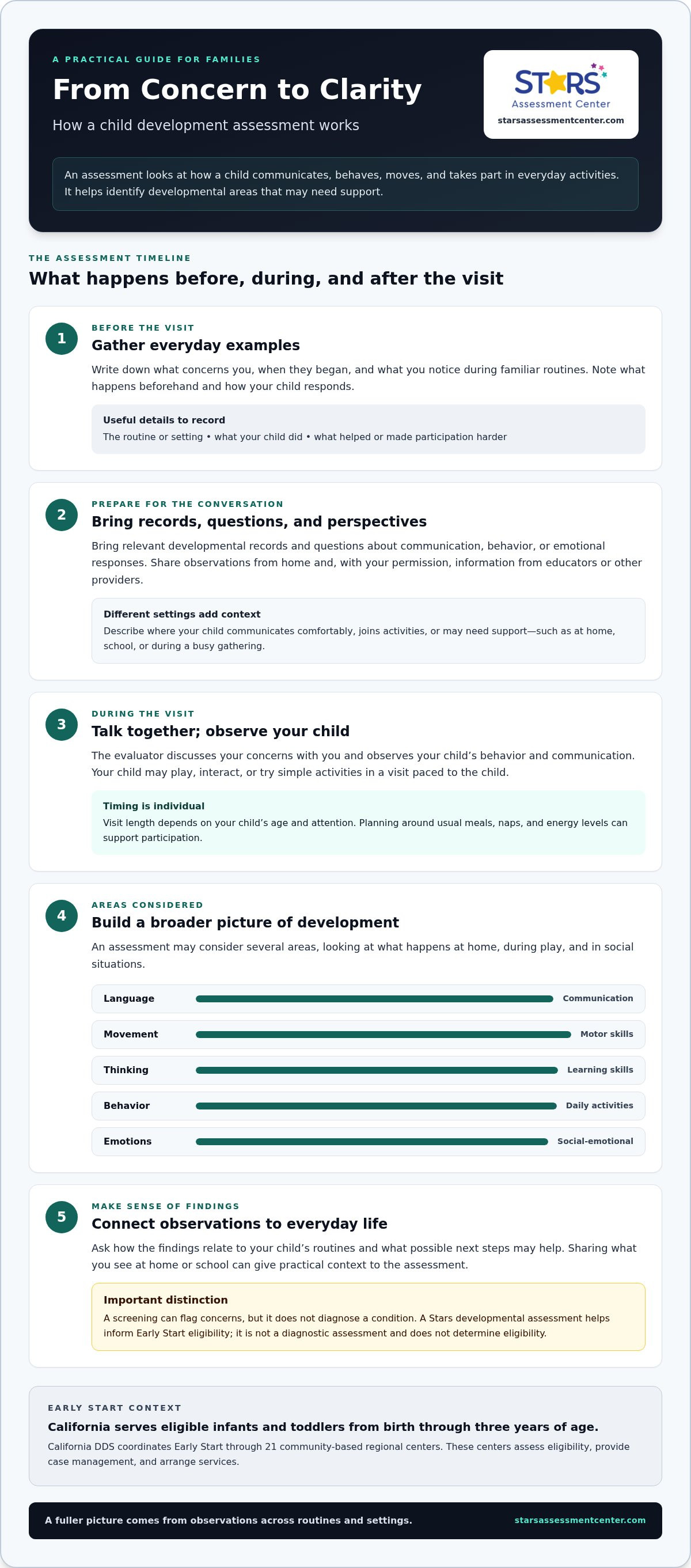
Assessment areas may include language, movement, thinking, behavior, and emotions. California’s Early Start system serves eligible infants and toddlers from birth through three years of age and their families, according to the California Department of Developmental Services. California DDS coordinates Early Start services through 21 community-based regional centers, which assess eligibility, provide case management, and arrange services, according to the California Department of Developmental Services.
Assessment Process and Appointment Timing
Before the assessment, write down your concerns, when they began, and examples from everyday activities. Bring relevant developmental records and questions about communication, behavior, or emotional responses. These details help the evaluator understand what your child does during familiar routines, not only during the visit.
The assessment includes discussion with you and observation of your child’s behavior and communication. Your child may play, interact, or try simple activities while the evaluator observes. The visit is structured and paced to the child, and its length depends on the child’s age and attention. Planning around usual meals, naps, and energy levels can support participation.
Stars Assessment Program’s developmental assessment helps inform eligibility for Early Start, a program that provides developmental services to eligible children. The assessment is not a diagnostic assessment and does not determine eligibility. Families can describe their concerns and ask how the findings relate to their child’s everyday routines and possible next steps.
Coordination with parents, schools, and providers
Parents and caregivers see children across everyday routines, while educators may observe different activities in childcare or school settings. Sharing these perspectives can clarify where a child communicates comfortably, joins activities, or may need support. In Santa Clara County, families can request an assessment from Stars Assessment Center to better understand their child’s development and next steps.
Your observations are valuable throughout the assessment. You might describe how your child signals for food, responds to familiar voices, or explores toys at home. If an educator has noticed different communication during group activities, share that too. Observations across settings give the assessment practical context, rather than relying only on what happens during the visit.
Before an assessment, prepare a brief record of what you see. Include the routine, what your child did, and what helped or made participation harder. For example, note whether your child follows a familiar direction during play, meals, or a transition. If another caregiver has a different observation, include it. Differences across settings can help build a fuller picture of your child’s development.
- Share examples of communication, play, movement, and interactions with other children.
- Describe the settings where a behavior occurs, such as home, school, or a busy gathering.
- Bring questions about how an evaluation’s findings relate to everyday learning.
With your permission, information from an educator or another provider can help connect observations across settings. Share relevant examples and explain which routines matter most to your family. A teacher’s note about difficulty joining a group activity, alongside your account of successful play at home, can show how context affects participation.
Home support works best when it fits naturally into the family’s day. A caregiver can pause during a familiar game to give a child time to request a turn, or name objects during dressing and meals. Follow recommendations that match the child’s assessed needs, and share what happens during those activities. That feedback helps parents and providers adjust strategies around real routines.
Coordination doesn’t require parents to become specialists. It means sharing what they notice, asking how findings apply at home or school, and agreeing on practical next steps. Families seeking a clearer picture of developmental needs can explore developmental assessment support as one way to connect observations with an evaluation.
Potential developmental delays and behavioral concerns
Developmental concerns can involve speech and language, cognitive skills, motor skills, social-emotional development, adaptive skills, or vision and hearing. A child may have difficulty expressing needs, following directions, joining play, or managing transitions. These examples help you describe what you observe, but this is not a diagnostic assessment.
The American Academy of Pediatrics recommends developmental screening at 18 months and again at 24 to 30 months. Screening may use standardized tools and observations to assess speech, behavior, and motor skills. It can flag potential concerns related to language, autism, hearing or vision, ADHD, learning disabilities, or social-emotional development. If a child struggles to use words during play or has difficulty with simple movements, share those examples during an evaluation.
A developmental assessment looks at how skills appear in daily life. The evaluator may observe how your child communicates, responds to instructions, moves during play, and interacts with others. Explain whether your concerns occur at home, in childcare, or in both settings. Examples from educators can add context to your observations of everyday routines.
Social-emotional development is one of the assessment areas. Consider whether your child seeks interaction, responds to other children, shares interest, or becomes distressed during changes in routine. Describe what happens before and after, such as whether a transition away from a preferred activity leads to crying or withdrawal. These details help show whether you are noticing a recurring pattern or an isolated moment.
A multidisciplinary developmental assessment considers your observations alongside your child’s developmental history and skills. The aim is to understand how your child is developing and what next steps may be helpful. You can ask how the findings relate to communication, movement, behavior, and participation in everyday activities.
Support plans may include speech, occupational, physical, or behavioral therapy, depending on the child’s needs. These approaches address different skills: speech support focuses on communication, while physical therapy may address movement. Occupational therapy may support participation in everyday activities, and behavioral therapy may target specific behaviors. The assessment findings help shape which supports are appropriate.
- Record examples of communication, movement, play, and social interaction.
- Note where concerns occur, such as at home, during play, or in education settings.
- Ask how the evaluation findings connect to your child’s daily activities and support needs.
Agency addresses and contact information
Families in Milpitas can begin by identifying whether their concerns relate to early development, school participation, or both. Local early intervention programs serve children with diverse needs, including developmental delays, communication challenges, sensory concerns, and motor impairments. Naming the concern clearly can help families navigate the right conversation.
Early development support often involves a collaborative effort among local regional centers, specialized developmental clinics, and community agencies. These organizations contribute to a coordinated local system of care. When preparing to contact an agency for a child development evaluation Milpitas, write down the child’s age, the specific concern, and examples from home or childcare.
For local early learning and development inquiries, families can connect with community resource coordinators to discuss their child's needs. Use the initial conversation to explain your concerns and ask which program or developmental specialist is relevant. For example, describe whether the question concerns communication, motor skills, or participation in everyday activities.
Before making a call, organize the details that will help explain the situation:
- Write a short description of the developmental or behavioral concern.
- Note examples from home, childcare, or other familiar settings.
- List questions about assessment steps, eligibility, or recommendations.
- Keep any screening results or developmental records nearby.
You do not need technical language to explain what you have noticed. For example, you might say your child rarely uses gestures to request a favorite toy, or that transitions to meals regularly lead to distress. Concrete examples give the evaluation a clearer starting point than a broad description such as “development seems behind.”
For questions about early intervention programs, identify local regional centers and specialized evaluators as partners in the county support network. Explain whether the child has an existing assessment, whether concerns involve a developmental delay, and what guidance the family needs next. Keep a record of whom you spoke with and any recommendations or next steps discussed.
Concerns about participation may involve classroom routines, communication with peers, or access to activities. Write down one example from childcare or school and one from home, then share both when describing your concern. This comparison can show whether a difficulty appears in one setting or across daily routines.
A contact conversation is most useful when it ends with a clear understanding of the next step, such as identifying the relevant program or preparing information for a comprehensive evaluation through the Stars Assessment Program. Keeping contact details, examples, and recommendations together can make follow-up easier for families managing several concerns.
Autism spectrum disorder evaluation
An autism assessment considers a child’s communication, behavior, and social interaction as part of their development. It looks at how these skills appear during everyday activities, not just in one moment. You might describe how your child shares attention during play, responds to familiar words, or handles a change in routine. These details help clarify which areas may need closer attention.
Screening can identify a possible concern, while a fuller evaluation examines the child’s pattern of development. Screening alone doesn’t diagnose autism. An evaluation may include caregiver discussion, observation, and structured activities that show how the child communicates and responds. Families can prepare by noting examples from play, meals, childcare, and other familiar settings.
Context matters. Your child might use gestures with a familiar caregiver but communicate differently in a new setting. Another child may enjoy a repeated activity yet find transitions difficult. Share what happens before and after these moments, and whether the pattern appears across settings. This helps the evaluator understand your child’s strengths and support needs without focusing on a single behavior.
Assessment findings can describe your child’s developmental skills and areas where support may help. You may want to understand how communication relates to social connection or how emotional responses affect daily routines. Ask the evaluator to explain each finding in clear, simple language, including what it could mean during play, learning, or family activities.
Evaluation and intervention are distinct steps. An assessment helps clarify concerns; an individualized support plan uses the findings to address the child’s needs. For instance, communication-focused support may be relevant when a child has difficulty expressing choices, while social-emotional support may address participation and emotional responses. Recommendations should connect to the child’s observed skills and everyday growth.
You can make the assessment more informative by bringing specific questions and examples. Describe a situation where your child connects easily with someone familiar, then explain what changes around unfamiliar people or group activities. Include your child’s interests, successful routines, and ways of communicating. Strengths provide useful context alongside concerns.
If autism-related concerns are prompting your next step, explore autism evaluation support to learn how an assessment can help clarify your child’s developmental profile.
Stars Assessment Program: Social-Emotional Assessment
Stars Assessment Center offers social-emotional assessments to help families understand concerns about a child’s emotions, behavior, and interactions. Consider requesting an assessment if these concerns affect everyday routines or make it difficult for your child to connect with others.
For a broader view, a multidisciplinary developmental assessment considers development across the assessment areas, while a speech and language evaluation focuses on communication. Stars Assessment Center also offers autism screening. These assessments help families explore specific questions about their child’s development and understand possible next steps.
If you’re ready to discuss your child’s developmental or social-emotional concerns, contact Stars Assessment Program.
Take the Next Step With Clarity
If you are considering a child development evaluation in Milpitas, start by identifying the questions you most want answered, such as how your child communicates, manages emotions, or connects with others. Those priorities can help focus a discussion on your child’s needs and everyday experiences.
Stars Assessment Program offers Social-Emotional Assessment, Multidisciplinary Developmental Assessment, and Speech and Language Evaluation. These options address different areas of development, so families can focus on the concerns most relevant to their child. Bringing a few examples from daily routines can help make the next conversation more specific and useful.
When you’re ready to discuss your child’s developmental concerns, contact Stars Assessment Program. Taking one thoughtful step can make the path ahead feel more manageable, and your observations are a valuable place to begin.
Frequently Asked Questions
What conditions can developmental screening identify?
Developmental screening can flag possible concerns involving speech or language, learning, autism, hearing or vision, ADHD, and social-emotional development. It identifies areas that may benefit from closer evaluation; it doesn’t diagnose a condition. For example, a parent might mention that a child rarely uses gestures to communicate or struggles to join play. Those specific observations can help clarify what to explore next.
What if my child is anxious about the testing session?
Tell the evaluator what tends to worry your child, such as an unfamiliar room or a new adult. At Stars Assessment Center, assessments are structured, play-based, flexible, and child-led, with parents present throughout. Activities can be adjusted if your child is uncomfortable or does not cooperate. The visit is paced to the child, and its length depends on the child’s age and attention.
Why consider professional assessment services?
A professional developmental assessment can help families understand a child’s skills and identify areas to discuss further. For children under 3 years, assessment areas include speech and language, cognitive, motor, social-emotional, adaptive, vision and hearing screening. Stars Assessment Program explains results in clear, simple language. This is not a diagnostic assessment, but the findings can help families understand development and consider appropriate next steps.
Where can I get a child development evaluation in Milpitas, CA?
Families seeking a child development evaluation in Milpitas can contact Stars Assessment Program, which serves families in Santa Clara County. Assessments are for children under 3 years, and no referral is needed. The assessment is provided at no cost to families. The center’s physical address is 6910 Santa Teresa Blvd., Suite 200, San Jose, CA. Call (844) 700-9889 to discuss scheduling.
Which Milpitas providers offer developmental evaluations for infants and children?
Stars Assessment Program offers developmental assessments for infants and children under 3 years in Santa Clara County, including families in Milpitas. Its evaluations can consider communication, cognitive, motor, social-emotional, adaptive, and vision and hearing screening areas. Families can contact Stars directly without a referral. Assessment in your preferred language is available, and results are explained in clear, simple language.
How can I get an early intervention evaluation for a child under age 3 in Milpitas?
Contact Stars Assessment Program directly to request an assessment for a child under 3 years. No referral is needed. The assessment may help inform eligibility for the Early Start program, and Early Start developmental assessments are provided at no cost to families. An assessment doesn’t guarantee eligibility. Families can call (844) 700-9889 and share their main concerns when discussing the next step.
What documents and referrals are needed to schedule a child development evaluation?
No referral needed. Families can contact Stars directly. To make the conversation useful, gather any developmental records or screening results you already have, plus notes describing what you’ve noticed. For example, write down a communication concern and when it happens, such as during meals or play. These details help explain your questions; the assessment is available for children under 3 years.
How long are wait times for developmental evaluations near Milpitas?
Scheduling depends on appointment availability and the assessment being requested, so families can call Stars Assessment Program at (844) 700-9889 to discuss arranging an evaluation. The assessment visit itself is structured and paced to the child, and its length depends on the child’s age and attention. Parents remain present throughout, and activities can be adjusted to support the child’s comfort.


