

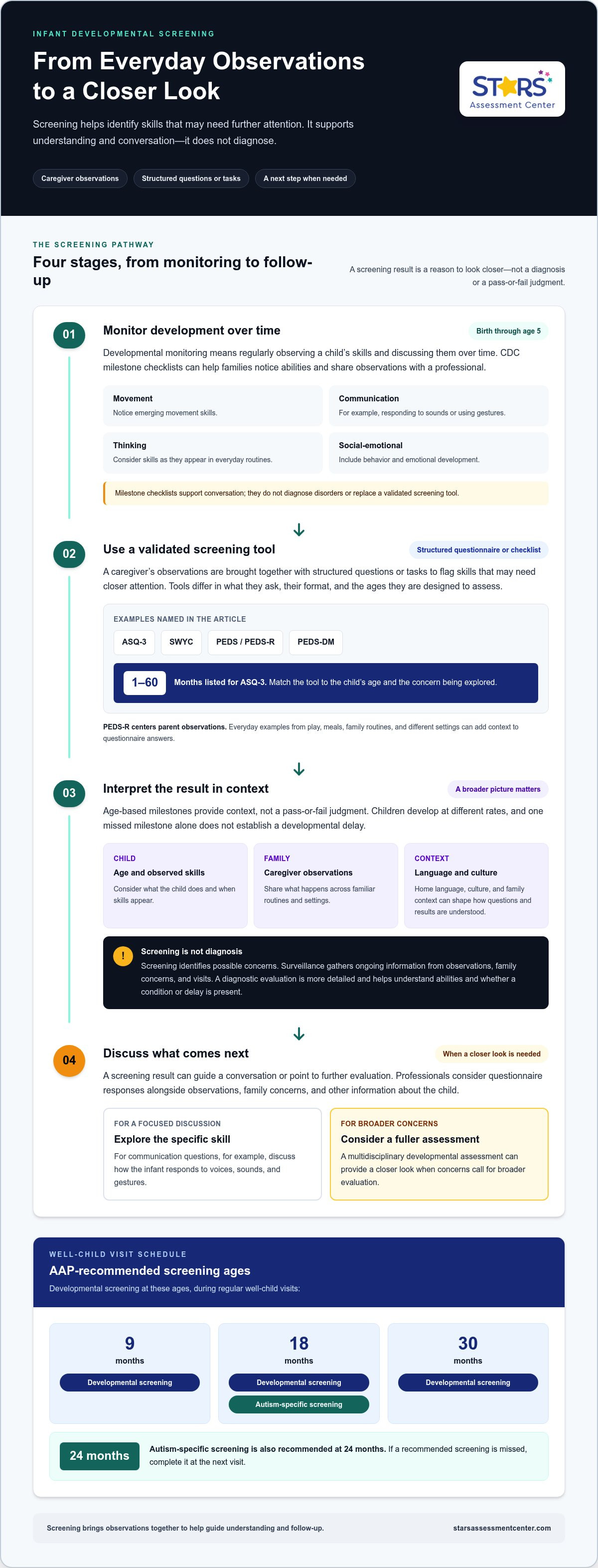
A screening result is a reason to look closer, not a diagnosis. Validated developmental screening tools for infants use research-based questionnaires or checklists to ask about skills such as movement, language, thinking, behavior, and emotions. The American Academy of Pediatrics recommends developmental screening at 9 months, 18 months, and 30 months, with autism-specific screening at 18 months and 24 months during regular well-child visits.
It’s understandable to wonder what developmental screening tools for infants can reveal about your baby’s development. These tools bring together caregiver observations and a child’s responses to identify areas that may need further attention. They support early understanding, not a diagnosis or a label.
In this article, you’ll learn how screening works, what PEDS-R and other validated tools assess, and how motor, language, cognitive, and social-emotional skills may appear in screening questions. We’ll also explain why a child’s age, culture, and home language matter when results are interpreted, so you can better understand what a screening can tell you and what may come next.
Key Takeaways
- Screening questionnaires gather caregiver observations and may flag areas for closer attention; they don’t provide a diagnosis.
- PEDS-R and other validated tools differ in what they ask about and the ages they’re designed to assess.
- A child’s home language, culture, age, and family context can shape how screening questions and results should be understood.
- Looking across movement, communication, thinking, and social-emotional development gives a broader picture than focusing on one skill alone.
- When concerns call for a closer look, a Social-Emotional Assessment or Multidisciplinary Developmental Assessment can help guide the next step.
How Do Screening Tools Work?
Screening combines caregiver observations with structured questions or tasks to flag skills that may need closer attention. CDC milestone resources help families track development, while validated tools provide a more formal screen.
Milestone Checklists and Developmental Monitoring
Developmental monitoring means regularly observing a child’s skills and discussing them over time. CDC milestone checklists support this process by helping families notice abilities in areas such as movement, communication, thinking, and social-emotional development. Monitoring is relevant from birth through age 5 years. A parent might note whether an infant responds to sounds or uses gestures, then share those observations during a visit. A checklist supports conversation; it doesn’t diagnose disorders or replace a validated screening tool.
Comparing Skills With Age-Based Milestones
Age-based milestones describe skills that children commonly develop within a particular age range. Families and clinicians can compare an infant’s observed abilities with the CDC’s age-organized milestone resources, then discuss skills that have not appeared or have changed. This comparison offers context, not a pass-or-fail judgment: children develop at different rates, and one missed milestone alone doesn’t establish a developmental delay. PEDS-Developmental Milestones (PEDS-DM) is another named milestone-based screening option. The child’s age and observed skills help determine what deserves further attention.
Screening, Surveillance, and Diagnostic Evaluation
Screening uses a structured questionnaire or checklist to identify possible concerns; surveillance gathers ongoing information from observations, family concerns, and visits. A diagnostic evaluation is a more detailed assessment used to understand a child’s abilities and whether a condition or delay is present. ASQ-3, SWYC, and PEDS are screening options, not diagnostic evaluations. They differ in their questions and formats, so age fit, the family’s observations, and the concern being explored guide selection. A screening result can point to a need for further evaluation without providing a diagnosis.
Screening Ages and Well-Child Visits
Infant screening tools cover different age ranges, so the tool must match the child’s age. For example, ASQ-3 is listed for children aged 1 to 60 months, while other tools have narrower age ranges. In the United States, the American Academy of Pediatrics recommends developmental screening for all children at 9 months, 18 months, and 30 months during regular well-child visits. It also recommends autism-specific screening at 18 months and 24 months. If a recommended screening is missed, complete it at the next visit.
Parents' Evaluation of Developmental Status (PEDS-R)
The Parents’ Evaluation of Developmental Status, or PEDS-R, centers parents’ observations. Parents see their child across everyday settings, including play, meals, and family routines. Those observations can add context that a brief appointment may not capture. A screening questionnaire organizes what parents notice so families and professionals can discuss development more clearly.
What Parent-Report Screening Contributes
Parent-report screening uses a caregiver’s answers to identify areas that may need closer attention. A parent might describe how an infant communicates needs, responds to familiar people, or explores toys. These examples turn a general concern into a specific discussion about a child’s skills and development. PEDS-R is one of several parent-completed approaches. Other tools include PEDS, ASQ, ASQ:SE, and PSC, each with its own format and purpose.
Parents can answer based on what they regularly observe, rather than trying to recreate a skill during an appointment. Think about more than one setting. An infant may vocalize during play at home but stay quiet in an unfamiliar room. Sharing that difference gives the professional useful context. Caregivers can also describe the languages the child hears and who spends time with them, helping make the discussion more family-centered.
From Questionnaire to Conversation
A completed screening tool is a starting point for discussion, not a diagnosis. The professional considers the answers alongside observations, family concerns, and other information about the child. If responses raise questions about communication, for example, the next conversation can focus on how the infant responds to voices, sounds, and gestures. A multidisciplinary developmental assessment can provide a closer look when concerns call for broader evaluation.
Families should feel able to explain what a response means in daily life. A checked answer may not capture differences between familiar routines and new situations. Parents can add examples or describe skills they have noticed, including when and where they appear. That context helps ensure a questionnaire is not treated as a complete picture of a child’s development.
Consent and Family Partnership
In Head Start, written parental consent is required before developmental screening begins. Consent supports a shared process: parents know screening is planned, and staff can explain its purpose. A parent’s participation also connects questionnaire responses with the child’s everyday experiences. Discussing answers, questions, and next steps makes screening more useful for families and professionals.
Whether a family encounters PEDS-R or another parent-completed questionnaire, firsthand knowledge matters. A screening result can guide what to discuss next, while a fuller assessment considers a child’s development across areas. Sharing concrete examples from home helps keep that conversation specific and grounded in the infant’s daily life.
Validated developmental screening tools
Validated tools use research-tested questions or tasks to flag possible developmental concerns, not diagnose disabilities. Common options include ASQ-3, CSBS DP, M-CHAT-R, and BINS; the child’s age and the skill being screened help determine which tool fits.
Validity and False Positives
A validated screening tool has been studied to assess how well it identifies children who may need further evaluation. That matters because an informal checklist may miss concerns or flag them inconsistently. A positive screen signals a reason to look closer, not proof of a disorder. Results need context, too: in young children with heart defects, motor delays may lead an autism screener such as M-CHAT to over-identify risk.
Screening questions capture a particular moment and set of skills. A child’s response during a brief activity, for example, may differ from what a family sees in familiar routines. A trained professional considers the tool’s purpose, age range, answers, and the child’s broader development. If concerns remain, a fuller assessment can explore development across areas. This helps families understand why a positive result starts a conversation rather than settling one.
Common Validated Infant Screening Tools
Tools vary in age range and focus, so the best fit depends on the child and the question being explored. Examples include:
- ASQ-3: general developmental screening for children aged 1 to 60 months.
- CSBS DP: screening for children aged 6 to 24 months, covering seven predictors of later language delays.
- M-CHAT-R: autism screening for children aged 16 to 30 months, using parent reports and 20 questions.
- BINS: infant neurodevelopmental screening for children aged 3 to 24 months.
- CLAMS: language and auditory milestone screening from birth to 3 years.
Other options include the Denver II, for children aged 1 month to 6 years, and INFANIB, for infants aged 1 to 18 months. ASQ:SE-2 is designed to screen social-emotional development in young children. These ranges show why a tool designed for older toddlers may not fit an infant’s screening needs.
Some tools are completed by parents; others involve activities administered by a provider. The Bayley Scales of Infant Development, BRIGANCE Early Childhood Screens III, and Battelle Developmental Inventory Screening Tool are provider-administered options. The setting and specific concern help guide tool selection. A structured measure gives families and professionals a consistent starting point, while follow-up can clarify what the result means for that child.
Cultural and language considerations
A screening result reflects both a child’s skills and how questions are understood. For screening to be useful, the tool should suit the child’s age, respect family culture, and account for the home language. Trained professionals can interpret responses in context, rather than treating one checklist answer as the whole story.
Language matters in parent questionnaires and screening activities. A child may hear or use more than one language, so professionals need to know which languages are familiar at home. A parent’s answer about a child’s words, for example, may describe communication across languages, not just words spoken in English. This context helps clarify what a question measures and what the family observes.
Culture also shapes everyday routines and expectations. A gesture, play activity, or response to an unfamiliar adult may vary between families and settings. Before interpreting behavior, a screener should learn about the family’s practices and respect their perspective. Materials in a family’s native language can support understanding when feasible, while clear explanations help parents share meaningful examples.
Head Start screening includes communication with parents in their home language. This helps families understand the questions and describe their child’s abilities in familiar terms. It also supports a collaborative exchange: a parent can explain how an infant communicates during meals, play, or time with relatives. Those details add context a checklist alone cannot provide.
The CDC provides Indicadores en acción resources for Spanish speakers. Families can use Spanish-language milestone information to follow development and prepare questions about specific skills. Familiar-language resources can make it easier to discuss a toddler’s gestures, sounds, or social responses. Screening results should still be considered alongside the child’s age and broader developmental picture.
Language or cultural differences should not be mistaken for developmental delays without careful interpretation. Limited English responses in an unfamiliar setting, for example, do not by themselves describe a child’s communication in familiar situations. Screening, ongoing observation, and family input provide different kinds of information. Considering all three can help guide whether further assessment or support is appropriate.
Families can support accurate screening by describing the child’s communication, play, movement, and behavior in everyday settings. Mention which languages the child hears, who communicates with them, and where a skill appears. These examples help a trained professional interpret the tool’s questions and results. If a concern continues as a child approaches school, earlier family discussions can clarify what support may be useful.
Motor, language, cognitive, and social-emotional skills
Developmental screening looks across connected areas rather than treating one skill as the whole picture. An infant’s movement, communication, thinking, and emotional responses can offer different clues. Reaching for a toy, for example, involves movement, attention, and curiosity. Screening questions and activities organize these observations and show which skills may need closer discussion.
Motor skills include large movements, such as sitting or changing position, and smaller actions, such as grasping. A screener may consider how an infant uses their hands to explore a toy or moves toward an object. Motor observations matter alongside other skills: a movement difference can affect how a child engages with toys or people. The Infant Neurological International Battery, or INFANIB, focuses on infant screening from 1 to 18 months.
Language and communication include understanding and expressing messages through sounds, gestures, and words. A caregiver might describe whether an infant turns toward a voice, uses gestures, or tries to share attention. The Communication and Symbolic Behavior Scales: Developmental Profile screens seven predictors of later language delays for children aged 6 to 24 months. These observations help distinguish communication patterns that deserve follow-up from a single quiet moment.
Cognitive skills involve how children notice, explore, and learn from their surroundings. A screener may consider how an infant searches for a toy or responds when an adult changes an activity. These actions show how a child approaches a small challenge, not simply whether they complete a task. Looking at attention, exploration, and problem-solving together gives families a more useful picture than one isolated response.
Social-emotional skills include how a child connects with people, responds to feelings, and manages everyday interactions. The Ages and Stages Questionnaires: Social-Emotional, Second Edition (ASQ:SE-2), is listed for children aged 3 to 72 months. Autism-specific tools, such as M-CHAT-R for children aged 16 to 30 months, focus on autism risk indicators. A screening result is a prompt for further consideration, not a diagnosis.
One area can influence how another skill appears. For instance, limited movement may affect how an infant reaches for a shared toy, while a new setting may change how they communicate. Professionals interpret developmental milestones in context, using family observations alongside screening responses. If you have concerns across several areas, explore developmental assessment support to discuss a fuller picture of your child’s skills.
Stars Assessment Program: Social-Emotional Assessment
Stars Assessment Program offers a Social-Emotional Assessment when screening results or everyday observations raise questions about how your child manages feelings and interactions. If concerns involve several areas of development, a Multidisciplinary Developmental Assessment can provide a broader evaluation. Families with questions about communication can also consider a Speech and Language Evaluation, while autism-related concerns can be explored through its Autism offering.
A screening result is a starting point for understanding your child’s needs. Sharing specific examples from home, such as how your child communicates or responds during play, can help guide a fuller conversation about next steps.
Contact Stars Assessment Program or visit starsassessmentcenter.com to learn more.
Turn Your Observations Into a Helpful Next Step
Notes about how your child communicates, plays, connects, and responds can make the next conversation more specific. Rather than focusing only on a screening score, consider which everyday situations prompted your questions and what you hope to understand. That context can help guide a discussion about support suited to your child’s needs.
Developmental screening tools for infants can point toward areas to explore, while a fuller assessment can build a clearer picture. Stars Assessment Program offers Social-Emotional Assessment, Multidisciplinary Developmental Assessment, and Speech and Language Evaluation. These options give families a way to explore questions about emotional development, skills across several areas, or communication.
If you’re ready to discuss your observations and possible next steps, contact Stars Assessment Program. Your careful attention to your child’s development is a meaningful place to begin, and you can move forward one conversation at a time.
Frequently Asked Questions
Should I be concerned about my child's development?
If you notice a change or have a concern, share specific examples with your child’s doctor. You might describe how your infant responds to familiar voices, uses gestures, or reaches for toys during play. One observation does not explain the whole picture, but clear examples can focus the conversation. If something does not feel right, you do not have to wait for certainty to act.
What is developmental screening and why is it important?
Developmental screening uses structured questions or tasks to flag skills that may need a closer look. It helps families and professionals decide what to discuss next, rather than providing a diagnosis. For instance, a questionnaire may prompt a conversation about how a baby communicates during everyday routines. Screening can bring a concern into focus before it becomes more noticeable in settings such as childcare or school.
How accurate are developmental screening tools for infants?
Screening tools can identify possible concerns, but a result is not a diagnosis or a complete measure of a child’s abilities. Accuracy depends partly on whether the tool suits the child’s age and the area being screened. A child’s responses may also differ by setting or familiarity. Share examples from home alongside the result so the next discussion considers more than one brief screening moment.
How do parents complete an infant developmental screening questionnaire?
Use the questionnaire suited to your child’s age and answer from what you observe in everyday life. Consider how your infant communicates during play, responds to familiar people, or explores objects. If another caregiver regularly spends time with your child, their observations may add useful context. Note examples when an answer is difficult to choose, then discuss them with the professional reviewing the questionnaire.
Are infant developmental screening tools free or available in multiple languages?
Cost and language options vary by tool and setting, so they aren’t the same for every questionnaire. The CDC provides Indicadores en acción resources for Spanish speakers, but that doesn’t mean every screening tool is available in every language. If a form’s wording is difficult to understand, explain which language your family uses at home and ask for screening materials that support clear communication.
What should parents do if an infant screening suggests a developmental delay?
Discuss the result with your child’s doctor and bring examples of the skills that prompted concern. A follow-up evaluation can look more closely at your child’s needs. For children under 3 years, Stars Assessment Program offers Social-Emotional Assessment, Multidisciplinary Developmental Assessment, and Speech and Language Evaluation. This is not a diagnostic assessment; results are explained in plain language, with assessment in your preferred language. Families near San Jose, Santa Clara, Santa Cruz, Salinas, Milpitas, Gilroy, and Morgan Hill can contact Stars directly; no referral is needed.
How do ASQ-3, SWYC, and PEDS compare for infant screening?
ASQ-3 is a developmental screening tool, and families can check whether it fits their child’s age and needs. SWYC and PEDS are also screening options, but their questions and formats differ; choose based on the child’s age, family observations, and the concern being explored.


