
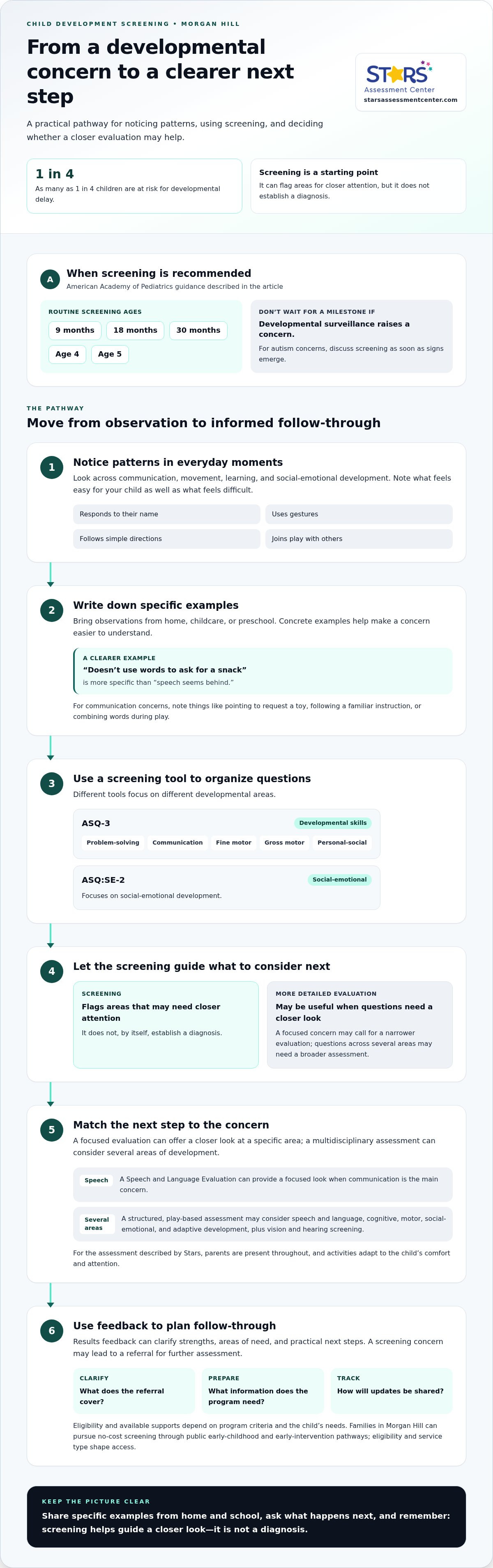
As many as 1 in 4 children are at risk for developmental delay, so noticing a concern is a useful reason to learn about screening. For families seeking child development screening in Morgan Hill, the American Academy of Pediatrics recommends formal, validated developmental screening at 9, 18, and 30 months, or when developmental surveillance raises a concern. Screening can help identify areas where a closer look may be helpful.
It’s understandable to want clear answers about what an appointment involves and what results might mean. A screening is one step in understanding your child’s development, and questions about communication, movement, learning, or social-emotional growth can help guide what comes next.
This article explains how screening differs from a more detailed evaluation, what testing timelines and results feedback may involve, and how referrals and family resource connections can support next steps. You’ll also learn when a multidisciplinary developmental assessment, social-emotional assessment, or speech and language evaluation may provide a fuller picture, so you can approach the process with greater clarity and confidence.
Key Takeaways
- Notice patterns in your child’s communication, movement, learning, and social-emotional development, and share specific examples when seeking guidance.
- Understand how screening differs from a comprehensive assessment and what can shape testing and report timelines.
- Use results feedback to clarify your child’s strengths, areas of need, and practical next steps.
- Learn how referrals and family resource connections can help turn assessment findings into coordinated support.
- Explore when a social-emotional assessment or another focused developmental evaluation may help answer your family’s questions.
Early identification of developmental delays
According to the American Academy of Pediatrics, standardized developmental screening is recommended at 9, 18, and 30 months, and at ages 4 and 5. When developmental surveillance raises a concern, screening can also be appropriate outside those visits. For autism concerns, discuss screening as soon as signs emerge rather than waiting for a scheduled milestone. In Morgan Hill, families can pursue no-cost screening through public early-childhood and early-intervention pathways; eligibility and the type of service shape access.
A screening helps identify areas that may need closer attention. It does not, by itself, establish a diagnosis. As many as 1 in 4 children are at risk for developmental delay, so examples from everyday routines can help make concerns clearer. Note whether your child responds to their name, uses gestures, follows simple directions, or joins play with others. Share what you observe at home, childcare, or preschool, including skills your child uses comfortably and situations that feel difficult.
For a practical first step, write down specific observations before a well-child visit. “Doesn’t use words to ask for a snack” gives a clearer example than “speech seems behind.” A screening tool can organize questions across developmental areas. The ASQ-3 looks at problem-solving, communication, fine motor, gross motor, and personal-social skills; the ASQ:SE-2 focuses on social-emotional development. These tools can help families and professionals decide whether a more detailed evaluation is useful.
Early speech and language support starts with noticing communication in ordinary moments. For example, record whether your child points to request a toy, follows a familiar instruction, or combines words during play. Bring those examples to the discussion, along with any changes you’ve noticed. If communication is the main concern, a Speech and Language Evaluation can offer a more focused look than a general screening. The goal is to clarify the child’s communication profile and guide appropriate next steps.
Early intervention and preschool programs can make the path forward easier to understand. A screening concern may lead to a referral for further assessment, while eligibility and available supports depend on the program’s criteria and the child’s needs. Ask what the referral covers, what information the program needs, and how updates will be shared while an evaluation is arranged. If a preschool or school has noticed similar patterns, include those observations. A consistent picture across home and school can help families explain concerns and plan for support.
Screening gaps remain substantial beyond any single family’s experience: thousands of young children across California are never screened for disabilities or developmental delays during their early years. Statewide data shows that many children still miss out on formal developmental screening before entering school, even though a national survey indicates that 27.1% of U.S. children under age 5 received developmental screening in recent years.
Timely follow-through matters too: a significant percentage of early-intervention-eligible children in Santa Clara County face delays in receiving services within mandated timelines. Without increased screening and prompt support from providers like the Stars Assessment Program, preschool and kindergarten classrooms in the Morgan Hill area will continue to be filled each year by children with unidentified challenges. Families can ask about the next step, expected timing, and how to check whether a referral has led to services.
Testing sessions and report preparation timelines
A screening and a developmental assessment serve different purposes. Screening flags areas that may need closer attention; it does not establish a diagnosis. Stars’ structured, play-based assessment considers speech and language, cognitive, motor, social-emotional, adaptive, vision and hearing screening. Parents are present throughout, and the activities adapt to the child’s comfort and attention.
Preparation starts at home. Write down the concerns that led you to seek testing, then collect examples from ordinary routines. You might note how your child asks for help, responds to a change in plans, or follows a familiar direction. Include observations from childcare, preschool, or an academy if those settings have noticed different patterns. Bring relevant developmental or educational records, and list any questions you want answered. Specific examples give the assessment team useful context beyond what a child demonstrates during one session.
The testing schedule reflects the questions being explored and the information needed to answer them. A focused concern may call for a narrower evaluation; questions across several developmental areas may require a broader assessment. A child’s comfort, attention, communication style, and willingness to join activities also shape how the session proceeds. Tell the evaluator what helps your child engage, such as a familiar routine or a short break between tasks. These details support a more useful testing experience without assuming every child follows the same schedule.
After testing, report preparation involves organizing observations and connecting them with the assessment findings. Families can help keep the process clear by asking which records are still needed and how the feedback meeting will be arranged. While waiting for the report, keep a brief log of new examples, such as words your child uses during play or situations that trigger distress. This adds current context to the conversation without trying to interpret test results yourself.
A practical sequence can make each step easier to track:
- Confirm the evaluation’s focus and gather relevant records.
- Share everyday examples from home and early learning settings.
- Attend the testing session and ask how follow-up feedback will work.
- Review the report, clarify unfamiliar terms, and note recommended next steps.
For concerns centered on interactions, emotional responses, or social engagement, a Social-Emotional Assessment can provide a focused way to explore those areas. Ask how its findings will be explained and how they relate to your child’s daily experiences. Clear feedback connects assessment observations with practical questions, such as what supports participation in play, communication, or learning routines.
Follow-up and family resource connections
After the assessment, turn the recommendations into a short plan you can revisit. Start with the specific next steps discussed, such as sharing relevant findings with your child’s care or preschool team. Write down the action, who will take it, and what information they need. For example, you could share observations about communication during group play.
Parents can keep referrals moving by recording each contact and its outcome. A simple note can include the referral date, the office or program contacted, documents submitted, and the next action. If a referral requires records, gather the assessment report and relevant school or childcare observations together. When a family hasn’t received an update, use the listed contact method to ask what step remains. This turns an unclear wait into a trackable process.
Resource connections work best when they match the concern and the family’s daily routine. A child who struggles to communicate during meals may benefit from a plan that includes practice during familiar routines. If concerns appear mainly during preschool transitions, share that example with the school team. Families can ask which community or early-childhood programs address the need identified in the report, what participation involves, and how progress will be reviewed.
- For communication concerns: Share examples of how your child requests help, responds to directions, or participates in conversation.
- For social-emotional concerns: Note situations that make play, transitions, or calming difficult.
- For learning concerns: Ask preschool staff to describe the tasks your child enjoys and those requiring support.
Keep conversations focused with specific examples. Saying, “my child leaves circle time when the group sings,” gives educators a situation to discuss. Add what helps, such as a visual reminder or a quieter place to begin. Concrete observations can help families and professionals consider practical next steps without reducing a child to a label.
At follow-up, clarify how the family will know whether a recommendation is helping. Agree on an observable example, such as joining one shared activity or using a gesture to request a preferred item. Set a time to revisit the plan with the relevant people, then record what changed and what remains challenging. If new concerns arise, add dated examples and share them during the next discussion. This creates continuity between home, school, and community supports.
Before each meeting, prepare questions such as: Which recommendation comes first? Who will coordinate the next step? What information would be useful to share with my child’s preschool? Written answers can help you leave with clear actions rather than unfamiliar terms. Keep the report and follow-up notes together for future discussions.
End each review with a summary conversation, noting what remains unresolved and who will take the next step. Families utilizing child development screening in Morgan Hill are asked to email the required forms or call the office at least 72 hours before an appointment with the Stars Assessment Program. Keep the agreed follow-up plan available for the next discussion.
Results feedback and next-step planning
A screening result is a starting point for discussion, not a label for your child. If a screening raises a concern, ask which skills prompted it and how they relate to daily routines. Difficulty following directions in a group, for example, may look different from difficulty communicating during family meals. Connecting observations to real situations helps clarify what support may be useful.
If your child does not pass a developmental screening, discuss the result with the professional who conducted it and ask what follow-up is recommended. Share your observations and examples from home or preschool. A screening concern does not establish a diagnosis. A developmental assessment can offer a fuller picture of your child’s strengths and areas that may need support. This is not a diagnostic assessment.
During feedback, ask the assessor to explain unfamiliar terms in everyday language. A report may describe an area as a relative strength while identifying another skill that needs closer attention. Ask how the observations relate to your child’s age, communication, learning, and participation in routines. If the report includes scores, ask what each score represents and how it should guide decisions, rather than focusing on a single number without context.
Turn the discussion into a written plan. For each recommendation, record the action, the person responsible, and the information needed. If a report suggests a broader evaluation, ask what questions that assessment would answer. If it recommends sharing findings with a preschool, identify which pages or observations are useful for the education team. These steps help keep the family’s concerns and the child’s everyday skills central.
- Clarify the finding: Ask which observed skills shaped the result and where they appear in daily life.
- Understand the next step: Confirm whether the recommendation is monitoring, additional assessment, or a referral.
- Share relevant details: Provide educators with specific examples that help explain the concern.
- Track the plan: Keep the report, contact notes, and agreed actions together for future conversations.
Before leaving the feedback discussion, ask what to watch for during everyday routines and what information may be useful to share with your child’s preschool. If a recommendation is unclear, ask for a practical example, such as how to support communication during play. Clear explanations can help you use the findings in daily life without treating the report as the only measure of your child’s abilities.
Finally, agree on how updates will be shared with everyone involved. A parent might keep a brief record of a new skill, a recurring challenge, or a change in participation, then bring those notes to the next conversation. This gives professionals and educators concrete information for reviewing whether the plan still fits. If the child’s needs change, the family can revisit the recommendations and discuss a suitable next action.
Screening and referral workflows
A clear workflow helps families move from a concern to an appropriate next step. In Morgan Hill, that often begins with a pediatric visit, followed by screening, discussion, and referral when needed.
Finding Screening Services in Morgan Hill
Families can ask their child’s pediatrician about developmental screening during a well-child visit. The American Academy of Pediatrics recommends standardized screening at 9, 18, and 30 months, and at ages 4 and 5. If concerns arise between visits, share specific examples and ask about the next step. For infants and toddlers under age three, families in Santa Clara County can seek a developmental assessment through local early-intervention pathways.
Before the appointment, write down the concerns you want to discuss. If your child attends preschool or childcare, include observations about play, communication, transitions, or other challenges. Stars’ developmental assessment is structured and play-based, and parents are present throughout. The activities are adapted to the child’s comfort and attention.
Developmental Screening Tools
Screening tools use structured questions to organize observations, rather than relying on one moment in a center or clinic. The ASQ-3 covers problem-solving, communication, fine motor, gross motor, and personal-social skills. The ASQ:SE-2 focuses on social-emotional development. For autism-related concerns, ask which age-appropriate screening approach is being used and what follow-up a result may prompt.
Parents should bring completed forms, relevant developmental or education records, and written examples of concerns from home or childcare. Include details such as what happened, where it happened, and what helped your child participate. If an infant responds differently to familiar voices or routines, describe the situation clearly rather than relying on a general label. These details help the professional understand the child’s everyday experience.
If you have questions about what the assessment covers, ask how the findings can help inform next steps. Stars’ multidisciplinary developmental assessment considers speech and language, cognitive, motor, social-emotional, adaptive, vision and hearing screening. When applicable, findings may help inform eligibility for Early Start, a program that may offer support. Early Start developmental assessments are provided at no cost to families.
Use the screening discussion to identify one next action, such as scheduling a follow-up or sharing observations with preschool staff. Keep the report, completed forms, and referral notes together so details remain consistent across conversations. Take the next step in understanding your child’s development when you’re ready to explore assessment options.
Stars Assessment Program: Social-Emotional Assessment
Stars Assessment Program offers a Social-Emotional Assessment for families seeking a clearer understanding of their child’s social-emotional development. The assessment considers areas such as bonding, eye contact, play, expressing feelings, and settling. Sharing examples from home or preschool can help connect the findings with your child’s everyday experiences.
If concerns span several developmental areas, a Multidisciplinary Developmental Assessment may provide a broader picture. A Speech and Language Evaluation can focus on communication, while an Autism assessment can address autism-related questions. The appropriate next step depends on the concern you want to understand and the information already available to your family.
Take the Next Step With Confidence
Choosing a next step depends on your child’s needs and the questions you want answered. If you’re considering child development screening in Morgan Hill, share your observations and concerns with Stars Assessment Center. No referral needed. Families can contact Stars directly. Assessment in your preferred language.
Stars Assessment Program offers Social-Emotional Assessment, Multidisciplinary Developmental Assessment, and Speech and Language Evaluation. These options can help explore social-emotional development, broader developmental skills, or communication, depending on your concerns. You don’t need to have every question resolved before taking a next step. Start with what you’ve noticed and what you hope to understand.
Contact Stars Assessment Program to discuss an assessment for your child. With clear information and thoughtful support, you can move forward one step at a time.
Frequently Asked Questions
How long does it take to get a developmental evaluation or early intervention services in Santa Clara County?
There isn’t one timeline for every family in Santa Clara County; scheduling, the child’s needs, and next-step coordination affect how the process moves. For children under 3 years, Stars Assessment Program provides developmental assessments with no referral needed. The assessment helps inform Early Start eligibility when applicable, but it is not a diagnostic assessment. Early Start is a program, and its service timing depends on the steps needed after assessment.


