

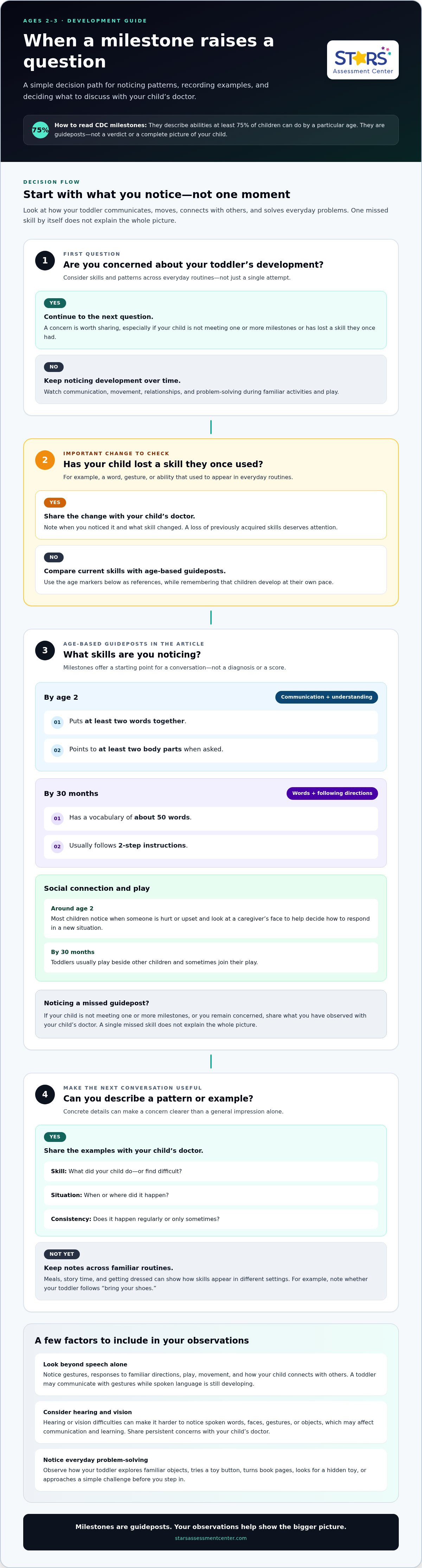
A developmental milestone is a guide, not a verdict. If you're thinking, “I have concerns about my 2-year-old's development,” share them with your child’s doctor, especially if your child isn’t meeting one or more milestones or has lost skills they once had. By age 2, children are expected to say at least two words together, according to the Centers for Disease Control and Prevention (CDC). The CDC explains that its milestones describe abilities at least 75% of children can do by a particular age.
It’s understandable to wonder whether your toddler’s progress is on track. Children develop at their own pace, and one missed skill doesn’t, by itself, explain what’s going on. Looking at the bigger picture, including how your child communicates, moves, connects with others, and solves everyday problems, can help make your next steps clearer.
This guide explores common social-emotional, physical, communication, and cognitive skills between ages 2 and 3, with a closer look at thinking and problem-solving. You’ll also learn which changes deserve attention, what to share when you raise a concern, and how a developmental assessment can help clarify your child’s strengths and support needs.
Key Takeaways
- Use age-based milestones as a guide while noticing how your toddler communicates, plays, and responds to others.
- Everyday routines and shared play can create natural chances to practice social and emotional skills.
- Simple movement and hands-on activities help you observe how your child explores and uses their body.
- Watch how your toddler approaches familiar problems, toys, and pretend play for clues about cognitive growth.
- Learn what a developmental assessment can clarify and which type of evaluation may fit your child’s needs.
How can you help your toddler grow and develop between 2 and 3 years?
Between ages 2 and 3, language, movement, relationships, and thinking develop together. Milestones can help you notice emerging skills and decide what to discuss with your child’s doctor.
Communication and Language Milestones
Communication milestones describe how toddlers understand language, express needs, and share attention. These skills matter in daily moments, from asking for a snack to following a familiar request.
By age 2, children are expected to put at least two words together, according to the Centers for Disease Control and Prevention. By 30 months, most children can have a vocabulary of about 50 words, according to the Centers for Disease Control and Prevention. At that age, toddlers usually follow 2-step instructions, according to the Centers for Disease Control and Prevention.
There isn’t a single milestone in the provided guidance that sets an exact age for responding to a name. Notice whether your toddler responds during ordinary moments, follows simple directions, and uses two-word phrases by age 2. Hearing or vision difficulties can make it harder to notice spoken words, faces, gestures, or objects, which may affect communication and learning. Share persistent concerns with your child’s doctor.
Tracking Toddler Development
Tracking development means observing your toddler’s skills over time rather than judging one moment. It helps you describe specific patterns, such as whether your child follows a familiar direction at home or uses new words during play.
CDC checklist milestones represent abilities that at least 75% of children can do by a particular age, according to the Centers for Disease Control and Prevention. They are useful reference points, not a test that explains a child’s whole development. Note the skill, the situation, and whether it happens consistently. For example, write down when your toddler follows “bring your shoes” and when the request is difficult.
Keep examples from different routines, such as meals, story time, and getting dressed. If a skill your child once used disappears, note when you noticed the change and share it with the doctor. Concrete observations can make a conversation about concerns clearer than a general impression alone.
Typical Milestones at Age Two
Typical milestones are skills commonly emerging around a given age across areas of development. They help you see your toddler’s abilities as a whole instead of focusing only on speech or movement.
By age 2, a child is expected to point to at least two body parts when asked, according to the Centers for Disease Control and Prevention. Other everyday examples include pointing to a familiar object when you name it, using gestures beyond waving, and playing with more than one toy at once. These actions show how toddlers communicate, explore, and coordinate attention.
Compare your child’s skills with age-based guidance, while remembering that abilities emerge at different times. A toddler might communicate with gestures while spoken language is still developing. Share a specific example with the doctor, especially if you notice concerns across several areas or a loss of previously acquired skills.
Cognitive and Problem-Solving Milestones
Cognitive milestones involve how toddlers understand, remember, explore, and solve simple problems. They matter because thinking skills appear in ordinary play, not only in activities that look like learning.
Watch how your child uses familiar objects, such as trying a toy button or turning book pages. Your toddler might also look for a toy hidden under a cloth or copy an action from a household routine. These examples offer clues about curiosity, memory, and problem-solving.
Give your child chances to explore safely, then pause before stepping in. If a block is out of reach, notice whether your toddler tries another approach or asks for help. If your 2-year-old doesn’t seem to know how to use common objects, mention the examples to the doctor. Describe what the object was and what your child did, so the concern has useful context.
Social and emotional development
At age 2, toddlers are learning to recognize feelings, seek connection, and manage frustration. Watching how these skills appear during play and familiar routines can help you understand your child’s social and emotional growth.
Typical Social and Emotional Development
Social-emotional development describes how a toddler responds to people, expresses feelings, and begins participating with others. These skills shape everyday interactions, from comforting a family member to joining play.
By age 2, most children notice when someone is hurt or upset, such as pausing when another person cries. They also look at a caregiver’s face to help decide how to respond in a new situation. By 30 months, toddlers usually play beside other children and sometimes join their play. These behaviors may appear differently across settings and relationships.
Notice the small moments. Does your child watch your face when meeting someone new? Bring you a toy to show you, copy another child’s actions, or pause when someone seems sad? If you’re concerned about how your toddler connects with others or responds to feelings, share specific examples with the doctor.
Learning and Emotional Security
Emotional security grows through familiar, responsive interactions that help toddlers feel safe exploring and learning. When a child knows a caregiver is available, they can return for comfort and then engage again with a toy, activity, or person.
Predictable routines can make transitions easier. For example, tell your toddler that cleanup comes before a favorite story, then follow through calmly. During play, describe what you notice: “You’re putting the blocks in the box.” This gives your child words for actions and feelings without asking for a spoken response.
When frustration rises, name the feeling and offer a simple choice: “You’re upset the tower fell. Shall we build it again or read?” A calm adult response models how to handle strong emotions. Notice what helps your toddler settle, such as a familiar song, a quiet space, or holding a trusted object.
Children may show feelings through facial expressions, gestures, movement, or words. Look at the whole interaction rather than expecting one particular response. If your toddler rarely seeks connection, seems unsure how to respond to others, or has difficulty recovering during familiar routines, note examples and discuss them with the doctor.
A Social-Emotional Assessment can be a helpful next step when questions about relationships, emotional responses, or social participation persist. It can offer a clearer view of your toddler’s social-emotional development and help guide what support may be useful.
Concerned About Your Child's Development?
Everyday play gives children chances to practice movement, communication, attention, and problem-solving. Short, shared activities can fit into routines you already have, from putting toys away to walking outside together.
Try simple activities that invite your toddler to explore. Offer large blocks for stacking, containers for filling and emptying, or toys with buttons to press. Name what your child is doing, then pause to let them respond with a word, gesture, or action. If your toddler loses a skill they previously used, tell the doctor and describe what changed.
- Make room for movement. Toddlers should get at least 30 minutes of structured physical activity daily, plus at least 1 hour of unstructured free play each day. Try kicking a ball together or letting your child choose how to move during outdoor play.
- Explore shapes and objects. Offer blocks or shape sorters, and describe what your child notices. Ask, “Where does the circle go?” without turning play into a test.
- Practice everyday actions. Invite your toddler to help put toys in a basket, turn a safe knob, or press a toy button. These activities give small hands a chance to explore cause and effect.
- Play pretend together. By 30 months, toddlers usually use objects in pretend play, such as feeding a doll with a block. Copy your child’s idea, then add a simple action.
Keep activities brief and follow your toddler’s attention. If your child turns away from a puzzle, switch to a book or a movement game. During story time, pause at a familiar picture and let your toddler point, name an object, or turn the page. These small exchanges make play interactive without requiring a particular answer.
Stairs and outdoor spaces can offer movement practice when an adult stays close. By 30 months, toddlers usually jump with both feet, according to the Centers for Disease Control and Prevention. Try a simple “jump like a bunny” game on a clear, safe surface, or kick a ball back and forth. Follow your child’s ability and keep play supervised.
Children learn through repetition, so offer a favorite activity again on another day. Notice what your toddler attempts, what captures their attention, and what feels difficult. Share examples with the doctor if you have concerns about movement, play, communication, or changes in skills.
Movement and physical development
Physical development includes large movements, hand control, and growing independence in everyday tasks. Watching how your toddler moves through familiar spaces can show which skills are becoming easier and where support may help. At age 2, children may climb onto and down from furniture without assistance. Notice how they manage balance, adjust their body, and approach a familiar chair or sofa.
Stairs offer another chance to observe coordination. By age 2, most children walk up a few stairs, with or without help, rather than climbing them. Stay close and notice whether your child places their feet carefully or seeks a hand. A child born prematurely may reach developmental milestones later than other children, so share birth history when discussing movement with a doctor.
Small hand movements matter, too. By 30 months, toddlers usually twist objects, such as turning a doorknob or unscrewing a lid. They also usually turn book pages one at a time. During dressing, notice whether your toddler can take off some clothes independently. These tasks involve grip, coordination, and planning, not simply strength.
At age 2, many children can hold an object in one hand while using the other. For example, they might steady a container while placing a toy inside. They may also use a spoon, though spills are part of the task. Copying a straight line or circle offers another way to observe hand control. Offer chunky crayons and paper, then watch how your child holds and moves them.
Movement often blends with language and pretend play. A toddler might say “go up” while stepping toward a cushion, or act out feeding a doll after carrying a toy spoon. Words paired with actions can show how your child plans and coordinates a familiar activity. Choose a safe, open space and let your toddler repeat a movement at their own pace.
Growth also includes physical changes. Two-year-old children gain an average of about 4 to 6 pounds per year and grow about 2 to 3 inches each year. By age 3, all 20 teeth appear. These figures describe averages and age-related development, while your child’s doctor can consider growth alongside movement and daily skills.
Note specific examples if your toddler struggles with a movement they previously managed or loses an acquired skill. Record the activity, what happened, and whether it occurs in different settings. For example, note difficulty climbing down from furniture or using a spoon at meals. Sharing these observations helps the doctor understand your child’s physical development in everyday life.
Cognitive skills and problem-solving
Cognitive development includes how toddlers notice patterns, remember experiences, and work out what to do next. These skills show up in small moments, such as finding a hidden toy or figuring out how a familiar object works. Watch the process, not just whether your child reaches the answer. Trying a new approach, looking to you for help, or repeating an action can all reveal how your toddler is thinking.
By 30 months, toddlers usually show simple problem-solving, such as using a stool to reach something. They also usually use objects in pretend play, perhaps feeding a doll with a block. These examples combine memory, imagination, and planning. Notice what your child attempts independently, and whether they adapt when the first idea doesn’t work. A familiar routine, like putting clothes in a laundry basket, can also show how your toddler connects an instruction with an action.
Offer everyday opportunities to explore without turning each activity into a test:
- Hide a toy beneath a cloth and give your toddler time to look for it.
- Offer two containers and invite your child to sort objects by shape or color.
- During a book, pause and let your toddler point to a named picture or turn a page.
- Ask your child to help with a simple task, such as putting a spoon beside a plate.
These activities let parents notice attention, memory, and flexible thinking in a comfortable setting. For instance, if a toy is inside a clear container, does your toddler try opening it, bring it to you, or choose another toy? If a shape doesn’t fit, do they turn it or try another opening? Give your child time to experiment, then offer a small hint if they seem stuck. Their response can be more informative than completing the task quickly.
Thinking skills often work alongside language and movement. A toddler may follow a familiar routine after watching you, point to body parts during a song, or use pretend actions to show what they remember. By 30 months, toddlers usually follow simple routines when prompted, such as picking up toys at cleanup time. Note which activities your child enjoys, what kinds of help they use, and whether a task feels difficult across different settings.
If questions about learning, attention, or everyday problem-solving continue, a Multidisciplinary Developmental Assessment can help clarify how skills are developing across areas. Explore an assessment to better understand your child’s strengths and support needs.
Stars Assessment Program: Social-Emotional Assessment
Stars Assessment Program offers a Social-Emotional Assessment when questions about your toddler’s relationships, emotional responses, or social participation persist. The assessment can help you better understand how your child connects with others and responds in everyday situations. If concerns involve several areas, a Multidisciplinary Developmental Assessment can look across developmental skills. A Speech and Language Evaluation may be appropriate when communication is a key concern.
Before an assessment, note a few examples: how your child responds to familiar people, joins play, or reacts when routines change. These observations can help focus the conversation on your child’s individual strengths and needs. Seeking a clearer picture is a reasonable next step when concerns continue or affect daily routines.
You’re welcome to contact Stars Assessment Program to discuss your concerns.
Take the Next Step With Confidence
If you have concerns about your 2-year-old’s development, you don’t have to sort through them alone. Bring your observations and questions to a conversation focused on understanding your child’s individual needs. A clearer picture can help you decide what support may be useful and what to focus on at home.
Stars Assessment Program offers a Social-Emotional Assessment, Multidisciplinary Developmental Assessment, and Speech and Language Evaluation. The right assessment depends on the questions you’re hoping to answer, whether they involve social connection, several developmental areas, or communication. Sharing specific examples can help make the next conversation more useful.
Contact Stars Assessment Program to discuss your child’s development and possible next steps. Taking time to seek understanding is a thoughtful way to support your child as they keep growing.
Frequently Asked Questions
How much will my 2-year-old child grow?
On average, a 2-year-old gains about 4 to 6 pounds per year and grows about 2 to 3 inches each year. These averages describe growth over time, not a requirement for every child. Your pediatrician considers measurements across visits rather than one reading alone. Bring up a noticeable change in appetite, energy, or growth pattern during routine care, and share your observations.
What Are Toddler Milestones?
Toddler milestones are skills children commonly develop as they grow, such as using gestures, moving independently, or engaging in pretend play. The Centers for Disease Control and Prevention explains that its checklist milestones are abilities at least 75% of children can do by a particular age. Use them as reference points, not a score of your parenting or a complete picture of your child’s abilities.
When Should I Call the Doctor?
Contact your child’s doctor if your toddler misses one or more milestones, loses a skill they previously had, or you have another developmental concern. Share what you notice and when it happens. For example, explain whether your child struggles to follow familiar directions during meals or has stopped using a gesture they once used. You can raise concerns during a routine visit or call the doctor’s office.
What developmental milestones should a 2-year-old meet?
By age 2, a child is expected to put at least two words together and point to at least two body parts when asked, according to the Centers for Disease Control and Prevention. Most children also walk up a few stairs, with or without help, rather than climbing them. Consider these examples alongside your toddler’s communication, play, movement, and everyday independence.
What are signs of developmental delay in a 2-year-old?
Possible reasons to seek advice include not meeting one or more milestones, losing previously acquired skills, or ongoing difficulty with everyday communication, movement, play, or interaction. One example alone doesn’t explain why a skill is difficult. Note what your child does, what was expected in that situation, and whether the pattern appears in different routines. A professional assessment can help clarify areas of strength and support needs.
How many words should a 2-year-old say, and what language skills are expected?
By age 2, children are expected to say at least two words together, according to the Centers for Disease Control and Prevention. By 30 months, most children can have a vocabulary of about 50 words, according to the CDC. At that later milestone, toddlers usually combine words with an action word. Notice whether your child uses words, gestures, or both to share needs and interests.
What social, play, movement, and self-care skills are typical at age 2?
At age 2, children may notice when someone is upset, copy others, and play simple make-believe games. By 30 months, toddlers usually play beside other children and sometimes with them, jump with both feet, and take off some clothes independently. These examples can look different across daily routines. Notice which activities your child attempts, enjoys, or finds difficult, and share concrete observations with their doctor.
How do I talk to my pediatrician about concerns about my toddler's development?
Bring two or three examples, including what happened, where, and what helped. If you have concerns about your 2-year-old’s development, Stars Assessment Program assesses children under 3 years. No referral needed. Families can contact Stars directly. This is not a diagnostic assessment. Assessment in your preferred language, with results explained in clear, simple language. No cost to families. Parents in San Jose, Santa Clara, Santa Cruz, Salinas, Milpitas, Gilroy, or Morgan Hill can discuss next steps.


