
The cost of a private developmental assessment in California depends on what the evaluation needs to cover, so there isn’t one price that fits every child. A focused assessment and a broader evaluation involving several developmental areas can require different amounts of testing, specialist input, and reporting.
It is understandable to want a clear figure before deciding what to do next. But cost is only one consideration: the assessment’s purpose and scope determine whether it can address your concerns. Stars Assessment Program offers child-led developmental assessments for families in Santa Clara and Santa Cruz counties. Assessment in your preferred language, with results explained in clear, simple language.
This article explains the factors behind private assessment costs in California, how insurance and public programs may affect family expenses, and what a developmental evaluation can help clarify. It also outlines how lower-cost assessment options may fit into the picture, so you can better understand the choices available for your child.
Key Takeaways
- Assessment costs vary with location and evaluation scope, so understanding what the assessment includes can help you compare options.
- Insurance coverage and out-of-pocket expenses depend on plan benefits, provider networks, and authorization requirements.
- Public programs and lower-cost assessment pathways may help families access developmental evaluations and support.
- Different assessment types focus on different developmental questions, from communication and social-emotional growth to broader developmental concerns.
- Learn how Stars Assessment Program’s assessment offerings can help clarify your child’s developmental needs.
Geographic differences in assessment costs
Private developmental assessment costs vary with evaluation scope, provider type, and local demand. In San Jose, Santa Clara, Santa Cruz, Salinas, Milpitas, Gilroy, and Morgan Hill, the assessment’s purpose and included work matter when comparing options.
Regional Variation in Private Evaluation Costs
Location can affect private evaluation costs through local demand, provider availability, and travel needs. Families in San Jose and Santa Cruz may find different provider options than families in Gilroy or Morgan Hill. Comparing what an assessment includes helps show whether price differences reflect the evaluation itself or practical factors such as travel and specialist availability. For families in Santa Clara, Santa Cruz, and San Benito counties, Stars offers developmental assessments at no cost.
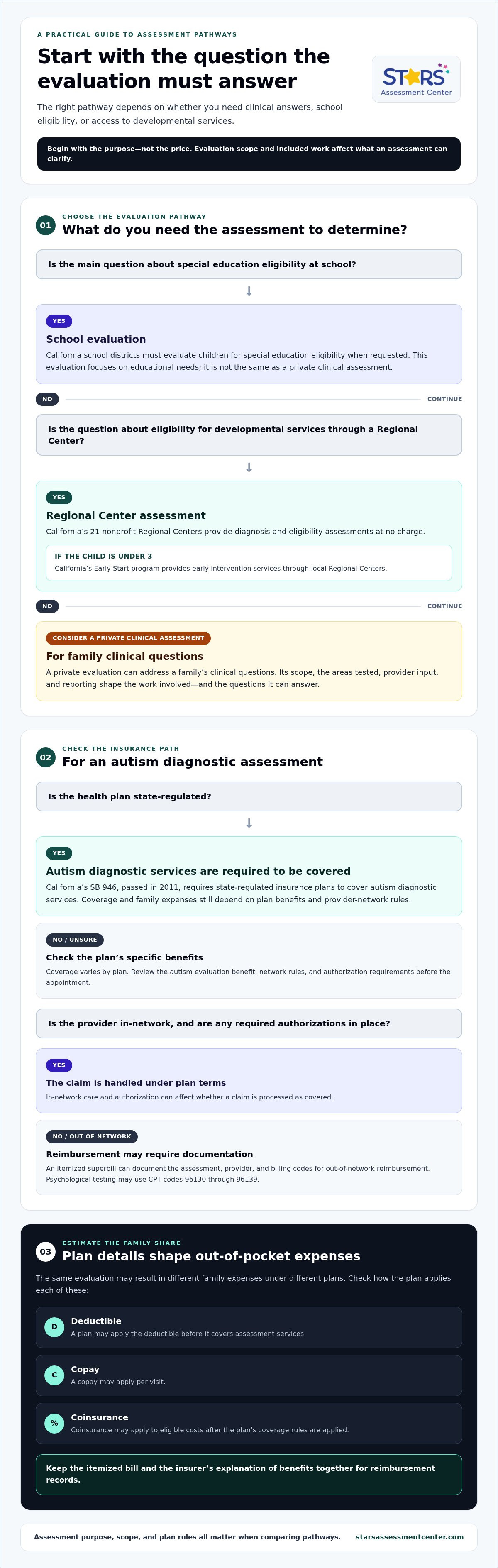
California has 21 nonprofit Regional Centers operated under the Department of Developmental Services, according to the California Department of Developmental Services. Regional Centers provide diagnosis and eligibility assessments at no charge. California’s Early Start program provides early intervention services through local Regional Centers for children under three, according to the California Department of Developmental Services.
Private clinical assessments and public evaluations serve different purposes. A private evaluation can address a family’s clinical questions, while a public school evaluation focuses on educational eligibility. Regional Center assessments consider eligibility for developmental services. Clarifying the purpose helps families compare the appropriate pathway in Santa Clara County or another local community.
Factors That Affect Assessment Costs
Assessment costs reflect a child’s age, the areas tested, the provider’s role, and the detail of the report. A focused communication evaluation differs from a multidisciplinary assessment covering cognitive, physical, and communication development. These distinctions matter because testing and interpretation shape the work involved and the questions the evaluation can answer.
Child and adult evaluations can differ in scope, history gathered, and provider type. A child’s assessment may include caregiver observations and age-related developmental skills. An adult assessment considers the person’s developmental history and current needs. Families should compare evaluations designed for the relevant age group and referral question.
School meeting costs depend on whether the meeting is part of a school evaluation or a separate private service. California school districts must evaluate children for special education eligibility when requested. A school eligibility meeting addresses educational needs; it is not the same as a private clinical assessment. Families can identify the meeting’s purpose before comparing services.
To find a licensed provider in California, identify the professional type that fits the evaluation, then use the relevant California licensing board’s public lookup. For example, a family considering a psychological evaluation can search for a licensed psychologist by name. The cost of a private developmental assessment in California depends on the evaluation’s scope and included work, not simply the city.
Does insurance cover autism testing and diagnosis?
California health insurance can cover autism diagnostic services, but coverage and family expenses depend on plan benefits and provider networks. California’s SB 946 requires state-regulated insurance plans to cover autism diagnostic services.
Insurance Coverage and Reimbursement
Coverage means an insurer pays for eligible assessment services under the terms of a health plan. It matters because diagnosis, behavioral therapy, and intervention may be treated as separate benefits.
Before scheduling, review the plan’s autism evaluation benefits, network rules, and pre-authorization requirements. In-network care and authorization can affect whether a claim is processed as covered. For out-of-network reimbursement, an itemized superbill can document the assessment, provider, and billing codes. Psychological testing may use CPT codes 96130 through 96139.
Out-of-Pocket Expenses
Out-of-pocket expenses are the share families pay after insurance applies its coverage rules. Deductibles, copays, and coinsurance can each affect the final amount, so the same autism evaluation may lead to different family expenses under different plans.
For example, a plan may apply its deductible before covering assessment services, then charge coinsurance on eligible costs. A copay may instead apply per visit. Review the plan’s benefit details and authorization rules before the appointment, and keep the itemized bill and insurer’s explanation of benefits together for reimbursement records.
California Insurance Coverage
California’s SB 946, passed in 2011, requires state-regulated plans to cover autism diagnostic services. This requirement matters for families seeking a diagnosis, but it doesn’t make every related service identical in coverage or payment.
Distinguish diagnostic assessment from ongoing therapy or behavioral intervention when reviewing benefits. Medi-Cal covers medically necessary applied behavior analysis for members under 21 after an autism diagnosis is documented. That coverage concerns treatment, not the cost of every assessment or service a family may need.
Insurance paperwork can clarify which part of care is being considered. A diagnostic evaluation establishes whether autism-related criteria are met; a therapy benefit addresses treatment after diagnosis. Ask the insurer about covered assessment services, in-network professionals, required authorization, and claim documentation. These details help families understand whether the plan uses direct billing or reimbursement and what expenses remain their responsibility.
If a claim is denied, review the explanation of benefits for the stated reason and the plan’s appeal process. Keep the referral, authorization decision, assessment report, superbill, and claim correspondence together. This record can help address missing documentation or a coding issue without confusing a coverage decision with the clinician’s diagnostic findings.
How Much Does An Autism Evaluation Cost?
Financial assistance can change how families access autism testing, especially when a child may qualify for public developmental services. In California, the route depends on the child’s age, needs, and the program’s eligibility criteria, not solely on whether a private evaluation has been completed.
For children under three, California’s Early Start program provides early intervention services through local Regional Centers, according to the California Department of Developmental Services. Families can self-refer without a doctor’s order, and Early Start eligibility does not require an autism diagnosis. This can help connect a child with support while families are still seeking answers through assessment.
California has 21 nonprofit Regional Centers. These centers provide diagnosis and eligibility assessments at no charge, offering a public pathway for families exploring developmental concerns. Regional Center assessment focuses on eligibility for services; private clinical testing may address a family’s separate diagnostic questions. Knowing the purpose of each assessment helps families choose a route that fits their immediate needs.
Medi-Cal covers medically necessary applied behavior analysis for members under 21 after an autism diagnosis is documented. This is coverage for intervention, rather than a promise that every diagnostic test will be paid for. Families can distinguish the assessment needed to document diagnosis from behavioral therapy or other services that may follow.
SSI and Medi-Cal often cover autism evaluations fully for eligible participants, especially children under three. Eligibility and the service being considered matter. A family can organize the next steps by identifying the program, the child’s age, and whether the current need is testing, intervention, or education-related support.
- For developmental concerns before age three: Contact Early Start through a local Regional Center. A doctor’s order and diagnosis aren’t required to request consideration.
- For Regional Center services: Learn which assessment addresses eligibility, then keep the resulting records with the child’s developmental history.
- For Medi-Cal coverage: Separate autism diagnosis from medically necessary ABA, which is covered for eligible members under 21 after diagnosis is documented.
- For SSI support: Review eligibility and whether the family’s need is assessment-related or concerns ongoing services.
Low-cost testing options are most useful when their purpose is clear. An informal screening can flag developmental concerns, while a diagnostic evaluation assesses whether autism criteria are met. A screening result and a diagnosis serve different roles, so families should consider what decision the assessment needs to support.
Public programs may provide a practical starting point for families who need developmental guidance without beginning with a private evaluation. For children under three, California Early Start and Regional Centers offer pathways to assessment and early intervention. Private testing may still be relevant when families need a clinical diagnostic evaluation or a report for a specific purpose.
Lower-cost assessment programs
Yes. California families can explore public assessment routes through Regional Centers and school districts, with eligibility depending on the child’s age, developmental needs, and the purpose of the evaluation. Sliding-scale and university-based services may also be options, but the public routes have clearer statewide criteria.
For infants and toddlers ages 0 to 36 months who are at risk of developmental disabilities or have a developmental delay, California programs may provide a path to assessment and services. Children under three can self-refer to Early Start without a doctor’s order, and a diagnosis isn’t required for Early Start eligibility. The California Department of Developmental Services says Early Start provides early intervention through local Regional Centers.
California has 21 nonprofit Regional Centers operated under the Department of Developmental Services, according to the California Department of Developmental Services. Regional Centers determine eligibility for ongoing developmental services for children age three and older. For children from birth through age four, provisional regional-center eligibility may be available without a developmental-disability diagnosis.
Provisional eligibility has specific criteria. A child must have significant functional limitations in at least two major life activities, and the disability cannot be solely physical. Children aged three or four don’t need to have received Early Start services to qualify provisionally. These distinctions can help parents identify which assessment pathway fits their child’s age and circumstances.
Public school evaluation is another route, but it serves an educational purpose. California school districts must evaluate children for special education eligibility when requested. A school evaluation addresses whether a child meets educational criteria; it does not automatically replace a clinical assessment for diagnosis or other purposes.
- For a child under three: Consider self-referral to Early Start when developmental concerns arise. A doctor’s order or autism diagnosis isn’t required to seek eligibility consideration.
- For a child from birth through age four: Review whether provisional regional-center eligibility criteria may apply, including functional limitations in two major life activities.
- For school support: Request a school district evaluation when the concern relates to learning or educational access. Keep the school’s eligibility purpose distinct from clinical diagnosis.
University-based clinics and sliding-scale programs can have different intake processes, service scopes, and eligibility rules. A standardized assessment may help organize observations, but the tools and report must address the family’s actual question. Parents can compare an initial screening, a school evaluation, and a diagnostic assessment by asking what decision each process is designed to inform.
Lower-cost pathways can reduce barriers, but their usefulness depends on the next step a family needs. A Regional Center eligibility assessment, school evaluation, and private clinical assessment answer different questions. Matching the route to the child’s age and support needs helps families avoid relying on an assessment that doesn’t serve their intended purpose.
How much do private autism evaluations cost in California?
Private autism evaluation costs vary with the assessment’s scope, testing, specialist time, and report detail. A brief screening and a comprehensive diagnostic evaluation answer different questions, so comparing them by price alone can leave families unsure what each process provides. For an individual private evaluation, the price depends on the case and is given after a quote request; the deciding factors include the evaluation’s scope, tests, interviews, and reporting.
An autism evaluation may take 1.5 to 4 hours or more. The length depends on the child’s needs and the evaluation process. A clinician may gather developmental history, observe communication and behavior, and use standardized tools such as the ADOS-2 or Childhood Autism Rating Scale. Families can compare evaluations by reviewing which parts of the process are included.
Some comprehensive private evaluations involve roughly 15 to 25 hours of specialized labor. That work can extend beyond face-to-face testing to include reviewing history, scoring results, interpreting findings, and preparing a report. This helps explain why two assessments addressing autism can differ in scope, even when both focus on the same diagnostic question.
Before choosing an evaluation, identify what you need the results to clarify. A diagnostic assessment considers autism criteria, while a speech and language evaluation focuses on communication. A broader developmental assessment can address multiple areas of development. The appropriate scope depends on the family’s questions and the decisions the report needs to support.
- Testing: Ask which standardized tools are used and what developmental areas they assess.
- Clinical process: Understand whether the evaluation includes caregiver interviews, direct observation, scoring, and feedback.
- Written findings: Clarify what the report explains and how findings relate to the referral question.
- Purpose: Distinguish a diagnostic evaluation from a screening or an assessment focused on one developmental area.
A screening can identify signs that deserve further attention, but it is not the same as a diagnostic evaluation. For example, the M-CHAT is a tool professionals use when assessing autism spectrum disorder. A positive screening result can guide follow-up; the diagnostic process uses broader clinical information to assess whether autism criteria are met. Stars provides developmental assessments, not diagnostic assessments.
Families comparing options can write down their main concern, such as communication, social interaction, or a broader developmental question. Then compare each evaluation’s stated scope and what it provides. This helps clarify what a quoted amount covers without assuming that a shorter appointment or fewer tests will answer the same question. Stars’ developmental assessments are provided at no cost to families and are not diagnostic.
If developmental concerns include communication or other areas of growth, explore a path toward developmental clarity and consider which assessment focus best fits your child’s needs.
Stars Assessment Program: Social-Emotional Assessment
Stars Assessment Program offers a Social-Emotional Assessment for families concerned about how their child connects, responds, and relates to others. If your questions involve several areas of development, a Multidisciplinary Developmental Assessment can consider cognitive, physical, and communication skills. A Speech and Language Evaluation focuses on communication, while an Autism assessment addresses autism-related concerns.
These assessment options can help families seek clearer information about an infant or toddler’s development. The right focus depends on the questions you want the evaluation to address. You can explore the relevant assessment and decide whether it fits your family’s needs.
For information about assessment options, visit starsassessmentcenter.com.
Choose a Next Step That Fits Your Child
As you consider the cost of a private developmental assessment in California, focus on the question you most want answered. A clear goal can help you decide whether you need insight into social-emotional development, communication, or several areas. Note the observations that prompted your concern, so the conversation starts with what matters in your child’s everyday life. If something does not feel right, you do not have to wait for certainty to act.
Stars Assessment Program offers Social-Emotional Assessment, Multidisciplinary Developmental Assessment, and Speech and Language Evaluation. These options give families different ways to explore developmental questions and seek a clearer understanding of their child’s needs.
If you’re ready to discuss which assessment focus may fit your concerns, contact Stars Assessment Program. Taking one thoughtful step can help you move from uncertainty toward a more informed path for your family.
Frequently Asked Questions
What does the process of getting an autism diagnosis typically involve?
An autism diagnosis typically involves developmental history, direct assessment, and clinical interpretation, rather than a brief conversation alone. Professionals may use standardized tools such as the ADOS-2 alongside observations and information from caregivers. The assessment considers whether the child’s developmental profile meets diagnostic criteria. For families in San Jose, it can help to keep examples of communication, play, and everyday interactions together for the evaluation.
Are there pre-authorization requirements or documentation needed?
Requirements depend on the insurance plan and whether the assessment is in network. Before an appointment, review the plan’s autism evaluation benefits and authorization rules. Documentation may include a referral, clinical history, prior screening results, or a written authorization decision, depending on the plan. Keep copies of the authorization, assessment report, itemized bill, and insurer correspondence to track a claim or reimbursement request. Stars’ developmental assessments are provided at no cost to families and are not diagnostic.
What Exactly Are You Paying For?
A private evaluation fee can cover more than the time spent in a testing session. The work may include reviewing developmental history, caregiver interviews, standardized testing, scoring, clinical interpretation, and a written report. Some evaluations also include a feedback meeting. Before comparing estimates, identify which of these elements are included and whether the report addresses the specific question your family needs answered.
What are out-of-pocket expenses with insurance, such as copays and coinsurance?
Out-of-pocket expenses can include a deductible, copay, or coinsurance, depending on the plan. A deductible is paid before coverage applies; a copay is a set charge, while coinsurance is a share of an eligible charge. The plan’s network rules and authorization requirements can affect what applies. Review the explanation of benefits after processing to see how the insurer calculated your responsibility.
How much does a private developmental assessment cost in California?
The cost of a private developmental assessment in California depends on the evaluation’s scope, provider type, testing, interviews, and report. The price depends on the case and is given after a quote request. Keep diagnostic evaluations distinct from developmental assessments: Stars Assessment Program offers assessments at no cost to families for children under 3 years, and this is not a diagnostic assessment. Families in its service area can contact Stars directly without a referral.
What is the typical price range for a private developmental evaluation for children in California?
There isn’t one typical range that applies to every child’s private developmental evaluation. A focused assessment and a multidisciplinary evaluation involve different questions and may include different testing and reporting. Compare the stated scope and deliverables, not just the total fee. For children under 3 years in Santa Clara, Santa Cruz, and San Benito counties, Stars Assessment Program’s developmental assessment is provided at no cost to families, but it is not diagnostic.
Does Medi-Cal cover developmental or autism assessments from private providers in California?
Medi-Cal covers medically necessary applied behavior analysis for members under 21 after an autism diagnosis is documented. That treatment coverage is distinct from payment for a private assessment. For an assessment, coverage depends on the plan’s benefits and authorization rules. Stars Assessment Program provides developmental assessments at no cost to families for children under 3 years; the assessment helps inform next steps and is not a diagnostic assessment.
What should families ask a provider about fees, assessment scope, reports, and follow-up costs?
Clarify what the fee includes: interviews, testing, report preparation, and a feedback discussion. Ask whether the evaluation addresses your main concern, such as communication or social-emotional development, and what the written findings can support. Also clarify whether follow-up meetings or additional reports have separate fees. For families in San Jose and nearby service communities, Stars offers assessment in your preferred language, with results explained in clear, simple language.


