
Insurance is only part of the answer: the pediatric speech evaluation cost in San Jose depends on the assessment your child needs and the benefits in your plan. Coverage can vary, so there isn’t one out-of-pocket amount that applies to every family. The price depends on the case and is provided after a quote request.
It’s understandable to want a clear estimate before scheduling, especially when you’re also trying to understand what your child’s communication needs may be. An evaluation can look at how your child understands and uses language, communicates sounds, and interacts during everyday activities. The areas assessed can affect the time and expertise involved.
This guide explains how insurance coverage, assessment needs, and appointment length can shape costs in San Jose. You’ll also learn what a pediatric speech and language evaluation may involve, how it differs from ongoing therapy sessions, and what details to consider as you plan a next step for your child.
Key Takeaways
- Separate the one-time evaluation from ongoing therapy sessions when planning costs; the assessment’s scope and format can affect the total.
- Review your plan’s speech therapy benefits, including deductibles, copays, and out-of-network coverage, to understand what may be reimbursed.
- Learn how a child’s communication skills and developmental needs shape the areas covered in an evaluation.
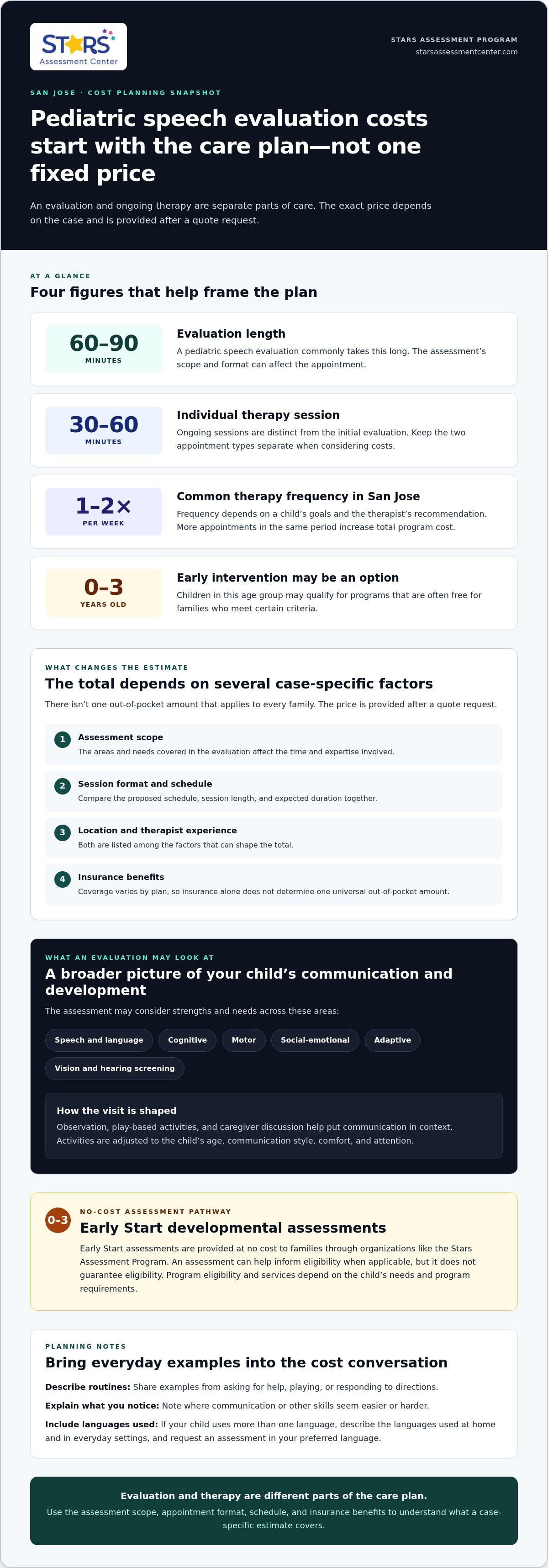
- Plan for an evaluation that commonly takes 60 to 90 minutes, while individual sessions often last 30 to 60 minutes.
- See how a speech and language evaluation or broader developmental assessment can help clarify what support may fit your child.
Speech therapy evaluation and session prices
When searching for a pediatric speech evaluation cost San Jose families need to know that an evaluation and ongoing speech therapy sessions are separate parts of a child’s care plan. Your total depends on assessment scope, session format, location, therapist experience, and insurance benefits; the exact figure is provided in a quote for your case.
The assessment may consider a child’s strengths and needs across speech and language, cognitive, motor, social-emotional, adaptive, vision and hearing screening. Before the appointment, think about what you hope to understand and share examples from daily life. The results are explained in clear, simple language, with guidance on possible next steps.
Frequency and Program Costs
San Jose speech therapy commonly takes place once to twice a week, depending on a child’s goals and therapist recommendation. More frequent sessions mean more appointments within the same period, so frequency directly affects the total program cost. Compare the proposed schedule, session length, and expected duration together. For example, a once-weekly plan and a twice-weekly plan create different appointment totals, even if each visit covers similar goals.
Consider how your child communicates in familiar routines, such as asking for help, playing, or responding to directions. These examples help put assessment activities in context and make the discussion more relevant to your family.
Free and No-Cost Options
In the United States, children ages 0 to 3 may qualify for early intervention programs that are often free for families who meet certain criteria. Eligibility and the services available depend on the child’s needs and program requirements. For a family considering this route, the practical first step is to learn how the child’s communication concerns are assessed and what support the program can provide.
Early Start is a program that may be informed by a developmental assessment. Early Start developmental assessments are provided at no cost to families through organizations like the Stars Assessment Program. The assessment helps inform eligibility when applicable, but does not guarantee eligibility.
The assessment is structured, play-based, flexible, and child-led. Activities are adapted to your child’s comfort and attention, and parents are present throughout. The assessment can take place in a natural environment or an assessment center. Its length depends on the child’s age and attention, and it is structured and paced to the child.
The assessment considers development across speech and language, cognitive, motor, social-emotional, adaptive, vision and hearing screening. For example, it may explore how your child understands language, uses sounds, words, or gestures, learns through play, moves, connects with others, and manages everyday routines.
To prepare, write down the concerns you want to discuss and a few examples of what you have noticed. Include the situations where communication or other skills seem easier or harder. If your child uses more than one language, share the languages used at home and in other everyday settings, and ensure you request an assessment in your preferred language.
Pediatric speech and language assessments
A pediatric speech and language assessment looks at how a child communicates, not just whether every word sounds clear. The U.S. Department of Education estimates that 6 million children in the United States have some form of communication impairment. An assessment helps describe an individual child’s skills and identify areas that may need closer attention.
Speech and language development includes understanding language and expressing ideas through sounds, words, and gestures. An assessment may also consider how a child communicates during play and everyday routines. For example, difficulty being understood is different from difficulty following familiar directions, and sharing both concerns can help clarify what you want to understand.
The assessment uses observation, play-based activities, and discussion with caregivers. Activities are adjusted to the child’s age, communication style, comfort, and attention. A child who communicates readily at home may need time to settle in a new setting, so familiar examples from parents help provide context.
Before the visit, write down a few examples of communication that prompted your concern. Include when each example happens, who the child is speaking with, and what makes communication easier or harder. If a child uses more than one language, describe the languages used at home and school. These details help make the assessment relevant to the child’s everyday life.
Assessment findings can clarify whether concerns involve speech sounds, understanding language, expressing thoughts, or several areas together. A child’s results can also help families understand what questions to discuss next. For instance, if articulation is the main concern, the findings can distinguish sound production from broader language skills. If several communication areas need attention, a wider developmental picture may be useful.
Families considering private pay can use the evaluation plan to understand what the appointment is designed to assess. Ask what communication areas are included, how caregiver observations are considered, and how results will be explained. These steps make it easier to compare an initial assessment with the child’s actual needs, rather than treating every evaluation as the same service.
Assessment is also distinct from a school-based review or an ongoing therapy program. A school may focus on communication in the learning environment, while a clinical evaluation can explore concerns parents notice across daily routines. Sharing school observations, such as difficulty being understood during group activities, can add context without replacing the child’s direct assessment.
When communication concerns appear alongside questions about other areas of development, a broader assessment may help connect the observations. For example, a child’s communication, play, and social interaction may be considered together. A child communication assessment can help families organize concerns and understand which skills the evaluation examines.
Typical session and evaluation lengths
In San Jose, a pediatric speech therapy evaluation usually takes 60 to 90 minutes. Ongoing sessions most often last 30 to 60 minutes, with younger children often starting with 30-minute appointments. These timeframes help families plan the visit, but they serve different purposes: an evaluation gathers information, while therapy sessions focus on developing selected communication skills.
A longer evaluation allows time to understand the reason for referral, observe the child, and consider relevant communication areas. The assessment may include caregiver discussion and activities suited to the child. For example, a parent can share how the child communicates at home, while the clinician observes responses during play. The 60-to-90-minute appointment gives the evaluation room to consider those different perspectives.
A therapy session is shorter because it focuses on working toward goals identified for the child. A 30-minute visit may suit a younger child beginning therapy, while a session lasting up to 60 minutes allows more time for planned activities. The appropriate length depends on the child’s needs and the goals being addressed, not simply on choosing the longest appointment.
To prepare for an evaluation, note your child’s communication examples before the visit. Include familiar words, sounds that are difficult to understand, or situations where following directions feels challenging. Bring those observations to the appointment. This step can help focus discussion within the scheduled 60 to 90 minutes and connect assessment activities with your child’s daily routines.
For ongoing therapy, consider how the session length fits your child’s attention and participation. A shorter appointment may be a manageable starting point for a young child. As skills develop, the therapy plan can focus on the activities and practice that match the child’s goals. The session should have a clear purpose, whether it addresses speech sounds, language, or another communication need.
Setting also shapes how families use appointment time. In a clinic, allow time to arrive and help your child settle before the session begins. For online therapy services, plan for a quiet space and have any needed materials ready. These steps help children participate during the scheduled 30-to-60-minute session instead of spending much of it adjusting to the setting.
When comparing therapy services, look at duration alongside the session’s purpose and the child’s response. Ask how the proposed length supports the planned activities and how progress will inform future sessions. A family can then consider whether a 30-minute starting visit or a longer appointment best matches the child’s current goals and ability to participate.
What is included in a pediatric speech-language evaluation, and how long does it take?
A pediatric speech-language evaluation in San Jose usually takes 60 to 90 minutes. The appointment typically combines caregiver discussion, observation, and activities that help describe a child’s communication. Its focus depends on the concern prompting the visit. For example, difficulty saying certain sounds calls for different observations than difficulty understanding everyday directions.
The first step is sharing what you have noticed. Describe specific moments, such as difficulty asking for help, joining interactions, or responding to familiar directions. The discussion can also cover your child’s communication routines, languages, and the situations where they seem most comfortable expressing themselves.
Next, the evaluator observes how your child communicates during age-appropriate activities. They may consider speech sound production, understanding language, expressing needs, and using communication during interaction. A picture-naming activity, for instance, can provide one example of how a child says familiar words. The evaluator interprets observations alongside caregiver input, rather than relying on one activity alone.
The areas reviewed depend on the referral concern and your child’s participation. If speech sounds are the main question, the evaluation may focus on how your child produces particular sounds and whether others understand them. If language is the concern, discussion may include understanding questions or expressing thoughts. When more than one area raises questions, the assessment can consider those concerns together.
Children don’t all respond to an unfamiliar setting in the same way. A child may speak freely at home but need time to feel comfortable with a new person. Sharing examples from familiar routines can give useful context if your child is quiet during part of the appointment. Caregivers can also describe gestures, words, or other ways their child communicates.
After the activities, the evaluator explains the findings and what they suggest about the child’s communication. Families can ask how observations relate to concerns at home, what strengths appeared, and which areas may need attention. For example, results may help distinguish a speech sound concern from a broader question about understanding or expressing language.
The 60-to-90-minute appointment allows time for this information gathering and discussion. The exact flow depends on the child’s needs, attention, and areas being assessed. Before the visit, prepare a short list of examples and questions. That step helps keep the conversation focused, supports a clearer explanation of findings, and helps you understand what the evaluation covered.
Insurance coverage and out-of-network superbills
Insurance can affect what families pay for pediatric speech therapy, but benefits depend on the plan and service. For a child’s evaluation or therapy sessions, review whether speech-language services are covered, whether a referral is required, and how deductibles, copays, and visit limits apply. These details determine how the plan treats each appointment.
For out-of-network care, a superbill is an itemized document that families can submit to their insurer for possible reimbursement. It generally records the service, provider, and payment information. Reimbursement depends on the plan’s out-of-network benefits and its rules for eligible services. A superbill is not a promise of payment, so include its potential reimbursement only after understanding those plan terms.
Use a simple sequence to understand your benefits: identify whether the evaluation and therapy are covered, determine whether the provider is in network, then review any deductible, copay, coinsurance, or session limit. Coverage for an evaluation may differ from coverage for ongoing sessions. Keeping those items separate helps you estimate your own responsibility for each part of care.
Medicare Part B provides one specific comparison, though it does not describe a child’s private insurance plan. Speech therapy patients with Medicare Part B typically pay 20% after meeting their deductible. That percentage applies to the Medicare fact, not automatically to a pediatric plan in San Jose.
Without insurance, estimate monthly spending by multiplying the private-pay charge per session by the number of sessions scheduled. For example, a plan with two sessions each week creates a different monthly total from one with a single weekly visit. Include the evaluation separately, then account for any changes in frequency or session length. This approach shows how the schedule affects the budget without blending assessment and therapy charges.
For a practical comparison, make a short list of the evaluation, planned sessions, and insurance terms. Record which items apply to each service, then calculate the expected out-of-pocket amount using your plan’s actual benefits. The price depends on the assessment’s scope, session format, frequency, and insurance arrangement; the exact figure is provided in a quote for your case.
If you’re weighing assessment needs alongside coverage, explore assessment options and consider which questions you want the evaluation to answer. A clear list of concerns, such as speech sounds or understanding language, can help keep the discussion focused on your child’s needs.
Stars Assessment Program: Social-Emotional Assessment
Stars Assessment Program offers a Social-Emotional Assessment for families seeking insight into how a young child connects, communicates, and responds during everyday interactions. If speech concerns appear alongside questions about social engagement or other developmental skills, a broader view may help clarify what your child needs. Its Speech and Language Evaluation focuses on communication, while a Multidisciplinary Developmental Assessment considers development across several areas. Stars Assessment Program also offers Autism assessment.
Before the assessment, note the situations that prompted your questions, such as difficulty expressing needs or joining interactions. Sharing these observations helps guide the discussion and connect the assessment to your child’s everyday experiences.
Contact Stars Assessment Program to discuss an assessment for your child.
Take the Next Step With Clarity
When considering pediatric speech evaluation cost in San Jose, know that Stars Assessment Program provides developmental assessments at no cost to families. If you have questions about how your child communicates, connects with others, or responds to everyday directions, you can contact Stars directly. If something does not feel right, you do not have to wait for certainty to act.
Stars Assessment Program offers a Speech and Language Evaluation, Social-Emotional Assessment, and Multidisciplinary Developmental Assessment. The right focus depends on the questions you want an assessment to address. Pricing depends on the individual case and factors such as assessment scope, appointment format, and insurance arrangements; an exact figure is provided after a quote request.
If you’re ready to discuss your child’s developmental assessment needs, contact Stars Assessment Program. Taking one thoughtful step can make the path ahead feel clearer for your family.
Frequently Asked Questions
What do I do if I suspect my child has a speech or language problem?
Write down specific examples, then arrange an evaluation focused on your concern. Note what your child says or understands, when communication feels difficult, and what helps. For instance, record whether familiar directions are easier to follow with gestures. If your child is under the age of 3 years, Stars Assessment Program offers a Speech and Language Evaluation. This is not a diagnostic assessment, but it can help clarify developmental questions.
What is the average cost of a pediatric speech-language evaluation in San Jose, CA?
There isn’t one average amount that applies to every pediatric evaluation in San Jose. Private evaluation charges depend on the assessment’s scope, appointment format, clinician, and insurance arrangement. The pediatric speech evaluation cost in San Jose therefore depends on what the evaluation needs to cover. Separate a one-time assessment from any recommended therapy when comparing estimates, so you understand which services each amount includes.
How much do private speech therapy clinics in San Jose charge for an initial evaluation?
Private clinics set evaluation charges according to the child’s needs and the assessment’s scope. A focused question about speech sounds can involve different assessment work than concerns covering several communication areas. Ask for a case-specific quote that identifies what the initial evaluation includes, such as caregiver discussion, assessment activities, and a results conversation. This breakdown helps you compare the service itself rather than looking only at a single total.
Does health insurance cover pediatric speech evaluations in California?
Coverage depends on the specific health plan and the service being considered. Review your plan’s speech-language benefits and identify how it handles evaluations, referrals, deductibles, and visit limits. Ask whether the evaluation is treated differently from ongoing therapy. Keep notes on the answers and any claim requirements. This gives you a clearer picture of your plan’s terms without assuming that another family’s coverage will match yours.
Can California Medi-Cal cover a child’s speech-language evaluation?
Medi-Cal coverage depends on the child’s plan, the requested service, and applicable benefit rules. Review the member materials for speech-language evaluation coverage and any steps needed before an appointment. Separately, Stars Assessment Program provides developmental assessments, including Early Start assessments, at no cost to families. These assessments help inform eligibility when applicable; they are not a diagnostic assessment and don’t guarantee program eligibility.
How much do speech evaluations cost at San Jose children’s hospitals or university clinics?
Hospital and university clinic charges depend on the evaluation setting, the services included, and how the visit is billed. A facility estimate may separate the evaluation from other services, so read each listed item before comparing options. For families near San Jose, ask whether the estimate covers only the assessment or also related appointments. That distinction helps explain why two evaluations can have different totals.
Do San Jose speech clinics offer sliding-scale fees, payment plans, or free screenings?
Payment arrangements and screening options differ among clinics, so there isn’t one standard option across San Jose. Look for written details about what a screening includes and whether it is distinct from a full evaluation. For children under the age of 3 years, Stars Assessment Program’s developmental assessment is provided at no cost to families. It’s an assessment, not a diagnostic service.
How can parents find a licensed pediatric speech-language pathologist in San Jose?
Ask for the speech-language pathologist’s full name and license details, then use California’s official professional-license lookup to review the record. Also consider whether the clinician evaluates children and addresses your specific concern, such as speech sounds or language understanding. Families in San Jose, Santa Clara, Santa Cruz, Salinas, Milpitas, Gilroy, and Morgan Hill can use those questions to organize their search and compare relevant experience.


