

A developmental screening is a starting point for understanding a child’s development, not the whole process. For developmental delay screening in Santa Clara County, parents can ask their child’s primary care provider for a screening; if it indicates that further evaluation is needed, the provider can refer the child for a comprehensive diagnostic evaluation. Screening can look at language, movement, thinking, behavior, and emotions.
It’s understandable to feel uncertain when your child’s development raises questions. A screening can help clarify what may need a closer look and what steps could follow, while a referral can connect families with a more in-depth evaluation when needed.
This guide explains the difference between screening and assessment, how Early Start may fit into the next steps, and how families in Santa Clara County can explore developmental support. Stars assessments are explained in clear, simple language, so families can better understand their child’s development and what may come next.
Key Takeaways
- Bring specific observations about your child’s communication, movement, learning, behavior, or emotions to their primary care provider and ask about screening.
- If screening points to a need for a closer look, a comprehensive evaluation can help clarify your child’s developmental strengths and support needs.
- Explore Santa Clara County’s Early Start resources, where parents and caregivers take an active role in supporting children’s learning through everyday activities.
- Standardized tools can help organize observations across developmental areas, giving families and professionals a clearer basis for next steps.
- For questions involving social-emotional, developmental, or communication concerns, learn how Stars Assessment Program’s assessments and evaluations may support your family.
Early identification and support for developmental delays
Early identification means noticing developmental concerns and taking a practical next step. In Santa Clara County, families can seek screening and connect with local early support.
Santa Clara County Early Start Program
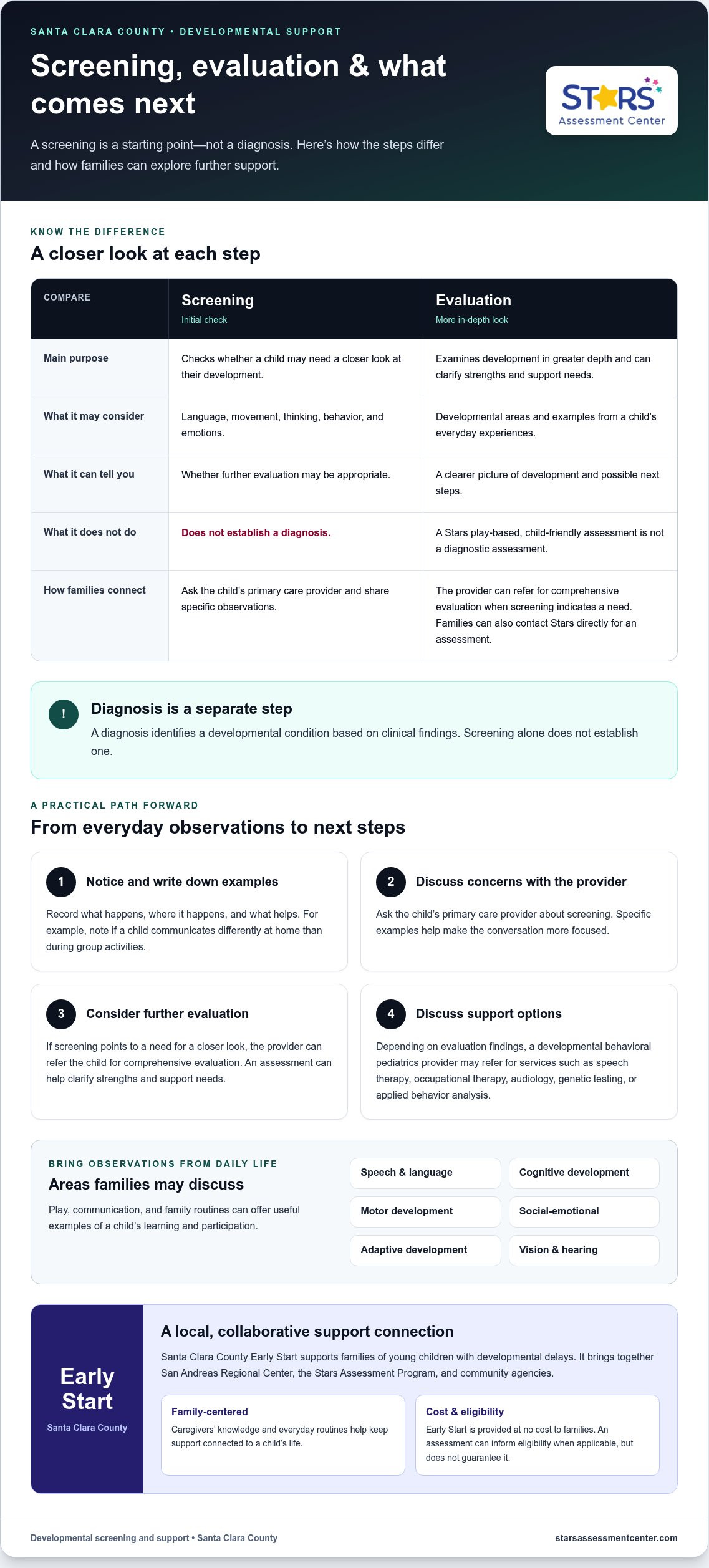
Santa Clara County Early Start is a collaborative program that supports families of young children with developmental delays. It involves San Andreas Regional Center, the Stars Assessment Program, and community agencies.
Families and caregivers are central to understanding a child’s development. Everyday activities, such as play, communication, and family routines, can offer useful examples of a child’s learning and participation. Sharing these observations during an assessment helps keep the discussion connected to the child’s daily life.
Early identification can help families understand what to explore next. If you’re concerned about a child’s development, write down examples, such as difficulty communicating a need or joining play, and discuss them with the child’s primary care provider. The provider can screen the child and help determine whether further evaluation is appropriate. Early Start offers a local connection to family-centered support.
Requesting a Developmental Screening
A developmental screening is a brief check that helps identify whether a child may need a closer evaluation. To request one for developmental delay screening Santa Clara County, ask the child’s primary care provider and describe the specific changes or skills you’ve noticed.
For an Early Start connection, contact the Stars Assessment Program Early Start Program to discuss available family support. The screening request itself can go to the primary care provider, who can consider the concerns and refer the child for comprehensive evaluation if screening indicates a need. Families interested in First 5 can ask about family resources, while using the primary care provider as the route for screening.
Before discussing your concerns, note examples from different settings. A child may use gestures at home but communicate less during group activities, for instance. Consider what you’ve noticed about speech and language, cognitive, motor, social-emotional, or adaptive development. Clear examples help make the discussion more specific.
Support After Qualifying for Services
If an assessment indicates that further support may be helpful, families can discuss next steps and available resources. Early Start is a program that may be informed by an assessment and is provided at no cost to families. The assessment helps inform eligibility when applicable, but it does not guarantee eligibility.
Families can share what works during routines, where a child needs help, and which goals matter at home. For example, a caregiver might describe how a child communicates during meals or responds to play. Those details help keep discussions about development connected to the child’s everyday experiences.
For questions about the next steps, contact the program involved and ask how your family can participate. Santa Clara County Early Start is collaborative, bringing together San Andreas Regional Center, the Stars Assessment Program, and community agencies. A developmental evaluation can also help clarify a child’s strengths and support needs when further assessment is recommended.
Developmental evaluation and referrals
A developmental screening is an initial check for possible concerns, while an evaluation examines development in greater depth. A diagnosis identifies a developmental condition based on clinical findings; screening alone does not establish one. Understanding these differences can help families know what to ask for next.
If you have concerns about development, you can contact the Stars Assessment Program directly for an assessment. The play-based, child-friendly assessment considers the child’s development and helps families understand possible next steps. This is not a diagnostic assessment.
Families can request a school district evaluation by writing to the district’s special education department or the school principal. Describe the child’s challenges with examples, such as difficulty communicating needs or participating in classroom activities, and ask what steps the district uses to consider an evaluation. Keep a copy of the request and any response for your records.
If a pediatrician doesn’t recommend screening, explain the specific behaviors or developmental changes that prompted your concern. Ask what factors informed the recommendation and whether another visit can review your observations; you can also seek a developmental assessment to explore the concern further.
Referral means directing a child to a specialist or service for further assessment or support. After evaluation, a developmental behavioral pediatrics provider may refer a child for applied behavior analysis, genetic testing, audiology, speech therapy, or occupational therapy, depending on the findings. These referrals address different needs: audiology can assess hearing, while a speech referral can address communication concerns.
Before an assessment, organize notes around the child’s everyday experiences. Record what happens, where it happens, and what helps, such as whether your child follows spoken directions at home but struggles in a noisy group. Consider speech and language, cognitive, motor, social-emotional, adaptive, and vision and hearing screening. Specific examples help focus the assessment.
When communication is the main concern, a Speech and Language Evaluation can examine a child’s speech and language skills. For concerns spanning several areas, a Multidisciplinary Developmental Assessment can provide a broader assessment. These options can help families explore concerns beyond an initial screening and understand what areas merit closer attention.
Evaluation findings can guide the next conversation with a primary care provider, school district, or developmental program. Ask what the results mean for the child’s daily routines, which concerns need follow-up, and how family observations can inform support. A clear record of the evaluation and recommended referrals can help keep those conversations focused.
Santa Clara County family and developmental resources
Family and developmental resources connect caregivers with screening, guidance, and support. In Santa Clara County, families can explore Early Start and Medi-Cal well-child services as starting points for developmental questions.
Early Start family support
Santa Clara County Early Start is a collaborative program offering resources to family members and caregivers. It involves San Andreas Regional Center, the Santa Clara County Office of Education, and community agencies.
Caregiver participation helps make an assessment relevant to a child’s daily life. Families can share how a child learns and participates through play, conversation, and familiar routines. Stars assessments are child-led and paced to the child, with parents present throughout.
For program information, families can contact Michelle Kjellesvig, Assistant Director of Early Learning & Development for the Santa Clara County Office of Education Early Start Program, at (408) 573-3000. When calling, describe the child’s age and the kind of developmental concern prompting your questions. This helps direct the conversation toward relevant local resources.
Medi-Cal preventive screening
Preventive screening is a check for developmental concerns provided during eligible well-child care. Santa Clara Family Health Plan Medi-Cal includes developmental screening at well-baby visits from birth through 12 months, and well-child visits from 12 months to 4 years.
Coverage also includes developmental screening at well-child visits for young adolescents ages 11 to 15, and well-care visits for adolescents ages 16 to 21. Santa Clara Family Health Plan Medi-Cal preventive care services and screenings for children and teens are available at no cost and without prior authorization.
Families can use these age-based visits to raise developmental concerns during routine care. For example, a caregiver can describe a question about communication or behavior and ask about screening at the child’s visit. Keeping notes about examples from home, school, or social activities can make that discussion more specific.
Behavioral health treatment referrals
A behavioral health referral is a recommendation from a qualified professional for treatment. Santa Clara Family Health Plan members need a referral from a licensed physician, surgeon, or psychologist to receive behavioral health treatment.
If a provider recommends behavioral health treatment, such as applied behavior analysis, families can ask that provider to submit prior authorization requests for necessary treatment. This applies to a medical recommendation for treatment; it is a distinct step from asking about developmental screening during a well-child visit.
To keep these resource pathways clear, families can note the question, the child’s age, and the relevant visit or provider. For instance, a caregiver exploring a behavioral health recommendation can record who made it and what treatment was discussed. A family seeking developmental screening can raise that concern during the child’s eligible well-child visit.
Standardized developmental and behavioral screening
A standardized developmental screening uses consistent questions or tasks to flag areas that may need closer attention. These tools can help organize observations about a child’s language, movement, thinking, behavior, and emotions.
Two tools listed for developmental screening are the Ages and Stages Questionnaires® Third Edition (ASQ-3) and the Ages and Stages Questionnaires®: Social Emotional (ASQ:SE-2). Their names point to different areas of focus: the ASQ-3 covers developmental skills, while the ASQ:SE-2 focuses on social-emotional development. A screening tool helps identify possible concerns; it doesn’t, by itself, provide a diagnosis.
In California, an estimated 48.1% of children ages 1-11 had received a standardized developmental and behavioral screening in 2021-2022. That figure describes the state, not an individual child or screening center. For families, the useful next step is to discuss screening during a child’s care and share examples that may help clarify which developmental areas to review.
Questions about development can connect a child’s skills with everyday situations. A caregiver might describe how the child communicates a need, handles a change in routine, or joins play with others. These examples help explain whether concerns relate mainly to speech and language, social-emotional development, or more than one area.
To prepare for a screening, consider these steps:
- Write down a specific example of a skill or behavior that concerns you.
- Note where you observe it, such as at home, during play, or in a group.
- Share what helps the child communicate, move, learn, or participate.
- Ask what the screening results suggest and whether further evaluation is appropriate.
Regular screening for special health care needs beginning early in a child’s life may reduce the long-term consequences of some chronic conditions. A screening result is best understood alongside a child’s daily experiences and family observations. If a result points toward further evaluation, the child’s primary care provider can refer the child for a comprehensive diagnostic evaluation.
Families can ask for screening in Spanish or another preferred language and request language support when arranging the visit. The screening provider can explain which language options are available for the appointment and materials, helping caregivers understand questions and share observations clearly.
Standardized screening can also help families describe concerns consistently across conversations. For example, if a child has difficulty expressing needs in different settings, caregivers can note what they observe at home and elsewhere. Sharing those details with the provider can help focus the discussion on communication and determine whether a closer assessment would add useful information.
Where can children get developmental delay screening in Santa Clara County?
A developmental screening is an initial check for signs that a child may need closer assessment. In Santa Clara County, parents concerned about development can ask the child’s primary care provider for screening. This gives families a clear starting point, whether the concern involves communication, movement, learning, behavior, or emotions.
Before an assessment, describe the skill or behavior that raised questions and when it happens. For example, explain whether your child uses gestures to communicate at home, responds to their name during play, or has difficulty joining activities. Specific examples help focus the discussion on the child’s development.
A primary care provider can refer a child to a developmental behavioral pediatrics provider for a comprehensive diagnostic evaluation if screening indicates further evaluation is needed. The evaluation can examine concerns in greater depth and guide referrals for other assessments or services. For example, a concern about spoken communication may lead to further consideration of speech and language needs.
Before requesting an assessment, gather details that can make the conversation more useful:
- Write down the developmental skill or behavior you’re concerned about.
- Note where you observe it, such as during meals, play, or group activities.
- Describe what happens when you offer help or change the activity.
- Bring questions about what screening results could mean for next steps.
These notes don’t need clinical language. A simple example, such as “My child points at a toy but doesn’t use words to ask for it,” gives the assessment team a concrete starting point. If you’ve noticed the same concern in different settings, describe each one. If it happens only in a particular situation, explain that too.
After the assessment, ask which areas were reviewed and what the findings suggest. If further support is discussed, ask how it relates to the concern you described. A child with questions across speech and language, cognitive, and social-emotional development may benefit from a broader assessment that considers multiple areas together.
If concerns involve several developmental areas, a Multidisciplinary Developmental Assessment can help families explore them through a broader evaluation. This may be a useful next step when a screening points toward further assessment or when questions extend beyond one specific skill.
Screening is a starting point, not a final label. In Santa Clara County, asking the child’s primary care provider is a practical first step; sharing clear observations can help focus the conversation and clarify whether further evaluation is appropriate.
Stars Assessment Program: Social-Emotional Assessment
Stars Assessment Program offers a Social-Emotional Assessment for families seeking a closer look at a child’s emotional and social development. Consider an assessment when concerns about interactions, emotional responses, or behavior remain after initial screening, or when you want a more detailed understanding of your child’s needs.
For concerns across several developmental areas, a Multidisciplinary Developmental Assessment can provide a broader view. A Speech and Language Evaluation focuses on communication, while an Autism assessment addresses questions related to autism. The appropriate focus depends on the concerns your family wants to explore.
Preparing a few examples from home, play, or daily routines can help make your concerns clear during an assessment. If you’d like to discuss developmental assessment options, contact Stars Assessment Program.
Take the Next Step With Confidence
Once you’ve identified a concern, consider what you want to understand better. For developmental delay screening in Santa Clara County, think about the questions still on your mind: Are social-emotional responses a concern? Would a broader view of development be useful? Is communication the area you’d like to explore?
Stars Assessment Program offers Social-Emotional Assessment, Multidisciplinary Developmental Assessment, and Speech and Language Evaluation. These assessment options can help families explore concerns in the areas they address and bring more focus to the questions they want answered. You don’t need to have every concern neatly organized before taking a next step. A few observations from daily routines can help you explain what you’ve noticed.
If you’re ready to discuss which assessment may fit your concerns, contact Stars Assessment Program. Moving forward with clear questions can help you feel more prepared to support your child’s development.
Frequently Asked Questions
What ages are eligible for California Early Start developmental evaluations?
Early Start supports infants and toddlers, and Stars Assessment Program evaluates children under the age of 3 years. Families can request an assessment when they notice developmental concerns, whether or not their child has a diagnosis. The assessment helps inform eligibility when applicable, but it doesn’t determine eligibility on its own. It is not a diagnostic assessment; families receive results in clear, simple language to help them understand possible next steps.
Does Santa Clara County offer free developmental screening for infants and toddlers?
Santa Clara Family Health Plan Medi-Cal preventive care screenings are available at no cost to members. Separately, Stars Assessment Center provides developmental assessments, including Early Start assessments, at no cost to families. Early Start is a program that may be informed by an assessment; the assessment helps inform eligibility when applicable but does not guarantee it. Screening and assessment are different steps: a screening can flag a concern, while an assessment looks more closely at development.
What developmental milestones and screening tools are used to identify delays?
Screening considers children’s language, movement, thinking, behavior, and emotions. Examples include how a child communicates needs, explores objects through play, moves around, or responds during interactions. Tools listed for screening include the Ages and Stages Questionnaires® Third Edition (ASQ-3) and Ages and Stages Questionnaires®: Social Emotional (ASQ:SE-2). A tool helps organize observations; it doesn’t provide a diagnosis. Share everyday examples with the provider to add context to screening responses.
How long does a developmental evaluation and referral take in Santa Clara County?
There is no single timeline for an evaluation and referral. The process depends on arranging the evaluation, the areas being assessed, and which follow-up referrals are needed. At Stars Assessment Program, assessment length depends on the child’s age and attention; the assessment is structured and paced to the child. The assessment is not diagnostic, and families receive results in plain language to help them understand next steps and discuss any referrals.


