
A referral for evaluation is a next step, not a diagnosis. Developmental screening vs. evaluation comes down to a brief check for possible concerns versus a closer look at a child’s development, strengths, and support needs. Screening can show whether further evaluation may be helpful, but it can’t diagnose a disability.
It’s understandable to feel uncertain when a screening raises a concern or someone recommends an evaluation. These steps serve different purposes, and neither tells the whole story of your child’s abilities or needs.
This article explains what developmental screening checks, how assessment and evaluation differ, and what a referral may mean. You’ll also learn how a more detailed evaluation can help clarify a child’s needs and guide decisions about support.
Key Takeaways
- A developmental screening is a brief check that can flag areas where a closer look may help; it isn’t a diagnosis.
- Standardized tools use questions or checklists to look at areas such as communication, movement, thinking, behavior, and emotions.
- An evaluation explores a child’s development in more depth, while assessment can describe skills and needs in a particular area.
- A referral opens the door to learning more about a child’s needs; it does not by itself mean the child has a disability.
- Understanding who conducts each step and what it can show can help families make sense of the next steps in seeking support.
What Is Developmental Screening?
Developmental screening is a structured check for possible concerns in a child’s development. Depending on the tool, it may ask about language, movement, thinking, behavior, emotions, and milestones.
Standardized Screening Tools
A standardized developmental screening tool uses consistent questions or tasks to check skills. This structure helps families and professionals organize observations instead of relying on memory alone.
For example, the ASQ-3 is designed for children from 1 to 66 months of age. It looks across developmental areas, helping identify patterns that may call for further evaluation. A developmental questionnaire can offer one way to organize observations about a child’s development. These tools differ in format and age range, so the child’s age and the concern being explored help determine which tool fits.
A screening score is a signal to consider, not a diagnosis. It can start a conversation about a child’s strengths, needs, and possible next steps.
Formal Screening Tools
Formal screening tools use research-based questionnaires or checklists rather than relying on informal observation alone. Their consistent format can help identify skills that may deserve a closer look.
The Infant Toddler Checklist, for example, is intended for children from 6 to 24 months. It includes 24 yes-or-no items and one open-ended question. A caregiver’s responses can capture details about communication that may not arise during a short visit.
Screening differs from developmental monitoring, which involves observing a child’s growth and milestones over time. A checklist adds a structured snapshot to those ongoing observations. Neither replaces a fuller assessment when concerns remain or more detail is needed.
Screening Tool Purpose
A screening tool helps determine whether a child’s development appears on track or whether further evaluation may be useful. It is designed to flag possible concerns, not explain their cause.
Questions may cover whether a child uses words, moves, or responds during everyday interactions. A parent’s concerns matter, too. A tool can organize observations, but it cannot make those observations irrelevant.
Screening may be recommended at certain ages, and professionals may also consider concerns raised between routine visits. If results suggest a closer look, an assessment can explore the child’s skills in more depth. A concerning result alone does not establish a disability.
Assessment Tools and Data Collection
An assessment gathers information about a child’s functioning in developmental areas. It may combine direct observation with information from people who know the child’s everyday behavior.
For example, communication can be explored through a child’s words, gestures, and responses during familiar activities. Social-emotional development can be considered through how the child expresses feelings and engages with others. These examples connect skills to daily life, rather than treating a score as the whole picture.
Screening tools, assessments, and evaluations can each contribute information about interests, strengths, and needs. The difference is how narrowly or deeply they examine development. A screening result can point toward an area to explore; assessment data can help describe what the child does and where support may be useful.
Referral for further evaluation and early intervention
A referral connects a child’s possible developmental needs with a closer evaluation. It starts a process for learning what support may help, not a diagnosis.
Screening as an Early Check
Screening is a check for possible developmental concerns, not a diagnosis. Its result can indicate whether a closer assessment may help clarify a child’s needs.
A screening concern may involve communication, movement, or social interaction. For example, a child’s responses may suggest that language skills deserve a closer look. Screening can prompt a referral, but families can also contact Stars directly for an assessment.
Under IDEA Part C, screening must be completed within 45 days after referral, according to the U.S. Department of Education. Screening uses appropriate instruments administered by trained personnel through the lead agency or an early intervention program. This timeline helps families understand when a screening step belongs in the referral process.
Eligibility and Age Ranges
Early intervention evaluation gathers information to determine a young child’s needs and eligibility for services. IDEA Part C provides early intervention services to eligible infants and toddlers and their families.
A referral does not automatically make a child eligible. Evaluation considers the child’s development and needs; eligibility decisions guide whether early intervention services are available. In most states, an Individualized Family Service Plan, or IFSP, is used for children from birth through age 2.
Parents can request an initial Part C evaluation and give consent, even when screening hasn’t identified a suspected disability. The program must evaluate the child in that situation. This matters if a parent continues to have concerns, because a screening result does not prevent a family from seeking a closer look.
To request evaluation through early intervention, parents can contact their state’s Part C program or lead agency directly. Families may self-refer rather than wait for a professional referral. A Part C program offering evaluations is available in every U.S. state and territory.
For children aged 3 years and older, local public school systems typically provide developmental services and support. Parents can contact their local school system to request an evaluation for school-related services. The evaluation pathway depends on the child’s age and the kind of support being considered.
Does insurance cover developmental evaluations, and what do they cost? Coverage depends on the insurance plan and evaluation pathway. Costs depend on the case and are provided after a quote request.
A detailed assessment can help families understand specific developmental concerns, such as communication needs. A multidisciplinary developmental assessment can be a next step when a broader picture of a child’s development is needed.
Does every child who is referred for evaluation have a disability?
No. A referral begins a process for understanding a child’s development, needs, and possible eligibility for services; it does not establish a disability. For toddlers, an assessment may clarify concerns about communication, daily participation, or another area of development. This is not a diagnostic assessment.
The purpose depends on the system involved. Under IDEA Part B, an evaluation determines whether a child has a disability and needs special education and related services. Screening may help inform whether to refer, but it does not make the eligibility decision. A referral for a school evaluation means the child’s needs will be examined, not that a disability has already been established.
For younger children, IDEA Part C addresses early intervention. If a parent requests and consents to an initial evaluation, the program must evaluate the child even when screening hasn’t identified a suspected disability. The evaluation helps determine needs and eligibility for services. A child’s results can inform decisions about support without making a referral itself a diagnosis.
Eligibility and support are related, but they are not the same question. An assessment may show that a child needs support in a particular area, while a program’s criteria determine access to specific services. For example, communication concerns may deserve careful assessment. Decisions consider developmental information and the child’s functioning, rather than treating a referral as proof of a condition.
Funding for an assessment is another distinct consideration. In California, CDI says a child under 3 may be eligible for Regional Center funding for a developmental assessment. That funding possibility doesn’t itself determine eligibility for special education under IDEA Part B or early intervention under Part C. Each decision follows the purpose and criteria of its own program.
Families can focus on what the evaluation is being asked to determine: a child’s developmental profile, eligibility for a program, or educational support needs. For instance, a school evaluation addresses special education and related services, while an early intervention evaluation considers needs under Part C. Keeping those purposes clear helps parents understand what a decision does, and what it doesn’t decide.
Even if a child does not qualify for a particular service, assessment information can help describe strengths and areas of concern. A referral is a step toward clearer answers, not a label or a prediction of the outcome for a child or family.
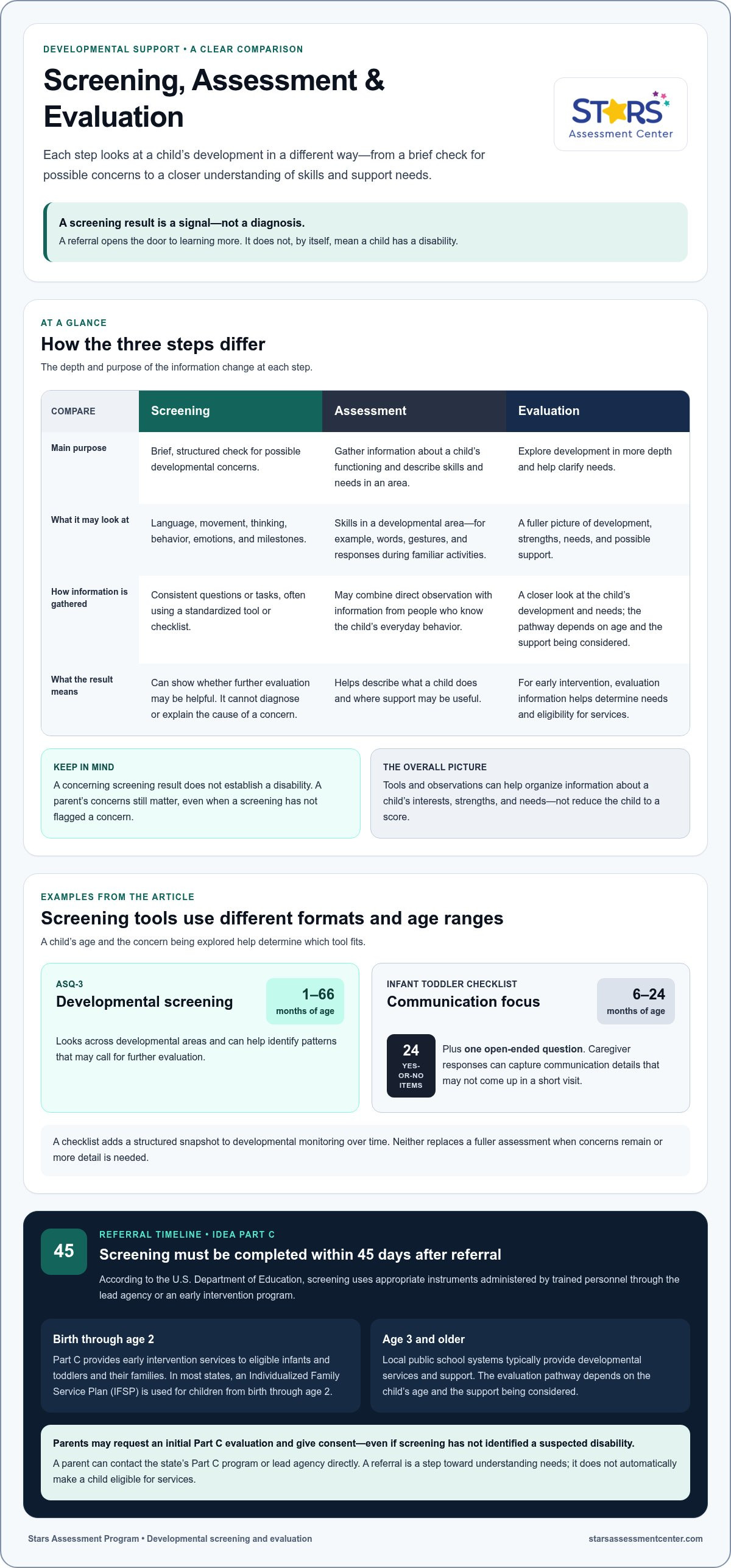
How screening, assessment, and evaluation differ
These terms describe related steps, but each answers a different question about development. Screening flags whether closer attention may help; assessment describes functioning across developmental areas; an evaluation gathers information to answer a broader question or inform decisions about services.
A screening tool offers a structured snapshot. It can flag possible concerns in infants and young children, but it does not explain why a skill is developing differently or determine a diagnosis. A checklist may ask about milestones, while a parent’s observations add context about how a child communicates or moves at home. The result helps guide what to explore next.
An assessment looks at a child’s development across relevant areas. Stars Assessment Program assesses speech and language, cognitive, motor, social-emotional, adaptive, vision and hearing screening. The structured, play-based assessment is child-led, adapts to the child’s comfort and attention, and parents remain present throughout. This is not a diagnostic assessment.
Evaluation is a more comprehensive process used after a child has been referred. It can examine development across areas and help clarify needs or eligibility for services. A developmental evaluation is described as a one-time, multidisciplinary examination, bringing together perspectives on areas such as communication, cognition, and physical development. The specific question behind the referral shapes what information is gathered and considered.
Consider a young child who uses few spoken words. Screening may flag communication as an area to explore. A speech and language evaluation can look at the child’s communication, while a multidisciplinary developmental assessment can consider other areas, such as play, learning, and interaction. Each step adds detail; they are not interchangeable.
The setting can shape the purpose, too. A school evaluation considers whether a child has a disability and needs special education and related services. A developmental assessment may instead describe functioning in a specific area without answering school eligibility questions. For families, knowing the referral question helps make a report easier to interpret: look for the skills examined, the observations gathered, and the decision the process is meant to inform.
In short, screening points toward a possible concern, assessment measures specific skills, and evaluation brings information together to answer a broader question. A child may have an assessment as part of an evaluation, while screening may prompt the referral that leads to both. Keeping these roles distinct helps parents understand what a result shows, and what it does not establish.
Who can perform developmental screenings and evaluations?
Who is involved depends on the step and its purpose. A pediatrician may discuss milestones during a well-child visit, while a program may arrange a closer assessment. Parents contribute by sharing examples of their child’s everyday communication, play, and routines, which help put observations into context.
The American Academy of Pediatrics recommends standardized developmental screening at the 9-, 18-, and 30-month well-child visits. A primary care professional can use a questionnaire or checklist to organize information and identify areas that may need follow-up. A parent’s observations matter too, especially when a child’s behavior differs between a clinic visit and familiar settings.
Under IDEA Part C, screening uses appropriate instruments administered by trained personnel through the lead agency or an early intervention program. The tools provide a structured check, while trained staff administer them and consider the responses. If a family has continuing concerns, parents can also refer themselves to early intervention for assessment instead of waiting for a screening result.
Evaluation involves a closer examination of development in response to a referral. Early intervention providers conduct evaluations when there’s a concern about a child’s development. A multidisciplinary process may consider areas such as communication, cognition, physical development, and social-emotional functioning. The professionals involved depend on the areas being explored and the evaluation’s purpose.
For education-related questions, a local public school system typically provides developmental services and support for children aged 3 years and older. A school evaluation considers whether a child has a disability and needs special education and related services. That purpose differs from a screening at a pediatric visit, which flags a possible concern rather than deciding school eligibility.
Families can help professionals understand what they see outside an appointment. For example, a parent might describe how a toddler communicates during meals, responds to familiar people, or follows everyday routines. These concrete examples add context to checklists and observations, helping evaluators understand how skills appear in daily life.
To make sense of who is involved, start with the question being addressed: a routine developmental check, an early intervention evaluation, or school eligibility. The screening tool, referral pathway, and child’s age help determine the setting and personnel. Parents can share concerns and everyday examples with the program handling the relevant step.
Stars Assessment Program: Social-Emotional Assessment
Stars Assessment Program offers Social-Emotional Assessment when a child’s emotions or interactions are a concern. This can help families explore a specific area of development beyond what a brief screening can show.
When a family has questions across developmental areas, a multidisciplinary developmental assessment can provide a broader picture. A speech and language evaluation may be useful when communication is a particular concern. The assessment can help clarify a child’s development and next steps, but it is not diagnostic.
These evaluations can help clarify a child’s strengths and needs. They are distinct from a brief screening and provide a closer look at development. If you’d like to discuss your child’s developmental concerns, contact Stars Assessment Program.
Choose a Next Step That Fits Your Child
Understanding developmental screening vs. evaluation can help you decide what information may be useful next. Start with the questions you still have: which skills concern you, when you notice them, and how they affect everyday routines. A few concrete examples can make a conversation more focused while keeping your child’s strengths in view.
You don’t need to have every answer before seeking guidance. If you’d like to talk through your child’s developmental needs and possible assessment options, contact Stars Assessment Program. A thoughtful next step can bring more clarity to your family’s questions and help you move forward with confidence.
Frequently Asked Questions
What Does It Mean When a Screening Identifies a Concern?
A screening concern means something may be worth exploring, not that a child has a diagnosis. Note what prompted the concern, such as difficulty communicating during play or following familiar routines. When does it happen, what helps, and do you notice it in different settings? Sharing these details can help clarify what questions an assessment should address. If something does not feel right, you do not have to wait for certainty to act.
What Is a Developmental Evaluation?
A developmental evaluation is a closer examination of a child’s skills and needs in response to a concern or referral. It may draw together observations and information about communication, learning, movement, or interactions. For example, if a child has difficulty both expressing needs and engaging in play, an evaluation can consider how those areas relate. Its purpose is to clarify development and guide decisions, not to define a child by one result.
Why Does the Timing Matter?
Timing matters because developmental questions can be raised during routine care or between visits, and families don’t need to wait for a scheduled screening to share a concern. The American Academy of Pediatrics recommends standardized developmental screening at the 9-, 18-, and 30-month well-child visits. If a parent notices a change or ongoing difficulty between those visits, sharing specific examples can help identify what information or follow-up may be useful.
What is developmental screening and what does it measure?
Developmental screening is a structured check that can flag skills for closer attention. Depending on the tool, questions may cover language, movement, thinking, behavior, and emotions. A caregiver might describe how a child communicates during play or responds to everyday interactions. The tool organizes observations into a snapshot, while daily experiences help explain what the responses mean.
What is a developmental evaluation and what does it assess?
A developmental evaluation gathers more detailed information to understand a child’s functioning and support needs. It may consider how skills work together, such as whether communication affects participation in play or daily routines. Professionals can use observations alongside information from parents and others familiar with the child. The areas explored depend on the concern being examined, so the findings can address a family’s particular questions.
How is developmental screening different from developmental evaluation?
Developmental screening vs evaluation describes the difference between an initial check and a closer assessment. Screening might flag communication as an area to explore. A speech and language evaluation can look at how a child understands and uses language, while a multidisciplinary assessment considers development across areas. Screening flags a possible concern; assessment gathers fuller information to clarify needs and next steps.
When should a child receive developmental screening?
The American Academy of Pediatrics recommends standardized developmental screening at regular well-child visits at 9, 18, and 30 months. Those visits provide opportunities to discuss development with a healthcare professional and share observations from home. Parents can also raise concerns outside those scheduled visits. A screening can be useful when questions arise about a child’s communication, movement, interactions, or other developmental skills.
What are the signs a child may need a developmental evaluation?
Consider discussing an evaluation if a child has difficulty communicating, interacting, learning through play, or using movement skills in everyday routines. A parent might notice that a toddler rarely uses gestures to express needs or struggles to join familiar play. Premature birth or medical complications may also lead families to have developmental questions. These observations can guide a conversation about whether a closer assessment would help clarify the child’s needs.


