

In toddlers, global developmental delay may be suspected when a child has significant delays in at least two developmental areas, such as movement, learning, communication, or social-emotional development. Signs may include difficulty sitting or walking, limited problem-solving or play skills, delayed speech, or challenges connecting with others. These signs do not establish a diagnosis on their own, but they can signal that a closer look may help.
It’s understandable to compare your child’s progress with other children’s and wonder whether a difference matters. Diagnosing global developmental delay in toddlers involves looking at a child’s skills across developmental areas, gathering information from caregivers, and assessing how the child learns and interacts. This article explains which motor, cognitive, communication, and social-emotional signs to notice, how developmental surveillance can support early detection, and what an assessment may involve. Recognizing a concern is not about labeling a child; it’s a way to understand their needs and identify appropriate support.
Key Takeaways
- Global developmental delay involves significant delays in at least two areas of a child’s development.
- Notice patterns across movement, learning, communication, and social-emotional skills rather than relying on one milestone alone.
- Share concerns with a healthcare professional and use ongoing developmental surveillance to help identify support needs early.
- An assessment can combine caregiver insights, observation, and direct evaluation to build a clearer picture of a toddler’s strengths and needs.
- If a child loses skills they had already gained, seek urgent medical attention.
Developmental surveillance and early detection
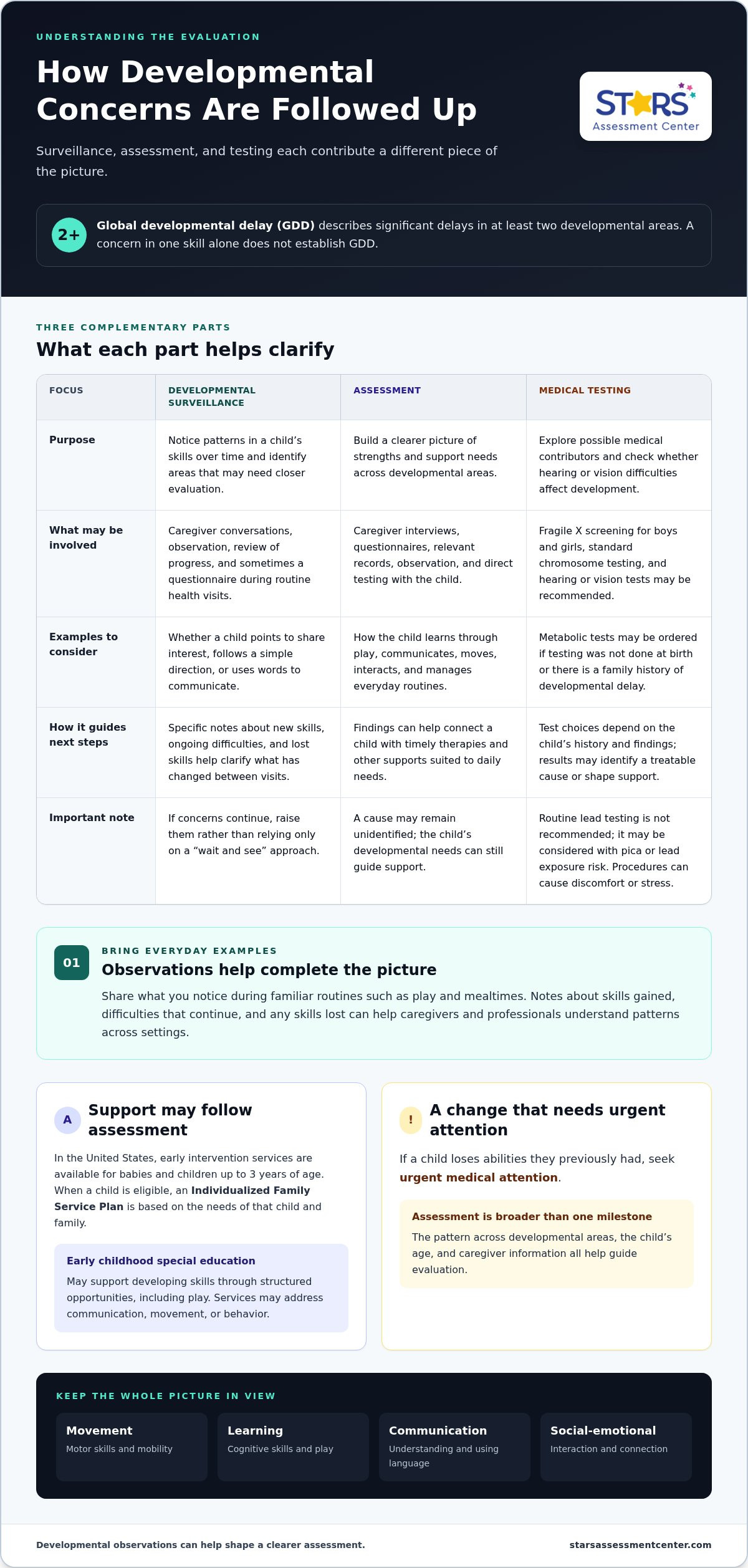
Developmental surveillance follows a child’s skills over time, helping families and professionals notice patterns that may need closer assessment. Screening and assessment can turn those observations into appropriate support, including early intervention and early childhood services.
Developmental surveillance
Developmental surveillance means keeping track of a child’s development over time through conversations with caregivers, observation, and review of progress. During routine health visits, a provider may ask how a toddler plays, communicates, and moves, or use a questionnaire to identify areas that may need further evaluation.
Bring specific examples to the conversation, such as whether your child points to share interest, follows a simple direction, or uses words to communicate. Notes about new skills, ongoing difficulties, and any lost skills can clarify what has changed between visits. If concerns continue, raise them rather than relying only on a “wait and see” approach.
Benefits of early assessment
Early assessment identifies a child’s strengths and support needs across areas such as movement, learning, and speech and language. This matters because early detection can connect children with timely therapies and other supports that address their daily needs.
In the United States, early intervention services for babies and children up to 3 years of age can minimize and often prevent the long-term effects of developmental delays, according to the U.S. Department of Education. When a child is eligible, an Individualized Family Service Plan is based on that child’s and family’s particular needs.
Early childhood special education can support developing skills through structured opportunities, including play. Depending on a child’s needs, services may address communication, movement, or behavior. Families can share observations and assessment results with the people supporting their child, helping connect goals with everyday routines.
Recommended tests and testing considerations
Testing considers possible medical contributors and checks whether hearing or vision difficulties affect development. For suspected global developmental delay, doctors may recommend Fragile X screening for boys and girls and standard chromosome testing; hearing and vision tests may also be part of an evaluation. Metabolic tests may be ordered if the child did not have them at birth or has a family history of developmental delay.
Testing can identify a treatable cause or reveal needs that shape support, while blood draws and other procedures may bring discomfort or stress. The choice of tests depends on the child’s history and findings; routine lead testing is not recommended, though it may be considered when a child has pica or lead exposure risk.
If tests don’t identify a cause, the child’s developmental needs can still guide appropriate support. A cause may remain unidentified, so ongoing surveillance and attention to the child’s skills remain useful. If a child loses abilities they previously had, seek urgent medical attention.
What are signs of Global Developmental Delay?
A developmental delay means a child hasn’t gained skills expected for their age compared with other children of the same age. A difference in one skill, such as using words, doesn’t by itself establish global developmental delay. The pattern across developmental areas, the child’s age, and information from caregivers all help guide assessment.
Global developmental delay (GDD) describes significant delays in at least two important areas of development. The term generally applies to children aged five and younger whose development is delayed across multiple areas. For example, a toddler may have difficulty with both movement and communication, or with learning and social interaction. The process of diagnosing global developmental delay in toddlers considers this broader pattern, rather than treating one milestone as the whole picture.
Developmental areas include speech and language, cognitive, motor, social-emotional, adaptive, and vision and hearing screening. These areas cover skills such as understanding and using language, learning through play, movement, interaction, everyday routines, and responses to sounds and faces. Delays can affect different combinations of skills, so observations from home and assessment activities both matter.
Signs can look different from child to child. One toddler might struggle to follow a simple direction or use gestures to communicate; another might find walking and joining a shared play activity challenging. Consider how skills develop in everyday settings, including mealtimes, play, and time with familiar people. These observations can help families and professionals decide what to explore when assessing global developmental delay in toddlers.
Several specialists may contribute to evaluation, including developmental pediatricians, psychologists, speech therapists, and neurologists. A psychological assessment for GDD can bring together caregiver interviews, questionnaires, relevant records, and direct testing with the child. This combination helps distinguish a developmental pattern from a concern limited to one setting or task. Families can share examples of what their child does during familiar routines, alongside any previous assessment records.
The Diagnostic and Statistical Manual of Mental Disorders, Fifth Edition (DSM-5), provides criteria used in medical diagnosis. Direct testing of cognitive abilities may contribute to a comprehensive assessment, alongside observation and caregiver information. Medical evaluations may also include specialist assessments, imaging, or laboratory work when indicated by the child’s history and findings. A medical diagnosis and educational eligibility are not the same decision; school-based assessment requirements can vary by state.
If a child’s skills raise questions across several areas, a multidisciplinary developmental assessment can help build a fuller picture of strengths and support needs. The goal is to understand the child’s development and identify appropriate next steps, including individualized intervention or education when needed.
Motor, cognitive, social, and emotional signs
Signs can appear in different combinations, and everyday routines often show how a child uses developing skills. Look for recurring difficulties across activities rather than treating one isolated moment as a diagnosis.
Motor signs
Motor signs involve difficulty using large or small muscles for movement and everyday tasks. Gross motor examples include trouble sitting steadily, moving between positions, or walking. Fine motor examples include difficulty grasping a small toy or picking up food.
Notice how movement affects participation. A toddler who struggles to move around may have fewer chances to explore toys or join active play. Hand coordination can also affect turning pages, stacking blocks, or feeding with fingers. These examples help describe what happens during familiar routines.
Write down the activity, what your child tried, and what support helped. A pattern across play, mealtimes, and movement is more informative than one difficult attempt. If motor skills seem to affect participation, share those examples during a developmental conversation.
Cognitive signs
Cognitive signs relate to learning, remembering, and solving simple problems. A toddler may have difficulty exploring how a toy works, copying an action, finding a familiar object, or understanding a simple direction during play.
Watch how your child responds when an activity is repeated. For example, do they try another way to reach a toy after the first attempt, or remember where a familiar item belongs? Responses can vary with interest and setting, so examples from several routines help show whether a skill is emerging.
Communication and cognition can overlap. A toddler may understand a familiar direction but not yet express a response with words; gestures, actions, and attention also provide information. Caregivers can describe what the child understands at home, while an evaluator considers how the child learns during play-based activities.
Social and emotional signs
Social-emotional signs concern how a child connects with people, shares attention, plays, and responds to feelings. Examples include limited attempts to share an interesting object, difficulty joining a familiar play routine, or needing substantial support to settle after a change.
Consider the setting and the people involved. A toddler may respond differently with a familiar caregiver than during a new activity, so note what helps the child engage. Prenatal history can provide useful background during a medical evaluation, but it cannot determine a child’s abilities on its own.
Record examples without labeling the child’s behavior as deliberate or uncooperative. If social interaction, communication, and play all raise concerns, sharing those observations can help professionals consider whether a broader assessment is appropriate. Early intervention can then be matched to the areas where support is needed.
Also notice loss of a skill your child previously used, such as stopping a familiar gesture or no longer using words. Developmental regression warrants urgent medical attention, rather than waiting for the next routine school or health check. A concise record of when the change began and which skills changed can help explain the concern.
Possible causes and risk factors
Factors linked with developmental delays can arise before birth, during birth, or after birth. Possible contributors include genetic or hereditary conditions, metabolic disorders, brain trauma, serious infections, toxic substance exposure, severe psychosocial trauma, and deprivation of food or environmental input. These factors can inform an evaluation, but a risk factor alone does not establish why a child’s abilities differ.
Symptoms do not identify one cause on their own. Delays in movement and language, for example, may occur with different underlying conditions, while children with the same diagnosis can have different strengths and support needs. A condition such as Down syndrome may be part of a child’s history, but their developmental profile still needs to be understood individually.
Family history gives clinicians useful context. For a child with global developmental delay or intellectual developmental disorder, a family history assessment should ideally cover three generations. Families can share known diagnoses, developmental differences, and relevant health conditions among relatives. This information helps clinicians consider hereditary patterns alongside the child’s own history and observed abilities.
Pregnancy and birth history can also guide medical evaluation. Prenatal alcohol exposure or another known risk factor does not remove the need to assess development and consider possible causes. Share relevant details with the professional evaluating the child, including known prenatal exposures, serious infections, or events involving brain trauma. A risk history should inform the assessment, not replace it.
Testing is selected around the child’s history and clinical findings. A blood test for lead may be ordered when a child faces a risk of excessive lead exposure; routine lead testing isn’t recommended to evaluate developmental delay. Brain imaging may be considered for specific neurological findings, microcephaly, or developmental regression, rather than as a routine test for every child.
In one study of children and youth with global developmental delay or intellectual developmental disorder, brain MRI abnormalities led to an etiological diagnosis in 7.9% of those studied. That finding describes the study group, not what an individual child’s scan will show. An MRI result is one piece of an assessment, considered with history, examination, and developmental findings.
Sometimes an evaluation does not identify a cause. That uncertainty does not erase a child’s needs or prevent families from seeking appropriate support for communication, learning, or daily activities. If a medical cause is identified, treating it may affect developmental skills. Whether a cause is known or not, ongoing attention to the child’s abilities can help guide suitable support.
Global developmental delay
Global developmental delay (GDD) describes significant delays in at least two important areas of development. It is generally used for children aged five and younger, when their abilities are still developing and standardized testing may not fully show their long-term learning profile. The term describes a developmental pattern; it doesn’t explain its cause.
GDD may involve combinations of movement, communication, cognition, and social-emotional development. For example, a young child may have difficulty walking and understanding speech, or learning through play and communicating needs. The combination matters: a delay in one area alone does not meet the definition of global delay. A developmental evaluation considers how skills fit together in the child’s everyday life.
Clinicians use assessment findings to understand the child’s current abilities, not to predict every future milestone. Direct testing of cognitive abilities can contribute to evaluation, alongside caregiver interviews, questionnaires, relevant records, and observation. A toddler’s response may differ between structured activities and familiar routines, so examples from home can add context to test results.
Age also shapes how GDD is understood. Children are typically diagnosed between birth and five years old, while signs may become noticeable in infancy or only later, including at school age. As children encounter new tasks, such as more complex play or classroom routines, differences in learning and communication may become easier to recognize. A change in what is expected can make an existing developmental pattern more visible.
GDD affects approximately 1%-3% of preschool-aged children. This estimate describes a population, not the likelihood that a particular child has GDD. A diagnosis depends on the child’s developmental profile and assessment, including whether significant delays affect at least two areas. That distinction can help families separate a broad developmental concern from a specific symptom, such as delayed speech alone.
Global developmental delay generally doesn’t worsen over time, but each child’s abilities and support needs can change as new skills emerge. Therapies tailored to areas of delay may help children develop skills and, in some cases, catch up with peers. The useful takeaway is to connect the diagnosis with practical goals, such as supporting communication during play or building skills needed for daily routines.
If your child’s concerns span several areas, a multidisciplinary developmental assessment can help clarify their profile and inform appropriate next steps.
Stars Assessment Program: Social-Emotional Assessment
Stars Assessment Program offers a Social-Emotional Assessment for families concerned about a toddler’s interactions, play, or emotional development. If concerns involve several developmental areas, a Multidisciplinary Developmental Assessment can help build a broader picture of the child’s skills. Speech and Language Evaluation and specialized Autism screening are also available when communication or autism-related concerns are part of the picture.
The assessment is structured, play-based, child-friendly, and paced to the child’s age and attention, with parents present throughout. Bring examples from everyday routines, such as how your child communicates during play or responds to changes. These observations can help clarify the child’s strengths and support needs.
If you’d like to discuss an assessment for your child, contact Stars Assessment Program.
Take the Next Step With Your Child’s Needs in Mind
Understanding global developmental delay in toddlers can help families move from uncertainty toward practical goals for everyday life. Consider what would make communication, play, or interactions easier for your child, and bring those priorities into a conversation with Stars. Assessment results are explained in clear, simple language to help you understand possible next steps.
Stars provides social-emotional assessment, multidisciplinary developmental assessment, and speech and language evaluation. The assessment can explore a specific area of development or build a broader understanding of your child’s strengths and support needs. You can start by sharing the concerns you have noticed in daily routines. No cost to families.
To discuss an assessment and possible next steps, contact Stars Assessment Program. Your observations matter, and sharing them can help your family move forward with greater clarity and care.
Frequently Asked Questions
Can this be prevented?
Global developmental delay cannot always be prevented because possible causes vary, and some remain unidentified. Factors can arise before, during, or after birth, including genetic conditions, infections, and exposure to toxic substances. Families can share known health and prenatal history during an evaluation, but a risk factor does not determine a child’s development. The practical focus is noticing concerns and seeking timely assessment and support.
How common is this condition?
Global developmental delay affects approximately 1%-3% of preschool-aged children. This population estimate doesn’t predict whether an individual toddler has the condition. A child’s developmental profile is assessed through their skills across areas, rather than inferred from prevalence alone. For families in San Jose or Santa Clara County, raising specific concerns during a child’s health visits can help identify whether further evaluation is appropriate.
What Is GDD?
GDD is short for global developmental delay, a term for significant delays in at least two areas of development. Areas can include speech and language, cognitive, motor, social-emotional, adaptive, and vision and hearing screening. The term describes a pattern of development; it does not identify the underlying cause or determine exactly what support a child needs.
What is developmental screening?
Developmental screening is a brief check of a child’s skills that helps identify whether a closer evaluation may be useful. A provider can ask caregivers questions, observe a child playing or communicating, or use a questionnaire. Screening does not diagnose a condition or rely on a blood or laboratory test. If screening results or family observations raise concerns, a more detailed assessment can look at the child’s abilities.
What should I do to prepare for an assessment?
Write down examples of your child’s communication, play, and daily routines, including what helps them participate. Bring relevant previous assessment records and note questions you want answered. At a Stars assessment, parents remain present during the child-friendly, play-based visit, which is structured and paced to the child’s age and attention. This is not a diagnostic assessment. Results are explained in clear, simple language to help you understand development and consider next steps.
When should I seek assessment?
You can request an assessment if developmental concerns persist, affect everyday routines, or appear in more than one area, such as communication and movement. If something does not feel right, you do not have to wait for certainty to act. If your child loses a skill they previously had, seek urgent medical attention. Share concrete examples, such as changes in gestures, speech, play, or walking, with the professional evaluating your child.
What is global developmental delay in toddlers and how is it defined?
In toddlers, global developmental delay means significant delays in at least two developmental areas, not just one skill. For instance, concerns involving both understanding language and movement could prompt a broader evaluation. A professional considers the child’s abilities together with caregiver observations and assessment findings. The definition describes developmental differences; it does not explain their cause or establish what a child will achieve later.
What developmental milestones and standardized tests are used to diagnose global developmental delay?
Evaluation considers age-related skills in areas such as speech and language, cognitive, motor, social-emotional, adaptive, and vision and hearing screening. A provider may ask about examples like walking, using gestures, following directions, or playing with familiar toys. Questionnaires and direct assessment activities can add structured information. No single milestone or observation establishes the full picture; findings are considered alongside caregiver conversations and relevant records.


