

A concern about your child’s development is worth discussing before you know its cause. If you’re wondering whether your child needs a developmental evaluation, missed milestones, communication differences, difficulty interacting, or challenges with routines and regulation are reasons to seek a closer look. Screening is a brief check for possible concerns; an evaluation takes a deeper look at your child’s development.
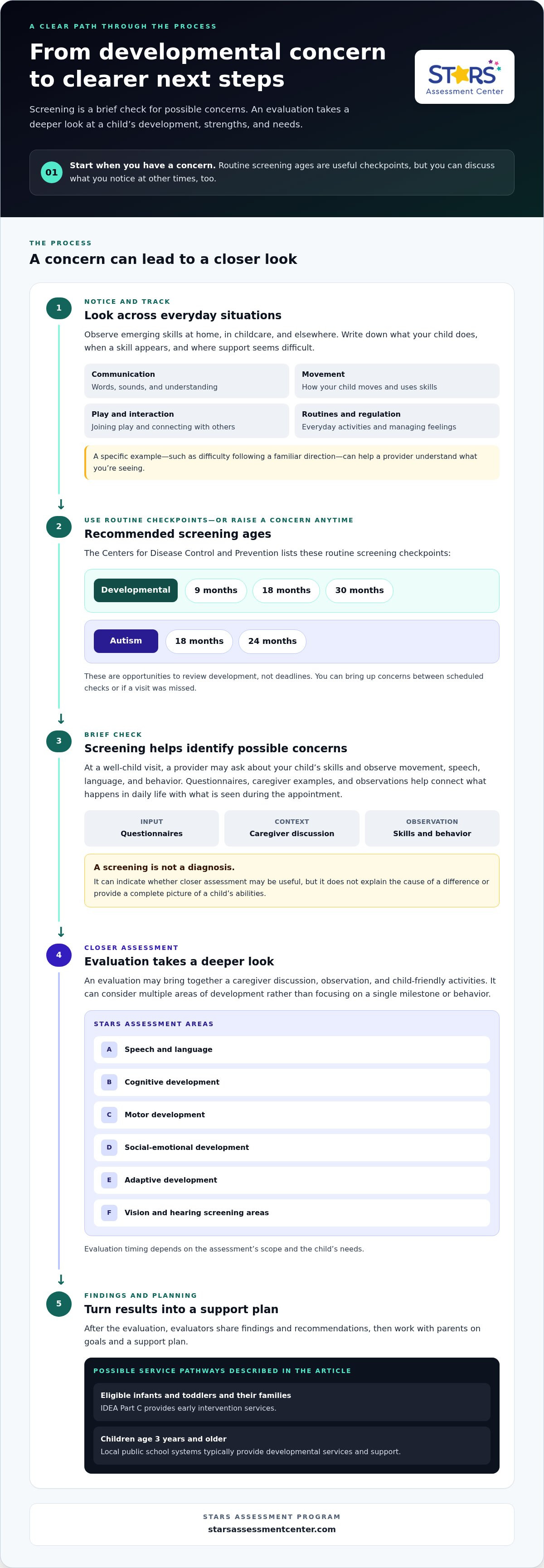
It’s understandable to feel unsure about what your observations mean or what to do next. The Centers for Disease Control and Prevention lists developmental screening at 9 months, 18 months, and 30 months, and autism screening at 18 months and 24 months, but concerns can be discussed at other times, too. This article explains how screening differs from evaluation, what an evaluation may assess across areas such as communication, movement, thinking, and social-emotional development, and which professionals may take part. You’ll also learn what to expect from the process so you can approach the next conversation with greater clarity.
Key Takeaways
- A screening is an initial check for possible developmental concerns; a full evaluation takes a closer look at a child’s strengths and needs.
- Routine screening is one opportunity to discuss development, and a parent’s concern can also be a reason to raise the subject at another time.
- Questionnaires and observations help professionals understand how a child communicates, plays, moves, learns, and interacts in everyday situations.
- An evaluation may consider several areas of development together, rather than focusing on a single milestone or behavior.
- Learn what different professionals may contribute and what information can help make an evaluation more useful for your family.
What are developmental and behavioral screening tests?
Developmental screening is a brief check of a child’s skills and behavior, not a diagnosis. Milestones offer practical examples of what to observe and discuss when you have questions about your child’s progress.
Tracking Developmental Milestones
Developmental monitoring means observing a child’s emerging skills over time at home, in childcare, and elsewhere. It matters because familiar adults can notice patterns across daily routines, not just during an appointment. Write down what your child does, when a new skill appears, and where support seems difficult. Share examples with the child’s healthcare provider.
Milestones are skills most children can do by a certain age. For example, by 4 months, many babies smile and coo; by 9 months, many make sounds like “mama” and “dada.” By 18 months, many children use several words, while by 2 years, many put at least two words together. These are guideposts, not a pass-or-fail checklist.
For age-based guidance, compare your observations with trusted child-development resources, then discuss questions at a well-child visit. Keep notes about communication, movement, play, and interaction. A concrete example, such as difficulty following a familiar direction, helps the provider understand what you’re seeing.
Milestones and Signs for Evaluation
A developmental milestone is a skill commonly reached around a particular age; a developmental delay describes skills that are not emerging as expected. This distinction matters because an evaluation can explore a concern more fully than a screening. Consider discussing an evaluation if your child has difficulty meeting milestones, communicating, interacting, or managing routines and regulation.
Look at development across areas rather than focusing on one skill alone. By 1 year, many children play peekaboo and follow simple directions; by 3 years, many name pictures of familiar objects and walk or run easily. A persistent concern across everyday situations, or loss of a previously used skill, deserves prompt discussion with the child’s healthcare provider.
Health insurance coverage varies by plan and evaluation type, so there is no single typical out-of-pocket cost. The price depends on the case and is given after a quote request; factors include assessment scope, provider, and insurance coverage.
Evaluation timing depends on the assessment’s scope and the child’s needs. Afterward, evaluators share findings and recommendations, then work with parents on goals and a support plan.
Raising a concern can help identify a possible delay sooner and clarify whether support may be useful. If something does not feel right, you do not have to wait for certainty to act. You can request an assessment when concerns arise, rather than waiting for the next milestone.
For children age 3 years and older, local public school systems typically provide developmental services and support, according to the U.S. Department of Education. Under IDEA, Part C provides early intervention services to eligible infants and toddlers and their families, according to the U.S. Department of Education.
Recommended screening ages
Recommended screening ages create routine opportunities to review development, but they aren’t the only times to raise concerns. A child’s healthcare provider can discuss screening whenever you notice a change in language, learning, behavior, or everyday skills.
Timing of Developmental Screening
Developmental screening uses brief checks at key ages to identify possible concerns. According to the Centers for Disease Control and Prevention, developmental screening is listed at 9 months, 18 months, and 30 months. The same organization lists autism screening at 18 months and 24 months. These checkpoints help families keep screening on the schedule without treating an age as a deadline.
If your child missed a well-child appointment or screening, ask about completing it at the next visit. You can also raise a concern between scheduled checks. Screening can indicate whether closer assessment may be useful; it doesn’t diagnose a developmental condition or explain the cause of a difference.
Screening at Well-Child Visits
At a well-child visit, a provider may ask about your child’s skills and observe movement, speech, language, and behavior. These conversations connect what you see at home with what the provider observes during the appointment. Bring a specific example, such as difficulty using words to ask for help or joining play, to make the discussion practical.
Screening is a brief check, while an evaluation takes a more detailed look at development. Results can indicate that further assessment may help clarify a concern. A developmental assessment may include a caregiver discussion, observation, and child-friendly activities, followed by findings and next-step guidance. Stars assesses speech and language, cognitive, motor, social-emotional, adaptive, and vision and hearing screening areas.
A screening result is one piece of information, not a diagnosis or a complete picture of a child’s abilities. If a result or your observations raise questions, share examples with the provider and discuss whether a fuller assessment would help. For instance, describe when communication or interaction seems difficult and whether the same concern appears during different activities.
Families in Santa Clara County can discuss screening questions with Stars Assessment Program or their child’s healthcare provider. Mention what you’ve observed, when it happens, and how it affects your child’s participation at home or in childcare. These details can help clarify whether continued monitoring or a more thorough assessment is the useful next step.
When a closer review could help you understand your child’s needs, a multidisciplinary developmental assessment can consider development across areas rather than relying on a brief screening alone.
Parent questionnaires and provider observations
Questionnaires and observations help organize what parents notice across everyday settings. Specific examples from home, childcare, and school can give an evaluator a clearer picture.
Parents’ Evaluation of Developmental Status
The Parents’ Evaluation of Developmental Status (PEDS) is a screening questionnaire designed for children from birth through age 8. It gives parents a structured way to share concerns about development, behavior, and learning. A PEDS screening can be completed in about five minutes. Record examples before answering, such as how your child asks for help or responds to a familiar routine.
Other tools suit different ages and questions. The Ages and Stages Questionnaire is designed for children from 1 month to 5 1/2 years old. The Modified Checklist for Autism in Toddlers is intended for toddlers between 16 and 30 months old and contains 23 yes-or-no questions. A questionnaire helps organize observations; it does not replace a full evaluation.
Parent Intake and Developmental History
An initial consultation gathers your child’s developmental history and your family’s current concerns. You can share examples about early skills, communication, play, relationships, and routines. Beforehand, note what your child does independently and where support is needed. For instance, describe how your child communicates during meals or plays with familiar people.
The evaluation may also include a child assessment, record review, feedback session, and written report. With your permission, the evaluator may review school reports, previous evaluations, early intervention documents, therapy notes, or medical information. Sharing relevant records helps connect observations across settings and gives the family a clearer basis for discussing next steps.
Parent and Teacher Reports
Parent and teacher reports describe a child’s skills in different settings. A caregiver may see how an infant communicates during feeding, while a teacher may observe participation in classroom routines. Comparing those examples can show whether a concern appears consistently or changes with the activity, people, or environment.
Parents, family members, childcare providers, and other caregivers can contribute observations. Bring completed forms and concrete examples to the appointment, such as a recent change in play or difficulty following a familiar direction. If a child attends school or a childcare program, relevant reports can add context, with permission for records to be reviewed.
During an assessment, providers may combine standardized tests, observations, and parent interviews. A young child might engage with toys, pictures, puzzles, conversation, or interactive activities. These activities let the evaluator observe skills directly, while parent reports explain how the child communicates and responds outside the appointment.
To prepare, gather any useful reports and write down your questions. Include examples from home and childcare, note what helps your child participate, and describe skills that seem difficult. These details help focus the discussion on your child’s everyday needs and support thoughtful next-step guidance.
Developmental-behavioral pediatricians and pediatric psychologists
A multidisciplinary developmental assessment can help clarify developmental, behavioral, and social-emotional concerns. The assessment focuses on your child’s skills and the situations prompting questions for your family.
When to Contact a Pediatric Provider
Contact your child’s pediatric provider when you notice a developmental concern or a loss of a previously used skill. Describe what changed and give an everyday example, such as a child no longer using a familiar word. This detail helps the provider understand the concern and discuss whether screening, a comprehensive evaluation, or another next step fits.
Parents don’t need to know why a skill changed before raising the concern. A short written record of communication, play, behavior, or routines can make the meeting more focused. Include when you first noticed the change and whether it appears at home, childcare, or school.
Requesting an Evaluation
Yes. Parents can request a comprehensive developmental evaluation when they remain concerned, even if a pediatrician recommends waiting. Share specific observations and explain how they affect daily activities, such as joining play or communicating needs. A clear description gives the evaluation team useful questions to explore.
A developmental assessment uses observation, play-based activities, and a discussion with parents. It looks at speech and language, cognitive, motor, social-emotional, adaptive, and vision and hearing screening areas. Ask for findings and next-step guidance to be explained in plain language, including how they relate to everyday routines.
Developmental-behavioral pediatricians and pediatric psychologists may contribute different perspectives to an assessment. The evaluation’s focus depends on the concern: a question about communication differs from a concern about emotional regulation or social interaction. Families can share examples from more than one setting, helping evaluators understand how a child responds across activities and relationships.
Observations add information beyond a family’s report. During play-based activities, the team can observe a child’s responses and engagement. For example, play can offer a chance to notice communication, problem-solving, and interaction. Activities are adapted to the child’s comfort and attention while exploring questions about development.
Stars Assessment Center’s multidisciplinary developmental assessment considers skills across the listed areas: speech and language, cognitive, motor, social-emotional, adaptive, and vision and hearing screening. This broader view can help families understand questions about movement, communication, or other developmental skills.
After assessment, recommendations may address speech and language support, early intervention, school accommodations, or further medical or developmental consultation. The findings can help families understand which needs are most relevant and what supports to discuss next. A written report can also help organize recommendations for home and educational settings.
Areas of development assessed in young children
A developmental assessment looks at how a child uses skills across everyday activities, not just whether one milestone appears. During the first five years, children develop rapidly across physical, social-emotional, cognitive, and language areas. Looking at these abilities together can help explain where a child is thriving and where extra support could help.
Evaluators consider how skills work together. For example, a child’s language affects how they request help, join play, and share ideas. Motor skills can shape how they explore toys, move through a room, or participate in routines. These real-life examples make assessment findings easier to connect with a child’s daily needs.
- Communication: How a child understands language, expresses needs, and uses speech or other communication.
- Motor skills: How a child moves, coordinates actions, and handles objects during play or routines.
- Thinking and problem solving: How a child explores, learns, remembers, and approaches a challenge.
- Social relationships and emotional regulation: How a child connects with others and responds to feelings or changes.
- Adaptive skills and play: How a child participates in self-care routines and uses play to explore or interact.
Each area offers clues, but the pattern across areas matters too. A child might understand a direction but have difficulty responding with words. Another may enjoy shared play yet struggle when an activity changes. An assessment considers these differences alongside the child’s strengths, familiar routines, and caregivers’ observations.
When autism is a concern, an evaluation may examine social communication, reciprocal interaction, and play. It can also consider flexibility, repetitive behaviors or interests, sensory differences, and emotional or behavioral regulation. Looking at these features together helps describe how they affect the child’s communication and participation, rather than focusing on one behavior alone.
Assessment findings connect observations to practical next-step guidance. If communication is a central concern, a Speech and Language Evaluation can focus on how a child understands and expresses language. If questions span several areas, a Multidisciplinary Developmental Assessment considers those developmental areas together. The goal is to make a child’s needs and abilities clearer for the family.
Recommendations can identify whether early intervention, school accommodations, or further developmental consultation should be discussed. They also help parents understand which skills to support in everyday settings, such as play, meals, or transitions. For a coordinated view of development across domains, explore a multidisciplinary developmental assessment.
Stars Assessment Program: Social-Emotional Assessment
Stars Assessment Program offers a Social-Emotional Assessment for families concerned about a child’s relationships, emotional responses, or behavior. When concerns involve communication or several areas of development, its Speech and Language Evaluation and Multidisciplinary Developmental Assessment may also be relevant. Stars also offers specialized screenings for Autism and Down syndrome.
A focused assessment can help clarify your questions about your child’s development and identify areas to discuss further. Consider requesting one if observations at home or in childcare leave you seeking a clearer understanding of your child’s social-emotional skills or broader developmental needs. Evaluations are conducted with assessment in your preferred language.
If you’d like to explore whether an assessment fits your concerns, visit starsassessmentcenter.com.
Take the Next Step With Confidence
You don’t need to have every concern neatly explained before seeking support. If you’re still wondering, “does my child need a developmental evaluation?” use the examples you’ve noticed to start a focused conversation about your child’s needs. A clearer understanding can help you decide what questions to raise and what support may be useful in daily life.
Stars Assessment Program offers Social-Emotional Assessment, Multidisciplinary Developmental Assessment, and Speech and Language Evaluation. These options address concerns in different areas, from emotional and social development to communication and broader developmental skills. The next step can be a conversation about which concern you want to explore and what would help your family move forward.
Contact Stars Assessment Program to discuss your child’s developmental assessment needs. Taking one thoughtful step can bring greater clarity and help you advocate for your child with confidence.
Frequently Asked Questions
What Is a Developmental Evaluation?
A developmental assessment takes a closer look at a child’s skills and support needs. It considers how a child manages everyday activities, such as communicating a choice, following a familiar routine, or joining play. Parents can bring questions about specific situations rather than trying to name a diagnosis. The findings help describe strengths and areas needing attention, giving families useful language for planning next steps.
What Does It Mean When a Screening Identifies a Concern?
A screening concern means further discussion or assessment could help clarify a child’s development; it is not a diagnosis. Ask what skill or response prompted the result, and share examples from home or childcare. For instance, explain whether your child uses gestures to request a favorite toy. Concrete details connect a screening result with everyday experiences and guide the next conversation.
What Happens During a Child’s Developmental Screening?
A developmental screening usually involves questions about a child’s skills, a conversation with a caregiver, observation, or simple activities. A provider might ask how the child communicates a need or responds to a familiar instruction. Screening itself generally doesn’t involve shots or blood tests. Your child can respond in their own way while you describe what you’ve noticed during ordinary activities.
Are There Any Risks to the Screening?
Developmental screening is a check of skills and behavior, not a physical procedure involving shots or blood tests. A screening result offers only a brief snapshot, so it can’t explain every difference a parent observes. Share concerns even if the result doesn’t flag them. A conversation about specific situations can help put the screening outcome in context.
Can Testing Help With School or College Accommodations?
An evaluation report can describe a child’s abilities and the situations where support is needed. For example, it might document difficulty communicating during group activities or following classroom routines. The report can help families explain those needs to an education team, but testing alone doesn’t grant accommodations. Schools and colleges have their own processes for considering support, so ask what documentation they need.
Does Developmental Screening Diagnose Autism or a Developmental Delay?
No. Screening identifies possible concerns that deserve closer attention; it doesn’t diagnose autism or a developmental delay. A screening result is a starting point for discussing a child’s behavior, communication, or other skills. If questions remain, consider whether further assessment would clarify them. Keep notes about situations that prompted concern, such as difficulty shifting between activities or responding during shared play.
How Can Parents Prepare for a Developmental Screening?
Before discussing an assessment, write down your main concerns and examples from everyday routines. Note how your child asks for help, responds to a name, or joins play with familiar people. Bring relevant reports if available, and mention what seems to help your child participate. Families in San Jose can describe what happens at home or in childcare to make the discussion more focused.
What Are Signs a Child May Need a Developmental Evaluation?
Consider discussing an evaluation if your child has difficulty meeting milestones, communicating, interacting, or managing routines. Losing a skill previously used is also a reason to contact the child’s healthcare provider. If you’re wondering whether your child needs a developmental evaluation, record what you observe, where it happens, and how it affects daily activities. These details help focus a conversation about the next step.


