

Families looking for early intervention resources in Santa Cruz County can explore local early support partnerships and First 5 Santa Cruz County programs. These include support for early literacy, family engagement, and educator training, alongside county resources for families with young children. Together, they offer starting points for learning about support for children with or at risk for developmental disabilities.
When you have questions about a child’s development, it helps to know where to begin. This guide outlines local family resources in Santa Cruz County, explains how developmental assessments fit into the process, and offers practical ways to prepare for a conversation about your child’s needs.
Key Takeaways
- Explore how local early support partnerships can connect families with resources for children’s development, learning, and family engagement.
- Learn how early intervention can support children with, or at risk for, developmental disabilities and which areas of development an assessment can consider.
- Understand what the no-cost evaluation, assessment, and service coordination rule means, according to San Andreas Regional Center.
- Find practical next steps if an evaluation doesn’t lead to eligibility or you have concerns about its findings.
- See what to consider as a child approaches age three and prepares for a transition to preschool services.
Children’s services and early support partnerships
Santa Cruz County offers several starting points for families seeking support. Family & Children’s Services focuses on child welfare, mandated reporter training, and community partnerships. These resources address different needs: community partnerships can help families seeking early support, while child welfare services address safety concerns. Identifying the most urgent need can help you choose a useful first step.
First 5 Santa Cruz County supports early literacy, family engagement, educator training, and quality improvement. Its programs include Raising a Reader, Quality Counts, and SEEDS of Learning™. These names point to different kinds of support: Raising a Reader focuses on early literacy, while Quality Counts and SEEDS of Learning™ connect with educator training and quality improvement. Families can use these program names to identify learning and engagement resources, rather than assuming every program provides developmental evaluation.
For nutrition and basic needs, Santa Cruz County WIC serves pregnant or postpartum individuals, infants, and children under age 5. The Human Services Department administers CalFresh, Medi-Cal, CalWORKs, General Assistance, child care support, and adult and family services. CalFresh provides monthly food benefits to income-eligible individuals and families. Applications are available online, by phone, or at county offices in Santa Cruz or Watsonville. These are practical entry points when food, health coverage, or child care affects a family’s ability to participate in support.
Several county tools address needs beyond early learning. 211 Santa Cruz County provides a guide to social services and local resources. Workforce Santa Cruz County offers job-search assistance, skills training, unemployment support, and employer services through county Human Services. Housing for Health offers coordinated entry, shelter referrals, rental assistance, and housing stabilization services. Each tool serves a distinct purpose: use 211 for broad resource navigation, Workforce for employment support, and Housing for Health for housing-related needs.
Substance use support is a separate pathway from developmental services. Santa Cruz County outpatient substance use disorder services provide care in a variety of settings. Local substance use disorder resources also include information about other County Behavioral Health services. For someone seeking residential substance use disorder services, those county resources can help identify relevant Behavioral Health information. Withdrawal management can be a first step for individuals struggling with substance use. These resources address substance-related needs; they are not substitutes for assessing a child’s development.
The California Overdose Surveillance Dashboard provides state- and local-level data on drug-related overdose outcomes. It is a data tool, not a family service or referral pathway. Use it to understand overdose outcomes across California and locally. For direct social-service navigation, 211 Santa Cruz County is the more practical tool. Separating information tools from service pathways helps families decide whether they need data, a referral guide, or a specific type of support.
Early Intervention for Developmental Disabilities
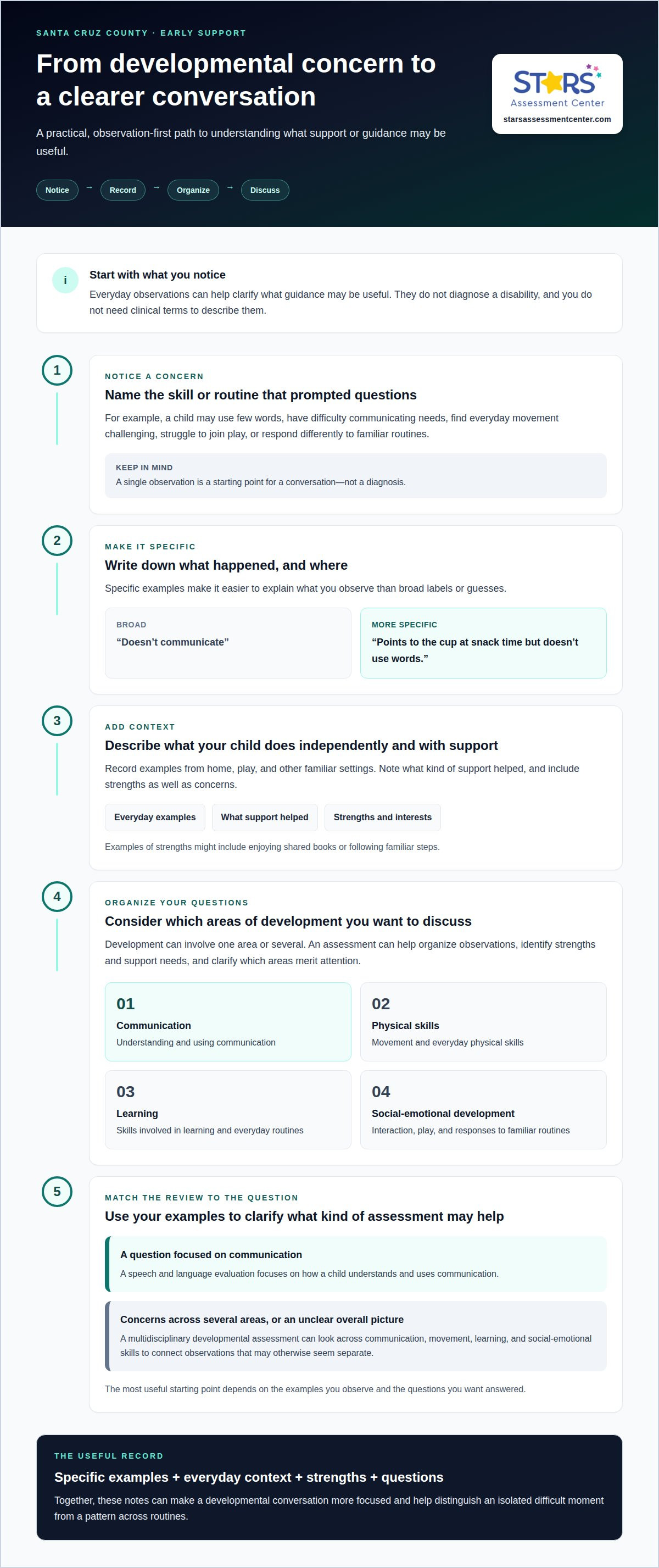
Early support can help families understand a child’s development and what to do next. In Santa Cruz County, start by identifying what prompted your concern. A child may use few words, have difficulty communicating needs, or find everyday movement challenging. Another child may struggle to join play or respond to familiar routines. These observations do not diagnose a disability, but they can help clarify what guidance may be useful.
Development can involve communication, physical skills, learning, and social-emotional development. A child may need support in one area or several. For example, limited responses to spoken directions may raise questions about understanding language. Difficulty with daily routines may point to a need to consider more than one skill. An assessment can organize observations, identify strengths and support needs, and help families understand which areas merit attention.
Before a conversation, record specific examples: what happened, where it happened, and what support helped. “Doesn’t communicate” is broad. “Points to the cup at snack time but doesn’t use words” gives a clearer picture. Include strengths, such as enjoying shared books or following familiar steps. These details help explain how your child communicates and participates in everyday settings.
A multidisciplinary developmental assessment can be helpful when concerns involve several areas or the overall picture is unclear. Looking across communication, movement, learning, and social-emotional skills can connect observations that might otherwise seem separate. A speech and language evaluation focuses on how a child understands and uses communication. The most useful starting point depends on the examples you observe and the questions you want answered.
Families seeking early intervention resources in Santa Cruz County can prepare for a developmental conversation by keeping a short record:
- Write down the specific skill or routine that raises questions.
- Describe what the child does independently and with support.
- Record examples from home, play, and other familiar settings.
- List questions about communication, movement, learning, or interaction.
These notes can make a developmental conversation more focused and help distinguish an isolated difficult moment from a pattern across routines. You do not need clinical terms to explain what you notice. Clear examples are a more useful starting point than labels or guesses about a diagnosis.
If a broader review would help clarify concerns, a multidisciplinary developmental assessment can examine several developmental areas together. It offers a structured way to understand a child’s strengths and support needs, rather than relying on one isolated behavior.
Are early intervention services free, and what costs or insurance rules apply?
Some early intervention steps may have no cost. According to San Andreas Regional Center, evaluation, assessment, and service coordination have no cost. This information gives families a concrete starting point. It doesn’t establish the cost of every developmental service, evaluation, or support in Santa Cruz County. Separate services may have different payment arrangements. Before scheduling, identify the exact service being discussed. Then ask which organization provides it and what payment information applies.
Keep the steps in the process distinct. An evaluation gathers information about a child’s development. An assessment helps clarify strengths and support needs. Service coordination organizes connections and next steps. The San Andreas Regional Center statement describes the activities covered by that resource, not a blanket rule for every service, provider, or insurance plan. Do not assume that separate therapy or evaluation services have the same cost arrangement.
Insurance questions are best handled service by service. Start with the name of the service, such as a speech and language evaluation. Then review the plan’s benefit summary and provider directory. These tools help you find plan language and identify listed providers. If the benefit summary uses unfamiliar terms, call the number on the insurance card. Ask about the specific service, rather than asking only whether “early intervention” is covered. That wording may not match the plan’s category.
Before an appointment, write down answers and the staff member’s name. Ask whether the service is covered under the plan, whether a referral or approval is needed, and whether any payment may be due. These are questions about the plan, not assumptions about its requirements. If you receive an explanation of benefits, use it to understand how the plan processed the claim and keep it with the appointment details and payment records.
- Benefit summary: Find the plan’s descriptions of covered service categories.
- Provider directory: Look for providers listed by the insurance plan.
- Insurance card: Find the plan’s contact number for service-specific questions.
- Explanation of benefits: Review how the plan processed a submitted claim.
- Written notes: Track dates, answers, names, and next steps.
If you are considering an assessment, first identify the question you want answered. A social-emotional assessment, developmental assessment, and speech and language evaluation each focus on different concerns. Naming the service makes insurance questions more precise and helps prevent a general cost answer from being mistaken for a decision about a particular appointment.
Keep the San Andreas Regional Center information alongside your plan notes. It confirms no cost for evaluation, assessment, and service coordination through that stated resource. For other services, use the plan’s documents and ask about the named service. This gives families a clearer picture before deciding how to proceed.
What should parents do if their child is not eligible or they disagree with an evaluation?
A decision that a child is not eligible can leave practical questions unanswered. Ask the evaluator to explain the decision in clear, everyday language. Which developmental areas were reviewed? What information informed the conclusion? Which observations showed skills developing as expected? Understanding the reasoning can help distinguish a program eligibility decision from ongoing family concerns about communication, play, movement, or daily routines.
Review the evaluation report and note any unclear terms or differences between the report and what you observe at home. For example, a child may use words during an appointment but rarely communicate during meals. Share that specific contrast, then ask how the evaluator considered the setting, familiarity, and the child’s comfort. Concrete examples make a follow-up discussion more focused.
Before your next conversation, keep a short observation log with the routine, what happened, and what support helped. “Struggles with communication” gives little detail. “At breakfast, points to juice but doesn’t answer when offered two choices” describes an observable moment. Include strengths, such as bringing a book to share or following a familiar cleanup routine. A balanced log captures skills and challenges across everyday situations.
- Evaluation report: Use it to review findings and unfamiliar terms.
- Question list: Record points you want the evaluator to explain.
- Observation log: Track examples across home and community routines.
- Records folder: Keep reports, notes, and relevant developmental history together.
If a finding seems inconsistent with what you see, point to a specific example. You might say, “The report describes shared play, but my notes show that joining other children remains difficult.” Ask what information could help clarify the difference. If the assessment focused on one area, ask whether your concern relates to that area or needs a separate discussion. Specific questions are more useful than challenging the entire report at once.
If a child is not eligible, ask what support remains available through the program and what signs might prompt another conversation. Keep the answer with the report. Continue noting changes, such as new words, increased frustration, or difficulty with a familiar routine, and share relevant examples in a follow-up discussion. Concrete notes make it easier to describe what has changed.
You can also ask how to raise concerns about an evaluation. Request clarification about the assessment activities, the skills observed, and the reasoning behind the conclusions. For communication concerns, describe how your child understands and expresses needs. For social interaction, note responses during play or shared routines. Clear records help you explain what you see and identify useful questions.
What early intervention resources are available for children nearing age three and transitioning to preschool services?
As a child approaches age three, families can begin planning for preschool routines and support needs. Consider everyday experiences such as communicating, joining play, following routines, and managing changes. Notes from home, childcare, and community activities can show what goes smoothly and where support may help, giving families concrete information for conversations about the next setting.
First 5 Santa Cruz County supports early literacy, family engagement, educator training, and quality improvement. Its programs include Raising a Reader, Quality Counts, and SEEDS of Learning™. Raising a Reader can support early literacy activities. Quality Counts and SEEDS of Learning™ connect with educator training and quality improvement. Families can use these program names to explore learning and engagement resources as they consider preschool experiences.
Use transition planning to organize information, not to assume a particular service or placement. Note what helps your child participate, such as picture cues, familiar songs, or extra time for a routine. Include your child’s interests, preferred activities, and ways of communicating. Sharing this practical picture when discussing preschool brings strengths into the conversation alongside support needs.
Families can take these steps to prepare:
- Describe routines the child enjoys, such as snack, story time, or outdoor play.
- Record situations that are difficult, including transitions between activities.
- Note helpful supports, such as a visual reminder or familiar adult.
- Gather questions about communication, participation, and classroom routines.
Santa Cruz County WIC serves infants and children under age five, as well as pregnant or postpartum individuals. Families already using WIC can include it among local family resources while planning for preschool. WIC is a nutrition program, not a preschool transition service. Knowing each resource’s role helps families seek the right support for each need.
For early literacy and family engagement, Raising a Reader offers a named starting point. For broader family-resource navigation, 211 Santa Cruz County provides a guide to local social services. These tools serve different purposes: First 5 Santa Cruz County programs relate to learning and educator quality, while 211 helps locate social-service resources. A simple list of questions and observations can help families use each conversation well.
If developmental questions remain as preschool planning begins, explore developmental assessment support to better understand a child’s strengths and needs. Carrying clear examples into that conversation can help focus attention on the skills that matter in everyday preschool routines.
Stars Assessment Program: Social-Emotional Assessment
Stars Assessment Program offers a Social-Emotional Assessment for families with questions about a child’s interactions, emotional responses, or participation in everyday routines. If concerns span several developmental areas, a Multidisciplinary Developmental Assessment can provide a broader view. A Speech and Language Evaluation focuses on communication, while autism-related support can help families explore specific concerns.
Consider an assessment when concrete examples keep raising questions, such as difficulty joining play, expressing needs, or managing familiar transitions. Sharing observations from home and other routines can help clarify what you’d like to understand. The right starting point depends on the concern you want to explore.
For a supportive next step, contact Stars Assessment Program or visit starsassessmentcenter.com.
Choose a Clear Next Step for Your Family
A useful next step can start with one focused question: what would help you understand your child’s needs more clearly? Naming that question can make it easier to explore early intervention resources in Santa Cruz County. You might be looking for insight into emotional responses, a broader view of development, or clarity about communication. Your family’s main concern can guide where to begin.
Stars Assessment Program offers Social-Emotional Assessment, Multidisciplinary Developmental Assessment, and Speech and Language Evaluation. Each offering can help families explore a different area of development. Sharing the question you want answered gives the conversation a useful starting point.
If you’re ready to discuss which assessment may fit your concerns, contact Stars Assessment Program. You can take this one step at a time, with your observations and questions guiding the way forward.
Frequently Asked Questions
What early intervention services are available for infants and toddlers in Santa Cruz County, California?
Families can seek developmental assessment and service coordination through local early support pathways. For children under 3 years, Stars Assessment Program offers social-emotional assessment, multidisciplinary developmental assessment, and speech and language evaluation. These assessments can help clarify developmental questions and inform next steps. Families exploring early intervention resources in Santa Cruz County can also use First 5 Santa Cruz County programs for early literacy and family engagement.
Which agency provides early intervention in Santa Cruz County, and what areas does it serve?
San Andreas Regional Center is a key local resource for evaluation, assessment, and service coordination. Stars Assessment Program works alongside the regional center and serves Santa Clara and Santa Cruz counties. Its office is in San Jose, making the county-level service area more useful than relying only on city names. Families should distinguish the regional center’s role from assessment services offered by Stars.
How can families refer a child for early intervention in Santa Cruz County?
Families can contact Stars Assessment Program directly for an assessment, and no referral is needed. To prepare, write down the specific developmental concern and a recent example, such as difficulty expressing needs during meals. Families seeking regional-center services can contact San Andreas Regional Center about its process. A family’s observations can help explain what prompted the request, even without a diagnosis.
What are the eligibility requirements for California Early Start services?
Early Start eligibility is determined through its evaluation process; a Stars assessment can help inform eligibility but doesn’t guarantee it. A diagnosis isn’t required to request a Stars assessment for a child under 3 years. The assessment is observational, not diagnostic. Families can share concerns about communication, movement, learning, or social-emotional development so the evaluation can consider the areas relevant to their child.
How do families get an evaluation and how long does it take?
Families can begin by contacting Stars Assessment Program directly, without a referral. The process includes an initial consultation, developmental review, structured assessment, parent discussion, and next-step guidance. The visit length depends on the child’s age and attention; it’s structured and paced to the child. Parents remain present, and assessment activities can adapt to the child’s comfort and participation.
Where can families find local early intervention offices, contact details, and languages offered?
Stars Assessment Program’s address is 6910 Santa Teresa Blvd., Suite 200, San Jose, CA, and its phone number is (844) 700-9889. It serves Santa Clara and Santa Cruz counties. Families can request an assessment in their preferred language. Local place names such as San Jose, Santa Clara, Santa Cruz, Salinas, Milpitas, Gilroy, and Morgan Hill may help orient searches, but the stated service area is county-based.


