

The fastest support often starts with a calm adult, not a perfect phrase. Parents looking for emotional regulation help for toddlers in San Jose can try a quiet calm-down space, two simple choices, a predictable routine, and warm attention when their child makes an effort to cope. These tools work best when practiced during calm moments, so they’re familiar when big feelings arrive.
It’s understandable to want help right away when your toddler feels overwhelmed. Name the feeling, stay close, and offer a simple next step, such as breathing together or choosing between two acceptable options. The goal isn’t to stop every upset. It’s to help your child feel supported while learning how to handle strong emotions.
Here are practical tools for difficult moments, ideas for creating a calm space, and ways to build regulation support into everyday routines.
Key Takeaways
- Practice simple calming skills when your toddler is already settled, so they’re easier to reach for during a difficult moment.
- Make a calm-down space inviting and keep it a supportive choice, not a punishment.
- Offer two acceptable choices while holding steady boundaries to help your toddler feel involved.
- Use predictable routines and gentle transition cues to make everyday changes easier to manage.
- Notice and praise small efforts to cope, even when your child is still learning.
1. What simple emotional regulation tools help children ages 2-5?
Practice works best before a toddler is upset, when attention and connection are easier to maintain. During a familiar moment, name the feeling, model one calming action, and invite your child to copy you. For example, say, “I feel frustrated, so I’m taking a slow breath.” Children can begin labeling emotional expressions as early as 2 years, so simple words help make feelings easier to recognize. Parents seeking emotional regulation help for toddlers in San Jose can start with this kind of everyday practice.
Keep practice brief and playful. Try belly breathing together: place your hands on your bellies, breathe in slowly, then breathe out. Or pretend to blow bubbles with gentle breaths. Introduce a visit to the calm-down space during a relaxed moment, not only when your child is distressed. Practicing ahead of time helps your toddler get familiar with calming strategies before strong feelings make it harder to listen or try something new.
Build regulation skills in small steps instead of expecting your toddler to manage a difficult situation alone. If waiting for a toy is hard, start with a short turn while you stay close. Say, “You’re waiting while I take my turn,” then help your child ask, “My turn next?” Praise the specific effort, such as waiting or using words. When that skill feels familiar, practice it during another activity, such as sharing crayons.
Turn-taking games offer low-pressure practice with impulse control. Roll a ball back and forth, pass a toy, or take turns adding blocks to a tower. Use a simple phrase such as, “My turn, then your turn,” and show what waiting looks like. If frustration rises, pause the game and offer a break. ZERO TO THREE describes self-control development for toddlers aged 24 to 36 months, so adult modeling remains important during play.
In San Jose, support for toddlers may include counseling, developmental assessments, and speech and language evaluations. These address different needs: counseling may focus on feelings and behavior, while assessments look at development and communication. Families looking for emotional regulation help for toddlers in San Jose may be concerned about distress during transitions, difficulty expressing needs, or their child’s developmental progress.
Costs depend on the kind of support and its scope, while insurance coverage depends on the plan and service. Wait times can vary with provider schedules, referral steps, and the type of care requested. Families can review their plan’s benefits and ask about the scheduling process when arranging services.
Play can also help children rehearse responses to everyday challenges. Use puppets to act out a toy being grabbed, then model asking for it back or seeking an adult’s help. Practice one response at a time while your child is calm. Repeating the same words and steps in familiar settings gives the skill a predictable shape, making it easier to try during a real conflict.
2. Calm-down space setup and supervision
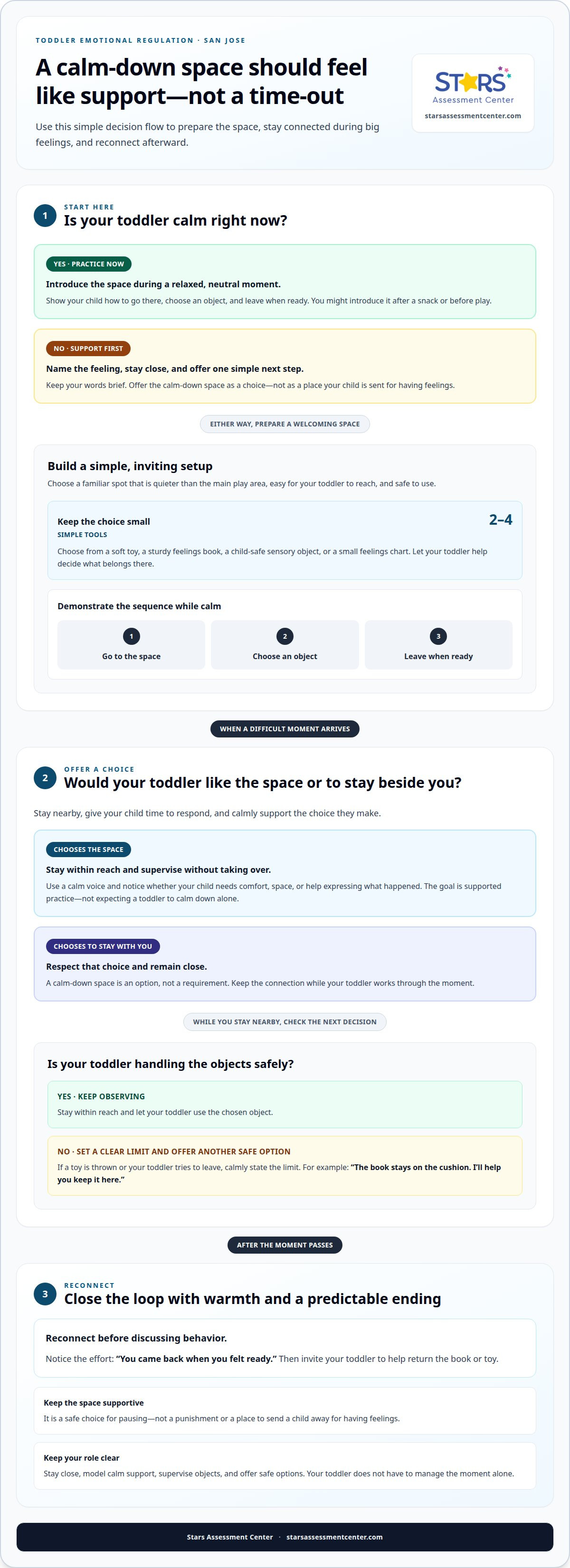
Choose a familiar spot that feels quieter than the main play area, such as a corner with a cushion or a small chair. Make it easy for your toddler to reach, and explain its purpose while your child is calm: “This is a place to pause when feelings feel big.” A calm-down space should be a safe choice, not a punishment or a place where a child is sent away for having feelings.
Offer 2-4 simple tools so the space feels inviting without becoming cluttered. For example, include a soft toy, a sturdy picture book about feelings, a child-safe sensory object, or a small feelings chart. Let your toddler help choose what belongs there. Their input can make the spot feel personal and useful, rather than like an adult-created consequence.
Introduce the space during a neutral moment, such as after a snack or before play. Show your child how to go there, choose an object, and leave when ready. Keep your words brief: “You can sit here, hold your bear, or stay beside me.” A simple demonstration gives children a clear sequence without asking them to follow a long explanation while upset.
During a difficult moment, offer the space as one option and stay nearby. For example, say, “You seem frustrated. Would you like the cushion or to sit with me?” Give your toddler time to respond, then calmly support the choice they make. Staying close helps you maintain connection and notice whether your child needs comfort, space, or help expressing what happened.
Supervise actively without taking over. Sit within reach, use a calm voice, and watch how your child handles each object. If your toddler throws a toy or tries to leave, set a clear limit: “The book stays on the cushion. I’ll help you keep it here.” Then offer another safe option. The goal is supported practice, not expecting a child to calm down alone.
After the moment passes, reconnect before discussing behavior. You might say, “You came back when you felt ready,” then invite your child to help return the book or toy. That small routine gives the space a predictable beginning and ending. If you’re looking for more guidance on a toddler’s emotional development, explore developmental assessment support as one way to learn about their needs.
3. Choices within consistent boundaries
Two clear options can help toddlers participate without giving them a decision that belongs to the adult. Keep the limit steady, then offer a choice within it: “It’s time to leave the playground. Would you like to walk to the gate or hold my hand?” Both options keep the boundary in place while giving your child a chance to practice cooperation.
Use short, familiar words during a tense moment. If your child refuses a coat, for example, try, “The coat comes with us. Do you want to put it on, or should I help?” Long explanations can be hard for toddlers to follow when upset. A brief choice gives your child something specific to do, while you remain responsible for keeping the limit clear.
Make choices concrete if spoken options are difficult to process. Hold up two shirts, point to two snacks, or show pictures of shoes and boots. Name each option: “Red cup or blue cup?” Then pause and give your child time to respond. Visual choices can make an activity easier to understand, especially when you’re getting ready to leave.
Follow through after your child chooses. If your toddler picks the blue cup, use it. If they don’t choose, calmly select one and move on. Avoid adding more options after the first pair, since extra possibilities can turn a simple decision into a struggle. Keep the pattern predictable: you set the boundary, your child chooses between acceptable actions, and the routine continues.
Not every situation calls for a choice. If your child reaches for a hot pan or moves toward a street, act immediately and give a direct safety instruction. For everyday transitions, offer choices before frustration builds: “Walk to the car or ride in the stroller?” If neither option is accepted, repeat the boundary and help with the next step. Calm follow-through shows that choices are real, while limits still apply.
Practice offering choices during everyday activities, not only during conflict. At snack time, offer apple slices or yogurt; during cleanup, ask whether blocks or books go away first. If your child protests, briefly acknowledge the feeling, then repeat the same two options. Consistent words and actions across home and preschool can help adults respond in familiar ways. Repeated choices give children safe opportunities to decide while learning that adults maintain important boundaries.
4. Establishing predictable routines
A familiar sequence helps toddlers understand what will happen next. A morning routine, for example, might go from getting dressed to breakfast, then shoes and the car. Keep the steps in the same order when possible, and describe each one in simple words. Predictable routines can help toddlers feel secure and take part in everyday tasks.
Choose one difficult part of the day to make more predictable first. If getting dressed causes stress, practice the same steps each morning: choose clothes, put them on, then place pajamas in a basket. A parent can work toward getting dressed by 7:15 as one step in managing a challenging morning. Break the task into small actions and respond calmly when the child needs help.
Timers can help make an ending easier to understand. For tooth-brushing, an egg timer can show a countdown. Let your toddler watch it, then say what comes next: “When the timer ends, we rinse and choose a book.” This combines a visible cue with a short reminder. The timer supports the routine, while your steady presence helps your child move through it.
Use the same cues before transitions, especially when a preferred activity needs to stop. Tell your child, “After this song, we put the blocks away,” then follow through when the song ends. If the change is still hard, offer a brief pause to finish one small action, such as placing the last block in the bin. Repeating the same cue helps make the next step more predictable.
Include small jobs in routines to give your child a clear role. A toddler might carry a napkin to the table, put a cup beside a plate, or bring a book to the reading spot. Describe their part and keep the wording consistent: “First, your cup goes here; then we sit.” Repeating these actions gives children practice following a sequence and participating in family routines.
Special events can disrupt familiar patterns, so preview changes with concrete details. Before visiting relatives, explain, “We’ll ride in the car, say hello, eat, then come home.” A simple picture sequence can help your child see the order. If plans change, name what is different and explain the next step. Predictability doesn’t mean every day has to be identical. It means helping your child understand what will happen now.
Build regulation practice into routines instead of saving it for difficult moments. Before leaving the playground, pause together and take a slow breath, then walk toward the car. At bedtime, follow the same sequence of pajamas, brushing teeth, and a story. Familiar actions give toddlers opportunities to practice coping, shifting attention, and moving between activities.
5. Positive attention for regulation efforts
Notice your toddler’s effort, even if the feeling hasn’t disappeared. If your child pauses before grabbing a toy, say, “You stopped and looked at me. That helped me understand.” Specific praise connects the action with its effect. It tells children what they can try again, instead of simply hearing “Good job” without knowing what they did well.
Focus on persistence rather than a perfect outcome. Your toddler may still cry while waiting for a turn, yet manage to keep their hands to themselves. You might say, “Waiting was hard, and you stayed beside me.” This recognizes practice, not just success. In early learning moments, an emotionally warm approach is associated with positive behavior in children.
Acknowledge feelings and name a helpful response. If your child is upset after a snack spills, try, “You’re disappointed. You brought me the towel.” Don’t require your child to stop crying before offering connection. Instead, notice a constructive action, such as asking for help, moving away from a conflict, or accepting comfort from a familiar adult.
Look for small signs of calming, not only complete quiet. Your toddler might take a breath, loosen their grip, or come closer after moving away. Describe what you notice: “Your hands are resting now,” or, “You came back to sit with me.” This helps children connect their actions with how a moment feels, without suggesting they should hide or suppress emotions.
Consistent praise can make feedback easier to understand. Agree on a short phrase, such as “You used words to ask,” and use it at home and during preschool handoffs. You can also share a specific observation with another caregiver: “She asked for help when the zipper got stuck.” Matching language helps children hear the same message in familiar settings.
Keep attention warm and immediate, then let your toddler return to the activity. A smile, a gentle acknowledgment, or a few seconds of shared play can reinforce an effort without turning every response into a reward. If difficulty expressing needs makes these moments hard, consider a Speech and Language Evaluation to explore your child’s communication skills and needs.
Stars Assessment Program: Social-Emotional Assessment
Stars Assessment Program offers a Social-Emotional Assessment to help families understand a toddler’s social-emotional development when concerns persist across everyday situations. The assessment can provide insight into how a child responds to feelings, communicates needs, and engages with others. If questions extend beyond emotional development, a Multidisciplinary Developmental Assessment or Speech and Language Evaluation may help clarify other areas of development. Families concerned about autism can also explore an autism assessment.
An assessment may be a useful next step when emotional or communication concerns affect routines, play, or connection with others, and home strategies alone aren’t clarifying what support may help. Contact Stars Assessment Program or visit starsassessmentcenter.com to learn about assessment options.
Take the Next Step With a Clearer Picture
Notice where your toddler feels most at ease and when everyday moments become difficult. You might write down what happened before a challenging moment, how your child responded, and what helped afterward. These observations can be a useful starting point for a conversation about your child’s development.
For families seeking emotional regulation help for toddlers in San Jose, an assessment can help clarify whether concerns are mainly social-emotional or connect with broader developmental or communication questions. Stars Assessment Program offers Social-Emotional Assessment, Multidisciplinary Developmental Assessment, and Speech and Language Evaluation. Each focuses on a different area of a child’s development, helping families explore the concern that brought them here.
You don’t have to make sense of every behavior on your own. If you’d like to discuss assessment options for your toddler, contact Stars Assessment Program. A thoughtful next step can help you feel more prepared to support your child as new skills develop.
Frequently Asked Questions
What quick tools work in the moment?
Check whether a basic need might be adding to your toddler’s distress. Hunger, tiredness, or feeling left out can make a difficult moment harder. Try a simple H.A.L.T. check: consider whether your child is hungry, angry, lonely, or tired. Then reduce demands and offer one clear next step, such as sitting together or getting a drink. A short, calm response gives your toddler less to process.
Is it normal for toddlers to have difficulty managing their emotions?
Yes. Emotional control develops gradually, and toddlers are still learning how to handle frustration, disappointment, and waiting. ZERO TO THREE describes self-control as developing for toddlers aged 24 to 36 months. A difficult response doesn’t automatically mean something is wrong. Notice the situations that tend to bring distress, how your child communicates, and whether familiar support helps them return to play or another activity.
What does emotional dysregulation look like?
Emotional dysregulation describes difficulty managing or recovering from strong feelings. You might notice your child struggling to shift after a small change, having trouble communicating during distress, or needing substantial adult support to rejoin an activity. The behavior alone doesn’t explain its cause. Look for patterns across situations, including whether changes, communication demands, or tiredness tend to come before the reaction.
What is self-regulation?
Self-regulation is the developing ability to manage feelings, attention, and actions in response to a situation. For a toddler, it could look like pausing when a toy is unavailable, accepting help, or returning to play after becoming upset. Young children don’t develop this skill in isolation. Caregivers support it by staying steady, helping the child recognize what’s happening, and showing workable responses.
What simple emotional regulation tools help children ages 2-5?
Pair a feeling with a practical request your child can use. During a calm play moment, practice saying, “I need help,” or “I need space,” using words, gestures, or a picture. You can also use a puppet to act out a frustrating situation and explore what the character could try. Keep the practice suited to your child’s communication and understanding.
When should I seek additional support?
Consider additional support when emotional or communication concerns repeatedly interfere with daily activities, relationships, or your child’s participation in play. For children under 3 years in San Jose and Santa Clara, or Santa Cruz counties, Stars Assessment Program offers assessment options. No referral needed. Families can contact Stars directly. There is no cost to families; this is not a diagnostic assessment. Assessment in your preferred language, with results explained in clear, simple language.
What emotional regulation skills are developmentally typical for toddlers?
Skills vary as children grow. Children can begin labeling emotional expressions as early as 2 years, and self-control is still developing between 24 and 36 months, according to ZERO TO THREE. A toddler might name a familiar feeling in one situation but need adult support in another. Consider the child’s communication, context, and progress over time rather than expecting the same response in every moment.
What are effective ways to help a toddler calm down during a tantrum?
First, make the area safe by moving objects your child could knock over or throw. Stay close, keep your voice steady, and use a few simple words instead of asking several questions. If your toddler doesn’t respond, pause while remaining available. When the intensity eases, reconnect and help your child communicate what happened, such as pointing to the toy they wanted.


