
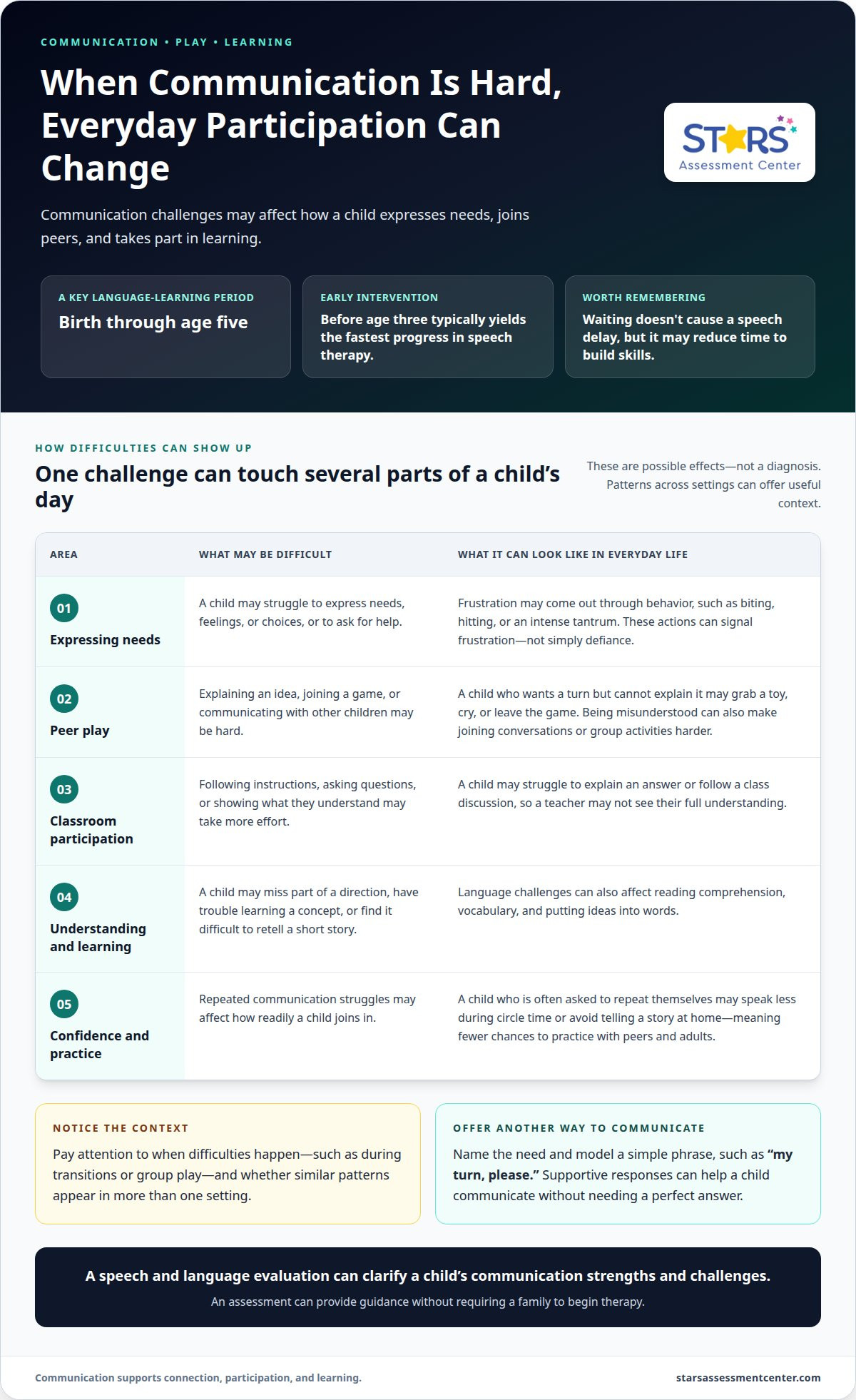
The risks of a wait-and-see approach for speech delay include missed opportunities to build communication skills during important years of development. Waiting doesn't cause a child's speech delay, but it may reduce time to strengthen those skills. Birth through age five is a key period for language learning, and early intervention before age three typically yields the fastest progress in speech therapy.
It can seem reasonable to wait when a child understands you, is progressing in other areas, or a relative talked late. Those observations matter, and some children catch up, but it is difficult to predict who will. An assessment does not commit your family to therapy. It can clarify your child’s strengths and needs, with results explained in clear, simple language.
This article explains how delayed support may affect a child's ability to express needs, connect with peers, and build skills that support learning. You'll also learn when monitoring may be reasonable, what an evaluation can clarify, and how timely support can give families practical next steps without blame or panic.
Key Takeaways
- Understand how communication challenges can affect a child’s ability to connect with peers, express needs, and participate in learning.
- Learn which developmental signs may call for a closer look, and when brief monitoring may be appropriate.
- See how an evaluation can clarify a child’s strengths and needs without committing your family to therapy.
- Explore why timely support may help build communication skills and ease challenges that can affect social and academic development.
- Find out how a developmental assessment can help families make sense of concerns across communication and social-emotional growth.
What Happens if Speech Therapy is Delayed?
Delaying speech therapy can postpone support while a child is building language and communication skills. Early intervention before age three typically yields the fastest progress in speech therapy, making timely evaluation useful when concerns persist.
Early Intervention Services
Early intervention services support young children with developmental concerns, including communication challenges, through services such as speech therapy. Programs may also include occupational or physical therapy, depending on a child's needs. For a parent, the value is a clearer understanding of what skills need support and how to encourage language in daily routines. An evaluation can provide guidance without requiring a family to begin therapy.
Brain Plasticity and Early Support
Brain plasticity is the brain’s capacity to adapt as it develops and learns. Birth through age five is a key period for language acquisition, so early support creates opportunities to practice communication during these important years. Waiting doesn't cause a speech delay, but it may reduce time to build skills. Early intervention before age three typically yields the fastest progress in speech therapy.
Language supports more than speaking. Children use it to understand instructions, learn concepts, and develop reading and writing skills. For example, a child who struggles to understand “put your cup on the table” may find everyday learning harder to follow. Support can consider understanding language as well as expressing it.
Speech and language skills grow through interaction, not only through formal sessions. A parent can use everyday moments, such as naming foods during a meal or describing a toy during play, to encourage communication. Early intervention can help caregivers learn strategies that fit naturally into routines, giving a child more chances to express needs and ideas.
Parent involvement is essential in early intervention. When caregivers practice language strategies during familiar activities, children have opportunities to use new skills in meaningful settings. For instance, pausing during a favorite story gives a child time to point, gesture, or try a word. Responding to those attempts supports communication without requiring a perfect answer.
- During play: Name the toy or action, then pause for the child to respond.
- During routines: Use simple language to describe steps, such as washing hands or putting on shoes.
- During books: Talk about a picture and give the child time to point, gesture, or speak.
These interactions don't replace an evaluation when speech or language concerns persist. A speech and language evaluation can clarify a child's communication strengths and challenges, while early support helps families understand useful next steps. The goal is not to pressure a child, but to make communication practice part of ordinary moments.
Social and behavioral effects of communication difficulties
Communication difficulties can affect how children join play, share ideas, and respond to everyday demands. You may notice changes in behavior, fewer interactions with peers, or challenges with learning.
Behavioral Challenges From Communication Frustration
A child who struggles to express needs, feelings, or choices may show frustration through behavior. A child who cannot ask for help may bite, hit, or have an intense tantrum. These actions can signal frustration, not simply defiance. Noticing when they happen, such as during transitions or group play, can help adults see where communication may be breaking down.
Imagine a child who wants a turn with a toy but cannot explain that to a peer. They may grab it, cry, or leave the game. Naming the need and offering a simple phrase, such as “my turn, please,” gives the child another way to communicate. If frustration keeps disrupting play or routines, a social-emotional assessment can help clarify how communication and behavior relate.
Social and Academic Effects
Communication difficulties can make it harder for children to connect with peers and join group activities. A child who is often misunderstood may withdraw, miss chances to make friends, or feel anxious about joining a conversation. For example, difficulty explaining the rules of a game can leave a child on the sidelines, even when they want to participate.
Classroom communication also supports academic progress. Children use language to follow instructions, ask questions, and show what they understand. If a student struggles to explain an answer or follow a class discussion, a teacher may not see their full understanding. As reading and writing develop, language challenges can also affect comprehension, vocabulary, and putting ideas into words.
Learning and Communication Effects
Language difficulties can affect both understanding others and expressing thoughts. A child may miss part of a direction, have trouble learning a concept, or find it difficult to retell a short story. These challenges can make tasks harder when an activity depends on listening, explaining, or sharing information.
Repeated communication struggles can also shape confidence. A child who is often asked to repeat themselves may speak less during circle time or avoid telling a story at home. That reduced participation can mean fewer opportunities to practice communication with peers and adults. Look for patterns across settings, such as difficulty joining conversations at preschool and explaining events after school.
Supportive responses can help keep communication open. Give a child time to respond, acknowledge gestures as meaningful attempts, and offer words for feelings or needs. For instance, “You wanted the blocks” can help connect an experience with language. Changes in behavior, social participation, or learning alongside communication concerns are useful context for understanding a child’s needs.
Risks of delaying evaluation for persistent speech and language challenges
Delaying an assessment can leave families unsure whether a child’s talking, understanding, or communication progress needs support. An assessment can help clarify strengths and needs without requiring a family to begin therapy.
Parents can seek an evaluation as soon as speech or language concerns persist; they don’t need to wait for a particular birthday. For children under age three, families can request an early intervention evaluation through their local early intervention program. A speech-language screening or evaluation can help determine whether broader assessment is needed.
A comprehensive speech and language evaluation may look at how a child understands language and expresses ideas, along with speech sounds, social communication, and play or interaction patterns. For children ages four and up, assessment may also consider vocabulary, sentence structure, storytelling, and pragmatic language, such as taking turns in conversation. These areas help explain where a child may struggle with daily communication or making friends.
Speech delay can have different contributing factors. Developmental language disorder, childhood apraxia of speech, and autism spectrum disorder are conditions that may not resolve on their own. An evaluation helps identify communication needs and whether further developmental assessment may be useful. Yes, hearing should also be considered when assessing speech concerns, because hearing affects access to spoken language.
When concerns extend beyond communication, a broader developmental assessment can consider a child’s skills in several areas. Stars Assessment Program’s multidisciplinary assessment looks at speech and language, cognitive, motor, social-emotional, adaptive, and vision and hearing screening. It can help families understand their child’s developmental profile and consider next steps.
Parents who remain concerned can describe specific examples during an evaluation: difficulty following a familiar direction, trouble combining words, or limited gestures during play. Write down when the concern appears and what helps the child communicate. A screening or evaluation can offer clarity even when a child has strengths in other areas, such as motor skills or social engagement.
Wait-and-see may suit a brief period of close monitoring when a child has mild articulation errors, strong language comprehension, age-appropriate vocabulary and sentences, no social or behavioral concerns, and steady progress. Prompt evaluation is more appropriate when concerns persist, progress stalls, gestures are limited, or communication difficulties affect play and interaction. Mild errors with R or TH sounds may resolve over time, but broader concerns deserve attention.
Risks of delaying support for developmental concerns
Waiting can feel reasonable when a child seems strong in other areas or relatives talked late. But language concerns deserve attention alongside a child’s other developmental strengths.
Late Bloomers and Developmental Delays
Some children who talk late catch up without intervention, but it’s difficult to predict who will. A family history of late talking followed by typical development can make waiting seem familiar. Yet limited gestures and a family history of speech delay are risk factors for not catching up independently. An evaluation helps put a child’s communication pattern in context rather than relying on family comparisons.
Assumptions about boys’ language development can also delay support. The belief that boys naturally develop language later than girls does not show whether an individual child’s communication is progressing as expected. A boy who rarely uses gestures or combines words deserves attention, even if a sibling also started talking late. Strengths in movement or social engagement do not answer every question about language development.
Missed Developmental Milestones
Developmental milestones offer useful points of comparison, not a reason to blame a child or parent. At 18 months, children should use at least 20 words, including different types of words. At 24 months, they should use at least 100 words and combine two words. These examples help families describe concerns clearly during an evaluation.
Other milestones can show how communication supports everyday participation. By age four, strangers should understand at least 90% of a child’s speech. Around age four or five, children should follow multi-step directions, such as going to a room, getting shoes, and bringing them to an adult. Difficulty with these tasks can affect independence, play, and conversations with caregivers.
As children enter kindergarten, language delays can affect phonological awareness, narrative development, grammatical skills, and social skills. A child who struggles to retell a story or explain what happened during play may find it harder to join classmates. Communication also helps children ask for clarification, share ideas, and build friendships. Those experiences contribute to learning and confidence over time.
Notice patterns rather than judging one difficult day. You can note a child’s words, gestures, responses to familiar directions, and attempts to interact during everyday routines. For instance, record whether your child combines words at home or uses gestures to request a snack. If concerns persist across play, home routines, and group settings, a multidisciplinary developmental assessment can help clarify needs across developmental areas.
Risks of delaying speech and language intervention
Delaying intervention can let communication needs carry into school, where language supports increasingly complex learning. A child who struggles to understand words or explain ideas may face challenges with phonological awareness, vocabulary, and comprehension. These skills matter when children begin connecting speech sounds with letters, following classroom explanations, and understanding what they read. The concern isn’t that every late talker will have academic difficulties. It’s that persistent language delays can make later learning harder without support.
Early speech and language support matters because the demands of school change over time. In the early grades, children learn to read; by ages 8-9, instruction shifts toward reading to learn. A child who finds reading comprehension difficult may then have trouble learning from written material across subjects. The gap can become more noticeable when lessons depend on understanding new vocabulary, following explanations, or connecting details in a text.
One study found that over 80% of children with language delays at 30 months had not caught up by age six. That finding doesn’t predict an individual child’s path, but it shows why waiting for speech to improve on its own can leave persistent needs unaddressed. Some late talkers do catch up, yet families can’t reliably identify in advance which children will. Understanding the risks of the wait and see approach for speech delay means recognizing that a timely evaluation can clarify current skills and whether intervention may help.
Academic effects can extend beyond early reading. Language supports phonological awareness, sentence structure, and the ability to tell or understand a story. A student who can’t follow a story’s sequence may struggle to explain what happened, answer questions, or write a clear response. At age 13, late talkers have been reported to continue experiencing reading comprehension difficulties. These challenges can affect confidence when classroom tasks repeatedly rely on language.
The goal of intervention is to address communication needs before they compound across learning and social settings. At age three, addressing a speech delay is easier than remediating a reading disability at age eight. That comparison highlights the value of responding to a present concern, rather than waiting for school difficulties to reveal it. One of the risks of the wait and see approach for speech delay is that a child’s current communication needs may go unaddressed as classroom demands grow. Support can focus on skills a child needs now, such as understanding language, expanding vocabulary, or communicating ideas.
A speech and language evaluation can help families understand a child’s communication profile and consider an appropriate next step. If speech or language concerns are affecting participation or learning, request a speech and language evaluation to discuss the child’s needs. Early clarity can help families make informed decisions before communication challenges interfere further with school progress.
Stars Assessment Program: Social-Emotional Assessment
Stars Assessment Program offers Social-Emotional Assessment to help families understand concerns involving a child’s emotions, behavior, and interactions. If communication difficulties are affecting play, relationships, or daily routines, this assessment can add perspective on a child’s social-emotional needs.
For concerns spanning more than one area of development, a Multidisciplinary Developmental Assessment can consider a child’s broader developmental profile. A Speech and Language Evaluation focuses on communication, while Autism-related assessment may be relevant when families have concerns about social interaction, communication, or repetitive behaviors. Understanding which areas need attention can help parents consider an informed next step.
If you’re concerned about your child’s communication or social-emotional development, contact Stars Assessment Program to discuss an assessment.
Choose a Clear Next Step for Your Child
Understanding the risks of the wait-and-see approach for speech delay can help you move from uncertainty toward a clearer picture of your child’s needs. Start by noting what you observe, such as communication during play, responses to familiar directions, or interactions with other children. These everyday examples can make a conversation about development more focused.
Stars Assessment Program offers Social-Emotional Assessment, Multidisciplinary Developmental Assessment, and Speech and Language Evaluation. The right assessment can help families better understand concerns affecting communication or social-emotional development and consider what support may fit. Reaching out is a practical next step when you’re ready to discuss your observations.
Contact Stars Assessment Program to talk about an assessment for your child. You can take this one step at a time, with your child’s needs guiding the way.
Frequently Asked Questions
What’s Recommended Instead?
Arrange a speech-language screening or evaluation when communication concerns persist, and keep brief notes about what you observe. For example, record words your child uses, how they respond to familiar requests, and how they communicate during play. These details can make it easier to describe patterns and understand what support may fit. An evaluation provides information for decision-making; it doesn’t require your family to begin therapy.
Why Do Some People Choose the Wait and See Approach?
Families may wait because a child seems to understand well, is progressing in other areas, or has relatives who talked late and later developed typically. Some also believe boys naturally start talking later than girls. These observations can feel reassuring, especially when a child is socially or physically engaged. On their own, however, they do not show whether a child’s communication is developing as expected.
What are the risks of waiting to evaluate a child with speech delay?
Waiting to evaluate can leave a family without clarity about a child’s communication strengths and needs. If challenges persist, a child may have difficulty explaining ideas, understanding language, or participating in conversations and classroom activities. For example, struggling to retell a story can affect both sharing experiences and showing comprehension. Evaluation helps identify which communication areas deserve attention and whether further developmental assessment is appropriate.
How does early speech therapy affect outcomes compared with a wait-and-see approach?
Early intervention before age three typically yields the fastest progress in speech therapy. Support can give a child structured opportunities to practice communication and help caregivers respond to communication attempts during everyday activities. A speech-language professional may focus on areas such as understanding words, expressing ideas, or speech-sound development. The appropriate approach depends on the child’s communication profile and the concerns identified through evaluation.
What speech and language milestones should children meet by age?
At 18 months, children should use at least 20 words, including different types of words. At 24 months, they should use at least 100 words and combine two words. By age four, strangers should understand at least 90% of a child’s speech. Around ages four or five, children should use sentences with five or more words and follow multi-step directions, such as getting shoes and bringing them to an adult.
What causes speech delay, and what medical conditions should be ruled out?
Speech delay can have different contributing factors, including developmental language disorder, childhood apraxia of speech, and autism spectrum disorder. Hearing should also be considered, since it affects access to spoken language.


