
One skill your baby hasn’t shown yet doesn’t automatically mean something is wrong. A child development checklist 12 months can help you notice emerging abilities, but it isn’t a pass-or-fail test. Babies develop at different paces, and a missed item by itself doesn’t diagnose a developmental delay.
It’s understandable to want clear guidance about which skills are relevant at this age and what to do if you have a concern. The CDC’s milestone checklists describe skills that at least 75% of children can do by a given age. They’re useful for starting a conversation, but they’re different from a formal developmental screening or evaluation.
This guide covers common 12-month skills in social-emotional development, communication, thinking, and movement. You’ll also learn how to record what you notice and bring questions, examples, or videos to a healthcare or developmental professional. The goal is a clearer picture of your child’s growth and a practical next step if you’d like a closer look.
Key Takeaways
- Use the child development checklist 12 months to notice skills during everyday play and routines, not to compare your baby rigidly with others.
- Look for emerging abilities across social-emotional, communication, cognitive, and movement skills. One unchecked item alone doesn’t provide a diagnosis.
- Keep brief examples of what your baby does, and note any skills they’ve stopped using, to make conversations about development more specific.
- Share persistent concerns or the loss of a previously acquired skill with a healthcare or developmental professional.
- Stars Assessment Program provides multidisciplinary developmental assessments for children under three, including evaluation of cognitive, physical, communication, and social-emotional development.
Child Development Checklist at 12 Months: Skills to Notice
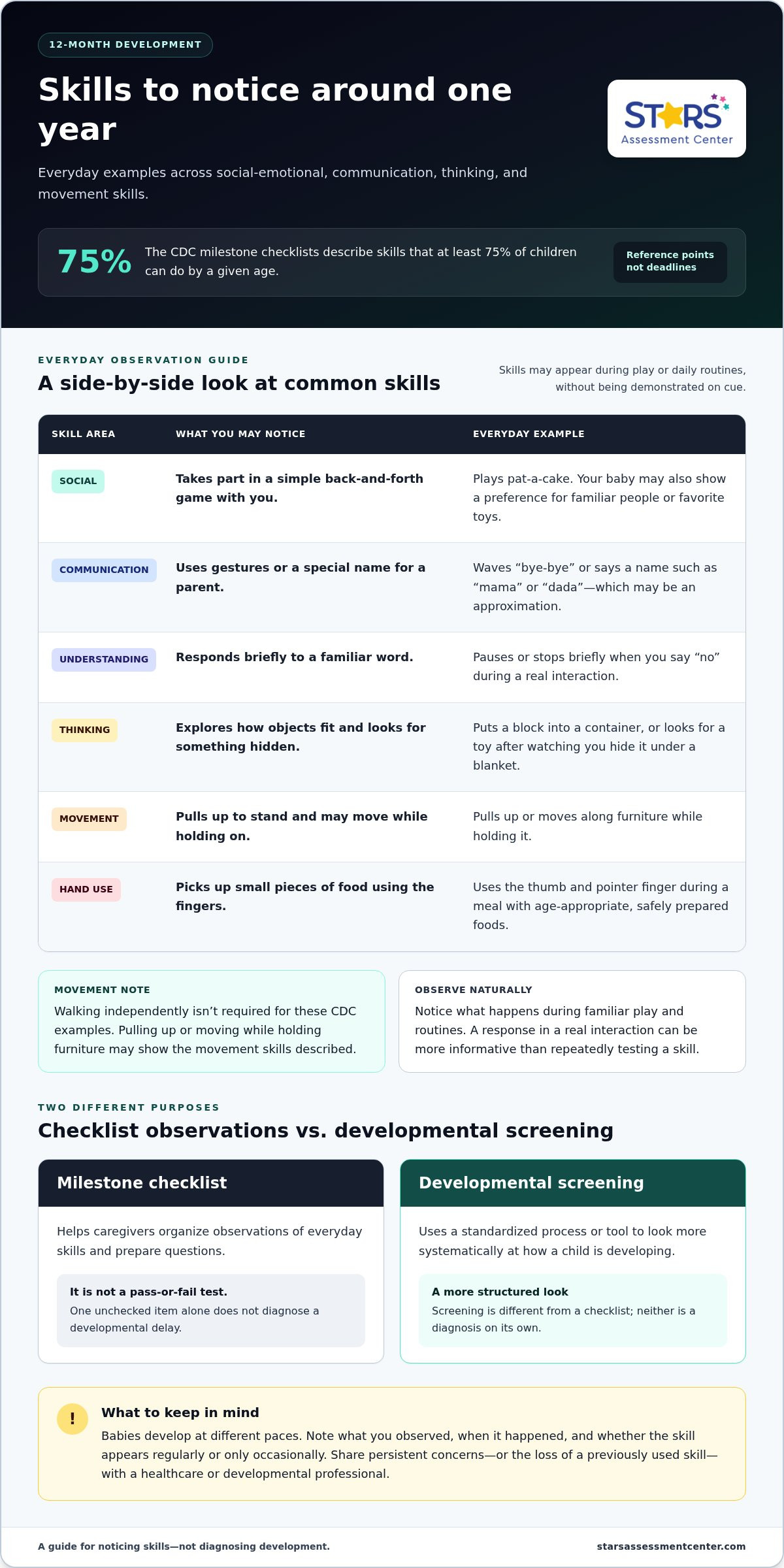
Babies don’t all gain new skills on the same schedule, and a checklist can’t diagnose a developmental delay. Milestones are skills many children can do by a particular age. The CDC’s milestone checklists focus on skills that at least 75% of children can do by that age, so they offer useful reference points, not deadlines for every baby.
Use this child development checklist 12 months to notice what your baby is learning in familiar situations. A skill may appear during play or a daily routine without your baby being asked to perform on cue. For a broader overview of child development stages, including infancy and toddlerhood, you can explore how different areas of development fit together.
Social-emotional and communication skills around one year
Notice how your baby interacts with you and communicates during ordinary moments. A skill may appear briefly, so observing over time can be more informative than relying on one attempt.
- Social-emotional: Your baby plays a simple back-and-forth game with you, such as pat-a-cake. They may also show a preference for familiar people or favorite toys.
- Communication: Your baby waves “bye-bye” or uses a special name for a parent, such as “mama” or “dada.” The name may be an approximation rather than a clearly pronounced word.
- Understanding: When you say “no,” your baby may pause briefly or stop what they’re doing. Notice the response during a real interaction, such as reaching toward something they shouldn’t touch, rather than repeatedly testing it.
Respond naturally when your baby looks, gestures, vocalizes, or takes a turn in a game. These exchanges help you notice communication and connection without turning play into a quiz.
Cognitive and physical skills around one year
Everyday play also gives you chances to notice how your baby explores and moves. Keep objects safe and within reach, and let your child engage at their own pace.
- Cognitive: Your baby puts an object, such as a block, into a container. After watching you hide a toy under a blanket, they look for it.
- Movement: Your baby pulls up to stand and may move along furniture while holding on.
- Hand use: Your baby picks up small pieces of food between the thumb and pointer finger. Observe during a meal with age-appropriate, safely prepared foods.
Walking independently isn’t required for these CDC examples. A baby who pulls up or moves while holding furniture may be showing the movement skills described here without taking unsupported steps.
A milestone checklist is a conversation starter, while a standardized developmental screening uses a formal tool to look more systematically at a child’s development. Neither should be treated as a diagnosis on its own. If an item gives you pause, note what you observed and when. The next sections explain how to interpret concerns and discuss them with a professional.
How to Read a 12-Month Development Checklist Without Treating It as a Test
A milestone list is a guide for noticing development, not a set of deadlines your baby must meet on a particular day. The child development checklist 12 months can help you organize what you’ve seen, but it doesn’t produce a score or tell you by itself whether your child has a delay. The American Academy of Pediatrics also provides age-specific information in its American Academy of Pediatrics 12-Month Milestones.
One unchecked item is a reason to observe and ask questions, not a conclusion. A broader pattern may be more useful to discuss, such as concerns in several areas or across everyday routines. Context matters, too. A baby may have had few chances to try a particular activity, or may show a skill on some occasions but not others. Record what happens and the circumstances rather than deciding what it means on your own.
What does it mean if a 12-month-old has not reached one milestone?
Write down what you’ve observed, including when the skill appeared, what was happening, and whether it happens consistently. A skill may emerge unevenly, but that possibility isn’t a reason to dismiss a concern or assume it will resolve without support. If you keep wondering about the same skill, or notice a loss of an ability your baby previously used, share that with their healthcare professional.
Why a milestone checklist is different from developmental screening
A checklist helps caregivers organize observations of everyday skills. A developmental screening uses a standardized process or tool to look more closely at how a child is developing. They serve related but different purposes, and neither should be treated as a diagnosis. For more on how screening works, see Early Childhood Developmental Screening: A Parent’s Guide to Growth and Support.
A parent checklist can guide questions about development, but it cannot diagnose a developmental delay. It can help you explain what you’ve noticed, while a screening or professional evaluation can offer a more structured look when there are questions to explore. You don’t need to wait until every item on a list feels concerning before bringing up a persistent worry.
Share specific examples rather than a general impression. Describe what your child does during play, a meal, or time with familiar people, and whether the skill appears regularly or only occasionally. These details give a professional a clearer starting point for discussing your concerns and possible next steps.
Stars Assessment Program provides multidisciplinary developmental assessments for children under three, looking at cognitive, physical, communication, and social-emotional skills.
When a 12-Month Milestone Concern May Need a Closer Look
A checklist can help you notice questions, but it can’t confirm or rule out a developmental delay. One skill that hasn’t appeared yet doesn’t provide a complete picture, and checking every item doesn’t replace professional screening when you have a concern. Trust your observations. If a worry persists, or your child has stopped using a skill they previously had, discuss it with their healthcare professional rather than waiting for the checklist to give you an answer.
You don’t need to arrive with a diagnosis or a perfect record. Your account of what happens at home gives a professional useful context. They may consider how your child communicates, plays, and moves, along with developmental history and your observations. The child development checklist 12 months can help you put those observations into words.
Observations worth sharing with a professional
Specific examples are often more helpful than a general impression. Before a conversation, jot down what you’ve noticed and the situations where it occurs. Include what your child does, how often you see it, and whether the skill appears during familiar routines or only occasionally.
- Identify the skill: Note what prompted your question, such as a communication, play, or movement skill.
- Describe the setting: Record whether you noticed it during a meal, playtime, a book, or time with a familiar person.
- Track consistency: Say whether it happens repeatedly, sometimes, or hasn’t appeared despite opportunities to try.
- Note changes: If your child stopped using a skill, describe what they used to do and when you first noticed the change.
Short notes are enough. If a behavior is difficult to describe, a brief video may help show what you’re seeing, though it shouldn’t delay raising a concern.
What a professional screening or assessment can clarify
A developmental screening uses a standardized process to help identify whether a closer review may be helpful. It isn’t a diagnosis. If questions remain, an assessment can take a broader look at relevant developmental areas rather than treating the checklist as a score. Depending on the concern, this may include communication, cognitive, physical, or social-emotional development.
Families can share what they’ve observed, ask what screening results mean, and discuss whether further assessment may help clarify their child’s strengths and support needs. If your questions are specifically about autism, screening and diagnostic evaluation are different processes, and a professional can explain which kind of discussion is relevant.
Seeking guidance doesn’t mean you’re labeling your child or assuming something is wrong. It’s a way to understand the observations you’ve gathered and consider an appropriate next step. A professional conversation can help put individual skills, patterns, and your child’s developmental history into context.
How to Use a 12-Month Checklist and Prepare for a Development Discussion
A checklist is most useful when it helps you describe what your baby does in real life. You don’t need to stage activities or prompt your child repeatedly. Use the child development checklist 12 months as a reminder of what to notice, then gather a few specific examples to make a conversation with a professional easier.
Simple ways to observe development during everyday routines
Familiar activities give your baby a comfortable chance to show skills. Keep the setting relaxed, follow your child’s interest, and note what happens without expecting a response every time.
- Songs and greetings: During a familiar song, notice whether your baby watches, gestures, vocalizes, or takes a turn. At arrivals and goodbyes, observe how they communicate with familiar people.
- Books and requests: As you look at a book together, notice how your baby engages with you and the pages. When you name a familiar object or make a simple request, observe how your child responds.
- Safe play and meals: During supervised play, notice how your baby reaches, grasps, moves, and explores toys. At mealtimes, observe hand use with safe, age-appropriate foods.
- Familiar games: A repeated game, such as taking turns with a toy, can offer a natural glimpse of interaction and problem-solving. Notice whether your child anticipates what comes next or tries a different way to reach an object.
These are opportunities to observe, not exercises your baby must complete. A quiet day, distraction, or lack of interest in one activity doesn’t tell the whole story.
Questions and notes to bring to an appointment
Keep notes short and concrete. Describe what you saw rather than writing that your child is “behind” or comparing them with another baby. Include context, such as where it happened and whether you’ve seen it more than once. A simple record can help you remember details during an appointment.
Development discussion notes
- Skill or area I’m wondering about:
- What I observed and where it happened:
- Present, emerging, or a concern I want to discuss:
- Changes over time, including any skill no longer used:
- Questions about development or recommended screening:
- Relevant developmental or health history:
Before the visit, choose the questions you most want answered. You might ask whether screening is appropriate, what a particular observation could mean, or what next steps are available. Bring relevant health or developmental history, and note when you first noticed any change. You don’t need to complete every line; even a few clear examples can help guide the discussion.
Stars Assessment Program offers multidisciplinary developmental assessments for children under three to help families get a fuller picture of their child’s development.
Where Families in Santa Clara County Can Seek Developmental Assessment Support
If you’d like more clarity about your child’s development, bring your observations and questions to a healthcare professional and discuss whether further assessment may be helpful. A parent checklist can organize what you’ve noticed, but it isn’t a referral, diagnosis, or substitute for a professional evaluation. You don’t need to reach a conclusion before asking for guidance.
Stars Assessment Program provides multidisciplinary developmental assessments for children under three in Santa Clara County and nearby communities. Specialists consider relevant areas of a child’s development together, rather than relying on one unchecked item from a milestone list. Families can share what they see at home and learn more about potential developmental support.
What a multidisciplinary developmental assessment can consider
Multidisciplinary specialists assess cognitive, physical, and communication skills in children from birth to age three. Social-emotional development can also be considered through a social-emotional assessment. The areas explored depend on the child and the questions families bring forward.
This process is distinct from completing a parent checklist. A checklist helps caregivers notice and describe everyday skills; an assessment offers a broader, professional look at development. It can help families better understand potential delays and access early intervention resources. An assessment doesn’t mean a concern has already been diagnosed, and the checklist itself doesn’t determine whether an assessment is needed.
Finding a next step that feels manageable
Bring a few notes, examples, and questions to a conversation with a healthcare or developmental professional. You might mention which skills you’ve observed, where they tend to appear, and any changes you’ve noticed over time. These details give the discussion a practical starting point without requiring you to interpret what they mean.
Stars Assessment Program serves families in San Jose, Santa Clara, Milpitas, Gilroy, Morgan Hill, Santa Cruz, and Salinas. If you live in one of these communities and are considering a closer look, a professional assessment can offer a fuller picture than a child development checklist 12 months alone. The checklist can support the conversation while specialists consider your child’s development across relevant areas.
Every family’s questions are their own, and asking for more information is a reasonable step. To explore assessment support for your child, learn about Stars’ multidisciplinary developmental assessments.
Take the Next Step With Confidence
You don’t need to have every answer before asking for guidance. If the child development checklist 12 months raised a question, choose the observation that matters most to you and bring it into a conversation with a professional. One clear example can be a useful starting point, even if you’re still unsure what it means.
If you’d like a broader understanding of your child’s development, a professional assessment can provide another way to gather information. Stars Assessment Program offers multidisciplinary developmental assessments for infants and toddlers under age three, considering cognitive, physical, communication, and social-emotional skills. Families in Santa Clara County and nearby communities can learn about the assessment and decide whether it fits their next step.
Explore developmental assessment support with Stars. Your observations and questions matter, and taking things one step at a time can help you move forward with greater confidence.
Frequently Asked Questions
Is every 12-month-old expected to walk independently?
No. Walking independently isn’t required by the 12-month examples in the CDC checklist. A baby may be working on standing, pulling up, or moving along furniture while holding on. If your child isn’t yet doing these things, describe the movements you do see and any situations that seem difficult. A healthcare professional can consider those observations alongside your child’s broader development and health history.
Can a baby miss one 12-month milestone and still be developing?
Yes. One skill not appearing yet doesn’t by itself show whether development is on track or delayed. For example, a baby might not put a block in a cup when asked but may place other objects into containers during play. Note what happens in different familiar situations, and share ongoing questions with a professional. The child development checklist 12 months is a reference for discussion, not a verdict on your baby.
What should I do if my baby loses a skill they used to have?
Contact your child’s healthcare professional and describe the change rather than waiting for another milestone review. Mention the skill your baby used before, when you last noticed it, and whether the change happened gradually or seemed sudden. If you can, write down examples or show a brief video. A loss of a previously used skill deserves a conversation so a professional can help determine what follow-up is appropriate.
How is a 12-month milestone checklist different from developmental screening?
A milestone checklist helps you keep track of skills you notice at home. Developmental screening uses a standardized tool or process to look more systematically at development. A screening result helps guide whether more discussion or assessment may be useful; it isn’t a diagnosis. If you’re given a questionnaire, answer based on what you’ve observed in everyday life, and ask the professional to explain any items or results you’re unsure about.
Should I use corrected age when checking milestones for a premature baby?
Ask your child’s healthcare professional whether to use corrected age when reviewing milestones. For a baby born prematurely, the age used to interpret development may differ from the number of months since birth, depending on the child’s history and the guidance being used. Share your baby’s birth and developmental history, and use the age your professional recommends rather than adjusting milestone dates on your own.
When should I talk with a professional about my 12-month-old’s development?
Talk with a professional whenever a concern persists, your child loses a skill, or you want help interpreting what you observe. Bring a few examples and note when they happen. Families in San Jose, Santa Clara, Milpitas, Gilroy, Morgan Hill, Santa Cruz, and Salinas can also explore Stars Assessment Program’s developmental assessments for children under three. You don’t need to diagnose a concern before asking for guidance.


