
What if a behavior your baby hasn’t shown yet is only one part of a bigger picture? It’s natural to wonder whether your infant is connecting, responding, and expressing feelings as expected. The signs of social emotional delay in infants can be difficult to interpret because babies develop at different rates, and one missed behavior doesn’t confirm a delay.
What matters is the pattern over time. Learn which social and emotional behaviors to notice, how they may change as your baby grows, and what your observations can and can’t tell you. This can help you raise concerns without feeling that you need to diagnose your child yourself.
We’ll cover age-related examples, behaviors that may be worth discussing with a professional, and practical details to observe, such as when a behavior happens and whether it repeats. A social-emotional assessment can consider your baby’s development more fully and help clarify possible next steps. You don’t have to reach a conclusion on your own.
Key Takeaways
- Social-emotional growth includes how babies express feelings and engage with familiar people, and it unfolds at an individual pace.
- Learn which signs of social emotional delay in infants may be useful to observe and discuss, without treating them as a diagnostic checklist.
- Consider whether a response difference appears repeatedly during familiar routines, rather than drawing conclusions from an isolated moment.
- Keep simple notes about what happened, when, with whom, and how often to make conversations about your concerns more specific.
- A multidisciplinary assessment can consider social-emotional development alongside other areas of growth for a broader picture of your child.
What social-emotional development looks like during infancy
Social-emotional development is how a baby expresses feelings, responds to people, and begins to build relationships. It appears in everyday exchanges: a baby looking toward a familiar face, smiling, making sounds during a back-and-forth interaction, or turning to a caregiver for comfort. These skills grow gradually through relationships and daily experiences, not all at once.
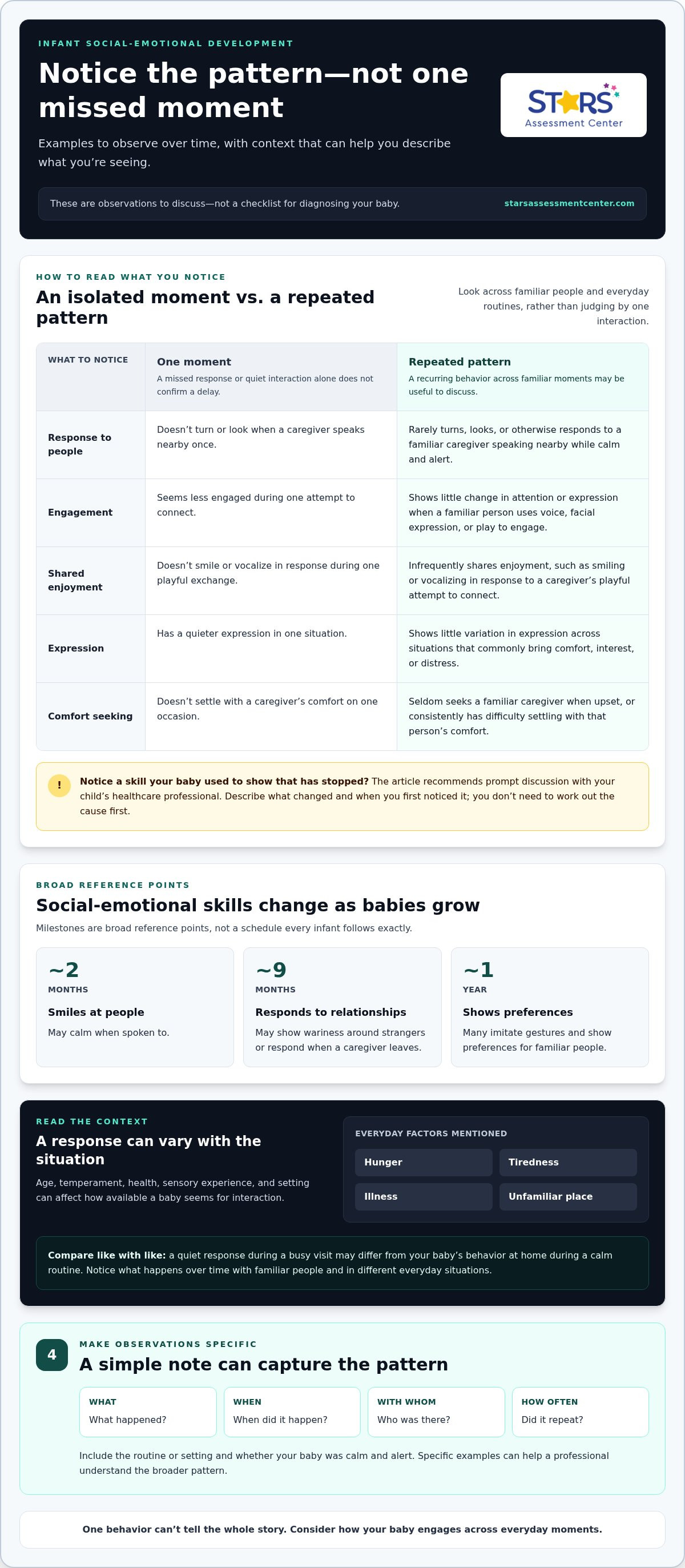
Developmental milestones offer broad reference points, not a schedule every infant follows exactly. Around 2 months, babies generally smile at people and may calm when spoken to. By around 9 months, they may show wariness around strangers or respond when a caregiver leaves. Around 1 year, many imitate gestures and show preferences for familiar people. A Child Development Overview offers broader background on how development unfolds, while age-specific guidance can help put particular behaviors in context.
What social and emotional skills include
These skills involve more than smiling or making eye contact. They include noticing and responding to people, expressing comfort or distress, beginning to settle with a caregiver’s help, and taking part in simple exchanges. A baby might look toward a parent’s voice, brighten at a familiar face, vocalize during play, or reach toward a trusted adult when upset.
Social-emotional skills develop alongside communication, thinking, movement, and other areas. A baby’s sounds can become part of a social exchange, while reaching toward a caregiver combines interaction with movement. That’s why one behavior can’t tell the whole story. If you’re wondering about signs of social emotional delay in infants, consider how your baby engages in different everyday moments instead of focusing on one skill in isolation.
Why age, temperament, and context matter
Babies don’t all show a skill in the same way. One may be expressive and quick to smile; another may watch quietly before joining an interaction. A baby might respond readily to a familiar caregiver but seem less engaged with someone new. Temperament can shape how a baby approaches people, but it does not, by itself, explain a developmental concern.
Context matters, too. Hunger, tiredness, illness, or an unfamiliar place can affect how available a baby seems for interaction. A quiet response during one busy visit may differ from how the baby behaves at home during a calm routine. Rather than comparing infants casually, notice what happens over time with familiar people and in different everyday situations. If a concern persists, those observations can help a professional understand the broader pattern and decide what further discussion may be useful.
Signs of social-emotional delay in infants to notice over time
Some behaviors may be worth discussing when they form a repeated pattern rather than appearing as an occasional difference. The signs of social emotional delay in infants aren’t a checklist for parents to use to diagnose a child. They’re observations that can help you explain what you’re seeing and ask whether your baby’s development would benefit from a closer look.
Notice how your infant responds in familiar, everyday moments. Over time, you might observe whether your baby:
- Rarely turns, looks, or otherwise responds when a familiar caregiver speaks nearby, even when calm and alert.
- Shows little change in attention or expression when a familiar person tries to engage through voice, facial expression, or play.
- Infrequently shares enjoyment during interaction, such as smiling or vocalizing in response to a caregiver’s playful attempt to connect.
- Shows little variation in expression across situations that commonly bring comfort, interest, or distress.
- Seldom seeks a familiar caregiver when upset, or consistently has difficulty settling with that person’s comfort.
These examples describe things a caregiver can observe, not what they mean. A baby may respond differently depending on age, temperament, health, sensory experience, and the people or setting around them. ZERO TO THREE’s Understanding Infant Social-Emotional Development offers additional context about the connection between early relationships and emotional growth.
Patterns in interaction and response
Look for responses across more than one familiar routine. Does your baby often seem not to notice a caregiver’s voice, face, or efforts to connect while being held, fed, or played with? Do shared moments of attention or enjoyment seem consistently limited? Note what you see, but don’t assume that one quiet interaction or missed response signals a delay.
Patterns in emotional expression and connection
Babies express feelings in different ways. A pattern worth discussing might include little observable change in expression across many everyday situations, or rarely turning to a familiar person for comfort when distressed. Consider the full context: how your baby communicates, who is present, what was happening, and whether the behavior is typical for them.
Pay particular attention if your baby stops doing a social or emotional skill they previously showed, such as responding to a familiar person or engaging in an established interaction. A loss of previously acquired skills deserves prompt discussion with your child’s healthcare professional. Describe what changed and when you first noticed it; you don’t need to work out the cause before raising the concern.
If a pattern continues to concern you, specific examples can help guide a conversation about your baby’s development. Stars Assessment Program provides social-emotional and multidisciplinary developmental assessments for infants and toddlers under three. Learn about social-emotional assessment for infants and toddlers.
When a behavior may be variation, and when to raise a concern
A baby’s response can change from one moment to the next. A quiet interaction during a noisy visit may not look like a calm exchange at home. The useful question isn’t whether a behavior happened once, but whether you notice a persistent pattern across familiar people and routines, or a change that continues to concern you.
Context can make observations clearer, but it can’t establish a cause. Fatigue, illness, hunger, or an unfamiliar setting may temporarily affect how a baby responds. If a behavior persists when your infant is rested, well, and with familiar caregivers, or if your concern remains even when responses vary, bring it up with a professional.
How setting and routine can shape what parents observe
Notice whether your baby responds differently with a familiar caregiver than with someone new, or during a quiet routine than in a busy setting. Jot down what was happening to help distinguish an occasional difference from a pattern. Temporary circumstances may be relevant, but they shouldn’t be used to dismiss a concern that keeps appearing across situations.
Observation: Your baby doesn’t respond to a familiar person’s attempt to engage during one visit.
Possible context: Your baby may be tired, unwell, focused elsewhere, or adjusting to an unfamiliar setting. This observation alone doesn’t identify a reason.
When to discuss it: Raise it if limited responses happen repeatedly with familiar people and during ordinary routines.
Observation: Your baby seems less expressive or harder to comfort than usual.
Possible context: A change in the day, your baby’s health, or the situation may affect behavior. Consider what else was happening and whether the change passes.
When to discuss it: Share the concern if the pattern persists, affects several familiar situations, or includes a loss of skills your baby previously showed.
Why signs are not a diagnosis
A behavior that concerns a parent doesn’t automatically mean a baby has autism or another diagnosis. Similar observations can have different explanations, and no single sign can settle the question. A professional interpretation considers a child’s developmental history, age, circumstances, and skills across areas, rather than drawing a conclusion from one moment or behavior.
Screening and assessment serve related but different purposes. Screening uses questions or tools to identify whether a closer look may be helpful; it doesn’t provide a diagnosis. An assessment takes a broader look at development and uses information from multiple sources, including caregiver observations. Understanding the distinction can make it easier to raise a concern without feeling you must already know what it means. For a parent-friendly explanation of screening, see early childhood developmental screening guidance.
If you’re unsure whether a pattern is meaningful, you don’t need to wait until you can explain it perfectly. Describe what you notice, how often it happens, and the situations where it appears. That gives a professional a clearer starting point for discussing whether further assessment may help.
How to record observations and decide what to do next
You don’t need to know what an observation means before bringing it up. A few clear notes can help you explain what you’ve noticed and give a healthcare professional useful context. Keep it simple: observe, record the circumstances, look for repetition, and share what concerns you.
- Observe: Describe the action you saw, such as “looked toward me after I called” or “didn’t turn toward my voice during play.” Avoid labels like “disconnected” or “delayed.”
- Note the context: Record when it happened, who was with your baby, what was going on, and whether your baby seemed tired or unwell.
- Look for repetition: Notice whether the behavior happens again in similar or different familiar routines. Also note skills your baby does show and any changes over time.
- Share your concern: Bring your notes and questions to a trusted healthcare professional. You can raise a concern even if you’re not certain a pattern exists.
What to note before a conversation
A short, specific example is often more useful than a general impression. You might write, “During three calm playtimes this week, my baby rarely looked toward me when I spoke,” rather than “My baby doesn’t connect.” Include what you expected, what your baby did, and whether the response differed with another familiar person or routine.
It can also help to note when you first noticed the behavior, whether it has changed, and which social or emotional skills you’ve seen. You don’t need a detailed diary or perfect records. A few observations on your phone or in a notebook can help you remember what you wanted to ask.
When to seek guidance promptly
Discuss persistent concerns with a healthcare professional rather than waiting for a particular checklist score or for every possible sign to appear. If your infant loses a social, emotional, communication, or other skill they previously had, raise that change promptly. Describe what your baby used to do, what has changed, and when you noticed the difference.
If your questions involve autism, it may help to understand the difference between autism screening and evaluation. A conversation about development doesn’t mean you’ve diagnosed your baby. It’s a way to share what you see and consider whether a closer look would be helpful.
Parents often search for signs of social emotional delay in infants because they want to make a thoughtful decision, not jump to conclusions. You don’t have to wait for certainty to speak up. If you’re concerned about your infant’s social-emotional development, learn about an infant assessment with Stars Assessment Program.
How a social-emotional assessment can support local families
Noticing a behavior that concerns you can raise many questions, but one observation alone can’t explain your child’s development. A social-emotional assessment offers a broader perspective by considering patterns alongside other areas of growth. It can help families better understand what they’re seeing and discuss possible next steps, rather than drawing a conclusion from a single moment.
What a broader developmental perspective can clarify
Stars Assessment Program provides multidisciplinary developmental assessments for infants and toddlers under three, including social-emotional assessments. A multidisciplinary team considers social-emotional observations alongside areas such as cognitive, physical, and communication skills. This wider view can place a concern in context, since a child’s skills develop together and one behavior may not capture the full picture.
For example, a family may describe when their infant responds to familiar people, how the baby expresses feelings, and what caregivers notice during daily routines. The team can consider those observations alongside information about communication and other developmental skills. An assessment may help families understand potential delays and access appropriate early-intervention resources. What the evaluation indicates, and which supports may be relevant, depends on the child and the findings. No single sign guarantees a particular diagnosis, eligibility decision, or outcome.
It’s okay to seek a fuller understanding even if you’re still unsure what a behavior means. Families can bring their questions and observations into the process without arriving with a label or certainty. A developmental assessment is one way to explore concerns while considering the child’s strengths and needs.
Support for families across the local service area
Stars Assessment Program serves families in San Jose, Santa Clara, Milpitas, Gilroy, and Morgan Hill, as well as Santa Cruz and Salinas. If you’re noticing possible signs of social emotional delay in infants, a multidisciplinary assessment can consider those observations alongside your child’s development in other areas.
Taking a next step doesn’t mean you’ve decided something is wrong. It can simply be a way to seek clarity and understand what support may be appropriate for your family. Explore Stars Assessment Program’s assessments for infants and toddlers.
Take a thoughtful next step for your child
You don’t need a complete explanation to start a helpful conversation. If the signs of social emotional delay in infants continue to concern you, it’s okay to share what you’ve noticed and ask what it might mean for your child. Your observations can be a starting point, not a diagnosis.
Stars Assessment Program provides social-emotional and multidisciplinary developmental assessments for infants and toddlers under age three, serving families across Santa Clara County and nearby communities. A broader developmental perspective can help you explore questions with support, without expecting one behavior to tell the whole story.
When you’re ready, learn about developmental assessment with Stars Assessment Program. Taking a step toward understanding is an act of care, and you can move forward one conversation at a time.
Frequently Asked Questions
Is it normal for an infant to make limited eye contact?
It can be, since an infant’s eye contact and other responses vary with age, temperament, and setting. A baby may look away when tired or focus more readily on a familiar face than a new one. Eye contact alone can’t identify a developmental delay. Notice how your infant engages across different everyday moments, and discuss a persistent concern with a healthcare professional who can consider the broader picture.
What are early signs of social-emotional delay in infants?
Possible signs of social emotional delay in infants may include a repeated pattern of limited response to familiar people, little shared interaction during play, or rarely seeking comfort from a caregiver when upset. These examples aren’t a diagnostic checklist, and the same behavior can look different depending on a baby’s age and circumstances. Note what happens and how often, then share recurring observations with a healthcare professional for guidance.
Can an infant show social-emotional delays without other developmental delays?
Yes, a concern in one developmental area doesn’t automatically mean a delay in another. Infants may show different strengths and needs across social-emotional development, communication, cognition, and physical skills. A professional assessment can consider these areas together without assuming in advance what it will find. If you’re noticing a difference in how your baby engages or expresses feelings, it’s appropriate to ask questions even if other skills seem to be developing as expected.
When should I talk to someone about my infant's social-emotional development?
Bring up a concern whenever a pattern persists or something about your infant’s development continues to worry you. You don’t need to wait until you’re certain or until a particular milestone checklist raises a concern. If your baby loses a skill they previously showed, discuss that change promptly with a healthcare professional. Share a concrete example, when you noticed it, and whether it has happened more than once.
Does one missed milestone mean my infant has a developmental delay?
No. One missed behavior by itself doesn’t diagnose a developmental delay. Babies develop at different rates, and a professional considers the child’s age, circumstances, recurring patterns, and development across areas before interpreting a concern. If a milestone hasn’t appeared, keep track of what you observe and bring questions to your child’s healthcare professional. Persistent concerns deserve attention, even if your baby shows other emerging skills.
What happens during a social-emotional assessment for an infant?
A social-emotional assessment considers how an infant interacts with people and expresses feelings as part of a wider developmental picture. Stars Assessment Program uses a multidisciplinary approach for infants and toddlers under three, considering social-emotional development alongside areas such as communication, cognition, and physical skills. The purpose is to help families understand potential concerns and possible next steps, not to guarantee a particular finding. Stars serves families in San Jose, Santa Clara, Santa Cruz, Salinas, Milpitas, Gilroy, and Morgan Hill.
Can an assessment help if I am not sure whether my infant's behavior is a concern?
Yes. You can seek guidance without having a diagnosis or knowing whether a behavior signals a delay. An assessment can put your observations in developmental context and help clarify what questions or next steps may be relevant. It doesn’t mean your infant will necessarily be found to have a delay or qualify for services. Stars Assessment Program offers developmental assessments for young children in the local area, so families can explore their concerns with support.


