

What if eye contact is one clue, not the whole picture? If you’re worried about a baby not making eye contact 9 months, it’s understandable to wonder whether this is a typical variation or a reason to seek guidance. One observation can’t tell you whether your baby has a developmental condition, but your concerns are worth discussing.
At nine months, babies show social communication in different ways. Notice how your baby responds to their name, shares smiles or sounds, and engages in back-and-forth games such as peek-a-boo. The pattern across everyday interactions, along with changes in other areas of development, offers more useful context than eye contact alone.
This article explains what eye contact can and can’t tell you at this age, which interaction patterns to observe, and how to raise your concerns with your child’s healthcare provider. You’ll also learn what developmental screening and a broader assessment may involve, so you can take a thoughtful next step without having to reach a conclusion on your own.
Key Takeaways
- If you’re concerned about a baby not making eye contact 9 months, look for recurring patterns rather than drawing conclusions from one moment.
- Notice how your baby connects during familiar routines, including responses to voices, gestures, sounds, shared enjoyment, and movement.
- Limited eye contact by itself doesn’t confirm a developmental condition, and frequent eye contact doesn’t rule one out.
- Write down specific observations and share them with your child’s pediatrician, especially if concerns persist or your baby loses a skill.
- A developmental assessment can look across social-emotional, communication, cognitive, and physical development to help clarify what support may be useful.
Baby Not Making Eye Contact at 9 Months: What This Observation Means
Noticing that your baby rarely looks toward your face can feel unsettling, especially when online advice makes one behavior sound like a clear answer. If you’re concerned about a baby not making eye contact 9 months, that concern deserves a thoughtful response, but a single behavior can’t establish a diagnosis. Eye contact is one way babies connect and communicate, not a pass-or-fail test of development.
An observed behavior is a starting point for questions, not a developmental assessment or diagnosis. Understanding what it may mean calls for context, repeated observations, and attention to your child’s broader development.
Is limited eye contact at nine months always a sign of a delay?
No single behavior shows a child’s full developmental profile. A baby may look away while concentrating on a toy, moving around, or responding to activity elsewhere. Those moments alone don’t explain how the child communicates or connects throughout the day. A brief description also can’t determine whether limited eye contact is situational or part of a wider concern.
Notice whether the behavior appears repeatedly in different everyday situations, such as during a quiet face-to-face interaction, play, or a familiar routine. Consider what happens alongside it: Does your baby seem to notice familiar voices, share smiles or sounds, or respond to your expressions? These observations don’t diagnose a delay, but they give a pediatrician or developmental specialist more useful context than “I don’t think my baby looks at me.”
Consider development as a whole. Social interaction, communication, movement, and learning are connected parts of a child’s growth. Persistent concerns are worth raising even if your baby shows strengths in other areas. Seeking guidance doesn’t mean you’ve reached a conclusion; it means you want help understanding what you’re seeing.
What does eye contact contribute to early interaction?
During familiar face-to-face moments, caregivers may notice their baby glancing toward them while listening, smiling, or taking turns making sounds. A look can be one part of a back-and-forth exchange, alongside facial expressions, vocalizations, gestures, and shared attention to something interesting. Eye contact is one part of infant social communication. Interaction isn’t measured by how long a baby holds someone’s gaze, and constant eye contact isn’t the expectation.
Think about the overall exchange. You smile or speak, your baby responds in some way, and you respond back. The response might be a look, a sound, a movement, or a change in expression. Social-emotional development describes how a child relates to other people, expresses feelings, and begins to take part in these shared experiences. Noticing different kinds of responses can help you describe your baby’s interactions more clearly.
Rather than trying to make your baby look at you, keep interactions comfortable and follow their cues. If eye contact continues to concern you, bring specific examples to your child’s pediatrician so you can consider them alongside other developmental information.
Look at the Whole Pattern: Social Interaction and Other Developmental Signs
To understand a concern such as “baby not making eye contact 9 months,” look beyond eye gaze to how your child engages in familiar moments. You don’t need to test your baby or create special situations. Everyday routines offer useful context: a response to a familiar voice during play, a smile during a favorite game, or a movement toward a caregiver can each help describe how your child responds and communicates.
Developmental concerns are considered across connected areas, because one behavior can’t describe a child’s full pattern of growth. Social interaction, communication, movement, and learning can inform one another. A clinician considers these areas together rather than treating one behavior as proof of a condition.
Social and communication behaviors to observe during everyday routines
Notice what happens naturally during play, feeding, and other familiar interactions. Does your baby turn or change expression when a familiar person speaks? Do they make sounds, use gestures, reach toward something, or share enjoyment with you? Also notice attention and movement, such as whether your baby shifts toward an interesting toy or follows an activity around the room. No single response is a pass-or-fail test.
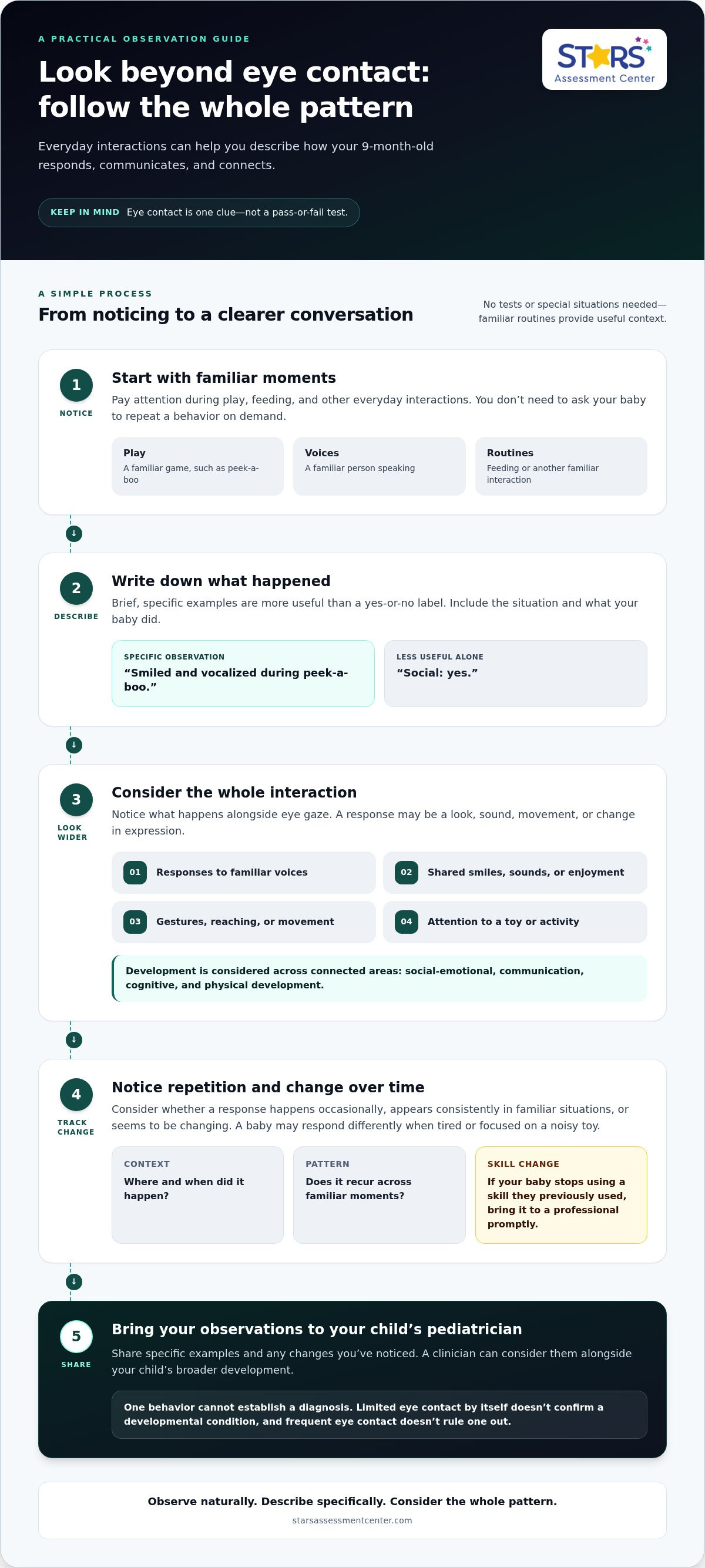
If it helps, jot down brief, specific examples without scoring your child. For instance, “smiled and vocalized during peek-a-boo” is more useful than “social: yes.” Include the situation and what your baby did. The CDC’s 9-month milestones can offer general context, including looking when their name is called and showing a range of facial expressions. These milestones are reference points for conversations, not a diagnostic checklist. A pediatrician can interpret them alongside current professional guidance and your child’s overall development.
Why changes over time matter
One day may look different from another. Consider whether a response happens occasionally, appears consistently across familiar situations, or seems to be changing. Your baby might respond to a voice during quiet play but not when tired or focused on a noisy toy. Recording when a behavior occurs can help show the pattern without asking your baby to repeat it on demand.
Changes deserve attention too. If your baby stops using a sound, gesture, or other skill they previously used, bring that change to a professional promptly. It doesn’t establish a diagnosis by itself, but it’s important information to share. You can also raise ongoing concerns even when you’re unsure how to describe them. A clear example, when it happened, and whether it’s new or recurring can help guide the conversation.
For families in Santa Clara County and nearby communities, Stars Assessment Program provides developmental assessments for children under three. Specialists consider areas including cognitive, physical, and communication development. A multidisciplinary developmental assessment can put your observations into a wider context.
Common Worries About Eye Contact at 9 Months: What It Can’t Tell You
It’s understandable to search for a clear answer when your baby’s eye contact seems limited. Eye contact alone can’t confirm Autism or another developmental condition. Frequent eye contact can’t rule one out, either. A baby may look toward a caregiver in some moments and not others, so the meaning depends on the broader pattern of social communication and development.
An assessment looks at how a child communicates, interacts, and develops across areas, not at one behavior in isolation. That wider view helps put an observation in context and determine whether further evaluation or support may be useful.
Does limited eye contact by itself mean Autism?
No. One behavior cannot establish Autism or another diagnosis. Qualified professionals consider a child’s broader social communication, developmental history, and behavior across situations. They also listen to caregivers, who can describe how a child responds during ordinary routines. If you’re exploring this topic, a guide to Autism screening versus evaluation for toddlers can help explain how these steps differ.
Screening, assessment, and diagnosis are related, but they aren’t interchangeable. A developmental screening uses questions or tools to identify whether a closer look may be helpful. A developmental assessment gathers more detailed information about skills and support needs. A diagnosis is a clinical conclusion made by qualified professionals using a comprehensive evaluation. Screening can guide next steps, but it doesn’t diagnose a child.
The American Academy of Pediatrics recommends general developmental screening at 9, 18, and 30 months, and Autism-specific screening at 18 and 24 months. A concern at nine months can still be discussed with your child’s pediatrician; you don’t have to wait for a particular screening age to share what you’ve observed. A conversation can help determine whether screening or further evaluation is appropriate.
Why online checklists cannot replace individualized evaluation
Online milestone lists can help you organize questions, but they can’t account for your baby’s full context. A checklist won’t show how your child responds during a familiar game, whether a skill is emerging, or how communication and movement fit together. Milestones are useful reference points, not a score that confirms or rules out a condition.
Try not to repeatedly test your baby or pressure them to look at you. Asking for eye contact over and over can make interactions feel less natural and may not give you a clearer answer. Instead, note specific examples as they happen and bring them to a professional. Share what concerns you, what you’ve noticed in other kinds of interaction, and whether anything has changed.
Online information can make uncertainty feel heavier, especially when different sources sound certain. You don’t need to decide what a behavior means on your own. A conversation and, when appropriate, an individualized developmental assessment can help put your observations into context and identify useful next steps.
What to Do If Your 9-Month-Old Makes Little Eye Contact
If you’re concerned about a baby not making eye contact 9 months, you don’t need to know what it means before asking for guidance. A practical next step is to notice what happens in everyday interactions, write down a few examples, and share your concern with your child’s pediatrician. You’re not expected to diagnose your baby or gather perfect evidence.
- Observe naturally. Pay attention during familiar routines such as play, feeding, or greeting a caregiver. Notice how your baby responds to a voice, shares enjoyment, uses sounds or gestures, and moves toward people or things. Keep interacting in a relaxed way rather than repeatedly prompting your baby to look at you.
- Record brief examples. Note the setting, what happened just before, and your baby’s response. For example: “During feeding, looked toward me when I spoke,” or “During floor play, babbled and reached for the toy.” Include other communication and movement observations, not only eye contact.
- Share your concern. Tell your child’s pediatrician what you’ve noticed and ask whether developmental screening or a more detailed assessment may help clarify your child’s development and support needs.
How to keep useful observations without turning play into a test
Keep notes neutral and short. You might write, “Smiled when grandparent sang,” rather than assigning a score or label. A few examples from different routines can help you describe what you see without making every interaction feel like an examination. Avoid comparing your baby with siblings or treating personal notes as screening results. They’re simply a memory aid for a conversation with a professional.
What to share when you ask for developmental guidance
Before the conversation, note your baby’s age, relevant health or developmental history, and the situations that prompted your concern. If a skill your baby used before has stopped, describe what changed and when you first noticed it. Mention both concerns and strengths, such as sounds, gestures, responses to familiar people, or new movements. You can also write down questions so you don’t have to remember everything during the appointment.
Be direct: “I’m concerned about how my baby responds to people and makes eye contact. Can we talk about development?” Persistent concerns are worth discussing, and a loss of previously used skills should be raised promptly. You don’t need to wait for a scheduled screening or a diagnosis to start the conversation. General developmental screening is recommended by the American Academy of Pediatrics at 9, 18, and 30 months, but you can bring up a concern at any visit.
A screening can help identify whether a closer look may be useful. An assessment can explore development in greater depth and help clarify what support may be appropriate. For more guidance on getting ready for that conversation, the parent guide to early childhood developmental screening can help you understand the process. Families seeking a broader developmental evaluation for a child under three can learn about developmental assessment options through Stars Assessment Program.
How a Santa Clara County Developmental Assessment Can Help Families
If you’re concerned about your baby’s development, an assessment can put individual observations into a broader picture. For a baby not making eye contact 9 months, that means considering more than gaze alone. Specialists may look at how your child communicates, connects with people, learns, and moves, while also listening to what you’ve noticed at home.
An assessment isn’t a promise of a diagnosis. Its purpose is to better understand a child’s strengths and possible support needs. For some families, that wider view brings clarity about development and helps inform conversations about early intervention resources.
What a multidisciplinary developmental assessment considers
A multidisciplinary developmental assessment considers several areas of growth together. These include social-emotional development, communication, cognitive skills such as learning and problem-solving, and physical development, including movement. Looking across these areas helps specialists understand how a child is developing rather than interpreting one behavior on its own.
Families can share examples from daily life, such as how their baby responds to familiar people, communicates needs, explores toys, or moves during play. Specialists use this information alongside the assessment to identify potential delays and help inform access to early intervention resources when appropriate. Stars Assessment Program offers multidisciplinary developmental assessments, social-emotional assessments, and speech and language evaluations for infants and toddlers under three, as well as specialized screenings for Autism and Down syndrome. A guide to multidisciplinary evaluations for infants can offer additional context about this broader approach.
Finding supportive assessment services in the local area
Stars Assessment Program provides developmental assessments for children under three and serves families in San Jose, Santa Clara, Santa Cruz, Salinas, Milpitas, Gilroy, and Morgan Hill. The assessment considers your child’s development across areas such as cognitive, physical, and communication skills. Bringing your questions and everyday observations can help the conversation reflect your child’s experiences and your family’s concerns.
It’s okay to seek guidance even when you’re unsure whether a behavior signals a developmental difference. You don’t need to arrive with a diagnosis or have every question answered. An assessment can offer a clearer understanding of areas where your child is progressing and where additional support may be helpful, without reducing your child to one milestone or observation.
To explore a next step, learn more about Stars Assessment Program’s developmental assessment services for infants and toddlers. A supportive conversation can help you understand the assessment process and consider options for your family.
Take a Thoughtful Next Step for Your Baby
If concern about a baby not making eye contact 9 months is still on your mind, you don’t have to resolve it alone or decide what it means before seeking guidance. Bring your observations and questions to your child’s pediatrician and ask what next step makes sense for your family.
Some parents find it helpful to learn what a developmental assessment involves before deciding how to proceed. Stars Assessment Program supports families seeking a clearer understanding of their child’s development through a broader, individualized assessment.
Learn about Stars Assessment Program’s developmental assessments for infants and toddlers. Taking the next step can start with a conversation about your child’s development.
Frequently Asked Questions
Is it normal for a 9-month-old to avoid eye contact sometimes?
A baby may look away during some interactions, but the reason and overall pattern matter. Your child might be focused on a nearby sound, object, or activity, for example. Notice whether they reconnect in other familiar moments, such as when you smile or speak. If looking away seems persistent or worries you, share what you’ve noticed with your pediatrician rather than relying on one moment to decide what’s typical.
Can a baby make little eye contact and still be developing typically?
Yes, limited eye contact by itself doesn’t tell you whether a baby is developing typically or needs further evaluation. A baby might engage through sounds, expressions, reaching, or movement in ways that are easier to notice than gaze. Consider what your child does across different everyday situations, and bring questions to your pediatrician if you’re unsure how to interpret those interactions.
Does not making eye contact at 9 months mean my baby has Autism?
No. Not making eye contact at nine months does not, on its own, mean a baby has Autism. Diagnosis requires a qualified professional to consider a wider range of information, including social communication and developmental history. If you’re worried, tell your pediatrician what you’ve seen and ask what next step is appropriate. You don’t need to decide whether Autism explains the behavior before asking for guidance.
When should I talk with my pediatrician about my baby’s eye contact?
Bring it up whenever the concern persists or you’d like help making sense of what you observe. You can mention it at your baby’s next appointment or call the pediatrician’s office to ask how to discuss it sooner. Report any skill your baby has stopped using, such as a sound or gesture they previously used. Sharing when you first noticed the change can help guide the conversation.
What other social or communication signs should I notice at 9 months?
Notice whether your baby responds to their name, reacts to familiar voices, shows different facial expressions, or takes part in simple back-and-forth play. You might also observe whether they use sounds or gestures to get your attention, or share enjoyment during a familiar game. The CDC’s milestone resources can help you prepare questions, but they aren’t a tool for diagnosing your child or scoring each interaction.
Can a developmental assessment help if my baby is not making eye contact?
A developmental assessment can help clarify how a child is progressing across areas such as social-emotional, communication, cognitive, and physical development. It can provide a broader understanding of strengths and possible support needs, rather than focusing on eye contact alone. Stars Assessment Program provides multidisciplinary assessments for children under three for families in San Jose, Santa Clara, Santa Cruz, Salinas, Milpitas, Gilroy, and Morgan Hill.
What should I bring up during a developmental evaluation for my baby?
Share your baby’s age, relevant health and developmental history, and the situations that prompted your concern. A short note on your phone can help you remember examples, such as how your baby responds to familiar people or communicates during play. Mention skills that are emerging as well as any that have stopped. Bring your questions, too, including what the evaluation may clarify and what support options could follow.


