

What if a toddler’s challenging behavior is a clue to understand, not a sign that something is wrong? Saying “no,” having tantrums, and struggling with changes in routine can be part of typical development between ages 1 and 3. Still, it’s understandable to wonder whether a behavior is a passing phase or worth discussing with a professional. Assessing toddler behavior problems means looking beyond one difficult moment to consider a child’s age, development, relationships, and daily experiences.
You know your child best, but it can be hard to describe what you’re seeing when behavior changes from day to day or seems tied to particular situations. An assessment doesn’t mean a behavior alone establishes a diagnosis. It can help clarify your child’s developmental needs and guide conversations about support.
This article explains how to view behavior in the context of age and development, what patterns and triggers to note, and when to seek closer attention. It also describes how a social-emotional assessment can contribute to a broader understanding of your toddler’s development, so you can take a calm, practical next step toward clarity.
Key Takeaways
- When assessing toddler behavior problems, consider patterns alongside your child’s development and everyday context rather than judging one moment on its own.
- Notice where and when behaviors happen, how long they last, how your toddler recovers, and whether routines are affected.
- Bring neutral examples, your child’s strengths, and your questions to a developmental conversation to make the next step clearer.
- A social-emotional assessment can be considered alongside cognitive, physical, and communication development for a fuller picture of your child’s needs.
- Stars Assessment Program provides multidisciplinary developmental assessments for children under three to help families better understand development and potential support needs.
Assessing toddler behavior problems starts with understanding development
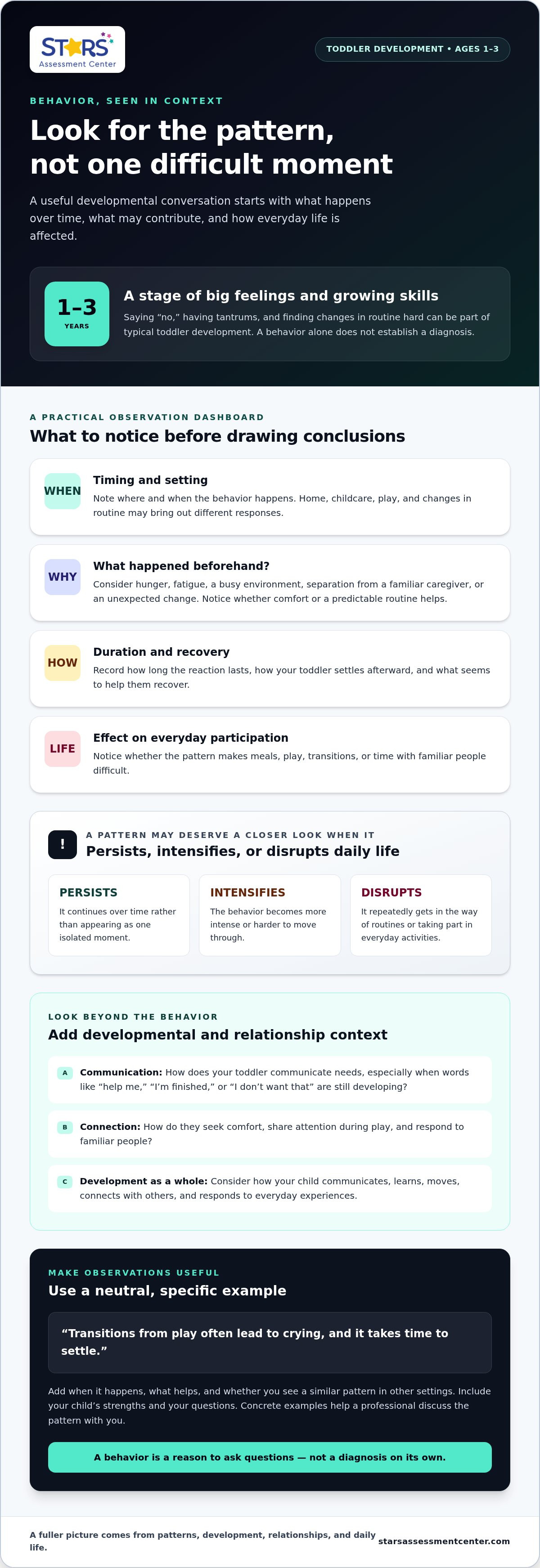
A behavior concern isn’t defined by one loud moment or a single challenging day. It’s a pattern considered in the context of a toddler’s age, developing skills, relationships, and everyday life. What happens at home may look different from what happens during childcare, play, or a change in routine. Noting those differences can help families and professionals understand what a child may be communicating and whether closer developmental attention could be helpful.
Strong emotions and resistance can be tiring for everyone involved. A toddler may protest getting dressed, become upset when a caregiver leaves, or struggle to move on from a favorite activity. These moments can disrupt family routines, but they aren’t a diagnosis. Assessing toddler behavior problems means considering patterns and broader development, not treating a behavior by itself as proof of a condition.
A difficult moment is an event; a concern worth exploring is a pattern that persists and gets in the way of everyday life.
Why toddler behavior changes with age and communication
Toddlers are gaining independence before they can always explain what they want, understand what’s next, or manage disappointment. A child who wants to pour a drink alone may become frustrated when help arrives. Another may cry during a transition because stopping play is hard to accept. These reactions can reflect a gap between strong feelings and still-developing ways to communicate or cope.
Daily conditions matter, too. Hunger, fatigue, a busy environment, separation from a familiar caregiver, or an unexpected change can make a hard moment harder. Note what happened beforehand and whether comfort or a predictable routine helped. For general context on toddler development and common behaviors, remember that developmental descriptions offer a broad overview, not a checklist for deciding what is typical for every child. No single milestone or age should be treated as a diagnostic cutoff.
When a behavior pattern deserves a closer look
Consider discussing a pattern if it continues over time, becomes more intense, or repeatedly makes it difficult for your toddler to take part in everyday activities such as meals, play, transitions, or time with familiar people. Also note what’s happening alongside the behavior: how your child communicates needs, responds to others, seeks connection, and recovers after becoming upset. These observations add context; they don’t establish a diagnosis.
Your concern is worth sharing, even if you’re unsure how to interpret what you see. Start with a neutral description: “Transitions from play often lead to crying, and it takes time to settle.” Add when it happens, what helps, and whether you see a similar pattern in other settings. Concrete examples give a professional something specific to discuss with you.
- Look for: persistence, increasing intensity, or disruption to routines and participation.
- Consider: communication, social connection, daily circumstances, and how your child recovers.
- Remember: a behavior is a reason to ask questions, not a diagnosis on its own.
What an assessment can reveal about toddler behavior and development
An assessment can put behavior into a broader developmental picture. Rather than interpreting a reaction on its own, professionals consider how a toddler communicates, learns, moves, connects with others, and responds to everyday experiences. The same outward behavior can have different contexts. For example, a child who moves away during a group activity may be tired, unsure what is expected, or communicating a preference in a way that’s still developing.
For families assessing toddler behavior problems, the goal is to understand the child’s strengths and support needs, not to assign meaning to one moment too quickly. A multidisciplinary perspective brings together observations from different areas of development and can clarify which questions may be useful to explore next.
Looking across developmental areas helps turn separate observations into a fuller picture of how a toddler experiences and participates in daily life.
How social-emotional development connects with behavior
Social-emotional development includes how a child connects with familiar people, expresses feelings, responds during interaction, and adjusts to routines or changes. An assessment may consider everyday examples, such as how a toddler seeks comfort, shares attention during play, or reacts when an activity ends. These observations describe development and relationships. They aren’t a behavioral label, and no single action establishes autism or another condition.
Context makes observations more meaningful. A toddler may be quieter with unfamiliar people than with family, or need extra time to settle after a change. The aim is to understand patterns across situations and how a child relates to people and routines, while recognizing that children show connection and emotion in individual ways.
Why communication and other developmental areas matter
A toddler who can’t yet express “help me,” “I’m finished,” or “I don’t want that” may show frustration through crying, pushing something away, or withdrawing. Communication is one part of the picture, not an automatic explanation for every behavior. Considering how a child understands language and communicates needs can help clarify what they may be trying to express and what they’re able to say or show.
Assessment may also consider cognitive skills, such as exploring objects or learning through play, and physical development, including how a child moves through and engages with their surroundings. These areas can interact: difficulty joining an activity might relate to understanding what to do, communicating with others, or physically accessing the play. This early childhood developmental screening guide explains how developmental areas can be considered together.
- Social-emotional: connection, emotional expression, and responses to changes.
- Communication: understanding others and expressing needs in the child’s own way.
- Cognitive and physical: learning through play and participating in everyday activities.
Stars Assessment Program provides multidisciplinary developmental assessments for children under three, considering social-emotional development alongside cognitive, physical, and communication skills. Families seeking a fuller developmental perspective can learn about Stars Assessment Program’s developmental assessments. An assessment can help clarify needs and inform conversations about possible support, without promising a particular conclusion or outcome.
Toddler behavior concerns: what to observe before drawing conclusions
When you’re concerned about a behavior, it can be hard to recall details later, especially after a demanding day. Brief, factual notes can help you spot what tends to happen around the behavior and explain your concerns clearly. You don’t need a perfect record or to decide what the behavior means. The goal is to gather useful context for a conversation about your toddler’s development.
Track a few examples across familiar settings. Home, childcare, and time with relatives may involve different routines, expectations, or demands. Similar behavior across settings can add context, while differences may show that particular situations affect your child. Neither pattern proves a cause. Observations help guide discussion; they don’t replace a professional assessment.
Record patterns without judging your toddler
Write down what you saw rather than using labels such as “difficult” or “bad.” Include the date, setting, what happened just before, your child’s observable response, and what helped them recover. A short note is enough. For example: “After snack, play ended; child cried and sat down; settled when shown the next activity.” Add a strength, such as enjoying a shared book or completing a familiar routine.
Consider impact, change, and the child’s wider development
Notice whether a behavior affects meals, sleep, play, transitions, or joining everyday activities. Consider whether it’s a steady pattern, a recent change, or more noticeable in one setting. Keep communication, health, age, and family changes in view as context, not assumed explanations. These details can help a professional understand what’s changed and what your child is managing well.
This comparison can help organize your notes. Use words such as “often,” “brief,” or “needed comfort” when exact counts or times aren’t available. There’s no need to make the record sound clinical.
| What to note | Helpful detail |
|---|---|
| Setting | Home, childcare, or another familiar place |
| Trigger | What happened just before, such as a transition or change in routine |
| Frequency | How often you noticed it, using a clear time period if possible |
| Duration | How long it lasted, or whether it was brief or extended |
| Recovery | What helped your toddler settle or rejoin an activity |
| Effect on routines | Whether meals, sleep, play, or participation were interrupted |
For instance, a note might say: “At childcare pickup, leaving the playground led to crying. It lasted until we reached the car; a familiar song helped. We left later than planned.” This describes the situation and its impact without judging the child or guessing at a reason.
Include positive moments, too. Record enjoyable interactions, a new way your toddler communicated, or a transition that went smoothly. These details show the child’s skills and the circumstances in which participation feels easier. When assessing toddler behavior problems, a balanced picture of challenges, strengths, and setting-specific patterns can make a professional conversation more useful.
How to take a calm, practical next step about toddler behavior
It’s okay to seek guidance before you know exactly what a behavior means. An assessment is a way to learn more about your toddler’s development and support needs, not a judgment of your parenting. You don’t need a complete record or a theory about what’s happening. A few clear examples and questions can help start a useful conversation.
Keep preparation manageable. Choose a small number of situations that show what concerns you, and include what your child does well. You can organize your next steps this way:
- Identify your concern. Describe what you’ve noticed and what feels difficult for your child or family.
- Gather a few examples. Note when the behavior happens, what came before it, how your toddler responded, and what helped.
- Describe strengths. Include enjoyable interactions, ways your child communicates, and routines or activities that go smoothly.
- Seek developmental guidance. Share your observations and ask what they may suggest about your child’s development and possible supports.
Prepare examples and questions for a developmental conversation
You don’t have to document every difficult moment. A few specific examples can be more helpful than a long list without context. For instance, explain that leaving a familiar activity is often challenging, describe what your toddler does, and mention whether a warning or visual cue helps. If you’re concerned about social-emotional development, communication, or another area, write down the questions you’d like answered.
You might ask: “How does my child’s communication relate to what we’re seeing?” or “What strengths do you notice, and what might help with transitions?” If you have questions about possible autism, this parent guide to autism concerns offers background. A behavior by itself isn’t evidence of autism or enough to establish any diagnosis; developmental concerns are understood in context.
Keep the focus on support, not labels
Assessment findings can describe a child’s observed strengths and areas where support may be useful. They may help clarify developmental needs and guide a conversation about possible next steps. An assessment doesn’t guarantee a particular diagnosis, outcome, or access to services. If early-intervention resources are discussed, eligibility depends on applicable criteria.
It’s natural to feel unsure about what an assessment might mean. Tell the professional what you hope to understand, such as how your toddler communicates needs, connects with others, or handles everyday changes. Your questions matter, and you’re an important part of building a picture of your child.
If you’re ready to explore a developmental assessment for your toddler, learn about Stars Assessment Program. The goal is greater clarity about your child’s development and what support may be appropriate, one thoughtful step at a time.
How Stars Assessment Program supports families assessing toddler behavior problems
Behavior can raise questions about more than what’s happening in a single moment. Stars Assessment Program provides multidisciplinary developmental assessments for children under three, helping families consider behavior as part of a broader picture of growth. A social-emotional assessment can contribute to understanding how a toddler connects with people, expresses feelings, and responds to everyday experiences.
For families assessing toddler behavior problems, this broader view can bring helpful context. A behavior may be easier to understand alongside a child’s communication, physical development, and cognitive skills than in isolation. The purpose is to better understand a child’s individual strengths and potential developmental needs. A behavior concern alone does not establish a diagnosis or determine a specific assessment outcome.
A broader developmental perspective for children under three
Multidisciplinary specialists assess cognitive, physical, and communication development, while social-emotional development also contributes to understanding a toddler’s overall profile. These areas can shape how a child participates in routines, explores their surroundings, interacts with others, and communicates needs. Looking across them can help clarify whether a concern may connect with a particular developmental area or needs further discussion.
Every child has an individual developmental path. Families bring important knowledge about what their toddler enjoys, how they communicate, and which daily situations feel challenging. Sharing those observations can ground the assessment conversation in the child’s everyday life. The aim is not to judge a child or family, but to build understanding of development and potential support needs.
An assessment may help families understand potential developmental delays and inform access to early-intervention resources. It does not promise a particular finding or eligibility for services. Instead, it can offer information to support thoughtful next steps based on the child’s needs and applicable criteria.
Finding local assessment support in the service area
Stars Assessment Program serves families in Santa Clara County and surrounding communities, including San Jose, Santa Clara, Santa Cruz, Salinas, Milpitas, Gilroy, and Morgan Hill. Families in these communities with questions about a toddler’s social-emotional, communication, cognitive, or physical development can explore those questions through a broader developmental perspective.
Before starting, consider what you hope to understand: for example, how your child communicates needs, connects with familiar people, or manages everyday routines. Bring observations about strengths and situations that feel difficult, too. These details help keep the conversation focused on your child as a whole, rather than on a single behavior.
If you’re considering an assessment for your child under three, explore Stars Assessment Program’s developmental assessment services. A multidisciplinary assessment can help your family move toward greater clarity about your toddler’s development and potential support needs.
Take the next step at your family’s pace
You don’t need to feel certain about what a behavior means before asking for support. If a question keeps coming back to you, that can be reason enough to talk it through. Notice what helps your toddler feel understood and what makes everyday moments easier. Small observations can guide a thoughtful conversation without defining your child by their hardest moments.
Assessing toddler behavior problems is not about finding fault. It’s an opportunity to better understand your child’s experience and consider what could support their growth. You can take things one question at a time, with your child’s strengths and individuality at the center.
If you’re ready to explore a developmental assessment, learn how Stars Assessment Program can support your family. Reaching out for clarity is a caring step, and you don’t need every answer before you begin.
Frequently Asked Questions
Are tantrums always a sign of a toddler behavior problem?
No. Tantrums can happen as toddlers experience strong feelings and learn to handle frustration, limits, and transitions. A tantrum by itself doesn’t establish a developmental condition. Consider whether episodes are changing, disrupting important routines, or happening alongside concerns about communication or connection. If you’re unsure, share specific examples with a developmental professional. Your concern is worth discussing, even if you’re still figuring out what pattern, if any, you’re seeing.
Can trouble communicating contribute to challenging toddler behavior?
Yes. A toddler who has trouble expressing a need, understanding what’s being asked, or finding a way to say “stop” may show frustration through actions or tears. For example, a child might push away a cup rather than ask for a different drink. Notice whether behavior occurs during communication demands and what your child uses to express themselves, including gestures, sounds, or words. These observations can help guide questions about communication development.
Is biting in toddlers always a reason to seek an assessment?
No. A bite on its own doesn’t determine that an assessment is needed or indicate a particular condition. Note what was happening, who was nearby, how often it occurs, and whether your toddler was tired, frustrated, or struggling to communicate. Also pay attention to safety and how caregivers respond. If biting persists, causes injury, or is part of broader developmental concerns, discuss the pattern with a professional who can help you consider an appropriate next step.
What should I write down before discussing my toddler’s behavior?
Keep a brief record with the date, setting, what happened beforehand, your toddler’s observable actions, and what followed. Include what helped, how the situation affected the activity, and anything that went well that day. For example: “At lunch, my child pushed the plate away, then pointed to the cup.” Add questions you want answered so you don’t have to remember them during the conversation. A few representative notes are more useful than trying to track everything.
Can a toddler be assessed before turning three?
Yes. Stars Assessment Program provides multidisciplinary developmental assessments for infants and toddlers under three. The program considers cognitive, physical, and communication development, with social-emotional assessment contributing to an understanding of a child’s developmental profile. Families in San Jose, Santa Clara, Santa Cruz, Salinas, Milpitas, Gilroy, and Morgan Hill can explore assessment support for young children. Findings may help clarify potential developmental delays and inform conversations about early-intervention resources.
Does an assessment mean my toddler will receive a diagnosis?
No. An assessment doesn’t guarantee a diagnosis, and one behavior alone can’t establish a developmental condition. The purpose is to understand your toddler’s development by considering observations, abilities, and support needs. Results may describe strengths and areas that could benefit from attention, and can help inform next steps. If you’re worried about a specific diagnosis, bring that question forward while remaining open to what a broader developmental picture may show.
What happens if my toddler’s behavior changes from day to day?
Day-to-day variation is useful context, not a reason to dismiss your concern or assume a diagnosis. Note what differs, such as sleep, routine, setting, people present, or how your toddler communicates that day. You can also record when things go more smoothly. If the behavior is hard to predict, share that with the professional, too. For families assessing toddler behavior problems, an honest picture of both easier and harder days can support a more informed discussion.


