
When you ask “how much does a private autism assessment cost Bay Area,” a single number may not tell you whether the evaluation fits your child’s needs. It helps to understand what the assessment includes, how screening differs from a comprehensive evaluation, and how insurance or early-intervention options fit in.
Fees can depend on the questions being answered, the evaluation’s scope, and the professionals involved. For children under three, a developmental assessment with specialized autism screening can help families understand a child’s cognitive, physical, and communication development. Screening isn’t the same as a formal medical diagnosis or an Early Start eligibility decision.
This guide explains what to compare across private, insurance-based, and early-intervention pathways, and what information to gather before deciding on a next step. You’ll also learn how a multidisciplinary assessment for an infant or toddler can bring developmental questions into clearer focus.
Key Takeaways
- There’s no single answer to “how much does a private autism assessment cost Bay Area.” The evaluation’s scope, disciplines involved, documentation, and payment route all matter.
- Learn how an initial autism screening differs from a comprehensive evaluation, and which developmental areas an assessment may consider.
- Private payment, insurance, and California Early Start are distinct pathways. Their benefits and eligibility depend on individual circumstances.
- Gather your child’s age, developmental observations, prior screening results, and documentation needs to make an estimate easier to understand.
- For children under three, Stars Assessment Program provides multidisciplinary developmental assessments that consider cognitive, physical, and communication skills, with specialized autism screening.
How Much Does a Private Autism Assessment Cost in the Bay Area?
There isn’t one fee that applies to every private autism assessment in the Bay Area. To compare options, look at what each evaluation is designed to answer, what work it includes, and what documentation it provides. A brief screening and a broad, multidisciplinary evaluation have different scopes, which may be reflected in their fees.
Assessment fees can vary with the questions being addressed, the expertise involved, and what the evaluation delivers. Use the factors below to compare services on a like-for-like basis.
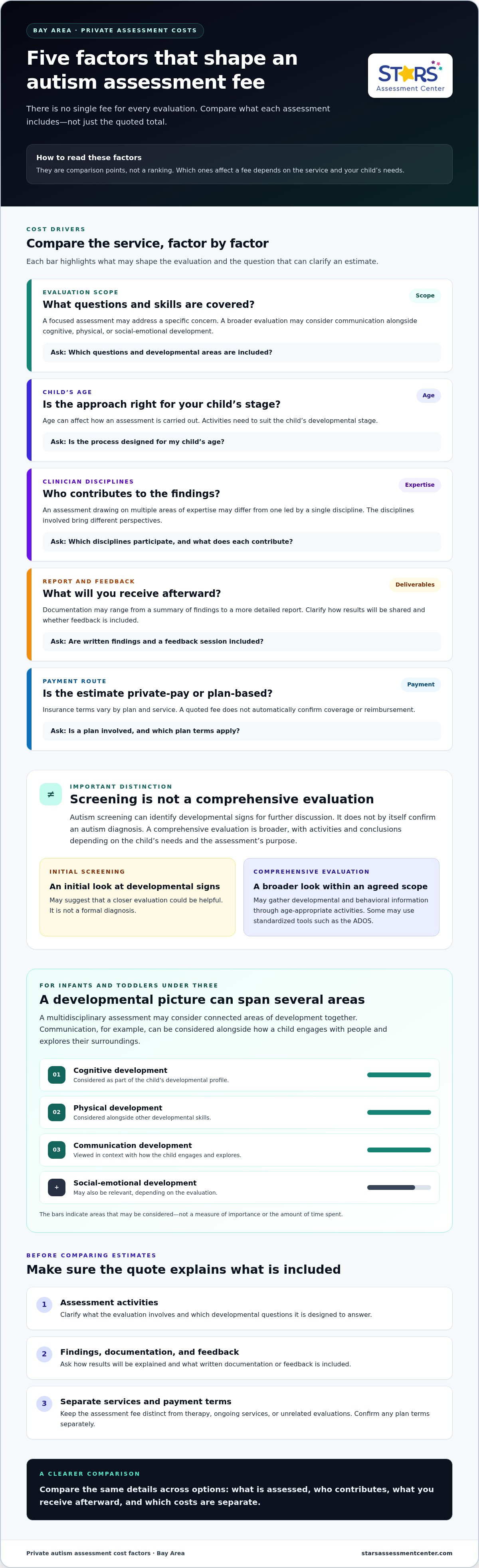
What can change a private autism assessment fee?
An evaluation’s length and the developmental areas it covers help define its scope. A focused assessment may address a specific concern, while a broader evaluation may consider communication alongside cognitive, physical, or social-emotional development. The child’s age can also affect how an assessment is carried out, since activities need to suit their developmental stage.
The professionals involved and the detail of the report also matter. An assessment that draws on multiple areas of expertise may differ from one led by a single discipline. Families may need different documentation, from a summary of findings to a more detailed report. When comparing estimates, focus on the service details rather than assuming that location alone explains the difference.
| Cost factor | What it may change | What families can clarify |
|---|---|---|
| Evaluation scope | Time spent and developmental areas considered | Which questions and skills are included? |
| Child’s age | Assessment approach and age-appropriate activities | Is the process designed for my child’s age? |
| Clinician disciplines | Expertise and perspectives contributing to findings | Which disciplines participate, and what does each contribute? |
| Report and feedback | Documentation and explanation of results | Are written findings and a feedback session included? |
| Payment route | How the family pays and any applicable plan terms | Is the fee private-pay, or is a plan involved? |
What should a quoted assessment fee explain?
Look for a clear description of the assessment activities, how findings will be shared, and what documentation or feedback is included. Some comprehensive autism assessments may use standardized tools such as the Autism Diagnostic Observation Schedule (ADOS), alongside developmental history and observation. The approach depends on the assessment’s purpose and the child’s needs.
Keep the assessment fee separate from therapy, ongoing services, or unrelated evaluations. A screening may identify developmental signs for further discussion, while a comprehensive evaluation may have a different scope and purpose. For infants and toddlers under three, a multidisciplinary developmental assessment may consider cognitive, physical, and communication skills, with specialized autism screening. Screening isn’t a formal diagnosis.
Insurance terms vary by plan and service, so don’t assume a quoted fee includes coverage or reimbursement. Compare the same details across pathways: what is assessed, what is provided afterward, and what costs are separate. This gives you a clearer basis for choosing a next step that fits your family’s needs.
What Does a Private Autism Assessment for a Young Child Include?
For a young child, “assessment” can refer to different services. Autism screening is an initial look at developmental signs that may suggest a closer evaluation could be helpful. A comprehensive evaluation is broader, and its activities and conclusions depend on the child’s needs and the specific assessment. Knowing which service is being discussed helps families understand what it can and cannot tell them.
Screening and comprehensive evaluation are not interchangeable
A screening can identify concerns for further discussion, but it doesn’t by itself confirm an autism diagnosis. A comprehensive evaluation may gather information about a child’s development and behavior through age-appropriate activities, then interpret that information within the agreed scope. If you’re wondering what observations might prompt a conversation, learn more about signs that may prompt an autism conversation.
The assessment’s purpose matters. A family seeking a clearer picture of a toddler’s overall development may have different questions from one seeking a specific diagnostic conclusion. For a broader explanation of the distinction, explore autism screening versus evaluation for toddlers.
Why a multidisciplinary approach matters for children under three
Young children develop across connected areas. A multidisciplinary developmental assessment can consider cognitive, physical, and communication skills together. Depending on the evaluation, social-emotional development may also be relevant. Looking across areas can put observations into context. For example, a child’s communication may be considered alongside how they engage with people and explore their surroundings.
Stars Assessment Program assesses infants and toddlers under three, considering cognitive, physical, and communication development and including specialized autism screening. This can help families organize questions about their child’s development, while keeping screening distinct from a formal diagnosis. The assessment’s scope and conclusions depend on the evaluation performed.
Families comparing pathways can also review the California Early Start program, which provides information about developmental services for infants and toddlers. Its process and purpose differ from those of a private assessment, so consider what question each pathway is intended to address.
For a child under three, Stars’ multidisciplinary developmental assessments bring together observations across key areas of early development, including specialized autism screening. Understanding the assessment’s purpose can make the next conversation more manageable.
Private Assessment, Insurance, or California Early Start: What Should Families Compare?
The right pathway depends on what you need to learn, your child’s age, and how payment works. A private assessment, an insurance-based evaluation, and California Early Start aren’t interchangeable. They may answer different questions or provide different kinds of support. If you’re asking “how much does a private autism assessment cost Bay Area,” compare the service as well as the payment route. A lower expected out-of-pocket amount doesn’t necessarily mean a pathway serves the same purpose.
- Private payment: This means paying directly for an assessment. Its scope and documentation depend on the evaluation arranged.
- Insurance: Coverage may depend on the plan, service, referral or authorization requirements, and current benefit terms.
- Early Start: This public early-intervention pathway is for eligible infants and toddlers and focuses on developmental needs and services, not necessarily a private medical diagnosis.
What may insurance cover, and what should families verify?
Insurance coverage for an assessment is separate from coverage for therapy or other services. Before making plans, review your benefits for the specific evaluation, any referral or prior-authorization requirements, and potential deductibles, copayments, or other out-of-pocket responsibilities. Coverage depends on the plan and service, so don’t assume an assessment is covered because related treatment is included.
Keep your questions specific: Does the plan address this type of assessment? Are there required steps before scheduling? What portion, if any, could remain your responsibility? Plan documents and the insurer can clarify current terms. Avoid relying on general statements about autism benefits, since individual plan rules can differ.
How California Early Start fits into the decision
The California Early Start program serves eligible children from birth to 36 months. A formal diagnosis isn’t required to access the program, and eligible early-intervention services are provided at no cost to families. Regional centers assess eligibility and develop an Individualized Family Service Plan within 45 days of referral, according to the program information provided by California’s Department of Developmental Services. Use official program resources for current eligibility and referral guidance.
In the Bay Area, families within its service area may encounter San Andreas Regional Center in connection with Early Start. Its role is tied to regional-center processes, which differ from a private assessment’s purpose and findings. One pathway may focus on eligibility for early-intervention support; another may address assessment questions or specific documentation needs.
This distinction can guide your next step. If your main concern is understanding your child’s development and what support may be appropriate, a developmental screening can be a starting point. The guide to early childhood developmental screening offers more context. Compare options by writing down the question you need answered, the assessment or eligibility decision involved, and any costs or plan requirements.
How to Prepare for a Clear Autism Assessment Cost Estimate
A little preparation can make an assessment estimate easier to understand. You don’t need to arrive with a diagnosis or perfectly organized records. A clear description of your child’s age, your questions, and the information you hope to receive can help define the assessment scope. Then you can compare what different estimates include, rather than focusing on the fee alone.
Information to gather before comparing estimates
Start with a short, practical summary. Note your child’s age and the developmental questions you hope an assessment can address. Gather any screening results or relevant records you have. Everyday examples can help, such as how your child communicates needs, responds to familiar routines, or engages with other people. These are observations, not a way to diagnose your child.
Use this sequence to organize your notes:
- Clarify your main question. Write down what you hope to better understand, such as communication, social interaction, or your child’s broader development.
- Record your child’s age and context. Include their age and details that may help describe the developmental concern.
- Gather relevant information. Collect prior screening results, existing records, and a few examples of what you’ve noticed in everyday settings.
- Describe the scope you’re seeking. Consider whether you’re looking for an initial screening or a broader developmental assessment, and note what documentation would be useful to your family.
Parents often notice patterns before they know what those patterns mean. That’s okay. Specific observations provide useful context without requiring you to interpret them or reach a conclusion first.
Questions that make assessment scope easier to compare
Once you have your notes, compare service details rather than the estimate total in isolation. These questions can help you identify what each assessment covers and what may be separate:
- Which assessment activities and developmental areas are included?
- Does the process include a conversation about developmental history or direct observation?
- Is a feedback discussion included, and how will the findings be explained?
- What written report or other documentation is included?
- Are recommendations part of the described service, and what follow-up, if any, is included?
- Which payment responsibilities or plan requirements may apply, and could separate services involve additional costs?
An initial screening, a multidisciplinary developmental assessment, and a comprehensive diagnostic evaluation may serve different purposes. Compare like with like: align the purpose, assessment activities, feedback, and documentation before deciding what an estimate means for your family. For insurance, review the plan’s current terms for the specific service rather than assuming assessment and therapy benefits are the same.
For infants and toddlers under three, Stars Assessment Program provides multidisciplinary developmental assessments that consider cognitive, physical, and communication development, including specialized autism screening. Explore Stars Assessment Program to learn about developmental assessment and screening support for young children.
How Stars Assessment Program Supports Bay Area Families
Questions about a child’s development can bring uncertainty, and cost can add another concern. Stars Assessment Program offers multidisciplinary developmental assessments for infants and toddlers under three, with specialized autism screening. Families asking “how much does a private autism assessment cost Bay Area” may also want to understand what an assessment examines and whether it fits their child’s age and developmental questions. Stars focuses on early development, considering several areas of growth together rather than viewing one observation in isolation.
What families can expect from the Stars assessment focus
The assessment considers cognitive, physical, and communication development. These areas offer different pieces of the picture: how a child learns and explores, how physical development is progressing, and how they communicate. Considering these skills together can help families understand a child’s strengths and areas where additional support or attention may be useful.
Specialized autism screening is part of the assessment focus for children under three. Screening looks for developmental signs that may warrant further discussion; it is not, by itself, a formal autism diagnosis. Assessment findings can help families make sense of what they’re noticing and consider possible next steps, including early-intervention resources when relevant. Each child’s needs are individual, and the assessment aims to provide a clearer view of development, not promise a particular conclusion.
Stars serves families across its regional service area, including San Jose, Santa Clara, Santa Cruz, Salinas, Milpitas, Gilroy, and Morgan Hill. For parents in these communities, an assessment designed for infants and toddlers offers a development-focused way to explore concerns during the early years.
Take a supportive next step
It’s understandable to feel unsure about what an assessment involves, what it may clarify, or how to weigh cost alongside your child’s needs. You don’t need to have all the answers before seeking guidance. Everyday observations and questions about your child’s communication, learning, or physical development are a reasonable place to begin.
If you’re seeking developmental assessment and specialized autism screening for a child under three, learn more about Stars Assessment Program and take the next step at a pace that feels right for your family.
Connect with Stars Assessment Program
Take the Next Step at Your Family’s Pace
It’s natural to want a clear number before making a decision. When considering “how much does a private autism assessment cost Bay Area,” understanding the purpose and scope can help you decide what information would be useful for your child. You don’t need to resolve every concern before seeking support. A few everyday observations and questions are a meaningful place to begin.
For infants and toddlers under three, Stars Assessment Program offers multidisciplinary developmental assessments that include specialized autism screening. The focus is on helping families better understand development, not promising a particular diagnosis or outcome.
If you’re ready to explore this developmental assessment approach for your family, learn more about the program. Learn how Stars Assessment Program can support your family.
Clarity can come one question at a time. Move forward thoughtfully, with your child’s needs at the center.
Frequently Asked Questions
Does insurance cover a private autism assessment?
Insurance may cover some assessment services, but coverage depends on your plan, the type of evaluation, and current benefit terms. Before scheduling, check whether the plan requires a referral or prior authorization, whether the specific assessment is covered, and what deductible or copayment may apply. Benefits for therapy don’t automatically mean an assessment is covered. Keep any explanation of benefits or insurer response so you can refer to the details later.
Is autism screening the same as a full autism assessment?
No. Screening is an initial look at developmental signs and may suggest that closer evaluation is worth considering. A comprehensive assessment has a broader purpose and may involve developmental history, observation, assessment activities, and written findings, depending on the evaluation. A screening result alone doesn’t establish a formal diagnosis. If you need documentation for a particular purpose, clarify whether screening or a diagnostic evaluation can meet that need.
Can a child under three receive an autism assessment?
Yes, young children can receive age-appropriate developmental assessment and autism screening. Stars Assessment Program serves infants and toddlers under three with multidisciplinary developmental assessments that include specialized autism screening. The program considers development in areas such as cognition, physical skills, and communication. Screening can help clarify questions about development, but it isn’t a formal diagnosis. Families in San Jose and nearby communities can explore this age-specific approach.
What is included in a private autism assessment?
What’s included depends on the evaluation’s purpose and scope. A comprehensive private assessment may gather developmental history, use direct observation and structured assessment activities, and provide written findings with a discussion of results. The exact components vary, so check whether feedback, recommendations, or additional documentation are included. Also distinguish the assessment itself from therapy or ongoing services, which may be separate. This helps you understand what the evaluation delivers before comparing options.
Can California Early Start pay for a private autism assessment?
California Early Start has its own assessment and eligibility process; it isn’t a general reimbursement route for a privately arranged evaluation. The program serves eligible infants and toddlers from birth to 36 months, and a formal diagnosis isn’t required to access it. Families can contact their regional center for current guidance on referrals and eligibility. Early Start and a private assessment may answer different questions, so consider what kind of support or documentation you’re seeking.
How long does a private autism assessment take?
The timeline varies with the assessment’s scope, the child’s needs, and how the evaluation is organized. Some processes involve more than one activity, with time needed to gather developmental information, observe the child, interpret findings, and prepare any report. Ask for an explanation of the expected steps and when feedback or written findings are provided. Scheduling and report completion may be separate parts of the overall timeline.
What should I bring to my child’s autism assessment?
Bring any relevant developmental records or previous screening results you have, along with a short list of questions you want answered. Notes with everyday examples can help, such as how your child communicates needs or responds to familiar routines. You can also note when you first noticed a concern and whether it appears in different settings. You don’t need to interpret these observations or arrive with a suspected diagnosis; your notes simply provide useful context.


