

An autism evaluation can offer more than an answer to “Is it autism?” It can help turn what you’ve noticed into a clearer picture of how your toddler communicates, learns, connects, and moves through daily life. If you’re considering a toddler autism evaluation Santa Clara families can access, it’s understandable to feel unsure about what comes next or whether the process might label your child. Your questions and observations are a useful place to begin.
This guide explains how screening differs from a broader developmental assessment, what information can help assessors understand your child, and how a multidisciplinary assessment considers areas such as communication, cognitive, physical, and social-emotional development. You’ll also learn how an assessment can clarify your toddler’s strengths and support needs and help your family consider practical next steps. The goal is to better understand your child’s development and identify support that fits.
Key Takeaways
- Noticing developmental differences can raise questions, but it doesn’t mean you’re to blame or need to reach a conclusion alone.
- A toddler autism evaluation in Santa Clara can help families understand a child’s development and consider practical next steps.
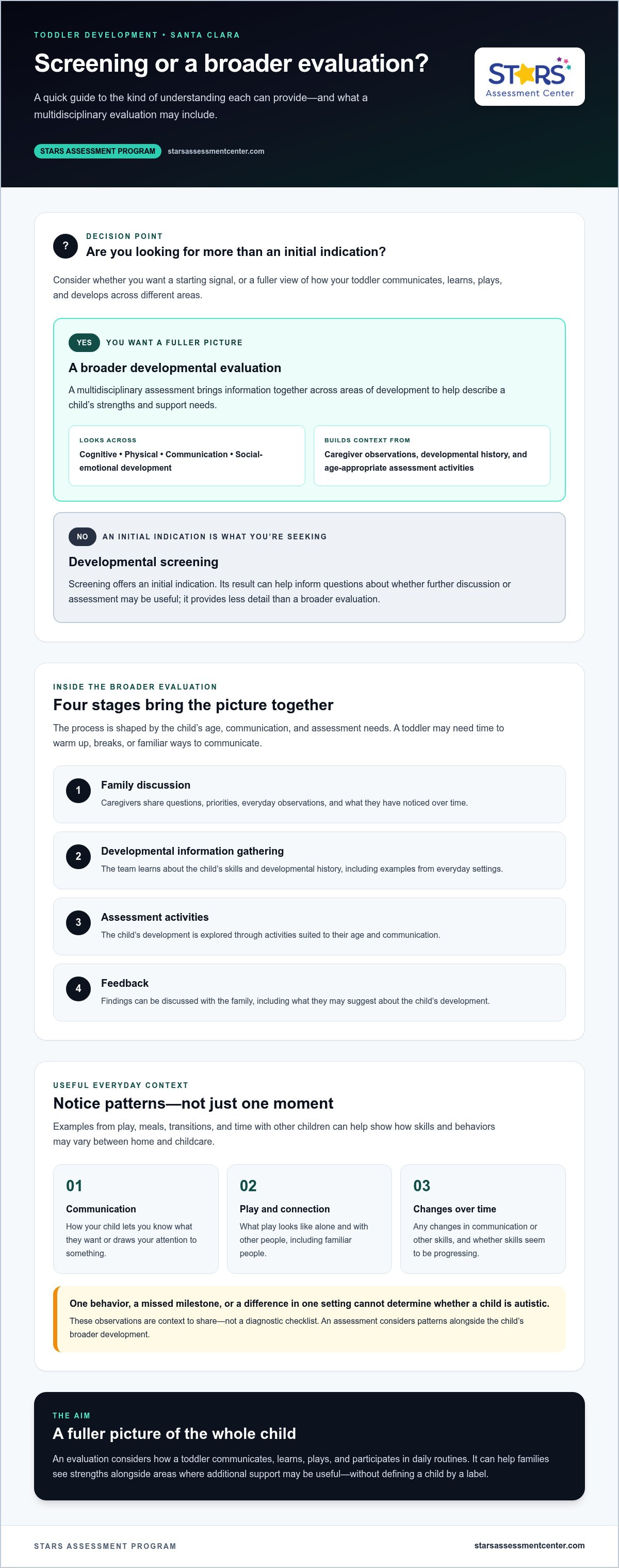
- Screening offers an initial indication; a broader developmental evaluation considers more areas of a child’s development.
- Every assessment is tailored to the child. Sharing everyday observations, developmental history, and family questions can provide useful context.
- Stars Assessment Program assesses children under three across multiple areas of development, helping families build a clearer picture of their child’s needs.
When to consider a toddler autism evaluation in Santa Clara
Differences in your toddler’s development can raise questions, but they don’t provide certainty and aren’t a reason to blame yourself or your child. You may be wondering whether a toddler autism evaluation Santa Clara families can access would help make sense of what you see. An assessment considers development and social communication in context, rather than relying on one behavior alone.
Autism is described as a spectrum because children can have different strengths and support needs. Learning about Autism Spectrum Disorder can provide background, but general information can’t tell you what a particular child’s behavior means. An assessment aims to build a fuller understanding of your toddler, not define them by a label.
What concerns might lead a family to seek an evaluation?
Families may consider an evaluation after noticing recurring differences in how their toddler communicates, interacts with others, or engages in play. They might have questions about how their child responds to their name, shares attention, uses gestures or words, or connects with familiar people. A change in developmental skills, or concern that skills aren’t progressing as expected, may also prompt questions.
Patterns across everyday situations can offer useful context. Think about what you notice during play, meals, transitions, and time with other children, and whether your toddler responds differently at home and in childcare. You might jot down examples such as:
- How your child lets you know what they want or draws your attention to something
- What play looks like alone and with other people
- Any changes in communication or other skills over time
These are observations to share, not a diagnostic checklist. One behavior, a missed milestone, or a difference in a single setting can’t determine whether a child is autistic. An assessment considers patterns and the child’s broader development.
Why an evaluation can help even when questions remain
You don’t need to arrive with a firm conclusion before seeking clarity. An assessment can organize family observations and developmental information into a clearer picture of how your toddler communicates, learns, plays, and participates in daily routines. It can also help distinguish areas where your child is thriving from areas where additional support may be useful.
Both sides of that picture matter. For example, a toddler may show strong interest in certain activities while needing support to communicate wants or join shared play. Understanding individual strengths alongside support needs can help families consider relevant next steps, rather than focusing only on a diagnosis.
Developmental screening is one way to start considering whether a closer look may be helpful. For a clearer explanation of how screening can support understanding of a young child’s growth, see this guide to early childhood developmental screening. A screening result can inform questions, while a broader evaluation provides more detail about development.
What happens during a multidisciplinary toddler autism evaluation?
A toddler autism evaluation Santa Clara families pursue may include several parts, shaped by the child’s age, communication, and assessment needs. The process is intended to understand a child’s development, not test a parent’s knowledge or expect a toddler to behave a certain way on demand. A child may need time to warm up, take breaks, or communicate in familiar ways.
A multidisciplinary assessment brings different areas of a child’s development together to create a more complete picture of their strengths and support needs.
How family observations inform the assessment
A conversation with caregivers puts the child’s development in everyday context. You may be asked about communication, play, interactions, routines, and changes you’ve noticed over time. Examples from home, childcare, or time with relatives can help show whether a skill or behavior differs by setting. You don’t need perfect notes or to know what each observation means. Your perspective is valuable, and you’re a partner in understanding your child.
What a multidisciplinary perspective can add
The assessment considers information across cognitive, physical, communication, and social-emotional development. These areas connect in daily life. For instance, a child’s ability to communicate a need may affect how they join play, while movement and problem-solving skills can shape how they explore toys and their surroundings. Looking at the areas together can help clarify patterns that might be less obvious when viewed in isolation.
Different professional perspectives can contribute to this broader view. The aim is not to reduce a child to scores or observations, but to consider how their skills work together and where support could make everyday activities easier. The Centers for Disease Control and Prevention’s Early Screening for Autism resource explains screening as one part of recognizing when further discussion or assessment may be useful.
A typical evaluation may include these stages:
- Family discussion: Caregivers share questions, priorities, and what they see in daily life.
- Developmental information gathering: The team learns about the child’s skills and developmental history.
- Assessment activities: The child’s development is explored through activities suited to their age and communication.
- Feedback: Findings can be discussed with the family, including what they may suggest about strengths and support needs.
The order and details can vary. If your child communicates with gestures, sounds, words, or a mix, share what works best for them. Stars Assessment Program’s multidisciplinary developmental assessments for children under three consider multiple areas of development to help build a fuller picture of a child’s profile.
Autism screening vs. evaluation: what Santa Clara parents should know
Screening and evaluation serve different purposes. Screening is an initial step that can indicate whether further discussion or assessment may be useful. An evaluation takes a broader look at development and places concerns in context. Neither process is a judgment of your parenting, and a screening result alone doesn’t establish an autism diagnosis.
Here’s a simple comparison:
Purpose
Screening: Identify whether there may be a reason to look more closely at a child’s development.
Evaluation: Build a fuller understanding of developmental patterns and support needs.
Scope
Screening: An initial, focused process that may highlight areas for follow-up.
Evaluation: A more comprehensive assessment that considers social communication and other areas of development.
What it can clarify
Screening: Whether additional discussion or assessment may be appropriate.
Evaluation: How a child’s strengths and needs fit together, and what questions may guide next steps.
What an autism screening can and cannot tell you
A screening can help bring a concern into focus. It may suggest that a child’s development would benefit from a closer look, giving caregivers and professionals a starting point for discussion. It isn’t designed to provide the same breadth of information as a comprehensive evaluation.
A result that raises concern does not confirm autism, predict a child’s future, or explain every behavior. It signals that follow-up may be worth considering. If you continue to have questions about your toddler’s development, those observations still matter even if a screening result doesn’t point to a need for further assessment. Screening is one piece of information, not the whole picture.
How an evaluation adds context to a screening concern
A broader evaluation can consider family observations alongside patterns across multiple developmental areas, such as communication, social-emotional development, cognition, and physical development. This view may help clarify whether a concern is part of a wider developmental pattern or whether a particular area needs more attention. It can also highlight strengths that support your child’s learning and participation in everyday routines.
For example, a screening may raise a question about social communication. An evaluation can explore that concern alongside how the toddler expresses needs, engages in play, responds to other people, and approaches new activities. The goal is to understand the child, not simply confirm a screening result.
For families considering a toddler autism evaluation in Santa Clara, this distinction can make the next step more manageable: screening offers an initial indication, while evaluation adds detail and context. The comparison of autism screening and evaluation for toddlers offers more detail about how these processes differ. Use any result as a starting point for informed questions, and share the everyday observations that matter to your family.
How to prepare for a toddler autism evaluation in Santa Clara County
Preparing for a toddler autism evaluation Santa Clara families may pursue doesn’t require a perfect record of every milestone or behavior. A few everyday examples can make the conversation more useful, but it’s fine if your notes are brief or you’re still unsure what to ask. Your observations matter because you know your child’s routines and personality in ways a single appointment can’t capture.
What parents may want to bring or write down
Before the appointment, consider jotting down examples of how your toddler communicates, plays, interacts with familiar people, and handles daily routines. Note changes you’ve noticed over time, along with situations where your child seems especially comfortable or engaged. You might also write down what you hope to understand, such as how to support communication or make transitions easier. Existing developmental or health records can add context if available, but gathering paperwork shouldn’t become a barrier.
- Communication: How your child expresses needs, responds to others, or shares interest.
- Play and interaction: Favorite activities, ways they play with others, and how they respond to shared play.
- Routines and changes: What daily transitions look like and whether skills or behaviors have changed.
- Your questions: The concerns you’d like discussed and what would help you feel clearer afterward.
- Relevant records: Any developmental notes, prior screening information, or health records you already have.
Keep it simple. A short note such as “uses gestures to ask for snacks, but not to share what they see” may be more useful than a long list without context. Mention if observations differ between home and childcare. Differences across settings can help the team understand what your toddler finds familiar, challenging, or engaging.
How local early-intervention resources fit into next steps
Assessment findings may help families describe a child’s strengths and support needs when discussing next steps. In Santa Clara County, Early Start is a local resource for young children with developmental needs. San Andreas Regional Center is also part of the local landscape of developmental support. Which options may fit depends on a child’s needs and circumstances; an assessment doesn’t guarantee eligibility, enrollment, or a particular service.
It’s okay to bring questions that don’t yet have clear answers. You might ask what the findings suggest, which developmental areas may benefit from support, and what resources could help your family understand next steps. Preparation supports an open conversation; you don’t need to arrive with a conclusion already formed.
If you’re preparing for an assessment for a child under three, explore Stars’ multidisciplinary developmental assessment support to learn more about understanding your toddler’s developmental profile.
How Stars Assessment Program supports Santa Clara families after an evaluation
After an assessment, families may still have questions about what their toddler’s development means in everyday life. Stars Assessment Program provides multidisciplinary developmental assessments for children under three, including specialized autism screening. The assessment considers a child’s broader developmental profile, so concerns can be viewed alongside skills and strengths that may guide family conversations about next steps.
A broader view of your toddler’s development
An autism-related concern may be one part of the picture. Stars’ assessments look across cognitive, physical, communication, and social-emotional development. Considering these areas together can help families understand how a child approaches learning and problem-solving, moves and explores, communicates needs, and connects with people.
This broader view matters because children have individual patterns of development. A toddler may have a clear strength in one area and need additional support in another. Looking at both can help families describe what their child does well, where daily activities may be challenging, and what questions they want to explore. The assessment isn’t about reducing a child to a label or focusing only on areas of concern.
Specialized autism screening contributes to this understanding, while broader developmental information adds context. Findings may help identify potential delays and give parents a clearer basis for discussing their child’s needs. They don’t, by themselves, promise a particular diagnosis, eligibility decision, or service outcome.
A clear next step for families in Santa Clara
For families searching for a toddler autism evaluation Santa Clara, a multidisciplinary perspective can help turn observations and questions into more informed conversations. Assessment findings may help parents consider which areas of development they’d like to understand further and explore early-intervention resources that could be relevant to their child. The process can also help families describe their child’s needs more clearly when discussing possible supports.
There’s no need to arrive with every answer. Parents can share what they’ve noticed, ask questions, and learn more about their toddler’s developmental profile one step at a time. Even when some uncertainty remains, a clearer picture of strengths and potential support needs can offer a useful starting point.
Stars Assessment Program serves families in Santa Clara and nearby communities, including San Jose, Santa Cruz, Salinas, Milpitas, Gilroy, and Morgan Hill, with assessments for children under three. If you’re ready to learn more about this approach to understanding your toddler’s development, learn about Stars Assessment Program.
Take the next step with confidence
You don’t have to know exactly what your toddler’s behavior means before seeking a clearer understanding. Starting a conversation with your questions and observations can help you decide what information or support may be useful next. An evaluation isn’t a verdict on who your child is; it’s a way to better understand how they experience and engage with the world.
For families considering a toddler autism evaluation Santa Clara, Stars Assessment Program provides multidisciplinary developmental assessments for children under three. These assessments consider cognitive, physical, communication, and social-emotional development, helping build a broader view of a child’s needs and strengths.
If you’re ready to explore an assessment for your toddler, learn about an assessment for your toddler. You can take this one step at a time, with your child’s individuality and well-being at the center.
Frequently Asked Questions
What happens during a toddler autism evaluation?
A toddler autism evaluation usually combines caregiver input with observation and developmental assessment activities suited to the child. The evaluator may ask how your toddler communicates needs, responds to familiar people, and handles everyday changes. If your child is quiet, restless, or slow to warm up, share that context rather than trying to make them perform. Their comfort and natural ways of communicating are useful parts of understanding them.
Is an autism screening the same as an autism evaluation?
No. A screening is an initial check that can point to questions worth exploring, while an evaluation looks more broadly at development. A screening result can help you decide what to discuss next, but it doesn’t settle whether a child is autistic. If a screen raises concern, bring the result and your observations to a follow-up conversation so they can be considered together.
Can a toddler be evaluated for autism before age three?
Yes. Children can receive developmental assessments before their third birthday, and Stars Assessment Program provides multidisciplinary assessments for children under three. Families don’t have to wait until a child can explain their experiences with words. Caregiver observations, play, gestures, and emerging communication can all help build an understanding of development. If you have concerns, you can discuss them even when your toddler is very young.
How do I prepare my toddler for an autism evaluation?
Keep the day as familiar and low-pressure as you can. Tell your toddler simply that you’ll be visiting a place to play and talk, using words that fit their understanding. Bring a familiar comfort item if it helps them settle, and plan for their usual needs, such as snacks or rest. You don’t need to rehearse answers or teach specific skills beforehand; the goal is to see your child as they are.
Does an autism evaluation guarantee an autism diagnosis?
No. An evaluation doesn’t guarantee a particular result. It gathers information to help clarify a child’s development and possible support needs, and its findings may or may not indicate autism. The outcome can also identify questions that need more discussion. Whatever the findings, they aren’t a measure of your child’s worth or potential. Ask the evaluator to explain what the results mean and what they can’t tell you.
What happens after a toddler autism evaluation in Santa Clara County?
After an evaluation, families can use what they’ve learned to guide conversations about developmental supports and local resources. Santa Clara County Early Start is one resource families may explore; assessment findings don’t guarantee eligibility or a specific service. Stars Assessment Program serves families in Santa Clara County and nearby communities, including San Jose, Santa Cruz, Salinas, Milpitas, Gilroy, and Morgan Hill. Your child’s needs and circumstances shape which next steps may be relevant.
Can a toddler autism evaluation also look at speech and development?
Yes. A multidisciplinary developmental assessment can consider communication alongside other areas, rather than viewing speech in isolation. Stars Assessment Program assesses cognitive, physical, communication, and social-emotional development, and provides speech and language evaluations. For example, looking at how a toddler understands familiar directions alongside how they express wants can add context to communication concerns. This wider perspective can help families identify which questions they’d like to explore further.


