

What if your toddler’s hardest moments are telling you something they can’t yet put into words? Tantrums, resistance, or sudden changes can leave you wondering whether this is typical, especially when daily routines at home or childcare feel harder to manage. If you’re thinking about getting help for my toddler's behavior, you’re not alone. Asking for guidance doesn’t mean you’ve failed or that something is wrong with your child.
Behavior can offer clues about what a toddler needs, feels, or finds difficult in that moment. Looking at when it happens, what comes before it, and what helps afterward can reveal patterns without rushing to a label. This guide will help you consider behavior in context, try calm and consistent responses, and keep track of observations that may be useful when speaking with a professional.
You’ll also learn when a persistent concern, or challenges affecting everyday routines and development, may be worth discussing with your child’s pediatrician or exploring through an evaluation. A thoughtful next step can bring greater understanding and help you find support that fits your family.
Key Takeaways
- Describe what you observe without labeling your toddler, then note the situation and what seemed to help.
- Look for recurring patterns around routines, transitions, and other everyday moments to better understand what may be influencing behavior.
- Try calm, brief responses and predictable routines, adjusting your approach to your toddler’s age and needs.
- If behavior persists, affects daily participation, or leaves you unsure what to do, bring your observations and questions to a professional.
- When getting help for my toddler's behavior, a multidisciplinary assessment may help clarify how social-emotional, communication, and other developmental needs fit together.
Getting Help for My Toddler’s Behavior Starts With Understanding the Moment
Repeated, intense, or confusing behavior can leave you wondering what to do next, especially when it disrupts meals, play, sleep, or childcare. It’s understandable to feel concerned, frustrated, or unsure whether a moment is part of typical development. Start by describing what you see without deciding what it means. Behavior is an observable action, such as hitting, refusing, hiding, or crying. It may reflect a need, feeling, developing skill, or something happening in the child’s surroundings.
One tantrum or difficult day can’t establish a developmental diagnosis. Toddlers are still learning how to communicate, manage strong feelings, and respond to change. Their age, abilities, and the immediate situation all matter. A general overview of toddler development can offer background, but it can’t explain an individual child’s behavior on its own.
A single episode is a moment to understand; a recurring pattern is something you can document and discuss.
What Can Toddler Behavior Communicate?
Sometimes the clues are in what happened just before the behavior. A tired or hungry toddler may have less capacity to cope with a small disappointment. A transition away from a favorite activity can bring protest, while frustration may build when a child can’t yet express what they want. Hitting, refusing, hiding, or having a meltdown can each happen for different reasons. None of these actions, by itself, tells you why it occurred.
Consider the setting and what your toddler could understand or communicate in that moment. For example, refusing to put on shoes might follow a rushed transition, discomfort, or difficulty following a direction. The same action in another situation may have a different context. Consider your child’s age and current skills so you can focus on what they may be able to manage, rather than using labels such as “bad” or “manipulative.”
When Does a Concern Feel Worth Exploring?
You don’t need to know the cause before taking a concern seriously. Notice how often the behavior happens, how intense it seems, where it occurs, and whether it affects your toddler’s everyday participation. Does it appear during particular transitions, with certain people, or across several settings? Does it make it hard for your child to join play, communicate needs, or take part in family or childcare routines?
These observations can help you explain what you’re seeing, but they aren’t a test you must pass before asking for guidance. If you’re worried, uncertain, or finding the behavior difficult to manage, it’s reasonable to raise it with your child’s pediatrician or another appropriate professional. Share what happens, when it tends to happen, and how it affects daily life. You don’t need a diagnosis or a perfect explanation before starting that conversation.
How to Understand Patterns Behind Your Toddler’s Behavior
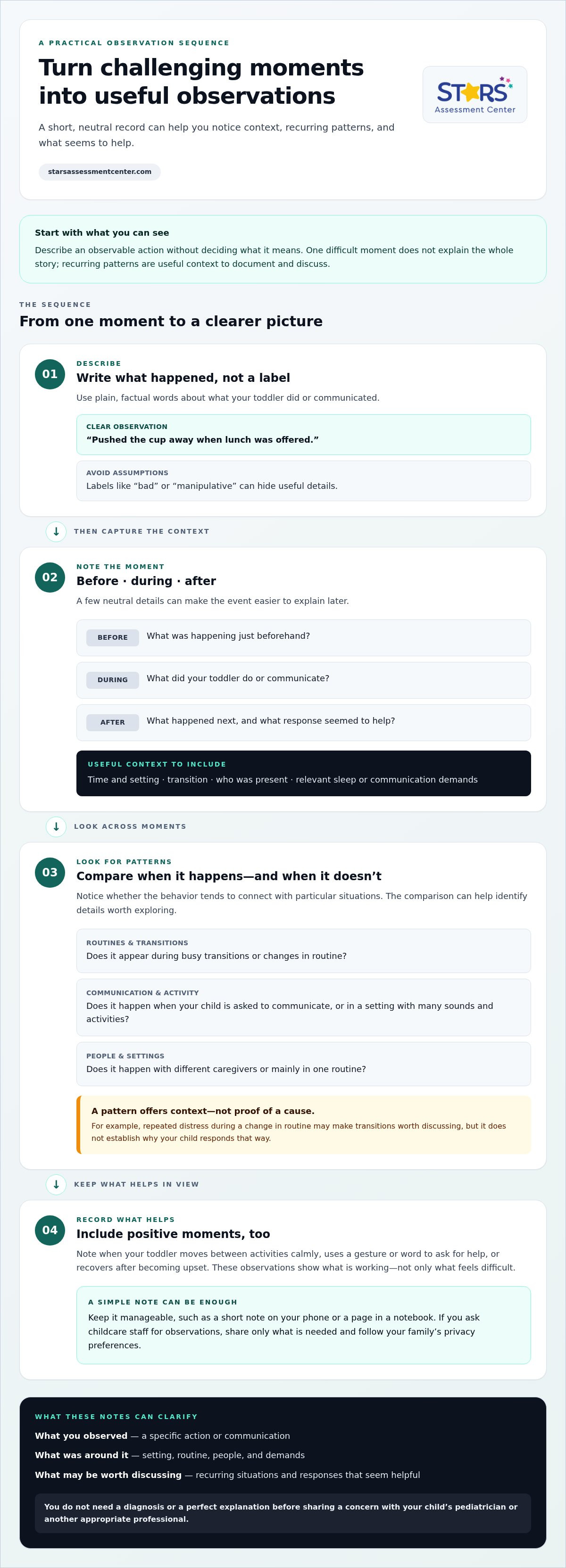
Once you’ve noticed a behavior, a few neutral notes can make it easier to see what’s happening around it. You don’t need to record every moment or interpret it as you go. A brief, consistent snapshot can help you explain your concern and make getting help for my toddler's behavior feel more manageable.
Try this sequence: describe what you saw, note the context, look for patterns over time, and record what seemed to help. Keep the words factual. “Pushed the cup away when lunch was offered” gives a clearer picture than “was difficult.” Labels such as “bad” or “manipulative” can hide useful details and may not reflect what a young child intended.
What Should I Write Down About a Behavior Concern?
After a challenging moment, jot down what happened immediately before, what your child did, and what followed. Add the time and setting, whether there was a transition, who was present, and anything relevant about sleep or communication demands. Keep it simple enough to maintain, such as a short note on your phone or a page in a notebook.
- Before: What was happening just beforehand?
- During: What did your toddler do or communicate?
- After: What happened next, and what response seemed to help?
Include positive moments, too. Note when your toddler moved between activities calmly, used a gesture or word to ask for help, or recovered after becoming upset. These details show what’s working, not just what feels difficult. If you ask childcare staff for observations, share only the information needed to understand the concern and follow your family’s privacy preferences.
How Can Patterns Help Explain What a Toddler Needs?
Compare moments when a behavior occurs with times it’s less likely. Does it tend to happen during busy transitions, when your child is asked to communicate, or in a setting with many sounds and activities? Does it happen with different caregivers or mainly in one routine? These comparisons can help you choose which details to share and what questions to explore.
A pattern is useful context, not proof of one cause. For instance, repeated distress during a change in routine may suggest that transitions are worth discussing, but it doesn’t establish why your child responds that way. Broader information about development can help frame your observations; the early childhood developmental screening guide explains how families can think about development across areas. The CDC parenting tips for toddlers also offer ideas for connecting and communicating with young children.
If you have ongoing questions about your child’s development, Stars Assessment Program’s multidisciplinary developmental assessments consider multiple areas of development for infants and toddlers under age three.
Which Supportive Responses Can Help With Toddler Behavior?
Supportive responses are options to try, not guaranteed fixes or treatment. A toddler’s age, communication skills, temperament, and situation all affect what may be helpful. The goal in a hard moment is not to deliver a perfect lesson. It’s to keep everyone safe, make the limit understandable, and help your child move toward a safer choice.
A calm, consistent response helps toddlers understand what to expect, even before they can manage the moment on their own. That doesn’t mean you’ll always feel calm. If you’re overwhelmed, pause briefly when it’s safe, take a breath, and use a simple phrase you can repeat.
What Can I Do During a Difficult Moment?
Use a steady voice and a few clear words. During a meltdown, a long explanation may be hard for a toddler to take in. Try a short limit such as, “I won’t let you hit,” followed by a safe alternative: “You can stomp your feet,” or “You can show me what you need.” Adapt the wording to what your child can understand and communicate.
Safety comes first if your child’s behavior could hurt them or someone else. Move nearby objects, create space, or calmly block an unsafe action when you can do so safely. Then redirect toward an acceptable option. Avoid shaming, threats, or arguing during an intense moment. You can talk more about what happened once your child is calmer. For additional perspective on understanding challenging toddler behaviors, Head Start’s guidance also emphasizes thoughtful, calm adult responses.
Keep the limit brief and repeat it consistently. For example, if a toddler throws a toy, you might say, “Toys stay on the floor,” then put the toy out of reach and offer a soft ball to roll. This sets a boundary without labeling the child as bad.
How Can Routines and Connection Support Behavior?
Predictable cues can make transitions easier to understand. Before leaving the playground, try a familiar signal such as, “One more turn, then it’s time to go.” Pair words with a gesture or visual cue if that suits your toddler’s communication skills. A simple routine, used consistently, can help your child anticipate what comes next without promising that every transition will go smoothly.
Notice helpful actions specifically. “You used gentle hands” or “You pointed to ask for help” tells your toddler what worked. Adults can model the behavior they want to see, too: use gentle hands, take turns speaking, and show how to ask for a pause. These small moments build connection and offer a clear example.
Choose one response or routine to practice first, and adapt it to your family’s needs. Change may take time, and a strategy that helps in one setting may need adjustment in another. If questions about your toddler’s development persist, a multidisciplinary developmental assessment can offer a broader view of your child’s needs.
When Should I Seek Help for My Toddler’s Behavior?
Consider discussing a concern if behavior continues over time, becomes more intense, or makes it hard for your toddler to take part in everyday activities such as play, meals, or childcare. You don’t need to know exactly why it’s happening. If you’re unsure whether what you’re seeing needs attention, that uncertainty is reason enough to start a conversation with your child’s pediatrician or another appropriate professional.
Bring a few notes about what happens, where you notice it, and how it affects your child and family. You can also describe what your toddler enjoys, what they do well, and what helps them feel supported. These details give a professional useful context. An assessment may explore development and support needs; it doesn’t automatically mean your child will receive a diagnosis.
If there’s an immediate risk of serious harm, or you have an urgent health concern, seek timely professional help rather than waiting for a routine discussion. For less urgent but persistent concerns, you can ask about appropriate next steps at your child’s regular appointment.
What Is the Difference Between Screening and Evaluation?
A screening is an initial check that can help identify areas that may benefit from a closer look. It doesn’t diagnose a condition or predict a child’s future. An evaluation is a more in-depth assessment of development, informed by the concern and the child’s individual abilities. If your questions involve social communication, this autism screening and evaluation guide explains how the two steps differ.
What Can a Multidisciplinary Assessment Clarify?
A multidisciplinary assessment can consider several areas together, including social-emotional, communication, cognitive, and physical development. This broader view may help make sense of how a child’s skills and needs relate to one another. For example, it can bring context to a concern that appears during interactions or daily routines without assuming there’s one simple cause.
Findings can help families understand a child’s strengths, areas of concern, and possible next steps. An assessment isn’t a promise of a particular diagnosis, eligibility decision, or intervention outcome. It’s one way to gather a clearer picture when questions remain. Stars Assessment Program provides multidisciplinary developmental assessments for infants and toddlers under age three. Learn about multidisciplinary developmental assessments.
Getting Local Help for Toddler Behavior in Santa Clara County
Seeking guidance can feel easier when you have a few clear details to share. You don’t need a complete record or a certain explanation. A short summary of what concerns you, what you’ve noticed, and what you hope to understand can help make a conversation more focused. For families in San Jose, Santa Clara, Santa Cruz, Salinas, Milpitas, Gilroy, and Morgan Hill, a developmental assessment may be one option when questions persist and a broader view of a child’s development could be helpful.
How Can I Prepare to Talk About My Child’s Behavior?
Bring brief notes rather than trying to remember every difficult moment. Include where and when a behavior tends to happen, what comes before it, how your child communicates, and whether routines or transitions seem relevant. Note strategies you’ve tried and what happened next. If childcare staff have observations, you can share the details that feel appropriate and useful while respecting your family’s privacy.
Make room for strengths, too. What does your child enjoy? When do they seem comfortable, curious, or connected with others? Mentioning successful moments helps create a fuller picture of your toddler than focusing only on concerns. You might also write down questions, such as:
- What is the purpose of the assessment?
- Which areas of development will be considered?
- What might the findings help us understand, and what could the next steps be?
What Support Can a Developmental Assessment Provide?
Stars Assessment Program provides multidisciplinary developmental assessments for infants and toddlers under age three in San Jose, Santa Clara, Santa Cruz, Salinas, Milpitas, Gilroy, and Morgan Hill. Specialists consider areas such as social-emotional, communication, cognitive, and physical development together. This can help families understand how a concern fits within a child’s broader strengths and support needs, rather than viewing one behavior in isolation.
A social-emotional assessment may be relevant when you have questions about how your toddler manages feelings, interacts with others, or expresses emotions. It can offer information about development, but it doesn’t automatically mean a diagnosis or guarantee a particular outcome. The findings may help clarify what your child is doing well, where questions remain, and what kinds of next steps could be worth discussing.
If you’re getting help for my toddler's behavior and wondering whether an assessment could add useful context, explore the program and its approach to understanding early development. Learn about Stars Assessment Program.
Take One Thoughtful Next Step
You don’t have to solve every hard moment today. Choose one small next step that feels manageable, such as writing down a question you want to ask or sharing an observation with someone who knows your child. If you’re thinking, “I need help getting help for my toddler’s behavior,” remember that seeking guidance is a way to understand your child more fully, not a judgment of your parenting.
For families in San Jose, Santa Clara, Santa Cruz, Salinas, Milpitas, Gilroy, and Morgan Hill, a multidisciplinary assessment can offer a broader perspective when ongoing questions remain. Stars Assessment Program supports infants and toddlers under age three, with specialists considering cognitive, physical, communication, and social-emotional development. This can help families make sense of their child’s developmental picture and consider possible next steps.
Explore Stars Assessment Program’s multidisciplinary developmental assessments to take a thoughtful next step toward understanding your toddler’s development.
Frequently Asked Questions
Is challenging behavior normal for toddlers?
Yes, challenging behavior can be part of toddlerhood as children develop communication, flexibility, and ways to manage big feelings. What’s typical varies from child to child and can also depend on the situation. A tough moment by itself doesn’t tell you whether something is wrong. If a behavior repeatedly interferes with family routines or your child’s activities, consider discussing it with a professional rather than relying on comparisons with other children.
How do I know if my toddler’s behavior needs professional help?
Consider asking for guidance if you’re worried about your child’s safety, if the behavior regularly prevents them from participating in everyday activities, or if you’re unsure how to respond. You don’t need to wait until you can explain the cause. If you’re considering getting help for my toddler's behavior, write down one recent example and how it affected your child or family. Share it with your child’s pediatrician or another appropriate professional.
Can a toddler’s behavior indicate a developmental delay?
Behavior alone can’t establish that a toddler has a developmental delay. It may prompt questions about areas such as communication, social interaction, or managing feelings, especially if you notice other concerns alongside it. A professional can consider the child’s overall development and gather more context. For example, difficulty joining play may be worth discussing alongside questions about how your child communicates, not treated as proof of a particular condition.
What should I do during a toddler tantrum?
First, keep your child and others safe, then use a few calm words rather than trying to reason through the whole situation. If a tantrum starts because it’s time to leave, you might say, “You wanted more play. It’s time to go,” and help your child move to the next step. Once they’re calmer, reconnect and continue with the routine. If you feel overwhelmed, ask another trusted adult to step in when possible.
How can I track my toddler’s behavior before asking for help?
Use a brief note after an incident: what was happening, what your toddler did, how you responded, and what happened next. Add the date and setting so you can compare home and childcare observations later. For example, note whether a similar difficulty occurs at drop-off or only after a change in routine. Keep the record factual and secure, and include moments that went well to show what supports your child.
Can a developmental assessment help with behavior concerns?
It can help families understand behavior in the context of a child’s broader development, though it doesn’t guarantee a diagnosis or a specific outcome. Stars Assessment Program provides multidisciplinary assessments for children under three in San Jose, Santa Clara, Santa Cruz, Salinas, Milpitas, Gilroy, and Morgan Hill. Specialists consider areas such as communication, cognitive, physical, and social-emotional development, helping families discuss strengths, concerns, and possible next steps.


