
What if a toddler speech evaluation could help you understand not only where your child may need support, but also how they’re already communicating? If you’re searching for a toddler speech evaluation San Jose families can access, it’s natural to wonder whether your concerns are significant, what the assessment involves, and how your child might respond. Those questions are a useful place to start.
An evaluation isn’t a test your toddler has to pass. It’s a way to understand their communication strengths and needs and make sense of what you’re noticing in everyday moments. The results don’t automatically mean a diagnosis or eligibility for services. They can offer useful information as you consider possible next steps.
In this article, you’ll learn what a toddler speech evaluation may assess, how to prepare, and what families can do after reviewing the findings. Stars Assessment Program provides speech and language evaluations as part of multidisciplinary developmental assessments for children under three. Understanding what to expect can make the process feel more manageable and help your family move forward with greater clarity.
Key Takeaways
- A speech and language evaluation can help you understand communication differences without treating them as a reason to panic.
- Learn how evaluators may consider understanding, expressing messages, gestures, sounds, words, and interaction in everyday routines.
- See how a screening, comprehensive evaluation, and diagnosis differ, and what each can and can’t tell you.
- Prepare for a toddler speech evaluation San Jose families can approach with practical observations and questions about their child’s communication.
- Understand how findings from Stars Assessment Program’s multidisciplinary assessment may clarify your toddler’s strengths and potential support needs.
When might a toddler speech evaluation in San Jose be helpful?
You may notice that your toddler communicates differently from other children but feel unsure what those differences mean. Perhaps your child doesn’t seem to understand familiar words consistently, has difficulty expressing wants, uses few gestures, or finds back-and-forth interaction challenging. One moment alone rarely tells the whole story. Paying attention to communication during play, meals, and time with family can help you describe what you’re seeing and decide whether to seek guidance.
A speech and language evaluation looks at a child’s communication development, including how they understand and share messages. It considers communication strengths and areas where support may help, without assuming that a child has a diagnosis. If you’re researching toddler speech evaluation San Jose options, think of an evaluation as a way to gain a clearer picture, not as a label based on one behavior.
What communication differences might lead a family to seek guidance?
Families may have questions about how a toddler responds to words, communicates needs, or connects with others. For example, a child might lead an adult by the hand, use gestures or sounds more often than words, or find it difficult to take turns during play. These are useful observations to share, but they aren’t conclusions on their own. Communication varies from child to child, and context matters. A child may communicate differently with familiar people than in a new setting.
Look for patterns rather than judging one isolated moment. Does your toddler respond differently during a quiet routine than during busy play? How do they get your attention, show interest, or let you know what they want? If you’re wondering whether your child may be a late talker, an evaluation can help put your concerns in context without making assumptions about what they mean.
Why an evaluation can offer clarity without labeling a child
An assessment can recognize what a toddler is already doing to communicate and identify where additional support may be useful. It can also consider communication as part of early development, since children use language and interaction in everyday learning and relationships.
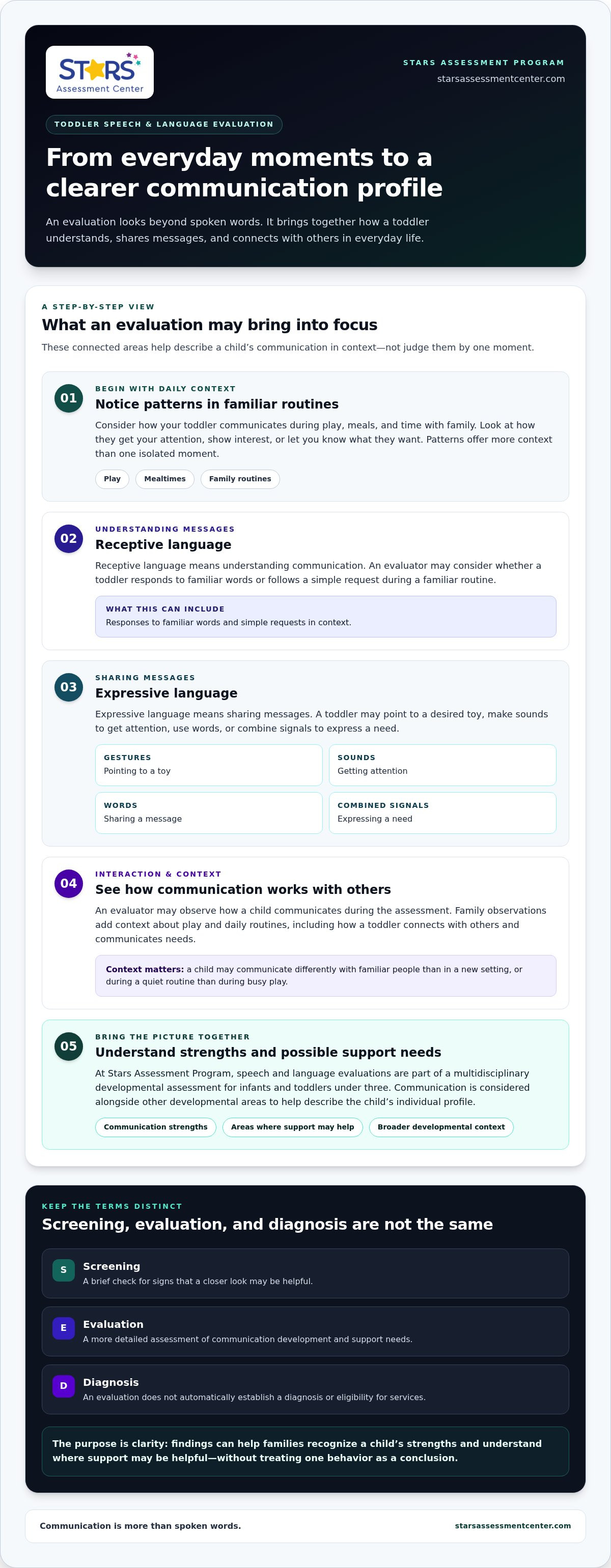
A screening is a brief check for signs that a closer look may be helpful; an evaluation is a more detailed assessment of communication development and support needs. Neither should be confused with a diagnosis. Findings can help families understand their child’s profile and consider next steps, but an evaluation doesn’t automatically establish a diagnosis or eligibility for services.
For additional local context, read the Santa Clara County toddler speech evaluation guide. It offers another perspective for families looking into toddler speech evaluation San Jose information. Stars Assessment Program provides speech and language evaluations as part of multidisciplinary developmental assessments for infants and toddlers under three, helping families consider communication alongside other areas of development.
What does a toddler speech and language evaluation assess?
A toddler’s communication is about more than the words they say. A speech and language evaluation looks at how a child understands messages and shares their own, including through gestures, sounds, words, and interaction. This fuller view can help explain how communication works in everyday situations that matter to family life.
Understanding and expressing communication
Receptive language means understanding communication. An evaluator may consider how a toddler responds to familiar words or follows a simple request during a familiar routine. Expressive language means sharing messages. A toddler might point to a desired toy, make sounds to get attention, use words, or combine signals to express a need.
These examples can help you think about communication, but they aren’t a checklist for diagnosing a delay. A child’s responses may vary with the person, activity, or setting. Your observations add valuable context: what does your toddler do during play, mealtimes, or other familiar routines? A specialist may also observe how the child communicates during the assessment. Together, these perspectives can help describe a child’s individual communication profile without relying on a single moment.
For general information about speech and language development, ASHA's Developmental Milestones offers a reference point for families. Milestones can help you frame questions, but they don’t explain every child’s development on their own.
How communication fits into a broader developmental picture
At Stars Assessment Program, speech and language evaluations are part of a multidisciplinary approach to understanding development in infants and toddlers under three. Communication is considered alongside other developmental areas, helping specialists understand how a toddler’s skills fit together. For example, family observations about play and daily routines can provide useful context about how a child connects with others and communicates needs.
This broader view doesn’t mean that a communication difference automatically points to a diagnosis or eligibility for services. Instead, findings can help families recognize a child’s strengths and understand where support may be helpful. The early childhood developmental screening parent guide offers more context on following children’s growth and considering questions about development.
If you’re exploring a toddler speech evaluation San Jose families can use to understand communication within early development, learn more about Stars Assessment Program’s developmental assessments.
Speech evaluation, screening, or diagnosis: what is the difference?
These terms can sound similar, but they describe different steps. Knowing what each can tell you helps set realistic expectations as you consider a toddler speech evaluation San Jose families may seek for a clearer picture of communication development.
| Step | What it involves | What it can tell a family |
|---|---|---|
| Screening | A brief initial check of communication development. | Whether a closer assessment may be helpful. It does not diagnose a condition. |
| Comprehensive evaluation | A more detailed look at communication skills and concerns, considered in the context of the child. | How the child communicates during the assessment and what strengths or possible support needs have been identified. |
| Diagnosis | A clinical conclusion made by a qualified professional using relevant assessment information. | Whether the child meets criteria for a particular condition. It is not an automatic result of screening or evaluation. |
What a screening can and cannot tell a family
A screening is an initial check to see whether a child’s communication may benefit from a closer look. It can guide a conversation about next steps, but it isn’t as detailed as a comprehensive evaluation. A screening result is not a diagnosis and shouldn’t be used on its own to interpret a toddler’s development. A qualified professional can explain the result in context and whether further assessment may be useful.
How evaluation findings differ from a diagnosis
An evaluation describes communication skills and concerns observed during the assessment; it doesn’t automatically assign a label. Findings may highlight abilities a toddler is using and areas where support could help. The conclusions depend on the assessment and the child’s individual circumstances. An evaluation also doesn’t guarantee eligibility for services or a particular outcome.
Families may encounter screening and evaluation in other developmental contexts, too. If you’re specifically wondering about autism, this autism screening versus evaluation explanation describes how those terms differ in that context. For speech concerns, the key distinction is that screening can point toward a closer look, while a comprehensive evaluation offers a more detailed account of communication development.
How can San Jose parents prepare for a toddler speech evaluation?
You don’t need to coach your toddler or collect perfect examples before an assessment. A few everyday observations can help the team understand how your child communicates in familiar situations, and your questions can make the conversation more useful for your family. Preparing for a toddler speech evaluation San Jose families may attend can start with simple notes about what you notice at home.
What observations and questions can parents bring?
Try keeping brief notes about what you notice during play, routines, and family interactions. Focus on examples, not conclusions. You might jot down how your toddler gets your attention, expresses a need, responds when someone speaks, or communicates with familiar people. Also note situations when communication seems easier, such as during a favorite game or a predictable routine.
- 1. Share communication examples. Include gestures, sounds, words, or other ways your child expresses wants and responds to others.
- 2. Describe the context. Note who was present and what was happening. A toddler may communicate differently at home, during play, or around unfamiliar people.
- 3. Bring relevant background. Share the languages your child hears and uses, your main concerns, meaningful changes you’ve noticed, and abilities you’d like the team to know about.
- 4. Write down questions. Ask what the findings describe, how strengths and support needs will be explained, and what possible next steps could look like.
Your notes don’t need to be formal or exhaustive. They’re a starting point for sharing what you know about your child. As you prepare for a toddler speech evaluation San Jose families seek, make a note of what you want to understand about the process and how the findings will be shared afterward.
Helping a toddler feel more comfortable
A new place or unfamiliar adults can feel like a lot for a young child. Before the visit, describe it simply and reassuringly, such as, “We’re going to meet someone who wants to learn how you communicate.” Keep the explanation relaxed. Your toddler doesn’t need to rehearse, perform, or show a particular skill on demand.
If it feels appropriate, bring a familiar comfort item, such as a favorite small toy or book. Let the team know what usually helps your child settle and share any concerns about the visit. Your knowledge of your toddler is valuable, including what helps them feel safe and ready to engage.
A little preparation can help you feel organized while keeping the focus on your child’s everyday communication. Learn about a toddler speech evaluation San Jose families can access through Stars Assessment Program by exploring speech and language evaluations.
What happens after a toddler speech evaluation with Stars in San Jose?
After an evaluation, families can use the findings to understand how their toddler communicates, what the child is already doing well, and where additional support may be helpful. Results aren’t a verdict or a promise of a particular service. They’re information to help you consider your child’s development and make informed decisions about what to explore next.
How a multidisciplinary assessment supports a fuller understanding
Stars Assessment Program provides multidisciplinary developmental assessments for infants and toddlers under three, including speech and language evaluations. Specialists consider communication alongside other developmental areas, helping families see how a child’s abilities fit together rather than viewing speech in isolation.
This broader perspective can add useful context to the observations you bring. For example, findings may help clarify how communication relates to your toddler’s everyday interactions and overall development. The aim is to describe the child’s individual profile, including strengths and potential support needs. An assessment doesn’t automatically establish a diagnosis or determine eligibility for services.
Turning evaluation information into informed next steps
Once you understand the findings, you can discuss what they may mean for your family. If the assessment identifies areas where support could help, the information may help you explore appropriate early intervention resources. Whether a child qualifies for a particular program or service depends on the relevant eligibility process and the child’s circumstances, not on the assessment alone.
Ask the team to explain unfamiliar terms and clarify how the findings relate to your concerns. You might ask which communication strengths stood out, what needs further attention, and what options may be worth learning about. Take time to absorb the information, reflect, and decide what questions you’d like to address next.
For families considering a toddler speech evaluation in San Jose, the multidisciplinary approach from Stars Assessment Program offers a way to understand communication within the broader picture of early development. The evaluation can start conversations about your toddler’s strengths and possible supports while leaving room for your family’s questions and choices.
To learn more about Stars Assessment Program’s assessment services, explore developmental assessment services.
Take the Next Step With Greater Clarity
Communication differences can leave you with questions, but you don’t have to interpret every moment on your own. A toddler speech evaluation can provide a fuller picture of how your child understands and shares messages, while recognizing existing strengths and areas where support may help.
A screening is an initial check, while a comprehensive evaluation provides a more detailed view of communication development. Findings don’t automatically mean a diagnosis or eligibility for services. They can help guide conversations about possible next steps and early intervention resources.
Stars Assessment Program provides multidisciplinary developmental assessments for children under three, including speech and language evaluations. For families considering a toddler speech evaluation San Jose, understanding the process can make it easier to decide what questions to ask and how to move forward.
Learn how Stars Assessment Program can support your family with a toddler speech evaluation. Your observations matter, and seeking clearer information is a thoughtful step toward understanding how best to support your child.
Frequently Asked Questions
Is a speech evaluation appropriate for a toddler who uses few spoken words?
Yes. Discussing ongoing communication concerns with a qualified developmental professional can be helpful, even if you’re unsure what your toddler’s limited spoken words mean. An evaluation looks beyond word count and may consider understanding, gestures, sounds, interaction, and communication during everyday routines. It doesn’t assume a diagnosis. A specialist can interpret findings in light of your toddler’s age, experiences, and overall development, helping you understand whether support may be useful.
What happens during a toddler speech evaluation?
A toddler speech evaluation considers how a child understands and shares messages. Depending on the assessment, it may look at receptive and expressive language, gestures, sounds, words, and interaction. Your observations can provide useful context about communication at home and during familiar routines. The process may vary, and the assessment team can explain what to expect and how findings will be shared. The aim is to help you understand your child’s communication profile, not to create performance pressure.
How is a speech screening different from a speech evaluation?
A screening is an initial check that may indicate whether a closer assessment could be useful. A speech evaluation takes a more detailed look at a child’s communication abilities and possible support needs. Neither step automatically provides a diagnosis or guarantees services. The appropriate next step depends on your toddler’s circumstances and the purpose of the assessment. If a screening raises questions, a qualified professional can explain the result and whether further assessment may help.
Can a toddler speech evaluation identify a developmental delay?
An evaluation can describe a toddler’s communication skills and identify areas that may need additional attention. Findings are interpreted in context and don’t automatically establish a diagnosis or determine eligibility for services. A multidisciplinary developmental assessment may consider communication alongside other areas of development, helping families understand a child’s broader profile. The results can support a conversation about possible next steps, while any diagnosis or service decision depends on the relevant assessment and individual circumstances.
How should I prepare my toddler for a speech evaluation?
Make a few notes about how your toddler communicates during play, familiar routines, and interactions with family. Include strengths as well as concerns, and write down questions you’d like answered. You can also share the languages your child hears and uses, along with meaningful changes you’ve noticed. Keep your explanation of the visit simple and reassuring rather than presenting it as a test. The assessment team can explain what to expect, since activities and procedures can vary.
Does a toddler need to speak words for a speech evaluation to be useful?
No. Spoken words are only one part of communication, and a toddler doesn’t need to reach a particular communication level before a family can seek guidance. An evaluation may also consider how a child understands familiar language, uses gestures or sounds, interacts with others, and expresses needs. These skills are considered individually and within the child’s broader developmental context. Sharing everyday observations can help the team understand communication beyond what happens during the assessment.
What can families do after a toddler speech evaluation in San Jose?
Review the findings with the assessment team, ask what they mean, and discuss possible next steps for your child. For children under three, developmental assessment information may help families explore early intervention resources, though eligibility isn’t automatic. Keep relevant recommendations and share new observations as your toddler grows. Stars Assessment Program provides multidisciplinary developmental assessments, including speech and language evaluations, for infants and toddlers under three in San Jose, Santa Clara, Santa Cruz, Salinas, Milpitas, Gilroy, and Morgan Hill.


