
If you’re looking for an early autism assessment San Jose families can turn to, it can help to start with a broader question: how is your child developing across communication, social interaction, play, and other skills? A behavior on its own does not establish what is behind it. Looking at patterns across different areas can give you a clearer starting point for understanding your child’s needs.
Screening, developmental assessment, and diagnosis are different steps. An autism-focused screening can identify signs that may need a closer look. A multidisciplinary assessment considers development across areas such as communication, cognition, physical skills, and social-emotional growth. Stars Assessment Program provides multidisciplinary developmental assessments and specialized autism screening for infants and toddlers under three in San Jose and Santa Clara County. Screening can offer useful information, but it does not establish a formal autism diagnosis.
This guide explains what an early assessment may explore, how screening differs from diagnosis, and how to prepare useful observations. It also explains how a broader developmental picture can help families consider appropriate support and next steps, without requiring you to have every answer before beginning.
Key Takeaways
- Noticing differences in your child’s development is a valid reason to seek more information. It does not mean you should assume a diagnosis.
- An early autism assessment San Jose families seek can consider a child’s skills and behaviors together, rather than treating one observation as conclusive.
- Developmental monitoring, screening, and comprehensive assessment serve different purposes. Knowing the difference can help you understand what each step may clarify.
- Brief notes about your child’s communication, play, routines, and social interaction can help you share useful observations. Preparation does not need to be perfect.
- Stars supports infants and toddlers under three with a multidisciplinary view of development that can help inform appropriate resources and next steps.
When to Consider an Early Autism Assessment in San Jose
Noticing differences in your child’s development is a reason to seek information, not a reason to assume a diagnosis. An early autism assessment looks more closely at development and behaviors that may be relevant to autism, while considering the child as a whole. Stars Assessment Program provides multidisciplinary developmental assessments and specialized autism screening for infants and toddlers under three in San Jose and Santa Clara County.
Developmental concerns are observations to explore, not proof of autism. Screening or developmental assessment can help families make sense of what they notice and consider appropriate next steps, but neither is the same as a formal diagnosis. For general background on how diagnosis may involve multiple types of information, see Diagnosis of autism.
What developmental differences might prompt a family to seek guidance?
Caregivers may have questions about how a child communicates, connects with others, plays, or responds to everyday experiences. You might notice, for example, that your child uses fewer gestures than expected, rarely shares attention during play, prefers repeating the same play routine, or reacts strongly to certain sounds or changes. None of these observations alone confirms autism.
Children develop in different ways, so it is useful to look for patterns across settings and areas of development. Share specific examples: what happens during play at home, how your child responds to familiar people, or how they communicate when they need help. Concrete details give specialists more context than a single moment or milestone.
Why consider assessment before a child turns three?
Early childhood is a valuable time to understand a child’s strengths and where extra support may help. An assessment can bring observations together across developmental areas, helping families make sense of questions that might otherwise feel disconnected. No single behavior or age automatically determines whether an assessment is appropriate. The goal is to get clearer information about this child’s needs.
If you are wondering what developmental screening can involve, consider how it differs from a broader assessment: screening looks for signs that may need further attention, while assessment considers more of the child’s developmental profile. For families considering an early autism assessment San Jose, seeking guidance can be a practical way to understand development and explore next steps, even when you are still unsure what your observations mean.
What an Early Autism Assessment Can Explore for Children Under Three
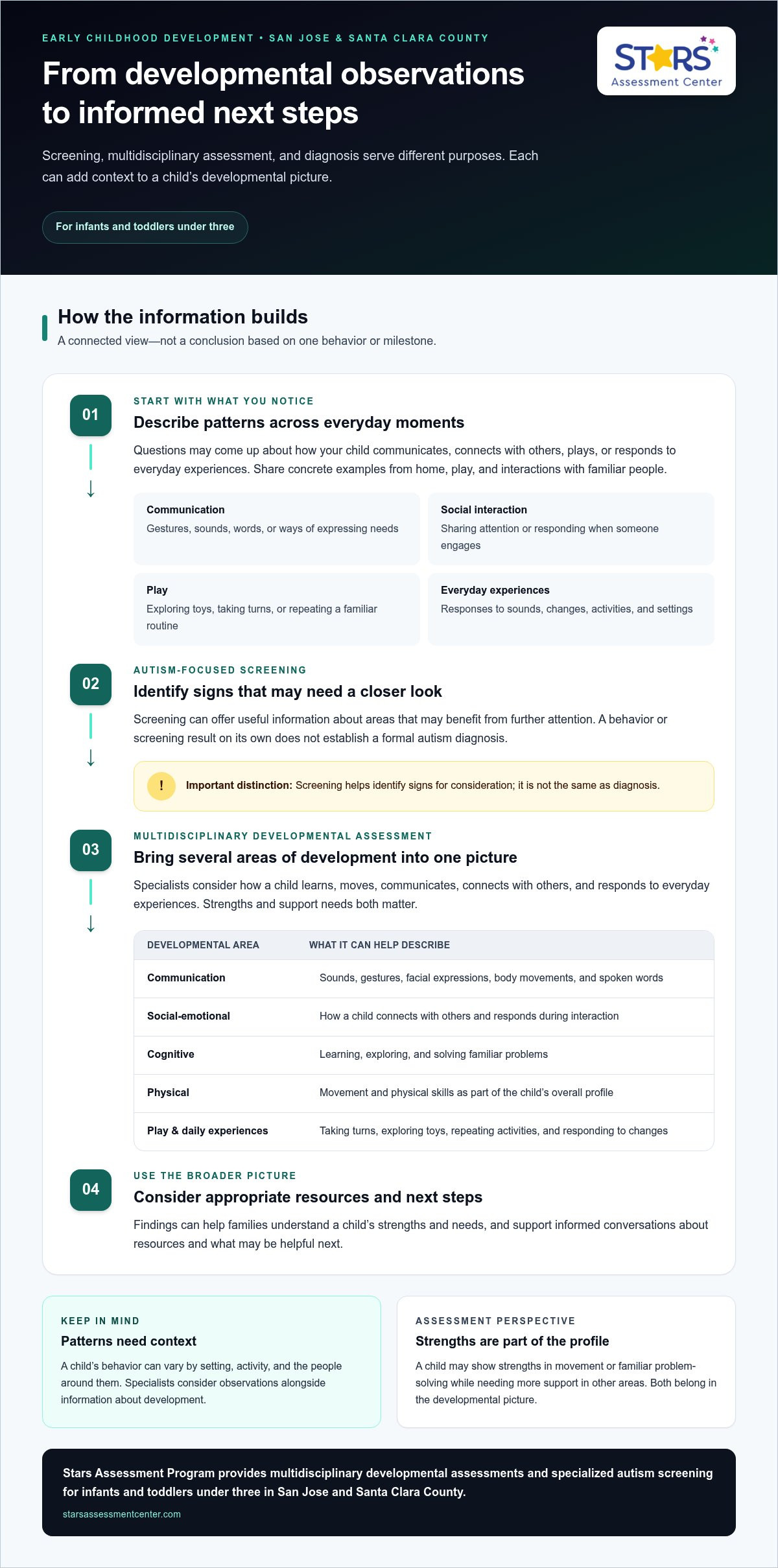
An autism-focused screening is most useful when considered alongside a broader understanding of a young child’s development. At Stars Assessment Program, specialists consider cognitive, physical, communication, and social-emotional development as parts of one profile. This multidisciplinary perspective puts questions about autism in context rather than relying on one behavior or milestone to tell the whole story.
A multidisciplinary early-childhood assessment may consider how a child learns, moves, communicates, connects with others, and responds to everyday experiences. These areas can affect one another. For example, how a child joins play may relate to communication, interests, and the support they need to feel comfortable in a new interaction.
How communication, interaction, and play add context
Communication includes more than spoken words. Specialists may consider how a child uses sounds, gestures, facial expressions, or body movements to share interest and express needs. Interaction and play can add context too: how a child responds when someone tries to engage, takes turns, explores toys, or repeats a familiar activity.
These observations are not a checklist for parents to use to diagnose autism. A child’s behavior can vary with the setting, activity, and people around them. Specialists consider what they observe alongside information about the child’s development, so individual moments are understood within a larger pattern.
Why a multidisciplinary view matters
Considering several areas can help distinguish a specific concern from a broader developmental pattern. A child may show strengths in movement or solving familiar problems while needing more support with communication or social connection. Those strengths matter. They are an important part of understanding the child, not details to set aside while focusing only on concerns.
Autism-focused screening can help identify areas that may benefit from closer attention. The Centers for Disease Control and Prevention explains the role of early screening and diagnosis as part of a broader process of understanding development. Screening does not establish a diagnosis. It can contribute useful information about whether further evaluation or support should be considered.
For families seeking an early autism assessment San Jose, Stars’ multidisciplinary developmental assessment brings observations together to help clarify a child’s profile. Findings can support informed conversations about appropriate resources and next steps. Learn more about Stars’ developmental assessments and how they offer a broader view of early development.
Screening, Assessment, and Diagnosis: What San Jose Parents Should Know
These terms describe different steps in understanding a child’s development. Knowing what each can and cannot establish helps set expectations. The table below summarizes the distinctions. A child’s care team may use information from more than one step to decide what questions or supports to consider next.
| Step | What it involves | What it can tell you |
|---|---|---|
| Developmental monitoring | Ongoing attention to a child’s growth and skills during everyday care and routine visits. | Whether development is progressing as expected or a concern may deserve closer attention. |
| Screening | A focused check for signs of a developmental difference, including signs associated with autism. | Whether further evaluation may be helpful. Screening does not diagnose autism. |
| Comprehensive assessment | A broader review of development, which may consider several areas of a child’s abilities and needs. | A fuller developmental picture to help inform appropriate support and next steps. It should not automatically be presented as a formal autism diagnosis. |
How is an autism screening different from an assessment?
Screening is an initial look for signs that may warrant further evaluation. It can identify a reason to ask more questions, but it cannot confirm autism. An assessment takes a broader view of a child’s development and support needs. Stars’ multidisciplinary developmental assessment considers cognitive, physical, communication, and social-emotional development, with specialized autism screening as part of understanding potential delays.
The distinction is useful when deciding what information you need: screening can flag signs for closer attention, while an assessment considers a wider developmental profile. The Centers for Disease Control and Prevention summarizes the American Academy of Pediatrics’ recommendation for autism-specific screening at 18 and 24 months in its guidance on CDC autism screening recommendations. Screening is one part of developmental care, not a diagnosis on its own.
Does an assessment automatically mean an autism diagnosis?
No. A screening or developmental assessment should not automatically be described as a diagnosis. Its purpose is to help make sense of observations, understand a child’s developmental profile, and consider possible next steps. Stars’ assessment can provide families with information about development and potential delays without promising a specific conclusion.
Families exploring an early autism assessment San Jose can learn about Stars’ developmental assessment program and its multidisciplinary approach.
How San Jose Families Can Prepare for an Early Autism Assessment
Preparing does not mean having every answer or assembling a perfect record. A few everyday observations can help Stars’ multidisciplinary team understand your child’s development across cognitive, physical, communication, and social-emotional areas. Use this flexible checklist as a guide, not a requirement for a successful assessment.
What observations and information can parents gather?
Brief examples can be more useful than trying to summarize everything. You might jot down what your child enjoys, how they communicate needs, or what kinds of support help during daily routines. There is no need to create a formal report.
- Notice communication: Include words, sounds, gestures, or other ways your child shares needs and interests.
- Describe play: Note favorite activities, how your child explores toys, and whether they invite others into play.
- Consider routines and interaction: Record situations where changes, familiar activities, or time with others seem to affect your child’s responses.
- Gather helpful context: Bring relevant developmental history or information from previous evaluations if you have it, and write down questions you would like to discuss.
Small details count. For example, “points to the snack cupboard when hungry” or “likes to watch other children before joining” gives a concrete picture of what you have noticed. If a behavior varies by setting or situation, mention that too. You do not need to decide what an observation means before sharing it.
What can families expect from the assessment experience?
The purpose of a multidisciplinary assessment is to understand the child’s development more broadly, rather than focus on one behavior in isolation. Specialists consider the child’s individual profile and the concerns and strengths caregivers describe. The assessment is about learning more about the child, not asking a parent to prove a particular conclusion.
Findings can help families make sense of developmental observations and discuss appropriate resources and next steps. They do not guarantee a specific outcome or automatically establish an autism diagnosis. Questions that remain can be part of the conversation too.
If you are considering an early autism assessment San Jose families can access through Stars, learn more about Stars assessment services and how the program supports a clearer understanding of early development.
How Stars Supports Early Autism Assessment in San Jose and Santa Clara County
Stars Assessment Program provides multidisciplinary developmental assessments for infants and toddlers under three in San Jose and Santa Clara County. The program also serves families in Santa Cruz, Salinas, Milpitas, Gilroy, and Morgan Hill. Assessments consider development across several areas, with specialized autism screening to help identify potential delays. This broader view gives families more context than considering an autism-related concern on its own.
A multidisciplinary, family-centered perspective
Children’s skills develop in connected ways. Stars specialists consider cognitive, physical, communication, and social-emotional development together to build a fuller picture of a child’s strengths and areas where support may be helpful. A question about communication, for example, can be considered alongside how a child engages with people, explores the environment, and approaches everyday activities.
The purpose is to understand and support the child, not to judge a family or reduce a child to a label. Caregiver observations provide context, while the assessment considers multiple areas of development. Autism-focused screening can flag potential concerns for further discussion, but it should not be treated as a formal autism diagnosis or a guarantee of any particular outcome.
Turning assessment information into next steps
Clearer information can help parents understand what their child is doing well, where they may need support, and what resources could be appropriate to explore. The assessment is one part of that process. Families can use what they learn to have more informed conversations about developmental needs and possible early support, without assuming that one result determines every next step.
You do not need to feel certain that autism explains what you are noticing before seeking guidance. If you are considering an early autism assessment San Jose families can access through Stars, learning about the program’s multidisciplinary approach can help you understand what information may be useful for your child and family.
Learn about Stars Assessment Program and its developmental assessment services for young children.
Take a Clearer Next Step for Your Child
Questions about your child’s development do not have to lead to rushed conclusions. Screening can flag areas for closer attention, while a multidisciplinary developmental assessment offers a broader view of a child’s abilities and support needs. Neither should be confused with an automatic autism diagnosis.
For families considering an early autism assessment San Jose, Stars Assessment Program serves infants and toddlers under three in San Jose and Santa Clara County. Its multidisciplinary assessments consider cognitive, physical, communication, and social-emotional development, with specialized autism screening to help identify potential delays. This information can help parents understand their child’s developmental profile and consider appropriate resources and next steps.
You do not need to have every concern figured out before seeking guidance. Learning more can be a helpful first move toward understanding what support may fit your child and family. Learn about Stars Assessment Program and its developmental assessments for young children.
Frequently Asked Questions
At what age can a child have an early autism assessment?
A child can be considered for developmental guidance during infancy or toddlerhood when caregivers have questions about development. Stars Assessment Program provides multidisciplinary developmental assessments for infants and toddlers under three. There is no single age or milestone that automatically means a child needs an assessment. The American Academy of Pediatrics recommends autism-specific screening at 18 and 24 months as part of routine well-child care, but concerns can be raised earlier.
Is an autism screening the same as an autism assessment?
No. Screening is an initial check for signs that may need a closer look. It can flag a reason to consider further evaluation, but it does not diagnose autism. An assessment takes a broader view of development and may consider communication, physical skills, cognition, and social-emotional development. Keeping the terms distinct helps families understand what a screening provides and what a broader assessment is intended to explore.
Does an early autism assessment provide a diagnosis?
Not automatically. An autism-focused screening can identify potential concerns, while a multidisciplinary developmental assessment helps describe a child’s skills and possible support needs. Stars’ assessment and specialized screening are not a formal autism diagnosis. The information can help families understand developmental observations and consider appropriate next steps. If you are unsure what a screening or assessment can establish, ask for a clear explanation of the findings.
What happens during a multidisciplinary assessment for a toddler?
A multidisciplinary assessment considers several areas of a toddler’s development rather than relying on one behavior or milestone. At Stars, specialists assess cognitive, physical, communication, and social-emotional development, with specialized autism screening to help identify potential delays. The purpose is to build a broader understanding of the child’s developmental profile. The information may help families discuss appropriate resources and next steps, but it does not guarantee a particular finding or outcome.
How can I prepare my toddler for an autism assessment?
Keep preparation simple and flexible. Note everyday examples of how your toddler communicates, plays, interacts with familiar people, and responds to routines. Bring relevant developmental history or existing evaluation information if you have it, and write down questions you would like to discuss. You do not need to create a formal report or coach your child to behave a certain way. Your observations can provide useful context about your toddler’s development.
Where can San Jose families find early autism assessment for a child under three?
Stars Assessment Program provides multidisciplinary developmental assessments for infants and toddlers under three in San Jose, Santa Clara, Santa Cruz, Salinas, Milpitas, Gilroy, and Morgan Hill. Specialists consider multiple areas of development and provide specialized autism screening to help identify potential delays. Families looking for an early autism assessment San Jose can learn about Stars’ assessment program and how it can help clarify developmental needs and possible next steps.


