
When your child’s social or emotional development seems different from what you expected, everyday behaviors can raise questions. A social emotional delay evaluation brings observations together to help you understand how your child connects, communicates, and responds to the world. It isn’t meant to define your child. Instead, it can offer a clearer picture of their strengths and support needs.
It can be hard to know whether a screening is enough or whether a fuller assessment may help. This guide explains what a social-emotional evaluation may consider, how it differs from a brief developmental screening, and what to expect before, during, and after an appointment. You’ll also learn how an individualized assessment can consider social-emotional development alongside other areas of growth.
Stars Assessment Program provides multidisciplinary developmental assessments for children under age three in San Jose, Santa Clara, Santa Cruz, Salinas, Milpitas, Gilroy, and Morgan Hill. These assessments include social-emotional assessment and consider each child’s development in context, helping families better understand potential delays and consider supportive next steps.
Key Takeaways
- A social emotional delay evaluation looks at how a child relates to others, expresses feelings, engages, and responds to everyday experiences.
- Caregiver observations and developmental history help build an individualized picture beyond a single moment or checklist.
- Screening can flag areas for closer attention, while a fuller evaluation can help clarify a child’s strengths and support needs.
- Examples from daily routines and a short list of questions can help you share what you’ve noticed during the assessment process.
- Stars Assessment Program’s multidisciplinary assessments for children under age three consider social-emotional development alongside other areas of growth.
What Does a Social-Emotional Delay Evaluation Assess?
Questions about your young child’s development can feel unsettling, especially when you’re trying to understand what a behavior means. A social-emotional evaluation doesn’t draw a conclusion from one moment. It brings together information about your child’s developmental patterns to help clarify how they connect with people, express feelings, and respond to everyday experiences.
A social-emotional evaluation is an individualized assessment of a child’s relationships, emotional expression, engagement, and responses to daily experiences, considered in the context of their age and development. These skills are connected: social-emotional development can shape how a child explores, communicates, and participates in family routines. For a broader overview of the topic, read Social-emotional development.
Which parts of social-emotional development may be explored?
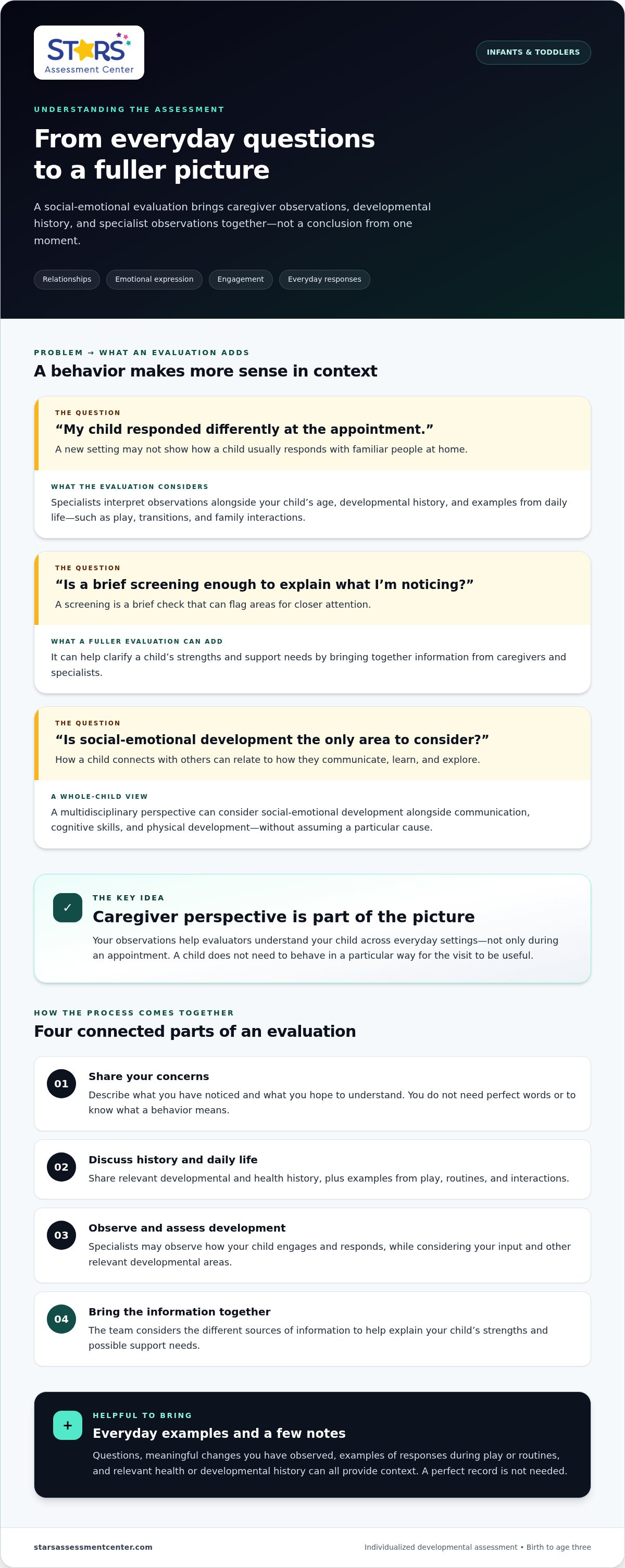
Specialists may consider how a child interacts with familiar caregivers, expresses feelings, responds to comfort, manages changes, and engages with people or activities. These observations are interpreted in context, rather than treating one behavior as a conclusion. For example, a toddler may respond differently during a new appointment than at home with familiar people.
Your child’s age, developmental history, and your observations help specialists make sense of what they see. You can share specific examples from everyday moments, such as play, transitions, or time with family. If you’re looking for examples of behaviors that may prompt questions, see the related article on signs of social-emotional delays.
Why consider the whole child during an evaluation?
Social-emotional development doesn’t happen in isolation. A child’s engagement with others can be considered alongside communication, cognitive skills such as learning and problem-solving, and physical development. For instance, a specialist may consider how a child participates in play in relation to how they communicate or explore their surroundings. This broader view adds context without assuming a particular cause.
A multidisciplinary perspective brings these areas together to build a more individualized picture of your child’s strengths and needs. Stars Assessment Program’s specialists assess social-emotional development alongside cognitive, physical, and communication skills for children from birth to age three. To learn how a brief screen differs from a fuller assessment, explore the early childhood developmental screening guide.
How Does a Social-Emotional Evaluation Work for Infants and Toddlers?
An assessment is an opportunity to understand your child more fully, not a test they need to pass. The experience can vary depending on the child, family, and questions being explored. In general, the process brings caregiver input and specialist observations together to build a broader developmental picture.
A social emotional delay evaluation may include these connected steps:
- Share your concerns. Describe what you’ve noticed and what you hope to understand. You don’t need to have the perfect words or know what a behavior means.
- Discuss your child’s history and daily life. Share relevant developmental and health history, along with examples from play, routines, and interactions.
- Observe and assess development. Specialists may observe how your child engages and responds, while considering your input and other relevant developmental areas.
- Bring the information together. The team considers the different sources of information to help explain your child’s strengths and possible support needs.
ZERO TO THREE describes assessment as drawing on observation and information from multiple sources. Its resource on screening and assessment offers additional context on this approach.
What information can parents bring?
A few notes can help you remember what you want to discuss. Write down questions, meaningful changes you’ve observed, or examples of how your child responds during play, routines, or interactions with familiar people. Relevant health and developmental history can also provide context. You don’t need to create a perfect record or rehearse your child’s behavior. Your everyday perspective is valuable as it is.
Caregiver observations help evaluators understand a child’s development across everyday settings, not just during an appointment.
What may happen during the assessment?
Specialists may observe your child and gather information from you. They might invite your child to take part in a comfortable, age-appropriate interaction, following the child’s cues. There isn’t one fixed format for every family, and your child doesn’t need to behave in a particular way for the visit to be useful.
A child may be quiet at first, need time to warm up, or respond differently than they do at home. That’s why the team considers observations together with your input and your child’s developmental history. One moment is only part of the picture. If you’re exploring an assessment for your child under age three, learn about Stars social-emotional assessments.
Screening or Social-Emotional Evaluation: What Is the Difference?
A screening and an evaluation can both help families make sense of developmental questions, but they have different purposes. A screening is a brief check that can flag areas for closer attention. A social-emotional evaluation takes a broader, individualized look at a child’s development, drawing on information such as caregiver input and specialist observations.
| Aspect | Developmental screening | Social-emotional evaluation |
|---|---|---|
| Purpose | Identify areas that may need follow-up. | Build a fuller picture of a child’s development and support needs. |
| Approach | Uses a brief screening tool or set of questions. | Considers the child individually, often bringing together caregiver information and specialist observations. |
| What it can clarify | Whether closer attention or further assessment may be helpful. | A child’s strengths, developmental patterns, and areas where support may be useful. |
A screening result is one source of information, not a standalone diagnosis. A score or response needs context and appropriate interpretation; it shouldn’t be treated as a complete explanation of a child’s development. An evaluation also doesn’t automatically label a child or guarantee a diagnosis. Its purpose is to understand the child more clearly. Findings and possible next steps depend on the child’s needs and assessment results.
Can a screening result tell you whether a child has a delay?
Not on its own. A screening can indicate that an area may benefit from closer attention, but it doesn’t provide the same individualized understanding as a fuller assessment. If concerns remain, an evaluation can explore developmental strengths and areas where support may help, using more than a single score or brief snapshot.
How can social-emotional and autism assessments relate?
Social communication and interaction may be relevant areas to consider during developmental assessment. But social-emotional differences aren’t the same as autism, and a social-emotional evaluation doesn’t automatically establish an autism diagnosis. The questions being explored and the assessment process matter. For a closer look at how the topics differ, read this guide to autism screening and evaluation.
For families, the practical distinction is that screening can point toward questions worth exploring, while an individualized evaluation can help bring the child’s broader developmental picture into focus. Neither process defines who a child is. The information can help caregivers understand what support may be appropriate for their child.
Preparing for an Evaluation in Santa Clara County and Nearby Communities
You don’t need to have all the answers before an evaluation. A few notes and questions can help you share what you’ve noticed and make the conversation more manageable. Stars Assessment Program serves families in San Jose, Santa Clara, Santa Cruz, Salinas, Milpitas, Gilroy, and Morgan Hill.
Questions families may want answered before the appointment
You can ask how the assessment works, what to expect when meeting with specialists, and how you can participate. It may also help to understand how the team will explain its observations and findings. Consider bringing questions such as:
- Which areas of my child’s development will the evaluation consider?
- How can I share what I’ve noticed at home or in other familiar settings?
- How will the team explain the findings and discuss possible next steps?
- What information about our routines, language, or family context would be helpful?
Your family’s routines and cultural or language context can help specialists understand your child’s experiences. Share the languages your child hears and uses, the people they spend time with, and what everyday activities look like for your family. There’s no single “right” routine to describe.
What information can I bring?
Write down concerns or questions you want to remember, along with examples from play, meals, transitions, or interactions with familiar people. Relevant health and developmental history may also help the team understand the bigger picture. Notes don’t need to be detailed or polished. Even a brief example can help explain what you’ve observed.
A social emotional delay evaluation is individualized, so the most useful information can vary from child to child. You don’t need to prepare your child to act a certain way or create a perfect record. Your perspective as a caregiver helps specialists understand development across everyday settings.
What happens after an evaluation?
After the assessment, findings can be reviewed with you in clear, family-centered language. The discussion may cover your child’s developmental strengths, areas where support could be helpful, and possible next steps. Recommendations depend on the individual assessment and your family’s context; an evaluation doesn’t guarantee a particular outcome.
For children under three, assessment findings may help families understand potential early-intervention options. California Early Start and regional-center pathways have specific criteria and procedures, so families should rely on current program guidance for eligibility and referral details. The evaluation can provide information to support a conversation about what may fit your child’s needs.
If you’re considering an evaluation for your child, explore Stars social-emotional assessments.
How Stars Assessment Program Supports Families Seeking an Evaluation
Stars Assessment Program provides social-emotional assessments for children from birth to age three as part of a broader developmental assessment approach. A social emotional delay evaluation can help clarify questions about your child’s development. The program’s specialists consider your child’s development in context, including their strengths and potential support needs.
A multidisciplinary view of a young child's development
Social-emotional development is considered alongside other areas, including cognitive, physical, and communication skills. Looking across these areas adds useful context. For example, a child’s ways of engaging can be understood alongside how they communicate, learn, or explore their surroundings. The goal is a fuller picture of the individual child, not a conclusion based on one concern or observation.
This multidisciplinary perspective can help families understand potential developmental delays and consider possible next steps. Assessment findings may also help families access early-intervention resources. They don’t guarantee eligibility for a particular program or service; next steps depend on the child’s assessment results and individual circumstances.
A supportive next step for local families
Asking questions about your child’s development is a caring step. It doesn’t mean you’ve decided what the answer is, and an assessment doesn’t define your child. It can help turn questions into clearer information that supports your family’s decisions.
Stars Assessment Program serves families in San Jose, Santa Clara, Santa Cruz, Salinas, Milpitas, and Morgan Hill. The program provides developmental assessments for children under age three, considering social-emotional development alongside other areas of growth.
You can take the next step at your own pace. Explore Stars Assessment Program and learn about the evaluation process.
Take a Supportive Next Step for Your Child
A social emotional delay evaluation can help turn questions into a clearer understanding of your child’s development. Screening may flag areas for closer attention, while an individualized assessment brings caregiver observations and specialist input together to explore strengths and possible support needs. Neither process defines your child.
For children under age three, Stars Assessment Program provides multidisciplinary developmental assessments that consider social-emotional development alongside cognitive, physical, and communication skills. Families in San Jose, Santa Clara, Santa Cruz, Salinas, Milpitas, Gilroy, and Morgan Hill can explore this assessment pathway.
You don’t need to have every concern neatly explained before taking a next step. Your questions and everyday observations are a helpful place to begin. Learn about an evaluation with Stars Assessment Program to better understand your child’s development and consider supportive next steps.
Frequently Asked Questions
What is a social-emotional delay evaluation?
A social-emotional delay evaluation looks at how a young child connects with others, expresses feelings, engages, and responds to everyday experiences. Specialists consider these developmental patterns alongside the child’s age, history, and caregiver observations. The purpose is to understand strengths and possible support needs, not to define the child based on one behavior. For infants and toddlers, the evaluation may also consider other developmental areas to provide broader context.
How is a social-emotional screening different from an evaluation?
A screening is a brief check that can flag an area for closer attention. An evaluation gathers a broader, individualized picture through information such as caregiver input and specialist observations. A screening result alone doesn’t diagnose a delay, and a score needs context. If questions remain after screening, an evaluation may help clarify a child’s developmental strengths and where additional support could be useful.
Can a toddler have a social-emotional delay without autism?
Yes. Social-emotional differences can occur without autism, and they don’t automatically mean a child is autistic. Social communication and interaction may be considered in developmental assessments, but an evaluation focused on social-emotional development isn’t the same as an autism assessment. Specialists interpret observations in the context of the child’s overall development and the questions being explored. A qualified evaluation can help clarify what support may be appropriate.
What should I bring to my child's social-emotional evaluation?
Bring questions you want answered, relevant health and developmental history, and examples of what you’ve noticed during everyday routines. You might note how your child engages during play, transitions, or interactions with familiar people. Information about family routines and the languages your child hears or uses can add helpful context. You don’t need a perfect record or to rehearse your child’s behavior; your observations as a caregiver are valuable.
How long does a social-emotional evaluation take?
The length can vary depending on the child, family, and areas being assessed, so there isn’t one duration that applies to every evaluation. The experience may involve caregiver discussion and specialist observation, with the team bringing information together to understand the child’s development. If timing is important for your family’s planning, you can ask how the assessment process is organized and how findings will be shared.
Does an evaluation mean my child will receive a diagnosis?
No. An evaluation doesn’t automatically result in a diagnosis or label. It gathers information about a child’s development, strengths, and possible support needs. What the findings indicate depends on the individual assessment and the child’s circumstances. The discussion may help your family understand the results and consider possible next steps, but one assessment should not be treated as a predetermined outcome for your child.
Where can families seek a social-emotional evaluation near San Jose?
Families with children under age three can access social-emotional and multidisciplinary developmental assessments through Stars Assessment Program. Its local service area includes San Jose, Santa Clara, Santa Cruz, Salinas, Milpitas, Gilroy, and Morgan Hill. Specialists consider social-emotional development alongside areas such as cognitive, physical, and communication skills. The assessment can help families better understand a child’s development and possible supports.
Can an evaluation help a family access early-intervention resources in California?
An evaluation can help clarify a child’s developmental needs and may support a family’s exploration of early-intervention resources, but it doesn’t guarantee eligibility. California Early Start eligibility may involve a qualifying developmental delay, an established risk condition, or a high risk of substantial developmental disability. Eligibility and next steps depend on the child’s circumstances and applicable criteria. Assessment findings can give families useful information as they learn about available pathways.


