
Could your child be communicating more than spoken words alone reveal? If you’ve searched “my child is not talking yet evaluation,” it’s understandable to feel unsure whether to wait, seek guidance, or both. Gestures, sounds, understanding, play, and interactions can all offer useful clues about how a young child communicates.
A communication evaluation isn’t about judging your child or drawing conclusions from one concern. It can help describe how your child understands and expresses communication, uses it during play and social interactions, and how these skills fit into their broader development. It also helps distinguish a screening, which can flag a reason for a closer look, from a more detailed evaluation.
This article explains what an evaluation may consider, how to prepare, and which everyday observations can help make the conversation more specific. For children under three in Santa Clara County and nearby communities, Stars Assessment Program offers multidisciplinary assessments that consider communication alongside cognitive, physical, and social-emotional development.
Key Takeaways
- Searching “my child is not talking yet evaluation”? An evaluation can offer a clearer picture of your child’s communication strengths and needs.
- Notice communication beyond spoken words, including gestures, sounds, play, and how your child connects with others.
- Not talking yet doesn’t explain why a child communicates differently. An assessment can help clarify whether support may be useful.
- Prepare by noting what your child seems to understand, when they communicate, and what helps them respond.
- For children under three, Stars Assessment Program considers communication as part of a broader developmental assessment.
Child not talking: when to consider an evaluation?
It can be worrying to wonder whether your child is communicating as expected, especially when spoken words are limited or haven’t emerged yet. Children develop at different rates, and a parent’s concern does not mean something is definitely wrong. You don’t need to know the reason for a communication difference before seeking individualized guidance.
A communication evaluation takes a closer look at how your child understands and expresses communication. It gathers information about strengths and areas where support could help. If you’re asking, “my child is not talking yet evaluation,” an assessment can provide useful information without assuming a diagnosis from late talking alone.
What does “not talking yet” mean in everyday communication?
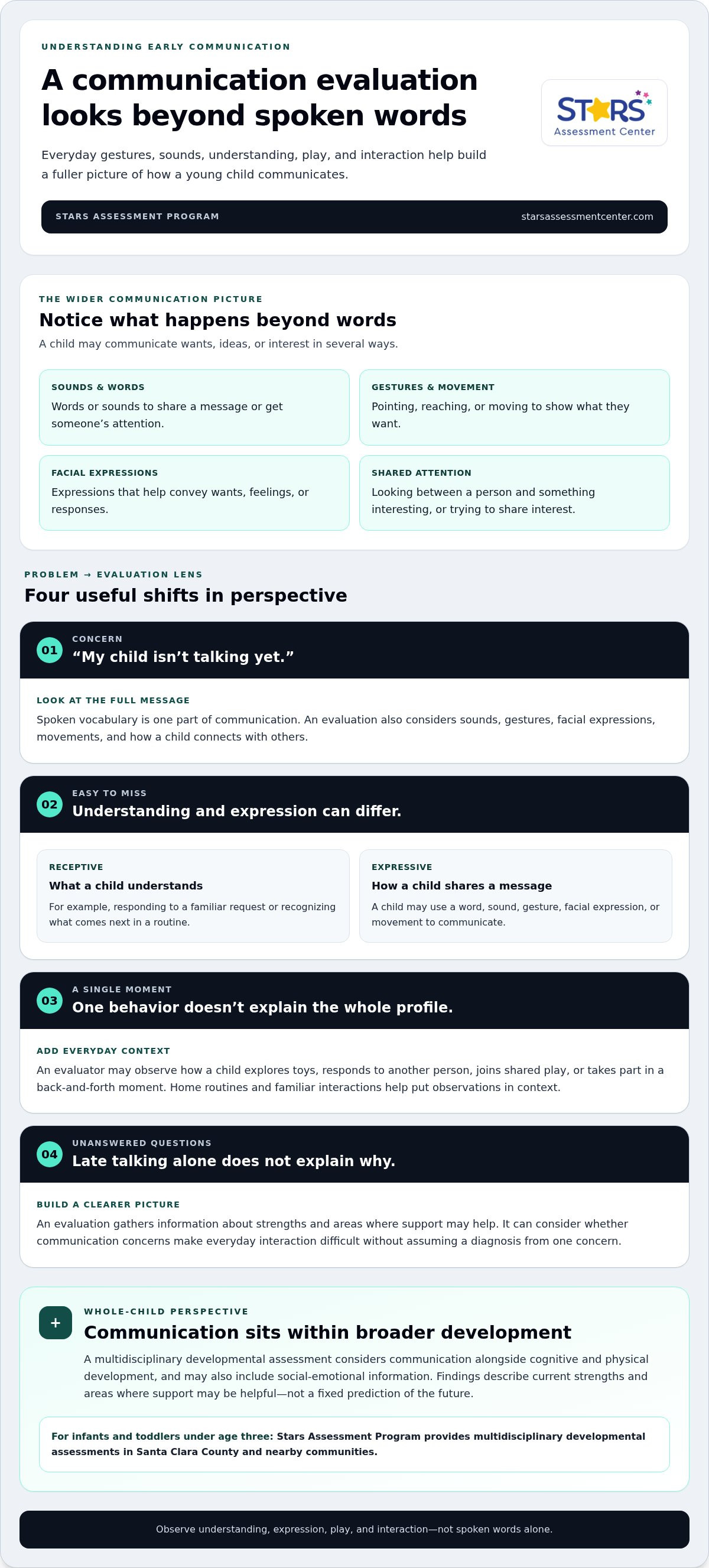
Communication is broader than spoken words. A child may use sounds, gestures, facial expressions, or movements to show what they want. They might look toward something interesting, point or reach, or try to share attention with you. These everyday interactions offer context about how a child connects and communicates.
It’s also useful to consider understanding separately from expression. Receptive communication is what a child understands, while expressive communication is how they share wants, ideas, and feelings. A child might follow familiar directions but use few words, or communicate through gestures and sounds that are easy to miss if you’re counting words alone. The overview of Language delay also distinguishes between receptive and expressive language concerns.
When can an evaluation offer useful clarity?
Consider seeking guidance when communication concerns persist or make everyday interaction difficult. For example, you may notice that your child has trouble letting you know what they need or joining shared play. You don’t have to decide whether the cause is a speech difference, a broader developmental concern, or an individual pace before seeking a closer look. The goal is to understand your child’s profile and identify possible next steps.
An evaluation gathers information about development; a diagnosis is a conclusion that may require further assessment. An assessment can describe what your child does well and where additional support may be helpful, without making assumptions based on one behavior. For infants and toddlers under three in Santa Clara County and nearby communities, Stars Assessment Program’s multidisciplinary developmental assessment considers communication alongside cognitive and physical development. This broader perspective can help families understand potential needs and consider appropriate next steps.
What does a speech and language evaluation look at beyond words?
A child’s spoken vocabulary is only one part of communication. A speech and language evaluation also looks at how a child understands others, shares messages, and takes part in everyday interactions. This broader view can help put observations from home, play, and familiar routines into context.
Understanding receptive and expressive communication
Receptive communication is what a child understands. For example, does your child respond to a familiar request, such as “Bring me your shoes,” or recognize a routine when you describe what comes next? Expressive communication is how a child communicates in return. A child might use a word, sound, gesture, facial expression, or movement to make a choice or share an idea.
Evaluation observations may include whether a child points or reaches, makes sounds to get someone’s attention, looks between a person and an object, or tries to share interest. Play and interaction matter too. An evaluator may observe how a child explores toys, responds to another person, or participates in a back-and-forth moment. These examples provide context, but no single behavior or checklist explains a child’s overall communication profile.
Why evaluators consider the whole child
Communication develops within a broader pattern of learning, play, interaction, and physical development. For instance, how a child explores a toy or moves toward something they want may help explain how they express choices. Looking across these areas can connect observations that might seem separate when considered on their own.
A multidisciplinary developmental assessment considers communication alongside cognitive and physical development, and may also include social-emotional information. Stars Assessment Program provides these assessments for infants and toddlers under age three. Findings describe a child’s current strengths and areas where support may be helpful. They are not a fixed prediction of what a child will be able to do in the future.
For another parent-friendly perspective on how developmental areas fit together, see this early childhood developmental screening guide. The CDC’s Communication milestones can also offer examples of observable skills at 30 months. Milestones are reference points, not diagnoses. If you’re considering a my child is not talking yet evaluation, share what you see in daily life as well as any questions those references raise.
To learn more about the broader assessment approach, explore a multidisciplinary developmental assessment.
Does a late-talking child always have a developmental delay?
No. Not talking yet, by itself, doesn’t explain why a child is using few or no spoken words. Children communicate in different ways and develop at different rates, but that doesn’t mean every child will catch up without support. If you’re asking, “my child is not talking yet evaluation,” an assessment can help clarify what your child is doing now and whether support may be useful.
How can children communicate differently?
Spoken words are only one way children express themselves. A child may use gestures, sounds, facial expressions, or shared interaction to make a choice, request help, or show interest. Consider what you notice across daily routines: Does your child communicate differently during meals, play, or time with familiar people? Do they respond in ways that show they understand what’s happening?
Family context matters, too. The languages a child hears and uses, the people they spend time with, and familiar routines can all provide helpful context. Rather than making assumptions based on language exposure or comparing your child with another, describe what you observe in the settings and languages that are part of your family’s life.
Evaluation is information, not a label
A developmental evaluation gathers a fuller picture of an individual child’s current strengths and areas where support may help. A multidisciplinary assessment can consider communication alongside cognitive, physical, and social-emotional development. Looking across these areas may help explain how your child communicates in different situations and what next steps could be appropriate. An evaluation does not guarantee a diagnosis, service eligibility, or a particular outcome.
A screening and an evaluation also serve different purposes. A screening is a brief check that can indicate whether a closer look may be helpful. An evaluation gathers more detailed information about development. Neither a single screening result nor the fact that a child talks late, on its own, provides a complete explanation.
If your concern specifically involves signs associated with autism, an autism screening may be one part of the conversation, while a fuller evaluation can offer a more detailed view. This guide to autism screening versus evaluation for toddlers explains the distinction. Sharing observations from familiar routines can help make the discussion more specific to your child.
How to prepare for your child’s communication evaluation
You don’t need to complete homework or arrive with a diagnosis. A few everyday examples can make the conversation more useful, but it’s fine if all you bring is a question or concern. If you’re thinking, “my child is not talking yet evaluation,” your observations as a caregiver are a practical place to start.
What observations can parents bring?
Rather than counting or scoring milestones, jot down examples that show how your child communicates and responds. A brief note on your phone is enough. Include what happens in familiar situations, since a child may communicate differently during play, meals, or transitions.
- How your child expresses themselves: words, sounds, gestures, requests, or attempts to share something interesting.
- What they seem to understand: responses to familiar words, routines, or requests.
- When communication happens: for example, asking for a snack, reaching for a toy, or getting your attention during play.
- What has changed: new ways of communicating, skills your child uses less often, or patterns you have noticed over time.
- Who else has observations: notes from caregivers who know your child in other familiar settings.
Share which languages your child hears and uses at home, and describe how communication looks across your family’s routines. This context helps keep the discussion specific to your child rather than based on assumptions or comparisons.
What questions can help families feel prepared?
It may help to write down a few questions you want answered. You could ask which areas of development the evaluation considers, how the findings will be explained, and how the results may guide possible next steps for your child and family. Ask for clarification whenever a term or recommendation feels unfamiliar.
For local context, read this Santa Clara County toddler speech evaluation guide. You don’t need to interpret your observations or determine the cause before an evaluation. Your questions, uncertainties, and examples from daily life all belong in the conversation.
Learn more about a developmental assessment for infants and toddlers.
Where to begin with a child evaluation in Santa Clara County
If you’re looking for a next step close to home, Stars Assessment Program provides multidisciplinary developmental assessments for infants and toddlers under age three. Families in San Jose, Santa Clara, Santa Cruz, Salinas, Milpitas, Gilroy, and Morgan Hill can explore an assessment that considers communication alongside other areas of early development.
Searching “my child is not talking yet evaluation” can leave you with many questions. A multidisciplinary assessment offers a way to look at your child’s development as a whole, rather than focusing only on spoken words.
What can a multidisciplinary assessment help clarify?
Communication is considered alongside cognitive and physical development, with social-emotional development also part of the program’s broader assessment offerings. Looking across these areas can help make sense of how a child’s skills relate to one another and provide a fuller picture of current strengths and possible needs.
Assessment findings can help families understand potential developmental delays and relevant support options. They are intended to inform understanding and next steps, not to promise a particular diagnosis, eligibility decision, or intervention outcome. The process centers on your child and the questions you bring.
Taking a supportive next step with Stars Assessment Program
You don’t need to arrive with a complete explanation for your concern. Your child’s strengths, the moments that feel challenging, and the questions you’re still working through are all useful starting points. Sharing what you’ve noticed can help guide a conversation focused on your family’s needs.
For more local information, explore the Santa Clara County toddler speech evaluation guide. To learn about assessment support for your infant or toddler, explore developmental assessment support through Stars Assessment Program.
Take the next step toward clearer understanding
If you’re wondering whether a my child is not talking yet evaluation could help, remember that spoken words are only one part of communication. An evaluation can look at what your child understands, how they share messages, and what strengths or support needs show up in daily life. It gathers information, not an automatic diagnosis or a prediction of your child’s future.
For infants and toddlers under age three, Stars Assessment Program offers multidisciplinary developmental assessments that consider communication alongside cognitive and physical development. Families in Santa Clara County and nearby communities, including San Jose, Santa Clara, Santa Cruz, Salinas, Milpitas, Gilroy, and Morgan Hill, can explore this broader perspective.
You don’t need to have every answer before taking a next step. Your questions and observations are a meaningful place to begin. Explore developmental assessment support through Stars Assessment Program to take a thoughtful next step toward understanding your child’s needs.
Frequently Asked Questions
Is it normal for a toddler not to be talking yet?
Children develop communication skills at different rates, and spoken words are only one part of the picture. Understanding familiar words, using gestures or sounds, interacting, and trying to share interest also matter. If you’re concerned, an evaluation can help describe your child’s current strengths and needs. It doesn’t assume that late talking automatically means a developmental delay, and it can help clarify whether additional support may be useful.
When should I get an evaluation if my child is not talking yet?
Consider seeking guidance if you have an ongoing concern about how your child communicates, understands, or interacts. You don’t need to know the cause before asking for a clearer picture. An assessment can consider your child’s development in context and discuss possible next steps. Online milestone lists may offer reference points, but they can’t determine what an individual child needs or replace a conversation about your observations.
What happens during a speech and language evaluation for a toddler?
A speech and language evaluation may explore how your child understands communication and expresses needs through words, sounds, gestures, and interaction. Observations from play and familiar routines can add helpful context. For children under three, a multidisciplinary developmental assessment can consider communication alongside cognitive and physical development. The assessment considers the child’s development and communication profile, and families can bring questions about the process.
Can a child understand words but still not talk much?
Yes. Understanding communication and expressing it are related but distinct skills. A child may seem to understand familiar words or routines while using few spoken words, and may communicate through gestures or sounds. These observations are useful context, not a diagnosis. An evaluation can help describe your child’s communication profile, recognize strengths, and clarify whether additional support may be helpful.
Does a speech evaluation diagnose autism?
A speech and language evaluation and an autism screening or assessment have different purposes and aren’t interchangeable. Communication observations may contribute to understanding a child’s development, but limited speech alone doesn’t establish autism. Families can ask what an evaluation considers and how findings will be explained. Stars Assessment Program provides specialized screenings for autism as part of its developmental assessment offerings, without assuming an outcome in advance.
How should I prepare for my child’s communication evaluation?
Note examples of how your child communicates during familiar activities, including words, sounds, gestures, and attempts to share interest. You might also write down what your child seems to understand and questions you want answered. Mention the languages used at home and observations from caregivers who know your child well. You don’t need to diagnose the concern or complete a formal checklist before the evaluation.
Can families in San Jose and nearby cities access an under-three developmental assessment?
Stars Assessment Program provides multidisciplinary developmental assessments for infants and toddlers under age three in Santa Clara County and nearby communities. Local coverage includes San Jose, Santa Clara, Santa Cruz, Salinas, Milpitas, Gilroy, and Morgan Hill. Assessments consider communication alongside cognitive and physical development, helping families understand a child’s current strengths and possible support needs. Explore the program’s assessment information to learn more about this next step.


