

Explaining developmental concerns to family can start with curiosity rather than disagreement. You don’t need to have all the answers before speaking up. Sharing what you’ve noticed can be an act of care, even if you’re worried relatives may dismiss your concern or feel defensive.
It can be difficult to be honest without sounding judgmental or suggesting a diagnosis. You may wonder what to say, how to respond to questions, and how to keep a difference of opinion from delaying support. Starting with your child’s strengths and describing specific moments can make the conversation feel more grounded and respectful.
This guide will help you share observations calmly, invite family members to listen and contribute, and agree on one manageable next step. You’ll find ways to respond if someone disagrees, keep the focus on your child’s needs, and consider professional assessment as a source of clarity, without trying to diagnose your child at home.
Key Takeaways
- Approach explaining developmental concerns to family as sharing a question, not presenting a diagnosis or prediction.
- Prepare by choosing your goal, noting examples from everyday routines, and planning a gentle opening.
- Use first-person language to describe what you’ve noticed, then invite relatives to share their perspective.
- Respond to dismissal, fear, or silence with empathy while keeping the conversation focused on your child’s needs.
- Consider whether a professional assessment could offer added clarity, alongside the knowledge your family already brings.
Why explaining developmental concerns to family can feel difficult
Talking about a child’s development can stir up strong feelings. You may worry about being misunderstood, while a relative may hear your concern as criticism of their parenting or a prediction about the child’s future. Differences in expectations, culture, or personal experience can make even a caring conversation feel tense.
A concern, however, doesn’t have to be a conclusion. It can simply be a question worth exploring. Explaining developmental concerns to family is often easier when the goal is shared understanding, not immediate agreement or a label.
What makes these conversations feel so personal?
Comments about a child can touch on identity, culture, family traditions, and hopes for the future. Relatives may respond with reassurance, questions, silence, or defensiveness because they’re feeling love, fear, or uncertainty, not necessarily because they don’t care. Choose a calm moment to talk, rather than raising the subject during a stressful event or family gathering.
Concern, observation, and diagnosis are not the same
An observation is something you’ve noticed in daily life, such as how your child communicates during play, responds to their name, or manages a familiar routine. A developmental concern is a question about what that pattern might mean. Neither is a diagnosis. One moment or behavior alone can’t establish a developmental diagnosis, and developmental milestones are guides for noticing patterns, not pass-or-fail tests.
For example, you might say, “I’ve noticed that she often points to show me things, but rarely uses words to ask for them.” That describes what you see without assigning a cause. A clinical term such as Global developmental delay has a specific meaning. Noticing a difference doesn’t determine whether that term, or any diagnosis, applies.
Noticing a developmental difference is not the same as determining its cause or clinical meaning. A calm, specific conversation gives relatives room to share what they’ve observed, too. You don’t need everyone to interpret the situation identically before you can compare perspectives and consider what might help your child.
Preparing to Explain Developmental Concerns to Family
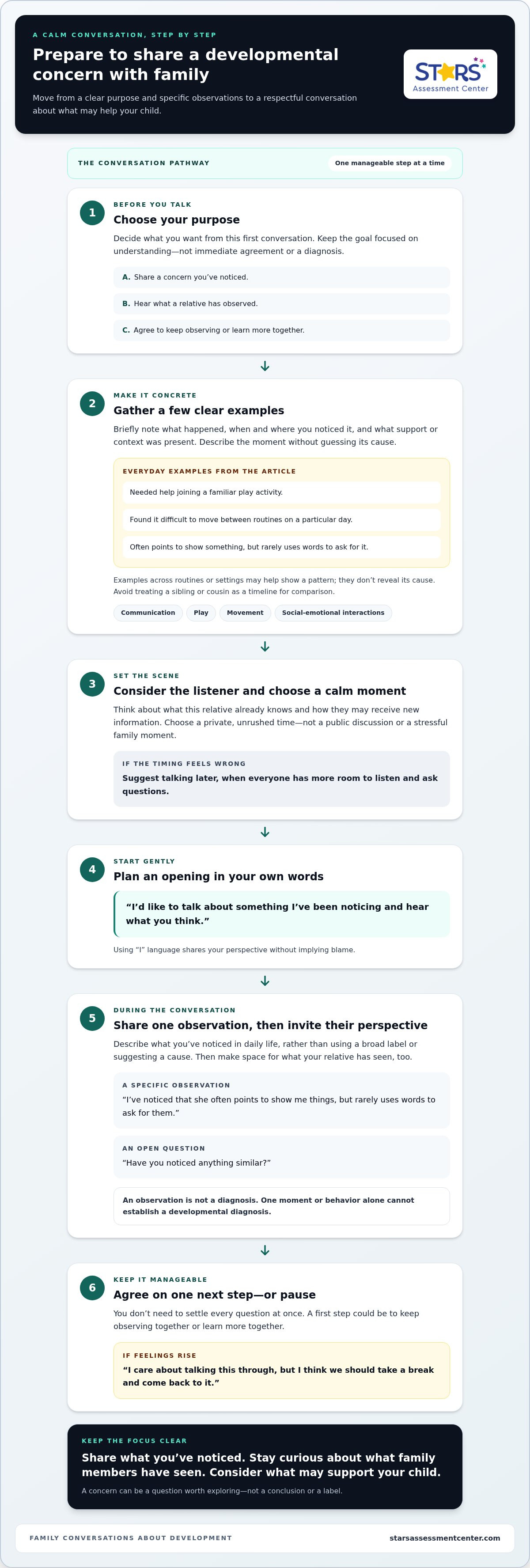
A little preparation can help you feel steadier and keep the conversation focused. Before explaining developmental concerns to family, work through four simple steps:
- Choose your purpose. Decide whether you want to share a concern, hear what a relative has observed, or agree to learn more together.
- Gather examples. Note a few specific moments from everyday life instead of relying on a broad label.
- Consider the listener. Think about what this relative already knows and how they may receive new information.
- Plan an opening. Choose a calm first sentence, such as, “I’d like to talk about something I’ve been noticing and hear what you think.”
Choose a private, unrushed moment when your child isn’t the subject of a public discussion. A quieter setting gives everyone room to listen and ask questions. If the conversation begins during a stressful moment, suggest talking later.
Choose observations that are clear and fair
Specific examples are easier to understand than broad labels or comparisons. Jot down what happened, when and where you noticed it, and what support or context was present. For instance, you might note that your child needed help joining a familiar play activity, or that moving between routines was difficult on a particular day. Examples from different routines or settings can help show whether you’re seeing a pattern. They don’t reveal its cause, so describe what happened without guessing why.
Depending on what concerns you, examples might relate to communication, play, movement, or social-emotional interactions. Keep notes brief and neutral. Avoid comparing your child with a sibling or cousin as if all children follow an identical timeline. Family members may have useful observations from their own time with the child, too.
Decide what you hope the conversation will accomplish
Choose one realistic goal for the first conversation. You might want to share what you’ve noticed and agree to keep observing, or to learn more together. Thinking about what the relative already knows can help you decide where to begin and what may feel new. You don’t need to settle every question at once.
If feelings rise or the discussion becomes overwhelming, prepare a gentle pause: “I care about talking this through, but I think we should take a break and come back to it.” If your questions point toward seeking a clearer picture of your child’s development, families with children under three in San Jose, Santa Clara, Santa Cruz, Salinas, Milpitas, Gilroy, and Morgan Hill can learn about multidisciplinary developmental assessment as one source of guidance.
What to say when sharing developmental concerns with relatives
A helpful conversation can begin with what you’ve noticed and why you’re bringing it up. Use “I” statements to describe your perspective without implying that anyone is to blame. You might say, “I care about how we can support Maya, and I’ve been wondering about something I’ve noticed.” Then share one clear example. The goal is to understand each other and keep your child’s needs in view, not to reach a diagnosis through family discussion.
Gentle sentence starters for raising a concern
Adjust your words to fit the relationship and the moment. With a close relative, you could say, “I’ve noticed he gets frustrated when it’s hard to tell us what he wants. Have you noticed anything similar?” With a co-parent, try, “I’d like us to compare what we’re seeing at home and decide whether we want to learn more.” Both approaches invite conversation without demanding agreement.
- For a skeptical relative: “I know you may be seeing things differently. I’m not trying to label her; I’d like to share what I’ve noticed and hear your perspective.”
- To suggest a next step: “We don’t need to figure everything out today. Would you be open to learning more together?”
- To keep care at the center: “We all want him to feel understood and supported. Can we talk about what helps him in these moments?”
These phrases leave room for different views while making your purpose clear. You’re sharing a concern, not assigning a cause or asking relatives to assess the child.
How to listen without losing sight of the concern
If a relative disagrees, pause and listen for the worry beneath their response. They may fear that a label will define the child or believe a challenging phase will pass. You can acknowledge that feeling: “I understand why this feels worrying.” Then return gently to the specific moment you observed. Listening doesn’t mean withdrawing your concern; it helps keep the discussion respectful and focused.
If the conversation shifts toward blame or broad labels, bring it back to what happened and what your child may need. You might say, “I’m not trying to decide what this means. I’d like us to understand what we’re seeing.” Explaining developmental concerns to family can involve uncertainty and differing perspectives. You can agree to keep talking, even if you don’t reach the same conclusion right away.
Responding to Family Reactions and Next Steps
Even a carefully planned conversation can bring an unexpected response. A relative may dismiss your concern, become frightened, go quiet, or ask, “So what does this mean?” You don’t have to answer every question in the moment. A calm reply can recognize their feelings while bringing the focus back to what you’ve observed and what might support your child.
If a relative dismisses the concern or becomes worried
If you hear, “They’ll grow out of it,” you might respond, “That may be possible. I’d still like to understand why this part of the routine seems hard for them.” If a relative becomes anxious or asks for a definite answer, try, “I don’t know what’s causing it, and I’m not asking us to decide that now. I want to make sure we understand what our child needs.”
Silence can mean someone needs time to process. Let them know the conversation can continue later: “I know this is a lot to take in. We can pause and talk again when you’re ready.” If family members disagree, acknowledge their perspective without debating a diagnosis neither of you can establish. Restate the specific observation and why it matters in everyday life, then allow room for reflection.
Turn shared concern into a manageable next step
You don’t need to settle every question to move forward. Choose one small action, such as keeping brief notes about when a challenge comes up, what was happening at the time, and what helped. You could also write down questions to discuss with your child’s pediatrician. A manageable step gives the family something practical to do without requiring immediate agreement about what an observation means.
An age-appropriate developmental assessment can help build a clearer picture of a child’s strengths and areas where support may help. A multidisciplinary assessment considers different areas of development, rather than relying on one family member’s interpretation. For families explaining developmental concerns to family, it may help to describe assessment as a way to learn more, not as proof that something is wrong.
Keep your child’s privacy and dignity in mind, especially with extended family. Share only what’s needed to support the conversation, and avoid discussing sensitive concerns in front of the child or people who don’t need to know. For children under three, Stars Assessment Program provides multidisciplinary developmental assessments for families in San Jose, Santa Clara, Santa Cruz, Salinas, Milpitas, Gilroy, and Morgan Hill. Explore a multidisciplinary developmental assessment as one way to gain a fuller understanding of your child’s development.
When professional guidance can help families move forward
Family observations are valuable, but relatives may see different parts of a child’s day. Professional guidance can bring those perspectives together and help clarify questions about development. It doesn’t replace what caregivers know about a child’s routines, personality, strengths, and needs. Instead, it adds another source of information as the family considers what support may be helpful.
What a multidisciplinary assessment may help clarify
A multidisciplinary developmental assessment considers more than one area of development. It can include communication, cognitive skills such as learning and problem-solving, physical development, and social-emotional interactions. Looking across areas can help build a fuller picture than a single conversation or isolated observation.
Screening, assessment, and diagnosis are related but distinct. A screening can indicate whether a closer look may be useful. An assessment gathers more detailed information about development, strengths, and possible support needs. Findings can guide understanding and planning, but the purpose of an assessment varies. Not every developmental assessment provides a diagnosis, and family members shouldn’t treat one as a conclusion before the evaluation is complete.
How to share the idea of an assessment with family
For relatives who feel worried about labels, present an assessment as a way to learn, not to blame. You might say, “We already know so much about what helps him. I’d like to understand more about his development and whether there are ways to support him.” Invite relatives to share useful observations, while remembering that caregivers guide decisions about the child’s care.
Explaining developmental concerns to family can include saying, “We don’t have to decide what this means before we ask questions.” That leaves room for uncertainty while keeping the focus on understanding the child, not debating who is right.
Stars Assessment Program provides multidisciplinary developmental assessments for children under three in San Jose, Santa Clara, Santa Cruz, Salinas, Milpitas, Gilroy, and Morgan Hill. The evaluation considers cognitive, physical, communication, and social-emotional development, and can include specialized screenings for Autism and Down syndrome, as well as speech and language evaluation. If you’re ready to explore whether an assessment could help your family better understand your child’s development, learn about multidisciplinary developmental assessments.
Take One Supportive Step Forward Together
Explaining developmental concerns to family doesn’t require perfect words or instant agreement. Start with what you’ve observed, speak with care, and make room for relatives to share their perspectives. If the conversation brings up uncertainty, you can pause, return to your child’s everyday needs, and choose one manageable next step.
Professional assessment can add perspective without replacing what family members know about the child. Stars Assessment Program provides multidisciplinary developmental assessments for children under age three, considering cognitive, physical, communication, and social-emotional skills. For families in San Jose, Santa Clara, Santa Cruz, Salinas, Milpitas, Gilroy, and Morgan Hill, an assessment can help clarify a child’s development and inform supportive next steps.
If you’d like to explore an assessment for your family, learn about developmental assessments for infants and toddlers. Take one thoughtful step toward understanding your child’s development.
Frequently Asked Questions
How do I tell family members I am worried about my child’s development?
Start with a specific observation and explain that you’re sharing it because you care about your child. For example, “I’ve noticed he often gets frustrated when we don’t understand what he wants, and I’d like to talk about how we can support him.” Explaining developmental concerns to family doesn’t require a diagnosis or immediate agreement. Invite relatives to share what they’ve noticed, and choose a calm, private time to talk.
What should I say if my family dismisses my developmental concerns?
Stay calm, acknowledge that they may see things differently, and restate the observation that prompted your concern. You might say, “I understand you think she may grow out of it. I’d still like to learn more because this is making everyday routines difficult.” Avoid arguing over a diagnosis. If emotions rise, pause and suggest returning to the conversation later. You can take a next step even if relatives aren’t ready to agree.
Can a family member diagnose a developmental delay?
No. Family members can notice and describe behaviors, but those observations alone don’t establish a developmental diagnosis. A relative may offer helpful context about how a child communicates, plays, or manages routines in their care. A qualified professional can consider those observations alongside other information during an assessment. Families don’t need to decide what a behavior means before seeking guidance or asking questions.
How do I discuss developmental concerns without upsetting the child’s parents?
Raise your concern privately, with care and without assigning blame. Begin with a strength or a shared hope for the child, then describe what you observed rather than using labels or comparisons. For example, “She seems to enjoy playing with you. I noticed transitions have felt hard lately. Have you noticed that too?” Respect the parents’ role in decisions, listen to their perspective, and offer support instead of pressure.
What if relatives disagree about whether a toddler needs an evaluation?
Different opinions don’t have to stop the family from learning more. Bring the conversation back to specific observations, such as communication, play, movement, or social interactions, and discuss how these affect daily life. Relatives can share useful examples, but they don’t need to reach a diagnosis together. A caregiver can consider discussing questions with the child’s pediatrician or exploring an age-appropriate developmental assessment.
When should I talk with a professional about developmental concerns?
Consider seeking professional guidance when you have ongoing questions about your child’s development, or when a skill or everyday routine is causing concern. You don’t need to wait until relatives agree or know what the concern means. Write down what you’ve noticed and discuss it with your child’s pediatrician or an assessment professional. An evaluation can help clarify strengths and potential support needs without making family observations any less valuable.
How can I explain a developmental assessment to family?
Describe an assessment as a way to understand a child’s development, strengths, and possible support needs, not as a label or a judgment about parenting. A multidisciplinary assessment may consider cognitive, physical, communication, and social-emotional development. Stars Assessment Program provides assessments for children under three and serves families in San Jose, Santa Clara, Santa Cruz, Salinas, Milpitas, Gilroy, and Morgan Hill. Explain that family observations can help inform the conversation.


