
What if a toddler developmental evaluation is less about putting a label on your child and more about understanding how they learn, communicate, play, and connect? If you’ve noticed something that concerns you, it’s natural to wonder whether a full evaluation is needed or what the process might feel like. Your observations matter, and asking questions is a caring first step.
A developmental evaluation offers a closer look at your toddler’s strengths and needs. It isn’t the same as a brief screening, and it doesn’t define who your child is. Instead, it can help turn questions into clearer information and possible next steps.
In this article, you’ll learn what an evaluation may assess across areas such as communication, physical, cognitive, and social-emotional development. We’ll also explain how to prepare, what to share with the evaluation team, and how findings may guide follow-up or early supports. Knowing what to expect can make the process feel more manageable and help you take it one step at a time.
Key Takeaways
- A toddler developmental evaluation can help explore a caregiver’s concerns without defining a child’s potential.
- Looking across developmental areas can show how skills such as communication and play may connect.
- Prepare to share observations and background information, and ask what to expect from the assessment process.
- Use the findings to discuss your child’s strengths, clarify recommendations, and identify who will coordinate follow-up.
- Stars Assessment Program offers multidisciplinary developmental assessments for children under three, considering multiple areas of development.
What Is a Toddler Developmental Evaluation, and When Can It Help?
Every toddler develops at their own pace, and differences in timing don’t automatically mean something is wrong. Still, if you have ongoing questions about your child’s development, it’s worth discussing them. You don’t need to know what may be causing a concern before asking for guidance.
A toddler developmental evaluation is a closer look at a child’s skills and development. It draws on caregiver observations and assessment activities to understand strengths, possible delays, and helpful next steps. It isn’t a verdict about your child’s potential. The goal is to build a fuller picture of how your toddler is developing and where additional support or information may be useful.
Monitoring, screening, and evaluation: what’s the difference?
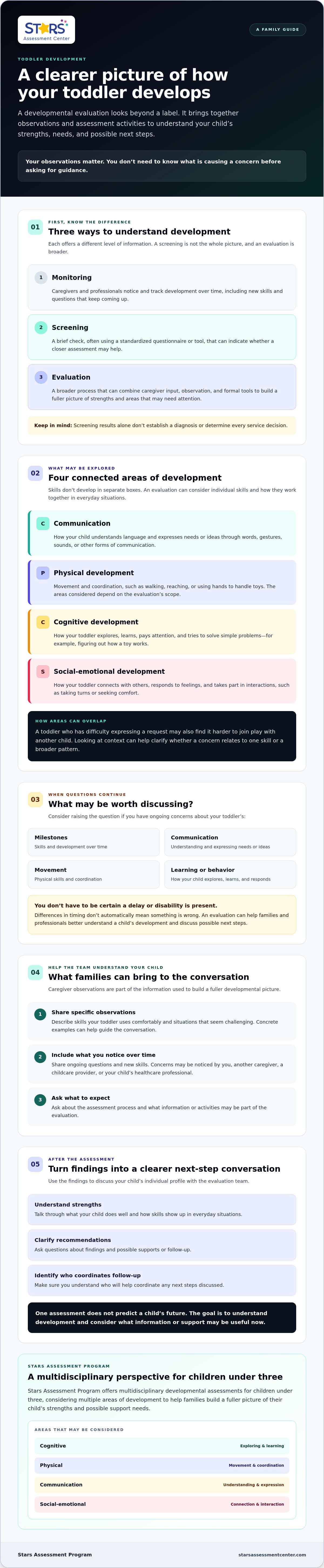
- Monitoring: Caregivers and professionals notice and track development over time, including new skills and questions that continue to come up.
- Screening: A brief check, often using a standardized questionnaire or tool, that can indicate whether a closer assessment may help.
- Evaluation: A broader process that gathers information to understand a child’s developmental profile, including strengths and areas that may need attention.
How Is an Evaluation Different From Developmental Screening?
A screening is a useful first check, not the whole picture. If it suggests that further assessment may help, an evaluation can gather broader information through approaches that may include caregiver input, observation, and formal tools. For example, the Bayley Scales of Infant and Toddler Development are one standardized tool used to assess development. Tools vary depending on the child and the questions being explored. Screening results alone don’t establish a diagnosis or determine every service decision.
When Should Parents Ask About an Evaluation?
Consider raising the question if you have continuing concerns about milestones, communication, movement, learning, or behavior. You might be the first to notice a concern, or it may come from another caregiver, a childcare provider, or your child’s healthcare professional. Share specific observations, including skills your toddler uses comfortably and situations that seem challenging. Concrete examples can help guide the conversation.
You don’t have to be certain that a delay or disability is present. Asking about an evaluation is a way to better understand what your child may need and what options to consider. Findings can help families and professionals discuss strengths, clarify questions, and identify possible next steps. One assessment does not predict a child’s future.
What Does a Toddler Developmental Evaluation Assess?
A toddler’s skills don’t develop in separate boxes. How a child understands a request, for example, may affect how they join a game or show what they want. A toddler developmental evaluation can look across several areas to understand individual skills and how they work together in everyday situations.
Which Developmental Areas May Specialists Consider?
Areas of development may include:
- Cognitive development: How a toddler explores, learns, pays attention, and tries to solve simple problems, such as figuring out how a toy works.
- Physical development: Movement and coordination, such as walking, reaching, or using hands to handle toys. The areas considered depend on the scope of the evaluation.
- Communication: How a child understands language and expresses needs or ideas through words, gestures, sounds, or other forms of communication.
- Social-emotional development: How a toddler connects with others, responds to feelings, and takes part in interactions, such as taking turns or seeking comfort.
These areas can overlap. A toddler who has difficulty expressing a request may also find it harder to join play with another child. Looking at the context can help clarify whether a concern relates to one skill or is connected to a broader pattern. The Centers for Disease Control and Prevention’s Developmental Monitoring and Screening resource explains how monitoring and screening can help families track development and identify questions to discuss.
Stars Assessment Program assessments may consider a child’s cognitive, physical, communication, and social-emotional development to help families build a fuller picture of their child’s strengths and possible support needs.
Why Can More Than One Specialist Be Involved?
A multidisciplinary assessment can bring different professional perspectives to a family’s questions. The specific team and approach can vary, so ask who will participate and which areas they will consider. Different viewpoints may help connect observations rather than focus on one skill in isolation.
Your knowledge is an important part of that picture. You can describe what your toddler does at home, what captures their interest, and which situations feel challenging. Those everyday observations add context to assessment activities and tools. Ask the team to explain its findings, what they suggest, and what questions remain.
Families looking for a broader view of development can learn more about Stars’ multidisciplinary developmental assessments and confirm which assessment details apply to their child.
What Happens During the Evaluation, and How Can Parents Help?
Knowing the general flow can make an evaluation feel less uncertain. A toddler developmental evaluation often begins with a conversation about your concerns and your child’s background. The evaluator may then observe your toddler or use assessment activities, followed by a discussion of findings and possible next steps. The format, length, tools, and people involved vary by provider and by the questions being explored. Ask Stars Assessment Program what to expect for your child’s assessment instead of assuming every appointment follows the same plan.
An evaluation is meant to understand your child’s development and possible support needs, not reduce them to a label. If an assessment identifies a concern, that information can guide a discussion about what may be useful. It doesn’t define your toddler’s personality, strengths, or future.
What Information Should Families Bring?
Your everyday observations can fill in details that may not come up during an appointment. Beforehand, jot down examples of skills you’ve noticed, questions you have, and situations where a behavior tends to appear. For instance, note whether your child communicates differently at home than in a busy group setting.
- Share relevant routines, such as how your toddler communicates during meals or play.
- Bring developmental, health, or previous screening records if you have them and the provider requests them.
- Let the team know your preferred language, cultural context, and any communication needs.
You don’t need to prepare a perfect report. Honest, specific examples are more helpful than trying to decide what they mean in advance.
How Can Parents Help a Toddler Feel Comfortable?
Keep the explanation simple and reassuring. You might say, “We’re going to meet someone and play with some toys.” Match your words to your child’s age and temperament. There’s no need to practice tasks or test skills beforehand. The aim is to see your toddler as they are.
Ask the provider in advance whether a familiar snack, comfort item, or breaks are appropriate. Toddlers may act differently in a new place or with unfamiliar people. That’s useful context to share, not a reason to feel you’ve prepared poorly.
What Should Parents Clarify Ahead of Time?
To feel ready, ask who will be involved, what you should bring, and how findings will be shared. You can also ask about the expected format and length of the appointment. These practical details differ, so confirming them directly is more reliable than relying on another family’s experience.
How Should Families Understand Evaluation Findings and Explore Next Steps?
Evaluation findings are best understood as a guide for discussion, not a forecast of your toddler’s future. They can describe strengths, areas where more information may help, and possible support needs. A finding may answer some questions while raising others. Ask the team to explain what the results mean for your child and family.
Screening or evaluation findings can guide conversations about support, but they don’t alone guarantee eligibility for a particular service. Eligibility and next steps depend on the child’s circumstances and the requirements of the relevant program. A toddler developmental evaluation can help families understand what questions to ask as they explore options.
What Questions Can Parents Ask After the Evaluation?
Take time to review the findings and ask for explanations in everyday language. You might ask:
- What strengths did you observe, and what developmental questions remain?
- How might the recommendations fit into our child’s everyday routines and our family’s priorities?
- Who should we contact about follow-up, and when should we check back?
If a recommendation feels unclear, ask for a specific example of what it could look like at home or in another familiar setting. Before ending the conversation, clarify which next steps are suggestions, which require a separate referral or eligibility decision, and who is responsible for coordinating each follow-up.
Where Can Local Families Verify Early Support Options?
Referral routes and eligibility can depend on a child’s age, needs, and current program rules. Families in Santa Clara County and nearby communities served by Stars, including San Jose, Santa Clara, Santa Cruz, Salinas, Milpitas, Gilroy, and Morgan Hill, should confirm current referral and eligibility steps with the relevant official California and local agency sources. Procedures can change, so check that information is current rather than relying on an old referral or contact list.
For California early intervention or regional referral questions, ask the evaluating provider which official agency is appropriate to contact, what information to have ready, and how to confirm whether an evaluation or referral meets program requirements. Use current state and local agency information, and confirm details with the agency that handles your child’s situation.
If you’re considering an assessment for a child under three, ask Stars about its multidisciplinary developmental assessment and confirm current referral and eligibility details.
How Stars Assessment Program Supports Toddler Developmental Evaluation
For families with a child under three, Stars Assessment Program offers a local option for a closer look at development. Its multidisciplinary assessments consider multiple areas, helping families explore a concern in context rather than focusing on one skill alone. This broader perspective can make a toddler developmental evaluation more useful for understanding a child’s strengths and possible support needs.
Stars serves families in San Jose, Santa Clara, Santa Cruz, Salinas, Milpitas, Gilroy, and Morgan Hill. Service coverage and availability can change, so confirm directly with the program whether your location and circumstances fit its current assessment options.
What Assessment Support Does Stars Offer?
Stars provides multidisciplinary developmental assessments for infants and toddlers under age three. Its assessment scope may include cognitive, physical, communication, and social-emotional development. The program also offers social-emotional assessments and speech and language evaluations. Which option may fit depends on your child’s needs and the questions you want to explore.
An assessment may help families better understand potential developmental delays and explore early intervention resources. It doesn’t guarantee a diagnosis, eligibility for another program, or a particular outcome. Instead, findings can give parents more information to discuss with professionals and use when considering possible next steps.
How Can Families Take a First Step?
Begin with the questions you already have. Describe a skill you’re wondering about, share what you’ve noticed in daily routines, and ask which evaluation pathway may be appropriate. You don’t need to arrive with a definite explanation for your concern. Your observations can help the program understand what information you’re looking for.
Before making plans, ask Stars to confirm its current service area, referral requirements, eligibility considerations, and appointment details. These specifics may depend on the child and the assessment being considered, so direct confirmation is the best way to understand what applies to your family.
If you’d like to discuss what you’ve noticed and learn about possible assessment options, contact Stars Assessment Program to discuss assessment options. Reaching out to ask questions is a constructive first step toward clearer information and support.
Take the Next Step With More Clarity
A toddler developmental evaluation can turn ongoing questions into a clearer picture of your child’s strengths, development, and possible support needs. Screening is a brief check, while an evaluation takes a broader look. Its findings can guide a conversation about what to consider next without defining your child’s future.
Sharing your observations and asking questions can help you feel more prepared, from the first discussion through reviewing recommendations. Stars Assessment Program provides multidisciplinary assessments for children under age three, considering areas such as cognitive, physical, communication, and social-emotional development. Families in San Jose and surrounding communities can confirm current service coverage and availability directly with the program.
If you’re exploring assessment options for your toddler, contact Stars Assessment Program to discuss assessment options. You don’t need to have every answer before reaching out. One thoughtful question can be a meaningful first step toward understanding what may help your child grow.
Frequently Asked Questions
What is a toddler developmental evaluation?
A toddler developmental evaluation is a closer assessment of a young child’s skills, strengths, and possible support needs. It may consider areas such as cognitive, physical, communication, and social-emotional development, drawing on family observations and assessment activities. Unlike a brief screening, it gathers broader information to help families understand their child’s developmental profile and discuss possible next steps. The specific approach depends on the child and the questions being explored.
When should I consider a developmental evaluation for my toddler?
Consider asking about an evaluation if you have continuing questions about your toddler’s milestones, communication, movement, learning, or behavior. You can raise a concern even if you’re unsure what may be causing it. Caregivers, childcare providers, and healthcare professionals may also notice skills or situations worth discussing. Share concrete examples of what you observe, such as when a skill appears or what situations seem challenging, to help guide the conversation.
What is the difference between a developmental screening and an evaluation?
A developmental screening is a brief check, often using a standardized questionnaire or tool, that can suggest whether more assessment may help. An evaluation is a broader process for understanding a child’s development, strengths, and possible needs. Screening results alone don’t establish a diagnosis or determine every service decision. If screening raises questions, ask a qualified provider what further assessment may clarify and what follow-up options are appropriate.
How do I prepare my toddler for a developmental evaluation?
Prepare by noting your concerns, examples of your child’s skills, and relevant routines or situations. Bring records if they’re available and the provider requests them, and share language or communication needs. Explain the visit simply, such as saying you’ll meet someone and play with toys. You don’t need to coach or test your toddler beforehand. Ask the provider whether comfort items, snacks, or breaks are appropriate for the appointment.
Does a developmental evaluation mean my toddler will receive a diagnosis?
No. An evaluation doesn’t automatically mean your toddler will receive a diagnosis. Its purpose is to understand development and discuss strengths, concerns, and possible support needs. The outcome depends on the child’s profile, the assessment’s scope, and the questions being considered. Ask the evaluator to explain what the findings do and don’t indicate, whether more information is needed, and what next steps may be worth exploring.
Can a toddler developmental evaluation help families find early intervention services in California?
A toddler developmental evaluation may help families understand potential delays and explore early intervention resources, but it doesn’t guarantee eligibility or access to a particular service. Referral routes and requirements can depend on the child’s circumstances and current program rules. Ask the evaluator which official California or local agency to contact, how to verify current steps, and what information to have ready before reaching out.
Where can I find a toddler developmental evaluation near San Jose?
Stars Assessment Program provides multidisciplinary developmental assessments for children under three and serves families in San Jose, Santa Clara, Santa Cruz, Salinas, Milpitas, Gilroy, and Morgan Hill. Its assessments may consider several developmental areas, including cognitive, physical, communication, and social-emotional skills. Confirm current service-area availability, referral requirements, eligibility considerations, and appointment details directly with Stars, since these details may vary. Ask which assessment options may fit your child’s needs.
What should I ask after my toddler's developmental evaluation?
Ask the evaluator to explain your child’s observed strengths, areas of concern, and any questions that remain. Clarify what recommendations could mean in daily routines and how they relate to your family’s priorities. Before the conversation ends, find out who to contact, what follow-up is suggested, and when to check back. If a recommendation or term is unclear, ask for a plain-language explanation or a practical example.


