
What if an assessment could focus less on what your child hasn’t learned yet and more on what helps them thrive? A Down syndrome developmental assessment can give families a clearer picture of a child’s communication, movement, learning, and social-emotional development, including emerging strengths and areas where support may help. It’s understandable to wonder how this differs from medical care or a routine checkup, or whether the process will reduce your child to a list of delays. Its purpose is to inform support, not define your child.
In this guide, you’ll learn what an assessment can and can’t clarify, what families may be asked to share, and how a multidisciplinary evaluation considers your child as a whole. You’ll also find practical ways to prepare, including observations and records that may be useful to bring.
For families in San Jose, Santa Clara, Santa Cruz, Salinas, Milpitas, Gilroy, and Morgan Hill, we’ll outline how to explore local assessment and early intervention pathways without assuming every child is eligible for the same services. Stars Assessment Program provides multidisciplinary developmental assessments for children from birth to age three, including specialized screening for Down syndrome. Families can confirm current availability, referral steps, and which local pathways may apply to their location.
Key Takeaways
- A Down syndrome developmental assessment can help organize questions about your child’s skills and support needs, but it doesn’t replace medical care or define your child by delays.
- Caregiver observations add important context. Share what you notice during everyday routines as well as what your child enjoys.
- When comparing assessment options, ask about age range, specialists involved, how family input is included, and how results will be explained.
- You don’t need perfect records before an assessment. A few questions, examples, and notes about your child’s communication are a helpful start.
- Before exploring local next steps, confirm eligibility, referral requirements, and current availability with the assessment provider or relevant early intervention pathway.
What a Down Syndrome Developmental Assessment Can, and Cannot, Tell You
Questions about how your child communicates, moves, learns, or connects with others are understandable. Asking them doesn’t mean your child is falling behind. It can help you understand what your child is already doing and what support may be useful.
A Down syndrome developmental assessment is a structured look at a child’s skills, strengths, and support needs across areas of development. It brings observations together to offer a fuller picture instead of relying on one skill or one moment. In brief, a medical checkup focuses on health; a developmental assessment focuses on how a child is learning and participating in everyday life.
Which areas of development may an assessment explore?
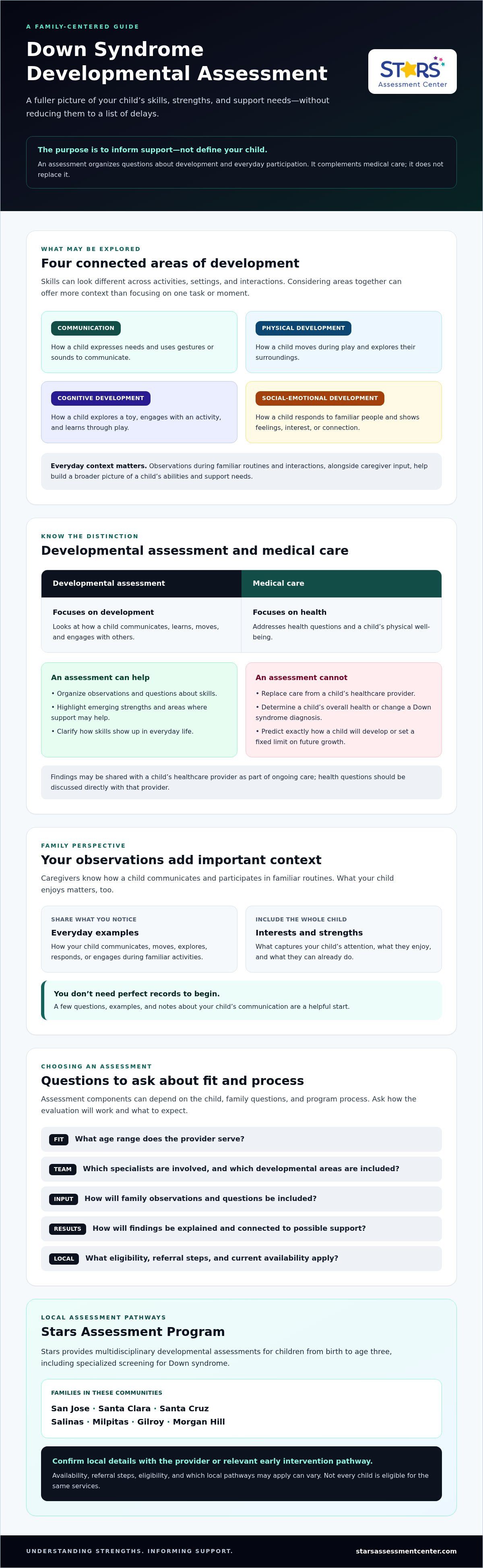
An assessment may look at communication, cognition, physical development, and social-emotional skills. In practical terms, the team may consider how a child expresses needs, explores toys, moves during play, responds to familiar people, or shows feelings and interest. These areas overlap in daily life, so looking at them together can provide more context than focusing on one task.
The team may consider how skills appear during familiar activities and interactions, alongside what caregivers share about home routines. Your child’s comfort, interests, and ways of communicating matter. Children develop as individuals, and milestones are not a pass-or-fail test. An assessment describes what a child can do and where added support may help at this time. It doesn’t define the child or set a fixed limit on future growth. General information about Down syndrome can provide background, but it can’t explain an individual child’s developmental profile.
How is developmental assessment different from medical care?
Medical providers address health questions, including concerns about a child’s physical well-being. A developmental assessment focuses on skills and support needs, such as how a child communicates, learns, moves, and engages with others. The two perspectives can complement each other, but they serve different purposes.
An assessment doesn’t change a Down syndrome diagnosis, determine a child’s overall health, or replace care from the child’s healthcare provider. It also can’t predict exactly how a child will develop. Families can share the assessment findings with their child’s provider as part of ongoing care and discuss health questions directly with that provider.
The goal is understanding, not labeling. A careful assessment can help families turn observations into clearer questions and possible next steps, while keeping the child’s individuality and strengths in view.
How a Multidisciplinary Assessment Builds a Fuller Picture of Your Child
A child’s skills are connected. How they communicate, move, explore, and engage with others can vary by activity, setting, and who is with them. A multidisciplinary assessment considers several areas together rather than drawing conclusions from one isolated skill. Looking across developmental areas can help families see how a child’s strengths and support needs fit together in everyday life.
At Stars, a Down syndrome developmental assessment may consider communication, physical, cognitive, and social-emotional development. The specific assessment components can depend on the child, the family’s questions, and the program’s process. Families can ask the team which areas will be included and how the findings will be explained.
What do specialists look at during the evaluation?
Depending on the assessment, examples might include how a child uses gestures or sounds to communicate, moves while playing, explores a toy, stays interested in an activity, or responds to another person. These observations help build a broader picture of how skills show up during interaction and play. They’re examples, not a diagnostic checklist, and they can’t predict a child’s future abilities.
A multidisciplinary team brings different perspectives to these observations. Rather than treating one behavior as the whole story, the assessment considers how developmental areas may relate and where a child’s abilities are already supporting participation.
How do family observations contribute?
You know your child in the rhythm of daily life. Share what they enjoy, how they communicate needs, which routines feel easy or challenging, and the strengths you notice. A skill that doesn’t appear during an assessment activity may be clear at home. You can also explain what helps your child feel comfortable and engaged. That context helps the team interpret what it observes.
You don’t need clinical language or a perfect record. Specific examples are useful: how your child asks for a favorite toy, reacts to a familiar song, or joins a family activity. For more context about how assessment may connect with support, read this Down syndrome early intervention assessment guide. The National Down Syndrome Society also explains how Early intervention can support children’s development.
Stars provides multidisciplinary assessments for infants and toddlers under age three. Visit Stars assessment information to learn more, and confirm the process, current availability, and referral steps directly with the program.
Choosing an Assessment: Questions to Ask About Fit, Process, and Local Support
Choosing an assessment is less about finding a single “best” option and more about checking whether its age range, expertise, and process match your family’s questions. A Down syndrome developmental assessment may offer useful information about skills and support needs, but it doesn’t guarantee eligibility for early intervention or any particular service.
It also helps to clarify which kind of service you’re considering. A screening is generally a brief check that may suggest whether further evaluation could be helpful. A developmental assessment takes a more structured look at skills and needs. A medical evaluation addresses health questions, while ongoing therapy focuses on providing support over time. These services can complement one another, but they aren’t interchangeable.
What should families ask an assessment provider?
Use these questions to compare options and understand what to expect. Ask the provider directly, and request clarification if an answer is unclear.
| What to compare | Questions to ask |
|---|---|
| Age served | What ages does the program assess, and is my child within that range? |
| Disciplines and areas | Who may participate, and which developmental areas are considered? |
| Family input | How can caregivers share observations, and can we describe what we see at home? |
| Explanation and next steps | How will findings be explained? Is guidance about possible next steps available? |
| Access and accommodations | What language access, accessibility options, or other accommodations can we ask about? |
Ask whether the assessment includes a written summary, how you’ll receive the findings, and whom to contact with follow-up questions. It may also help to ask how family observations are included in the summary. These details make it easier to understand how the process fits your family.
What local pathways may follow an assessment?
In California, families may want to ask about Early Start or a Regional Center pathway. Which process applies can depend on the child’s circumstances and where the family lives. Assessment findings may inform conversations with the relevant agency, but the assessment provider can’t promise eligibility or a specific service. Confirm current procedures, referral steps, and which agency has jurisdiction directly with the appropriate local agency.
For related background, see the California early intervention assessment guide. If you’re considering Stars from San Jose, Santa Clara, Santa Cruz, Salinas, Milpitas, Gilroy, or Morgan Hill, confirm the program’s current availability, eligibility considerations, and referral process directly with its team.
How to Prepare for Your Child’s Down Syndrome Developmental Assessment
Preparing for a Down syndrome developmental assessment doesn’t mean assembling a perfect file or rehearsing how your child should respond. Your everyday knowledge is valuable, and a few notes can help you share it clearly. If you’re unsure what to bring, ask the provider ahead of time which records or materials would be useful.
What information can help the assessment team?
Share relevant health or developmental information and previous evaluation summaries if you have them. You can also describe your child in your own words: favorite activities, everyday routines, strengths you notice, and questions or concerns you’d like the team to understand. There’s no need to create a formal report.
Examples can make your observations easier to discuss. You might note how your child communicates a choice, what helps them join a familiar activity, or which play routines hold their interest. Include the communication methods your child uses, such as gestures, sounds, words, or a communication aid. These details offer context that may not be visible during an appointment.
How can you help your child feel comfortable?
Ask in advance about the appointment’s timing, whether breaks are possible, and how caregivers can participate. If appropriate and permitted, bring a familiar comfort item or communication support. A preferred toy or book may help your child settle into an unfamiliar setting, but check with the provider about what’s suitable to bring.
Children may respond differently in a new place or with unfamiliar people. A quiet, tired, or hesitant moment doesn’t capture everything your child can do. Share what’s typical at home and what helps your child feel at ease. Keep following your child’s usual medical care. Preparing for an assessment isn’t a reason to change or delay it.
A simple preparation plan:
- 1. Write down the questions you want answered.
- 2. Note a few everyday examples of your child’s skills, interests, and communication.
- 3. Gather relevant records you already have, and ask the provider what else may help.
- 4. Check about timing, breaks, participation, and any accommodations your family may need.
That’s enough to get started. You don’t need to predict how your child will behave or collect every document before asking for guidance. For details about Stars’ assessment process and what to bring, contact Stars about assessment preparation.
Finding Down Syndrome Developmental Assessment Support Through Stars
For families seeking a local resource, Stars Assessment Program provides multidisciplinary developmental assessments for infants and toddlers under age three, including specialized screening for Down syndrome. The team considers areas such as cognitive, physical, communication, and social-emotional development. A Down syndrome developmental assessment can help families better understand a child’s developmental profile and explore possible next steps. It remains separate from medical care and does not determine eligibility for services.
What families can expect when exploring Stars
Stars’ assessments are intended to help identify developmental needs and connect families with information about early intervention resources. The assessment components and the appointment, report, and follow-up process can depend on the program’s procedures, so ask the team what applies to your child before getting started. For more background on screening and development, read this early childhood developmental screening guide.
Stars serves families in communities that include San Jose, Santa Clara, Santa Cruz, Salinas, Milpitas, Gilroy, and Morgan Hill. Availability and referral steps can vary, so ask Stars whether the program currently serves your location and whether the assessment may fit your child.
How to take the next step in Santa Clara County and nearby communities
Starting a conversation doesn’t require having every answer. Sharing your child’s age, where your family lives, and the developmental questions on your mind can help the team explain what options may be relevant. You can also ask:
- Is this assessment appropriate for my child’s age and needs?
- What referral information or records should we provide?
- What assessment areas may be considered, and how will findings be shared?
- Are services currently available for families in our community?
These questions can clarify the process without assuming a particular outcome. If your family is in San Jose, Santa Clara, Santa Cruz, Salinas, Milpitas, Gilroy, Morgan Hill, or elsewhere in Santa Clara County, contact Stars to discuss an assessment and confirm service fit, referral steps, and current availability. Explain what you’re hoping to learn and ask the team what to expect next.
Take the Next Step With Clarity and Support
A Down syndrome developmental assessment can help turn questions about communication, movement, learning, or social-emotional growth into a clearer understanding of your child’s strengths and support needs. It complements, but doesn’t replace, medical care, and it isn’t a measure of your child’s potential. Sharing everyday observations and asking how the process works can help you feel more prepared.
Stars provides multidisciplinary assessments for infants and toddlers under age three, including specialized Down syndrome screening. The program serves families in communities including San Jose, Santa Clara, Santa Cruz, Salinas, Milpitas, Gilroy, and Morgan Hill. Service fit, referral steps, and current availability can vary, so confirm those details directly with the team.
If you’re ready to explore whether an assessment may fit your family’s questions, contact Stars to discuss your child’s assessment needs. One conversation can help you identify what to ask and where to look next. Your child’s strengths and individuality remain at the heart of every step.
Frequently Asked Questions
What is a developmental assessment for a child with Down syndrome?
A developmental assessment is a structured look at a child’s skills, strengths, and possible support needs. A multidisciplinary team may consider communication, cognitive, physical, and social-emotional development, using observations and caregiver input to understand how skills appear in everyday life. A Down syndrome developmental assessment can help organize questions and inform discussions about next steps. It isn’t a pass-or-fail test or a prediction of what a child will achieve.
Does a developmental assessment diagnose Down syndrome?
No. A developmental assessment does not diagnose Down syndrome or replace medical care. It focuses on a child’s developmental skills and support needs; medical providers address health questions and diagnosis. Stars offers specialized screening for Down syndrome as part of its assessment offerings, but families should speak with a healthcare provider about diagnosis and medical concerns. Assessment findings can be shared with the child’s healthcare provider to support coordinated conversations about care.
What happens during a Down syndrome developmental assessment?
The assessment process can vary based on the child, family questions, and program procedures. A team may consider how the child communicates, moves, explores or plays, pays attention, and interacts with others. Caregivers can share examples from home, including routines, interests, and ways the child expresses needs. These observations provide context, but a child’s behavior during one appointment doesn’t capture every ability or determine future development.
Can my child receive an assessment before age three?
Yes. Stars Assessment Program provides multidisciplinary developmental assessments for infants and toddlers under age three, including specialized Down syndrome screening. The team assesses areas such as cognitive, physical, communication, and social-emotional development. If you’re considering an assessment, ask whether it fits your child’s age and needs, and confirm current service availability and referral steps directly with Stars. An assessment does not guarantee eligibility for early intervention or any specific service.
How do I prepare my child for a developmental evaluation?
Start with a few notes, not a perfect file. Write down your questions and examples of your child’s everyday routines, strengths, interests, and communication methods. Bring relevant health or developmental records and previous evaluation information if available, and ask the provider what materials are useful. You can also ask about timing, breaks, and whether familiar comfort items or communication supports are permitted. Your child’s response on the day is only one snapshot.
Can an assessment help my family access early intervention in California?
An assessment may help clarify developmental needs and inform conversations with California Early Start or a Regional Center, but it does not guarantee eligibility or services. The appropriate pathway and procedures can depend on your child’s circumstances and where you live. Confirm referral steps and jurisdiction directly with the relevant agency. Stars can help families access early intervention resources, but families should verify what options apply to them and what happens after an assessment.
Where can families get a Down syndrome developmental assessment near San Jose?
Stars Assessment Program provides multidisciplinary assessments for infants and toddlers under age three and offers specialized Down syndrome screening. Its stated service communities include San Jose, Santa Clara, Santa Cruz, Salinas, Milpitas, Gilroy, and Morgan Hill. Availability and referral processes may vary, so contact Stars to ask whether an assessment is appropriate for your child, what information to provide, and whether the program currently serves your location.


