
What if a screening result raises questions but doesn’t give you a clear answer? If you’ve noticed differences in how your child communicates, plays, or connects with others, it’s understandable to wonder whether they need professional attention. Early autism screening under three can be a helpful first step, but it isn’t a diagnosis or a prediction of your child’s future.
You deserve clear information without feeling judged or rushed. This guide explains what screening can and can’t tell you, how it differs from a developmental assessment and diagnosis, and what to expect during the process. You’ll also learn what observations to share, which questions to ask, and how to explore local support.
For families in Santa Clara County and nearby communities, Stars Assessment Program offers multidisciplinary developmental assessments for infants and toddlers under three, including specialized autism screening. A broader look at development can help clarify a child’s strengths and support needs. Understanding the process can make it easier to ask questions and consider next steps at your own pace.
Key Takeaways
- Early autism screening under three can help identify whether closer developmental follow-up may be useful, but it does not confirm or rule out autism.
- Learn what to expect as you share concerns, discuss your child’s development, and review possible next steps.
- Understand how screening, a broader developmental assessment, and diagnosis serve different purposes.
- Prepare for a conversation with a short record of your observations, examples, and questions.
- Explore Stars Assessment Program as a local option for specialized autism screening and multidisciplinary developmental assessment for children under three.
What Does Early Autism Screening Under Three Actually Tell You?
Noticing that your child communicates, plays, or responds differently from other children can raise questions. Those observations don’t mean you’ve caused a developmental difference, and they don’t tell you on their own what your child needs. Early autism screening under three offers a structured way to consider whether closer developmental follow-up may be helpful.
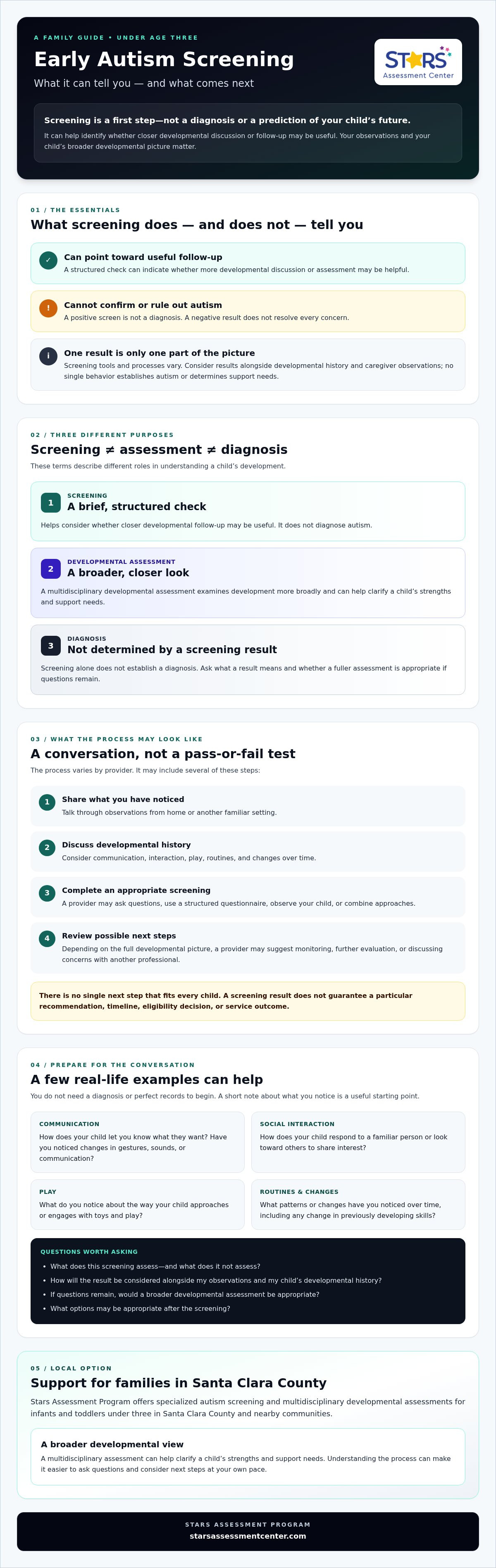
Screening is a brief, structured check that can indicate whether more developmental discussion or assessment may be useful. It does not diagnose autism or predict a child’s future. It’s one step toward understanding a child’s development, not a verdict. For a general overview of autism spectrum disorder, including characteristics and diagnosis, readers can explore this background resource.
Why families may consider screening before age three
Questions may come up during a routine developmental check-in or through a caregiver’s everyday observations. You might notice that your child rarely looks toward others to share interest, uses fewer gestures or sounds to communicate, or approaches play in a way that differs from what you expected. A change in previously developing skills may also prompt a conversation. No single behavior establishes autism or determines what support a child may need.
What screening can and cannot establish
A screening result helps guide discussion. It may suggest that additional assessment would be useful, but a positive screen doesn’t confirm autism. A negative result doesn’t resolve every concern, either. Screening tools and processes vary by provider, so results should be considered alongside a child’s developmental history and caregiver observations.
That context matters because a brief check can’t capture every aspect of a young child’s communication, interaction, play, or development. If questions remain, ask what the result means and whether a fuller assessment is appropriate. A broader evaluation can look at development in more depth and help clarify strengths and areas where support may be useful. For a closer comparison, read autism screening versus evaluation for toddlers.
How Autism Screening for Children Under Three Usually Works
Knowing the usual steps can make a screening conversation feel more manageable. The process varies by provider, but commonly involves sharing what you’ve noticed, discussing your child’s developmental history, completing an appropriate screening, and reviewing possible next steps. The Centers for Disease Control and Prevention explains how developmental monitoring and screening differ from diagnosis.
Screening tools and formats aren’t the same everywhere. A provider may ask questions, use a structured questionnaire, observe your child, or combine approaches. Any observation is one part of understanding development, not a pass-or-fail test. The aim is to gather useful information and consider whether follow-up could help.
What information may be discussed during screening
You may be asked about communication, social interaction, play, routines, and changes you’ve noticed over time. Specific examples can help, such as how your child lets you know what they want, responds to a familiar person, or plays with toys. Share differences you’ve noticed at home or in another familiar setting. You don’t need a diagnosis or perfect records to begin. Your observations are a useful starting point.
What may happen after a screening
After reviewing the information, a provider may suggest monitoring development, arranging further evaluation, or discussing your concerns with another professional. There’s no single next step that fits every child, and a screening result doesn’t guarantee a particular recommendation, timeline, eligibility decision, or service outcome.
The next step depends on your child’s full developmental picture, not on one screening result alone.
Screening follow-up is not the same as a comprehensive multidisciplinary developmental assessment. Screening helps identify whether a closer look may be useful. A multidisciplinary assessment examines development more broadly, which can provide a fuller understanding of a child’s strengths and support needs. If you’re considering early autism screening under three, ask what the screening does and doesn’t assess, how the result will be interpreted alongside your observations, and what options may be appropriate afterward.
For families looking for a local option, Stars developmental assessments include specialized autism screening and multidisciplinary evaluation for infants and toddlers under three. Ask the program about its current process and which next steps may fit your family’s situation.
Screening, Developmental Assessment, and Diagnosis: What Is the Difference?
These terms describe different steps. Knowing which one is being discussed can help you understand what a result means. Seeking screening is an information-gathering step, not a way of labeling your child. It can help clarify whether more discussion or assessment may be useful.
| Process | Purpose | Typical scope | Possible next step |
|---|---|---|---|
| Screening | Identify whether a closer look may be helpful. | A brief, structured check using caregiver information and, depending on the provider, other screening methods. | Discuss the result, monitor development, or consider further assessment. |
| Developmental assessment | Build a broader picture of a child’s development, strengths, and support needs. | May consider communication, cognitive, physical, and social-emotional development. The areas and methods used can vary. | Review findings and discuss appropriate supports or follow-up. |
| Diagnostic evaluation | Determine whether a clinical diagnosis is appropriate. | A separate clinical process conducted by qualified professionals; the scope depends on the evaluation. | Discuss the results and any recommended follow-up with the evaluating professional. |
A positive screen does not confirm autism, and a negative screen does not resolve every concern. The Centers for Disease Control and Prevention explains developmental and behavioral screening, including how screening differs from developmental monitoring and diagnosis. For early autism screening under three, consider the result alongside caregiver observations and the child’s developmental history.
How screening differs from a comprehensive developmental assessment
Screening is an initial check; an assessment takes a broader look. Stars Assessment Program provides multidisciplinary developmental assessments for infants and toddlers under three, considering areas such as cognitive, physical, communication, and social-emotional development. The specific areas explored may vary by child. Read more about multidisciplinary developmental assessment for additional context.
When a diagnostic evaluation may be discussed
If questions remain after screening or assessment, a provider may discuss whether a separate diagnostic evaluation is appropriate. Ask who conducts each step, what the process can establish, and how the findings will be explained. Clear answers can help you choose what to do next without treating a screening result as a final conclusion.
How Families in Santa Clara County Can Prepare and Find Next Steps
A little preparation can help you explain what you’ve noticed and get clearer answers, but you don’t need a complete record of your child’s development to start a conversation. For early autism screening under three, a few everyday examples and questions can give a provider useful context.
A short preparation checklist
- Your concerns: Write down what prompted you to seek screening or assessment.
- Specific examples: Note what you observe in communication, social interaction, play, or routines, and where it happens.
- Developmental history: Share what you remember about your child’s development and any changes over time.
- Prior evaluations: Bring reports or records if you have them. If you don’t, you can still ask for guidance.
- Family questions: Jot down what you want to understand about the process and possible next steps.
Questions to bring to a screening or assessment
Ask what the screening covers, who reviews the results, and whether further evaluation may be recommended. You can also ask how findings will be shared and whom to contact if questions come up afterward. If you’d like information in a particular language, ask whether that option is available. Language access and other program details can vary, so confirm them directly.
Finding support in the local service area
Families in Santa Clara County may want to ask providers about California’s Early Start program and the relevant Regional Center as possible avenues for developmental support. Processes, eligibility, and referral requirements can change or depend on a family’s circumstances. Verify current details with the program or provider rather than assuming a particular pathway applies.
Stars Assessment Program serves infants and toddlers under three in Santa Clara County and surrounding communities, including San Jose, Santa Clara, Santa Cruz, Salinas, Milpitas, Gilroy, and Morgan Hill. Service-area coverage doesn’t necessarily mean every location follows the same referral pathway or has identical availability. Confirm the program’s current service area, referral requirements, eligibility, and assessment availability directly. For more context on child development, see this guide to early childhood developmental screening.
If you’re exploring assessment options, contact Stars Assessment Program to ask about developmental assessment and confirm current process details for your family.
How Stars Assessment Program Supports Families Seeking Early Autism Screening
After learning what screening can and can’t tell you, you may want to understand which local options can help you explore your child’s development. Stars Assessment Program serves infants and toddlers under three in Santa Clara County and surrounding communities. Its services include specialized autism screening and multidisciplinary developmental assessment.
A multidisciplinary perspective can help families consider more than one area of development at a time. Stars’ evaluations may look at cognitive, physical, communication, and social-emotional development. The specific assessment process can vary, so ask which areas are relevant to your child and how the team will use the information you share. Screening itself does not establish a diagnosis or guarantee a particular outcome.
What families can ask Stars before starting
It’s reasonable to ask questions before deciding whether to move forward. For example, you can ask:
- What does the screening or assessment include, and how will caregiver observations be considered?
- Who reviews the information, and how will findings be shared with our family?
- What referral requirements or eligibility criteria should we know about?
- Which languages may be available, and what payment or insurance details should we confirm?
- Is assessment availability current for our family’s location and needs?
Confirm these details directly with the program, since referral steps, eligibility, language options, payment information, and appointment availability may vary. Asking doesn’t commit you to a particular path. It helps you decide what information you need and whether the service seems like a fit.
A supportive next step for concerned caregivers
Seeking information is a constructive step, whatever the screening or assessment eventually finds. You don’t need to be certain about what a behavior means before reaching out. Sharing your questions can help clarify which process may be appropriate and what to expect.
If you’re considering early autism screening under three, local families can contact Stars to discuss their concerns, ask about assessment next steps, and confirm current process details. A conversation can help you understand whether the program may fit your family’s needs, without promising a diagnosis or a specific service outcome.
Contact Stars Assessment Program to discuss assessment next steps.
Take the Next Step with Confidence
Questions about your child’s development deserve thoughtful attention, not rushed conclusions. Early autism screening under three can help you decide whether further discussion or assessment may be useful, but screening alone doesn’t diagnose autism or define your child’s future. Sharing your observations and asking what each step can tell you helps keep the process focused on your child’s individual needs.
For families in Santa Clara County and nearby communities, Stars Assessment Program offers specialized autism screening for infants and toddlers under three, along with multidisciplinary developmental assessment. The team can consider several areas of development, including cognitive, physical, communication, and social-emotional skills. Ask directly what an assessment includes, how referrals work, and whether assessments are currently available.
If you’re ready to explore your options, contact Stars Assessment Program to discuss your child’s assessment needs. Reaching out for information is a caring, constructive step, and you can move forward one question at a time.
Frequently Asked Questions
Can a child under three be screened for autism?
Yes, families can discuss autism screening for a child under three with an appropriate healthcare or developmental provider. Early autism screening under three can help identify whether closer follow-up may be useful, but it doesn’t diagnose autism. Ask what the screening covers, how the provider will explain the result, and whether a broader developmental assessment or another next step may be appropriate for your child.
Does an autism screening confirm that my toddler has autism?
No, an autism screening does not confirm a diagnosis. It can indicate that further discussion or evaluation may be useful, but the result needs to be considered alongside your child’s developmental history and your observations. Ask the provider to explain the screening’s limits and what options are available if concerns remain. A result that doesn’t indicate concern doesn’t automatically answer every question about development.
What are early signs that may lead parents to ask about autism screening?
Families may have questions about a child’s social communication, interaction, play, or patterns of development. For example, a caregiver may wonder how a child shares interest, responds to others, or uses play to communicate. These observations alone don’t establish autism or determine a child’s needs. If you’re concerned, describe specific examples to a provider and ask whether screening or a broader developmental assessment could offer helpful context.
What happens after a toddler’s autism screening?
The provider should explain the result and discuss possible next steps. Depending on the screening and your child’s overall developmental picture, these may include continued developmental discussion, further assessment, or a referral to another professional. Screening alone doesn’t establish a diagnosis or determine eligibility for services. Before leaving, ask who will follow up, how findings will be shared, and whom you can contact if questions come up later.
How is autism screening different from a developmental assessment?
Screening is an initial check to help identify whether closer follow-up may be useful. A developmental assessment takes a broader look at areas such as communication, cognitive, physical, and social-emotional development, though its scope can vary by child and provider. Neither term automatically means a diagnostic evaluation. Ask what the appointment includes, who reviews the information, and what the results can and can’t tell you.
Where can families in Santa Clara County ask about autism screening under three?
Families can raise developmental concerns with their child’s healthcare provider and ask about local assessment options. Stars Assessment Program serves infants and toddlers under three in Santa Clara County and nearby communities, including San Jose, Santa Clara, Santa Cruz, Salinas, Milpitas, Gilroy, and Morgan Hill. Contact providers directly to confirm current referral requirements, eligibility, service-area coverage, and assessment availability, as these details may vary.
Should I seek screening if my toddler’s initial screen does not show a concern?
If you still have questions about your child’s development, bring them to a qualified provider even after a screen that doesn’t indicate concern. Screening is one tool, not a complete account of development. Share the observations that prompted your concern and ask how to monitor your child’s progress or whether a broader assessment may help. You can ask follow-up questions and seek clarification about what the result means.


