
What if an assessment doesn’t give your child a label, but helps you understand what support may fit? If you’ve noticed differences in how your child communicates, moves, learns, or connects with others, it’s natural to wonder whether an evaluation is the right next step. An early intervention assessment California families pursue can offer useful information, but it doesn’t automatically determine eligibility for services.
This guide explains what an assessment can and can’t clarify, and how California’s Early Start pathway works for infants and toddlers from birth to 36 months. You’ll learn how screening, evaluation, and eligibility differ, what observations and records may be useful, and whom to contact about next steps. A formal diagnosis isn’t required to begin the Early Start process, and families can make a referral without a doctor’s referral.
Seeking answers doesn’t have to mean facing the process alone. For families in Santa Clara County and nearby communities, including San Jose, Santa Clara, Santa Cruz, Salinas, Milpitas, Gilroy, and Morgan Hill, Stars Assessment Program offers multidisciplinary developmental assessments for children under three. This guide will help you approach the next step with more clarity and a better sense of what to expect.
Key Takeaways
- An early intervention assessment California families seek can organize questions about a child’s development, but it doesn’t automatically establish a diagnosis or qualify a child for Early Start.
- Screening, developmental assessment, diagnosis, and program eligibility have different purposes. Knowing which step you’re discussing can help you ask clearer questions.
- Examples from everyday routines, play, communication, movement, and interactions can help describe your child’s strengths and needs. You don’t need perfect records to prepare.
- California’s Early Start pathway involves sharing concerns, asking about referral, completing an appropriate evaluation, and discussing next steps with the relevant program.
- Stars Assessment Program offers multidisciplinary developmental assessments for children under three, considering areas such as cognitive, physical, communication, and social-emotional development.
What an Early Intervention Assessment in California Can Tell Your Family
Questions about your child’s communication, movement, play, or connection with others deserve thoughtful answers. Asking for information doesn’t presume a diagnosis, and noticing a difference doesn’t mean you’ve reached a conclusion. An early intervention assessment California families consider is one way to better understand a child’s development and decide what to ask next.
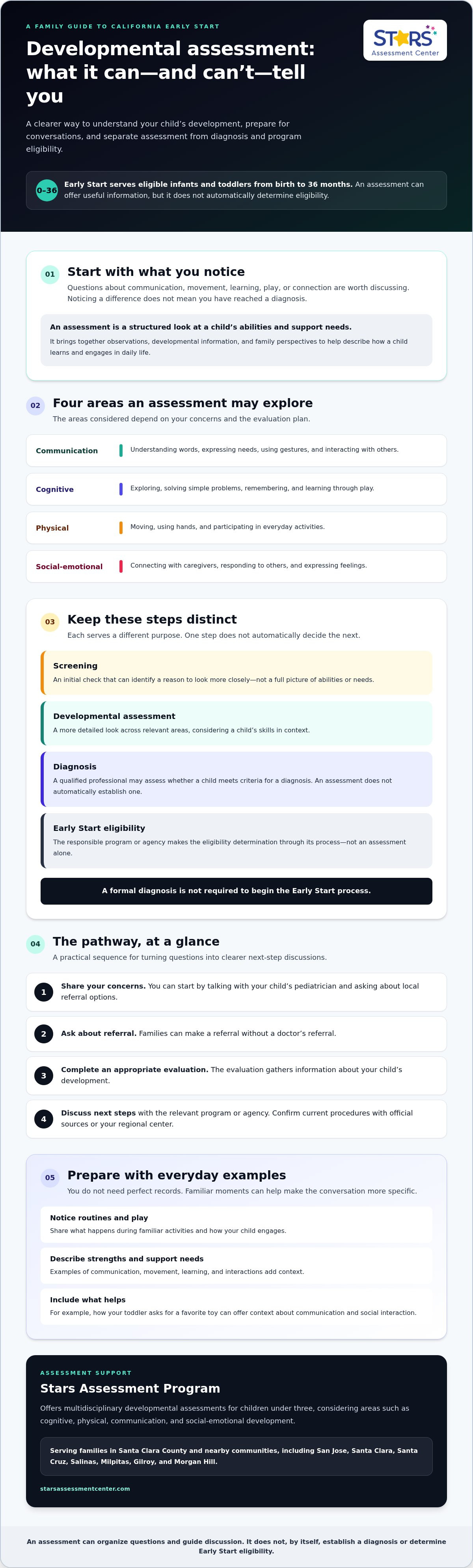
An early intervention assessment is a structured look at a child’s abilities and support needs, informed by observations, developmental information, and family perspectives. It can help describe how a child is learning and engaging in daily life. It doesn’t, by itself, diagnose a condition or guarantee eligibility for a program. California Early Start is the state’s early intervention program for eligible infants and toddlers. Early Start is distinct from Early Head Start, which is described on the linked Early Head Start page.
What areas of development may an assessment explore?
The areas considered depend on your concerns and the evaluation plan. A developmental assessment may look at:
- Communication: how a child understands words, expresses needs, uses gestures, or interacts with others.
- Cognitive development: how a child explores, solves simple problems, remembers, and learns through play.
- Physical development: how a child moves, uses their hands, and participates in everyday activities.
- Social-emotional development: how a child connects with caregivers, responds to others, and expresses feelings.
A multidisciplinary team can bring together perspectives from different areas of development. For example, a parent’s observations about how a toddler asks for a favorite toy may offer context about both communication and social interaction. Sharing what happens during familiar routines, including what helps the child engage, can make the discussion more specific than relying on a checklist alone.
What is the difference between screening and assessment?
Screening is an initial check. It can identify a reason to look more closely, but it doesn’t provide a full picture of a child’s abilities or needs. Assessment is more detailed. It gathers information across relevant developmental areas and considers a child’s skills in context. Neither screening nor assessment automatically establishes a diagnosis or decides Early Start eligibility.
Diagnosis and program eligibility are separate questions, too. A qualified professional may assess whether a child meets criteria for a diagnosis, while the appropriate California program or agency determines eligibility for its services. Keeping these steps distinct can make the process clearer: an assessment provides information that can guide discussions about possible next steps.
How California Early Start Assessment and Evaluation Fit Together
California Early Start is the state’s early intervention program for eligible infants and toddlers from birth to 36 months. If you’re wondering whether an early intervention assessment California families pursue connects to Early Start, separate the developmental evaluation from the program’s eligibility decision. An assessment gathers information about your child; it doesn’t determine eligibility on its own.
An assessment describes a child’s development; a formal eligibility determination is made through the responsible program’s process. For current information about the program and its procedures, consult the California Department of Developmental Services’ California Early Start program page. Requirements and steps can change, so confirm details with official sources or the regional center serving your area.
Who may families contact when developmental concerns arise?
You can start by sharing specific concerns with your child’s pediatrician and asking about local referral options. You may also contact the regional center serving your community to ask how its current Early Start referral and evaluation process works. According to California’s Early Start information, a parent or another person can make a referral, and a doctor’s referral isn’t required. Confirm the latest guidance directly with the state or regional center.
For the first conversation, describe what you’ve noticed, when it tends to happen, and what you hope an evaluation can clarify. For example, you might explain that your child communicates differently during play than at mealtimes. You don’t need to be certain that something is wrong before asking for guidance.
What happens after an evaluation is completed?
An evaluation can put your child’s strengths and areas needing support into clearer terms. Its findings may help you discuss what support could be appropriate and which steps to consider. What happens next depends on the results and the process of the agency responsible for reviewing eligibility. An assessment from a separate provider can inform your understanding, but it doesn’t replace the official program evaluation or guarantee services.
A practical sequence is:
- Share your concerns with your pediatrician or the appropriate local contact.
- Ask about referral and confirm which regional center serves your community.
- Complete the appropriate evaluation through the process explained by the responsible program.
- Discuss the findings and next steps, including how eligibility is reviewed and whom to contact with follow-up questions.
If you’re also looking for developmental information for a child under three, you can review Stars Assessment Program’s developmental assessment information. Stars is an assessment resource, not a state agency, and its assessment does not determine Early Start eligibility.
Assessment, Diagnosis, and Early Start Eligibility Are Not the Same
An assessment can help you understand your child’s development, but it doesn’t automatically mean your child has a diagnosis or will receive services. These steps answer different questions, and separating them can make conversations with providers and programs easier. You don’t need to know which label applies before asking for guidance.
Here’s a simple comparison. The exact process can depend on the purpose of the evaluation and the organization involved.
| Step | What it can help clarify | What it doesn’t decide by itself |
|---|---|---|
| Screening | Whether a closer look at development may be helpful | A diagnosis or eligibility for services |
| Developmental assessment | A more detailed picture of abilities, strengths, and areas where support may be needed | Automatic qualification for a program |
| Diagnosis | Whether the available evidence supports a particular developmental or medical condition | Eligibility for every service or program |
| Program eligibility | Whether a child meets the responsible program’s current criteria | A diagnosis in every case |
This distinction matters for families considering an early intervention assessment California resource. A developmental evaluation can contribute useful information, but the agency or program responsible for Early Start eligibility applies its own current rules. Check the California Department of Developmental Services’ California Early Start Program guidance or ask the relevant regional center how eligibility is determined. Don’t rely on an outside assessment alone to confirm a program decision.
Can an assessment diagnose a developmental condition?
Sometimes an evaluation is designed to answer a diagnostic question, but not every developmental assessment has that scope. Its conclusions depend on who conducts it, the purpose of the evaluation, and the information available. An assessment may describe developmental patterns or indicate that further evaluation could be useful without establishing a medical diagnosis. Ask what the evaluation is intended to assess and what its findings can support.
Does an assessment automatically qualify a child for services?
No. Assessment findings and formal eligibility decisions are related, but they’re separate. Findings may help explain your concerns and inform discussions with the program, while the responsible California agency makes its determination under current criteria. If the outcome isn’t clear, ask which criteria were considered, what the decision means, and whether there are additional steps or resources to explore. It’s appropriate to ask, even if you’re still unsure how to describe your child’s needs.
What California Families Can Prepare Before a Developmental Assessment
You don’t need a perfect timeline, a stack of reports, or the right terminology to prepare. Everyday observations are valuable. A few brief notes can help you describe what your child does comfortably, what seems harder, and what kind of support makes a difference.
Before an early intervention assessment California families arrange, consider jotting down examples from daily life. Use this checklist as a guide, not a requirement:
- Routines: Note what happens during meals, dressing, bedtime, or time with other children.
- Communication: Describe how your child expresses needs, responds to words, uses gestures, or connects with others.
- Play and movement: Record favorite activities, how your child explores toys, and movements or tasks that seem easy or challenging.
- Support and strengths: Share what your child enjoys, does independently, and manages with help.
- Changes over time: Write down skills or behaviors you’ve noticed developing or changing, and any questions you want answered.
What observations and questions are useful to bring?
Specific examples can be more helpful than general impressions. For instance, you might note that your child points to request a snack but doesn’t yet use words for it, or that they climb confidently at home but hesitate in a busy play area. Include what support helps and where the behavior occurs. You can also share the languages used at home and any cultural or family context that may help evaluators understand your child’s communication and routines.
Bring relevant reports, screening results, or questions if you have them, but don’t treat them as prerequisites. If you’re unsure what to prepare, ask the evaluator or program contact what would be useful for the specific assessment.
How can families navigate local California next steps?
Stars Assessment Program serves families in Santa Clara County and nearby communities, including San Jose, Santa Clara, Santa Cruz, Salinas, Milpitas, Gilroy, and Morgan Hill. Confirm the current assessment process and whether your location is served directly with the provider. For Early Start, check which regional center serves your home address and ask that center about its current referral and evaluation procedures. Don’t assume a city’s regional center based on a neighboring community, since service areas can differ.
For an accessible overview of screening and developmental milestones, see Early Childhood Developmental Screening: A Parent’s Guide to Growth and Support. It can help you organize questions, while screening remains distinct from a full assessment or program eligibility decision.
If a multidisciplinary assessment feels like a helpful way to better understand your child’s development, explore Stars’ assessment services and confirm current details directly with the program.
How Stars Assessment Program Supports Families Seeking Early Intervention Assessment
If you’re looking for more insight into your child’s development, Stars Assessment Program offers multidisciplinary developmental assessments for children under three. For families exploring an early intervention assessment California resource, this type of evaluation brings together perspectives on a child’s strengths and areas where more understanding may be useful.
Stars serves families in Santa Clara County and nearby communities, including San Jose, Santa Clara, Santa Cruz, Salinas, Milpitas, Gilroy, and Morgan Hill. Contact the program directly to confirm whether your location is currently served and which assessment may fit your concerns. Stars is an assessment resource, not the agency that makes official California Early Start eligibility decisions. An assessment can inform your understanding, but it can’t guarantee a diagnosis, eligibility, or services.
What can families expect from a multidisciplinary evaluation?
Multidisciplinary specialists consider relevant areas of development, including cognitive, physical, communication, and social-emotional development. Stars also offers speech and language evaluations and specialized screenings for Autism and Down syndrome. These assessments can help families explore their concerns, but they don’t promise a particular finding or outcome. Your observations matter, too. Examples from play, daily routines, communication, and interactions can give context about what your child does and what support may help.
The right questions can help you understand whether an assessment aligns with what you’re seeking. You might ask which areas are considered, what the evaluation is designed to clarify, and how the findings will be shared. If Down syndrome is part of your family’s questions, Stars’ Down Syndrome Early Intervention: Santa Clara County Assessment Guide may offer relevant context as you consider next steps.
How can families take a next step with Stars?
Before reaching out, note your main concerns and ask which assessment may be appropriate. Confirm the current referral requirements, service area, and availability directly with Stars. These details are specific to the provider, so checking with the program is the best way to get current information. If you’re also pursuing California Early Start, contact the appropriate regional center separately to understand its process and eligibility decisions.
You don’t need to have every question answered before making an inquiry. A conversation can help you learn whether Stars’ assessments fit your family’s needs and what information to have ready. Explore assessment support from Stars.
Take a Clear, Supported Next Step
A developmental assessment can turn questions about your child’s growth into a clearer picture of their strengths and possible support needs. It isn’t the same as a diagnosis or an official Early Start eligibility decision, so confirm program requirements with the appropriate California agency or regional center. Your everyday observations and questions are a useful place to begin; you don’t need perfect records to ask for guidance.
For families seeking an early intervention assessment California resource, Stars Assessment Program offers multidisciplinary assessments for children under three. Evaluations consider cognitive, physical, communication, and social-emotional development. Stars serves Santa Clara County and nearby communities, including San Jose, Santa Clara, Santa Cruz, Salinas, Milpitas, Gilroy, and Morgan Hill. Confirm current service availability directly with the program.
To ask which assessment may fit your concerns, contact Stars Assessment Program. Share what you’ve noticed and ask about the next steps for your family.
Frequently Asked Questions
What is an early intervention assessment in California?
An early intervention assessment in California is a structured evaluation of an infant’s or toddler’s development, strengths, and possible support needs. Depending on the concerns and evaluation plan, it may consider communication, cognitive, physical, and social-emotional development. Family observations provide useful context. The assessment can guide questions and next steps, but it isn’t automatically a diagnosis or a decision about eligibility for California Early Start.
Is a developmental assessment the same as California Early Start eligibility?
No. A developmental assessment gathers information about a child’s abilities and needs, while the responsible Early Start program or agency makes the formal eligibility determination using its current criteria. An assessment may contribute useful information, but it doesn’t guarantee eligibility or services. Ask the regional center serving your area how eligibility is determined, and check the California Department of Developmental Services for current Early Start guidance.
Who can I contact if I am concerned about my child’s development in California?
You can discuss your observations with your child’s pediatrician and ask about local options, or contact the regional center serving your address to ask about Early Start referrals. California guidance allows parents and others to make a referral, and a doctor’s referral isn’t required. Families in San Jose, Santa Clara, Santa Cruz, Salinas, Milpitas, Gilroy, and Morgan Hill should confirm the appropriate regional center and current process for their location.
What happens during an early intervention assessment for an infant or toddler?
The evaluator gathers information about your child’s development and may consider areas such as communication, learning, movement, and social-emotional development. The specific areas and methods depend on the concerns and evaluation plan. You may be asked about your child’s routines, play, interactions, strengths, and what support helps. The purpose is to understand development more clearly, not to promise a diagnosis or program eligibility decision.
Can my child receive an assessment without a confirmed diagnosis?
Yes. A confirmed diagnosis isn’t always needed before you ask about an assessment or start discussing developmental concerns. You can describe what you’ve noticed and ask a pediatrician, regional center, or assessment provider about appropriate next steps. California Early Start eligibility is considered through the program’s process and may be based on developmental delay or an established risk condition, so ask official sources how current criteria apply to your child.
How should I prepare my toddler for a developmental assessment?
Keep preparation simple. Note examples of what your toddler does during play, meals, communication, movement, and interactions, including what they do independently and what help works. Write down questions, strengths, changes you’ve noticed, and the languages used at home. Bring relevant reports if you have them, but don’t worry about perfect records. Ask the evaluator beforehand whether there’s anything specific to bring or share.
Does an early intervention assessment guarantee services for my child?
No. An assessment can explain developmental strengths and possible needs, but it doesn’t guarantee a diagnosis, Early Start eligibility, or services. The responsible program reviews information and makes eligibility decisions under its current rules. If you’re unsure about the outcome, ask which criteria were considered and what next steps are available. Stars Assessment Program offers developmental assessments for children under three; confirm current service availability directly with the program.


