
What if a developmental screening raises questions instead of giving you a clear answer? That can feel unsettling when you’re trying to understand whether a difference in your child’s development needs follow-up. Developmental screening birth to three is a starting point: it can identify areas to look at more closely, but it can’t diagnose a condition.
If you’re unsure what a result means, you’re not alone. A brief screening and a full developmental evaluation serve different purposes, and knowing which step may help next isn’t always obvious. This guide explains what screening can and can’t tell you, when to discuss concerns with your child’s doctor, and how to explore a fuller assessment if questions remain.
You’ll also learn how a multidisciplinary assessment can consider more than one area of development, including communication, physical skills, and learning. For families in Santa Clara County and nearby communities, Stars Assessment Program offers developmental assessments for infants and toddlers under age three. The aim is to provide a clearer picture and a respectful path forward, not to assign a label based on one screening result.
Key Takeaways
- Developmental screening birth to three can flag areas that may benefit from closer attention, but it doesn’t diagnose a condition.
- Consider development across areas such as communication, movement, learning, and social-emotional growth rather than treating milestones as a pass-or-fail checklist.
- Understand how monitoring, screening, and a fuller evaluation differ so you can ask informed questions about next steps.
- Bring specific observations from everyday routines when you talk with your child’s doctor or another professional.
- A multidisciplinary assessment can consider several areas together, including cognitive, physical, communication, and social-emotional development.
What developmental screening birth to three can tell you
You may notice that your child communicates, moves, or responds to people differently from what you expected, yet feel unsure what those differences mean. Developmental screening birth to three offers a brief, structured way to identify whether closer follow-up may be helpful. It can bring questions into focus without deciding what they mean for your child’s future.
A screening is not a diagnosis. It offers a snapshot based on information gathered at that time, and a result that suggests follow-up doesn’t confirm a developmental condition. A result that doesn’t raise concerns also can’t guarantee that questions won’t arise later. If more information is needed, a comprehensive evaluation explores a child’s development in greater depth.
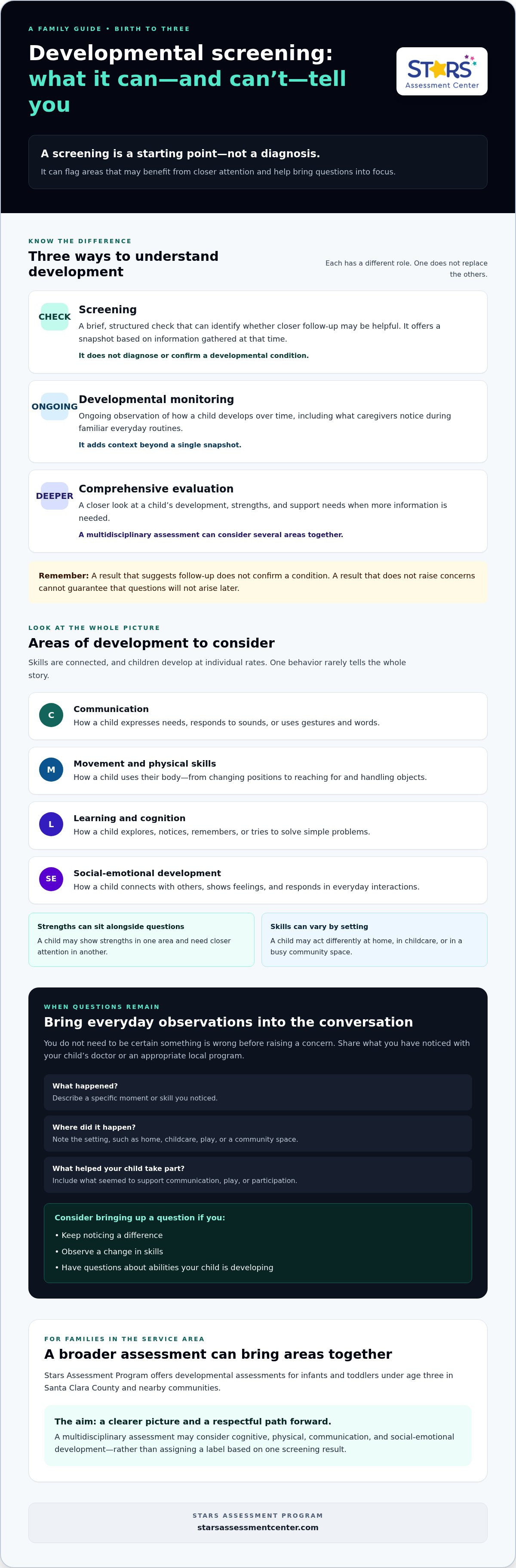
Screening is a brief check for possible concerns, monitoring is ongoing observation of development, and a comprehensive evaluation takes a closer look at a child’s strengths and support needs.
Which areas of early development can screening consider?
Screening may ask about skills across several parts of everyday life:
- Communication: How your child expresses needs, responds to sounds, or uses gestures and words.
- Movement: How your child uses their body, from changing positions to reaching for and handling objects.
- Learning: How your child explores, notices, remembers, or tries to solve simple problems.
- Social-emotional development: How your child connects with others, shows feelings, and responds during everyday interactions.
Children develop at individual rates, and one behavior rarely tells the whole story. A child may show a skill in one setting but not another, or have clear strengths in one area alongside questions in another. Screening is a starting point for a conversation, not a pass-or-fail milestone checklist. For a broader overview of how young children grow and develop, see Early childhood development.
When might a parent raise a developmental question?
Bring up a concern if you keep noticing a difference, observe a change in skills, or have questions about abilities your child is developing. You don’t need to be certain something is wrong before asking. Share specific examples from familiar routines, such as how your child lets you know they want something or responds during play. Your pediatrician or an appropriate local program can help you decide whether screening or further discussion may be useful.
For more context on screening and ways to support a child’s growth, read this early childhood developmental screening guide.
How development changes across the birth-to-three years
During the first three years, children build skills in connected ways, but there isn’t one path or pace that fits every child. Examples of development can help you notice what your child is learning. They aren’t diagnostic criteria or a pass-or-fail checklist. Screening is one part of the picture, and your observations during everyday routines can add useful context.
Development is best understood by looking across several areas together, because a child’s strengths and needs rarely fit into one skill or observation.
Communication, movement, and learning in everyday routines
Think about what you notice during ordinary moments. Your child might respond when you speak, use sounds or gestures to communicate a need, move toward a favorite toy, or explore how an object works. These examples can help you describe skills without deciding whether they’re “on track.” For background on how monitoring and screening differ, see the CDC’s Developmental Monitoring and Screening guidance.
Skills may look different from one setting to another. A child who communicates readily at home might be quieter in childcare, or explore more freely in a familiar room than in a busy community space. When sharing a concern, note what happened, where it happened, and what helped your child take part. These details can give a professional a fuller view than a single yes-or-no answer.
Social-emotional development and relationships
Caregivers may also notice how a child seeks connection, shares attention around an interesting object, or expresses feelings during play and transitions. These behaviors can vary with familiarity, comfort, fatigue, and the situation. One behavior by itself doesn’t establish a diagnosis or prove a particular condition. If you have autism-related questions, this guide to questions about autism offers related information.
As you observe, include what your child enjoys and does well, as well as moments that raise questions. For example, describe how they show excitement during a familiar game, then explain what communication looks like when they need help. This balanced picture supports a more useful conversation than focusing only on what feels difficult.
A few notes across home, childcare, or community routines can help you explain patterns and differences. If you’d like to learn about the assessment options Stars provides for children under three, visit Stars Assessment Program’s website.
Screening, developmental monitoring, and evaluation: what is the difference?
These terms describe different ways of understanding a child’s development. Knowing the difference can make a screening result feel less like a verdict and help you ask what, if anything, should happen next. With developmental screening birth to three, the goal is to identify whether closer follow-up may be useful, not to diagnose or label a child.
| Process | Purpose and breadth | Possible next step |
|---|---|---|
| Developmental monitoring | Ongoing observation of a child’s skills and progress during everyday life. Caregivers and professionals may share what they notice. | Continue observing, discuss questions, or consider screening if concerns arise. |
| Developmental screening | A brief, structured check that can show whether a child may benefit from closer attention in one or more areas. | Discuss the result and decide whether more information or a fuller assessment may help. |
| Developmental evaluation | A more in-depth look at a child’s development, often considering several skills and sources of information. | Review the findings with qualified professionals and discuss appropriate next steps for the child. |
The CDC’s Developmental Monitoring and Screening resource explains how ongoing observation differs from formal screening. Whatever the result, context matters. A child’s experiences, strengths, and behavior across settings can help professionals understand what a screening does and doesn’t show.
What happens when screening suggests follow-up?
A result indicating that follow-up may be useful is an invitation to talk, not a diagnosis. Review what prompted the result, share examples from daily routines, and ask whether a fuller assessment is appropriate. The next step depends on the child’s needs and the local process. Screening alone doesn’t guarantee a particular finding, service, or eligibility decision.
What a multidisciplinary evaluation can add
A multidisciplinary evaluation can bring together perspectives on cognitive, physical, communication, and social-emotional development. Looking across these areas may give a broader picture than focusing on one skill alone, including how a child’s abilities and support needs relate to one another. Stars Assessment Program provides multidisciplinary developmental assessments for children under three. Families can review its multidisciplinary developmental assessment guide for more information.
If you’re exploring assessment options, you can also visit Stars Assessment Program’s website. Confirm current intake and referral details directly, since local processes can vary.
What to do if concerned about your child’s development
If questions about your child’s development remain, you don’t need to figure out the answer on your own. A simple plan can help you move from worry to a useful conversation. The goal isn’t to diagnose your child at home. It’s to share what you’ve noticed and learn whether screening or another next step may be appropriate.
- Write down observations. Note what you see, when it happens, and whether it changes over time.
- Talk with your child’s pediatrician. Share your concerns and ask what they recommend.
- Ask whether screening may help. A screening can help identify whether closer follow-up is worth considering.
- Clarify what comes next. Ask who to contact, whether a fuller assessment is appropriate, and how to follow up if questions persist.
How to prepare for a screening conversation
A few notes can make it easier to explain your concerns, but you don’t need a formal log. Include your child’s strengths, the skills or situations you’re wondering about, and examples you’ve noticed over time. You might ask about communication, movement, learning, or relationships. Describe what happens during familiar routines, such as meals, play, or getting dressed, rather than trying to interpret or label a behavior yourself.
Share context that could help someone understand your child’s experience. This might include the languages your family uses, cultural practices, who spends time with your child, and how routines differ between home, childcare, and other settings. You can also ask for information in the language you’re most comfortable using and clarify what language-access options are available.
Where California families can ask about next steps
California Early Start and Regional Centers may be relevant starting points for families seeking information about developmental concerns in young children. Confirm current referral processes, age guidelines, and services through official California sources or the appropriate local program, because details can depend on the pathway and the child’s circumstances. Ask who can make a referral, what information is needed, and whom to contact if you’re unsure where to begin.
A screening or assessment provider may help clarify a child’s development, but don’t assume that one provider decides eligibility for Early Start or other services. Confirm that question with the agency responsible for the program. If concerns continue, ask your pediatrician or local program to explain the next step rather than waiting for certainty. This can help families make informed choices about developmental screening birth to three.
For information about Stars’ multidisciplinary developmental assessments for children under three, learn about Stars assessment services. Check directly with the program for current intake, referral, and eligibility details.
Developmental assessment for children under three in the Stars service area
When questions call for a closer look than screening can provide, Stars Assessment Program offers multidisciplinary developmental assessments for infants and toddlers under age three. A multidisciplinary approach can consider several areas together, including cognitive, physical, communication, and social-emotional development. This broader view may help families and professionals discuss a child’s abilities and areas where more understanding could be useful.
Stars serves families in San Jose, Santa Clara, Santa Cruz, Salinas, Milpitas, Gilroy, and Morgan Hill. Contact the program directly to confirm whether your family’s location and circumstances fit its current assessment options. A developmental screening birth to three can raise questions, while a fuller assessment may offer more information for conversations about appropriate supports. Neither step guarantees a diagnosis or a particular service.
What families can ask a multidisciplinary team
It’s reasonable to ask how an assessment is structured before deciding whether to pursue it. Consider questions such as:
- Which areas of development will the assessment consider?
- Who will participate in the assessment and share their perspectives?
- How will the findings be explained to caregivers?
- What information should we bring, and what happens after the assessment?
These questions can help you understand the process and decide whether it feels like a suitable next step. Confirm the current assessment scope and procedures with Stars directly rather than assuming every multidisciplinary evaluation includes the same things.
Finding a supportive next step close to home
If you live in San Jose, Santa Clara, Santa Cruz, Salinas, Milpitas, Gilroy, or Morgan Hill, ask Stars whether it currently serves your area and whether a referral or other intake steps are required. The program’s assessment may provide information to discuss with your child’s doctor or other relevant professionals as you consider next steps. It doesn’t determine eligibility for California Early Start or other services, and outcomes depend on each child’s circumstances.
It’s okay to ask questions before making a decision. Confirming the details can help you understand your options and choose a next step that feels right for your family. To ask about current assessment options and intake details, contact Stars about assessment options.
Take a thoughtful next step for your child
Developmental screening birth to three can help identify whether closer follow-up may be useful, but it isn’t a diagnosis or a prediction of your child’s future. If questions remain, observations from everyday routines can guide a conversation with your pediatrician or an assessment professional. A fuller evaluation may offer a broader picture of your child’s development and areas to explore further.
Stars Assessment Program provides multidisciplinary developmental assessments for infants and toddlers under age three. Its offerings include social-emotional assessment and speech and language evaluation. Families can ask about the assessment process, current intake details, and whether the program serves their area before deciding what feels right.
Learn about developmental assessment options with Stars and gather the information you need to consider a next step. You don’t have to have every answer before reaching out. A thoughtful question is a meaningful place to begin, and your child’s strengths remain an important part of the conversation.
Frequently Asked Questions
What is developmental screening from birth to age three?
Developmental screening is a brief, structured check to see whether a young child may benefit from closer follow-up. It can use questions about skills and everyday behaviors, such as how a child communicates, moves, learns, or interacts. Developmental screening birth to three doesn’t diagnose a condition or predict a child’s future. It helps parents and professionals decide whether to discuss concerns further or consider a fuller evaluation.
When should I ask for a developmental screening for my baby or toddler?
Ask about screening whenever you have a concern, notice a change, or want to discuss how your child is developing. You don’t need to wait for a scheduled checkup. The American Academy of Pediatrics recommends general developmental screening at 9, 18, and 30 months, and autism-specific screening at 18 and 24 months. Talk with your child’s pediatrician about your observations and the best next step for your family.
Does a developmental screening diagnose autism or a developmental delay?
No. A screening can indicate that a child may benefit from closer assessment, but it can’t diagnose autism or a developmental delay. A result suggesting follow-up is a reason to discuss what was observed with a qualified professional, not a label. A fuller evaluation gathers more information about development and may help clarify a child’s strengths and support needs. Ask the professional who conducted the screening what the result means and what options are available.
What happens if my child does not meet a milestone?
One missed or later-emerging skill doesn’t by itself establish a developmental concern. Children develop at individual rates, and a milestone is best understood in the context of other skills and everyday experiences. If you have questions, note what you’ve observed and bring examples to your child’s pediatrician. If you’ve noticed a change in skills, share that too. A professional can help you decide whether monitoring, screening, or a fuller evaluation may be appropriate.
Can I request a developmental evaluation without a screening first?
You can ask your child’s pediatrician or a local assessment provider whether a direct evaluation is an option. A screening isn’t always the only way to start a conversation, but referral requirements and intake steps may vary by provider or program. Explain what concerns you and ask what information is needed, whether a referral is required, and what the assessment process covers. Confirm current requirements with the specific provider or program you contact.
What does a multidisciplinary developmental assessment look at?
A multidisciplinary developmental assessment may consider several areas of a child’s development together. At Stars Assessment Program, the team assesses cognitive, physical, and communication development. Services also include social-emotional assessment and speech and language evaluation. Families can ask which areas an assessment will cover, who participates, and how findings are shared with caregivers. Confirm the specific process and scope directly with the provider before proceeding.
Where can families in Santa Clara County ask about screening or assessment?
Start by sharing your questions with your child’s pediatrician, who can discuss screening and possible next steps. For assessment options, Stars Assessment Program serves infants and toddlers under age three in San Jose, Santa Clara, Santa Cruz, Salinas, Milpitas, Gilroy, and Morgan Hill. Contact Stars directly to confirm current service-area coverage, intake details, and referral requirements. For public programs, verify current guidance with the relevant California agency or Regional Center.


