
What if an evaluation isn’t a label, but a way to better understand how your baby learns, communicates, and connects? If you’ve noticed something that raises questions, it’s natural to wonder whether it’s part of your child’s individual pace or worth discussing with a professional. A developmental evaluation for infants San Jose families can be a supportive starting point for clearer answers.
You don’t need to have everything figured out before seeking information. An evaluation can consider several areas of development together, and its findings may help clarify what support or next steps could be appropriate. It doesn’t promise a diagnosis or service eligibility.
This article explains what an infant developmental evaluation may assess, how it differs from a screening, and what to prepare before contacting a provider. It also covers how Stars Assessment Program’s multidisciplinary assessments for children from birth to age three may help San Jose-area families understand their child’s development and explore possible next steps.
Key Takeaways
- A developmental evaluation can offer a closer look at your infant’s skills and possible support needs without automatically meaning a diagnosis.
- A brief developmental screening and a more in-depth evaluation serve different purposes.
- Before contacting a provider, note everyday observations and prepare questions about the process.
- An individualized assessment may consider cognitive, physical, communication, and social-emotional development, depending on the child’s needs.
- Stars Assessment Program’s multidisciplinary assessments for children under age three may help families understand possible next steps.
When to consider a developmental evaluation for an infant in San Jose
Questions about your baby’s development can bring uncertainty. You may wonder whether a new skill will emerge with time or whether it would help to talk with someone who can take a closer look. A developmental evaluation is an individualized assessment of a child’s current skills and possible support needs. It can provide useful information, but it doesn’t guarantee a diagnosis or predict a child’s future.
Infants develop in different ways, and one milestone or checklist item doesn’t tell the whole story. An evaluation considers a child’s skills across areas and may help families identify strengths, clarify questions, and consider possible next steps.
An evaluation can clarify how an infant is developing and which questions or supports may be worth exploring. It cannot predict a child’s potential or guarantee a diagnosis.
What developmental areas may an infant evaluation consider?
Depending on the child and the reason for the assessment, an evaluation may consider more than one area:
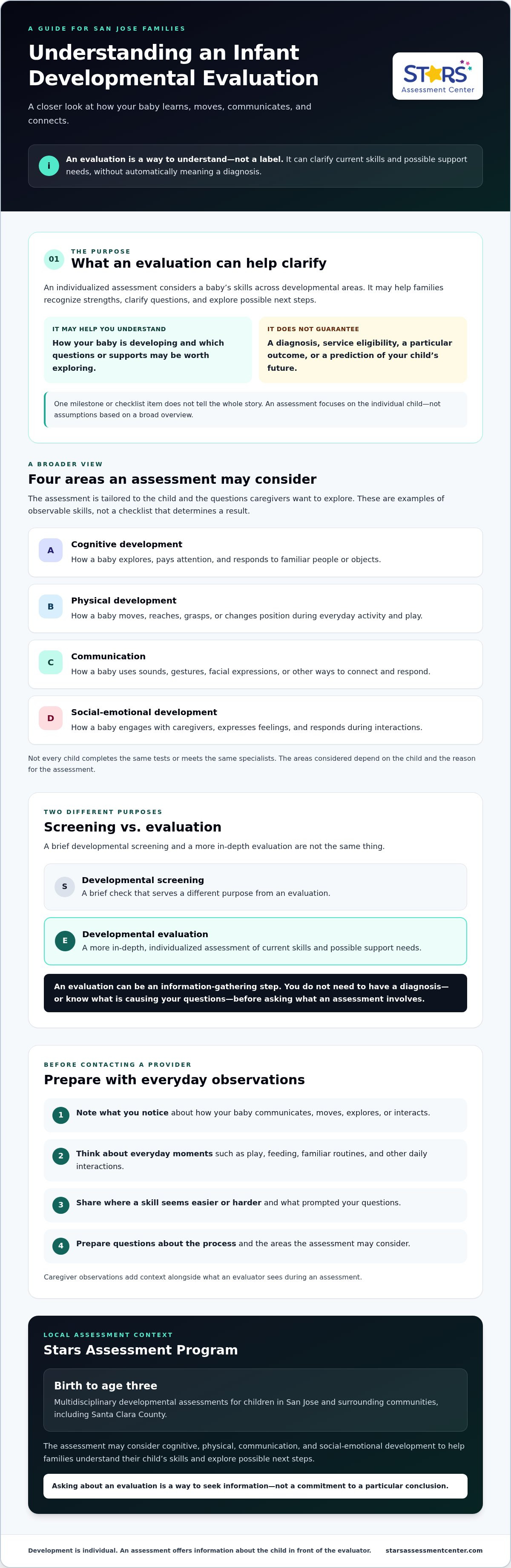
- Cognitive development: How a baby explores, pays attention, and responds to familiar people or objects.
- Physical development: How a baby moves, reaches, grasps, or changes position.
- Communication: How a baby uses sounds, gestures, facial expressions, or other ways to connect and respond.
- Social-emotional development: How a baby engages with caregivers, expresses feelings, and responds during interactions.
These examples describe observable skills, not a measure of how capable a child can become. Learning about the stages of child development can provide general context, but an individual assessment focuses on the baby in front of the evaluator rather than assumptions based on a broad overview.
When might a San Jose family ask about an evaluation?
Consider asking a pediatrician or an assessment provider about an evaluation if you have ongoing questions about how your infant communicates, moves, explores, or interacts. You don’t need to know what is causing your concern or have a diagnosis before asking what an assessment involves. Sharing specific observations, such as what you notice during play or everyday routines, can help explain what prompted your questions.
For families in San Jose and Santa Clara County, a local assessment option may help bring several developmental areas into view together. Stars Assessment Program provides multidisciplinary developmental assessments for children from birth to age three in San Jose and surrounding communities. Asking about an evaluation is a way to seek information and understand possible next steps, not a commitment to a particular conclusion.
What an infant developmental evaluation can assess
An infant evaluation is tailored to the child and the questions caregivers want to explore. Professionals with different areas of expertise may contribute, but that doesn’t mean every child completes the same tests or meets the same specialists. The aim is to build a clearer picture of development, recognize strengths, and identify questions or possible next steps for the family to discuss.
At Stars Assessment Program, the multidisciplinary assessment scope includes cognitive, physical, communication, and social-emotional development. Considering these four areas can help describe how a baby learns, moves, communicates, and engages with other people, giving families a broader view of everyday skills and possible support needs. Findings can inform conversations, but they don’t guarantee a diagnosis, eligibility, or a particular outcome.
How evaluators look at communication, movement, and learning
Communication can include how a baby uses sounds, gestures, or expressions to connect. Physical development may involve reaching, grasping, or moving during play. Early learning may be observed through how a baby explores an object or responds to a familiar routine. These are examples, not a checklist that determines a result.
Evaluators consider the child’s overall developmental picture rather than treating one behavior as conclusive. Caregivers can add context by sharing what they notice during feeding, play, or other daily interactions, including situations where a skill seems easier or harder for the baby. Those observations complement what an evaluator sees during an assessment.
Why social-emotional development can be part of the picture
Social-emotional development includes how an infant engages with familiar caregivers, responds during back-and-forth interactions, and expresses feelings. These observations are considered in an age-appropriate way and alongside other developmental information. They are not a judgment about a baby’s personality or bond with a caregiver. Stars offers a social-emotional assessment as part of its services. For more detail about this area, families can read about a social-emotional assessment for toddlers.
The Centers for Disease Control and Prevention explains developmental screening, one way families and professionals can check whether more questions may be helpful. An evaluation can provide a more detailed view tailored to the child and the concerns being explored.
If you’re searching for “developmental evaluation for infants San Jose,” Stars Assessment Program provides multidisciplinary assessments for children from birth to age three in San Jose and surrounding communities. You can learn about Stars’ developmental assessments and ask which evaluation options may fit your child’s needs.
Developmental screening vs. evaluation: what San Jose parents should know
A screening and an evaluation both help families ask informed questions, but they serve different purposes. A screening is an initial check for signs that closer discussion may be useful. A developmental evaluation takes a more detailed look at a child’s development and possible support needs. The scope depends on the child, family concerns, and provider’s process.
| Developmental screening | Developmental evaluation |
|---|---|
| Brief initial check of developmental skills | More in-depth, individualized assessment |
| May flag a reason to ask more questions | May examine one or more developmental areas in greater detail |
| Doesn’t establish a diagnosis by itself | Findings may clarify strengths, concerns, and possible next steps, but don’t guarantee a diagnosis or service eligibility |
What a developmental screening can and cannot tell you
A screening can help a caregiver or professional decide whether it may be useful to explore a concern further. It’s a starting point, not a final answer, and a result alone doesn’t confirm a condition. The Centers for Disease Control and Prevention explains developmental screening and how it differs from ongoing observation. For a broader overview, families can also look for the related article, “early childhood developmental screening.”
When a comprehensive evaluation may add useful detail
If questions remain after a screening or everyday observations, a more comprehensive assessment may offer a fuller view. For example, a multidisciplinary evaluation may consider several developmental areas together rather than focusing on one initial concern. The infant and toddler assessment resource from ZERO TO THREE discusses how observation, screening, and assessment can contribute to understanding a young child’s development.
For families considering a developmental evaluation for infants San Jose providers offer, seeking information doesn’t mean you’ve already decided what is happening. An evaluation can help organize questions, describe a child’s current skills, and inform family conversations about possible resources. It doesn’t automatically confirm a condition or qualify a child for services. Ask the provider which areas the assessment may cover and how findings can guide your next questions.
How to prepare for an infant developmental evaluation in San Jose
A little preparation can make it easier to explain what you’ve noticed and understand what to expect. You don’t need to rehearse your baby’s skills or arrive with a conclusion. Requirements vary, so confirm instructions and logistics with the assessment provider before the appointment.
- Write down your questions. Note what you’d like to understand, such as which developmental areas the evaluation may consider and how the findings will be shared.
- Record everyday observations. Jot down examples from routines, play, or interactions that prompted your questions. Include what you notice, when it tends to happen, and any context that may help explain the situation.
- Ask who may take part. Find out which professionals might be involved, how caregivers participate, and whether the provider would like you to do anything during the assessment.
- Confirm practical details. Ask about referral requirements, language access, appointment information, payment options, and any forms or records the provider wants you to bring.
A short list of questions, everyday observations, and the provider’s specific instructions is useful preparation. It can help you feel organized without turning your baby’s routines into a test.
Questions to ask before choosing an assessment provider
Ask which areas of development the evaluation may consider and which professionals could be involved. You can also ask how caregivers will contribute, how results and recommendations are explained, and whom to contact if questions come up afterward. Confirm current logistics directly with the provider, including referral steps, language preferences or access, and payment details. Policies can vary, so don’t rely on assumptions.
What to bring and share on evaluation day
Bring records if the provider requests them or if you believe they’ll help explain your concerns. Share specific examples from home, such as how your baby communicates during a familiar routine or moves during play. There’s no need to practice skills or test your infant beforehand. If something changes on the day, tell the assessment team. Your observations are useful context, not a performance score.
Before you go, double-check the appointment details and any requested documents with the assessment team. If you’re exploring a developmental evaluation for infants San Jose families may consider, you can contact Stars about its developmental assessments and ask what information to prepare.
Explore infant developmental evaluation with Stars Assessment Program
For families seeking a developmental evaluation for infants San Jose, Stars Assessment Program offers multidisciplinary developmental assessments for children from birth to age three in San Jose and surrounding communities. Its assessment scope includes cognitive, physical, communication, and social-emotional development. Depending on a child’s needs and the questions being explored, options may also include a speech and language evaluation or specialized screening related to Autism or Down syndrome. Not every assessment includes the same areas or screening options.
Assessment findings can help caregivers understand a child’s current skills and discuss possible next steps, including whether it may be helpful to explore early intervention resources. An assessment doesn’t guarantee a diagnosis, eligibility for services, or a particular outcome. Families can ask how results may inform their decisions and what questions to raise with other providers.
What families can ask Stars about its multidisciplinary assessments
A conversation with the provider can help clarify whether an assessment fits your concerns. Consider asking:
- How might the team consider cognitive, physical, communication, and social-emotional development?
- Which assessment options may relate to your questions, including a speech and language evaluation or specialized screening?
- Who may be involved, and how can caregivers share observations and ask questions?
- What are the current service area, referral steps, appointment availability, and payment details?
These details can depend on your circumstances or change, so confirm them directly with Stars rather than assuming a particular process or availability.
Local next steps after an assessment
After receiving findings, ask the assessment provider to explain what the results mean, what they don’t determine, and which questions or resources may be worth exploring. If you live in Santa Clara County, ask which local early intervention pathway applies and how to confirm the right contact for your family. Procedures should be verified directly, since an assessment alone doesn’t establish eligibility.
It’s okay to take the process one question at a time. If you’d like to explore whether Stars’ assessment options may fit your child’s needs, contact Stars Assessment Program and ask about the current service area, referral process, assessment scope, and practical details for your family.
Take a supported next step for your child
You don’t need a diagnosis or all the answers before asking about an evaluation. A screening can point to questions worth exploring, while a more in-depth assessment may offer a clearer picture of your infant’s skills and possible support needs. Your everyday observations and questions can help guide that conversation.
For families considering a developmental evaluation for infants San Jose, Stars Assessment Program provides multidisciplinary assessments for children under age three in San Jose and surrounding communities. The team may consider cognitive, physical, communication, and social-emotional development, with the assessment shaped by the child and the questions being explored. Findings can help families discuss possible next steps, without guaranteeing a diagnosis or service eligibility.
If you’d like to learn whether an assessment may fit your family’s questions, contact Stars Assessment Program to ask about an infant developmental evaluation. You can also ask about current service coverage, referral steps, and practical details. One thoughtful question is a meaningful place to begin, and you can take the process at your family’s pace.
Frequently Asked Questions
When should I consider a developmental evaluation for my infant?
Consider asking about an evaluation if you have ongoing questions about how your infant communicates, moves, learns, or interacts. You don’t need to identify a cause or wait for a diagnosis before seeking information. Share specific examples from everyday routines with your pediatrician or an assessment provider. A conversation can help you understand whether a closer look may be useful and what options are available for your family.
What happens during an infant developmental evaluation?
The process depends on your child, your family’s questions, and the provider’s approach. An evaluation may consider cognitive, physical, communication, and social-emotional development, using observations and other assessment methods chosen for the child. Caregivers can share what they notice at home and ask how findings will be explained. Contact the provider beforehand to learn what the assessment may involve, who may participate, and what to expect afterward.
Is a developmental screening the same as a developmental evaluation?
No. A screening is generally an initial check that may indicate whether further discussion or assessment could be helpful. A developmental evaluation is more in-depth and can explore a child’s skills and support needs in greater detail. Screening results alone don’t establish a diagnosis. If you’re unsure which step makes sense, ask your child’s pediatrician or an assessment provider to explain the purpose of each option.
Does an infant developmental evaluation mean my child has a diagnosis?
No. Requesting or completing an evaluation doesn’t mean your child has a diagnosis, and an assessment doesn’t automatically confirm one. It’s a way to better understand your infant’s current development, strengths, and areas you have questions about. Findings may help guide conversations about possible next steps, but they don’t predict a child’s future or guarantee eligibility for services. You can seek information without having already decided what is happening.
How do I find an infant developmental evaluation in San Jose?
Ask your pediatrician about local assessment options, or contact a provider directly to ask about its services and process. Stars Assessment Program offers multidisciplinary developmental assessments for children under age three in San Jose and surrounding communities, including Santa Clara, Santa Cruz, Salinas, Milpitas, Gilroy, and Morgan Hill. Confirm the current service area, referral steps, appointment availability, and payment details with the provider before making plans.
What should I bring to my infant’s developmental evaluation?
Start by confirming with the provider whether any documents or records are requested. It may help to bring notes about your questions and examples of what you’ve observed during routines, play, or interactions. You don’t need to practice skills with your baby or try to test them beforehand. Sharing everyday observations gives the assessment team useful context about your concerns and your child’s experiences.
Can an evaluation help my family explore early intervention resources?
Yes, assessment findings may help your family understand possible next steps and explore early intervention resources. They don’t guarantee that a child will qualify for a particular service or receive a specific outcome. Ask the provider to explain what the findings mean, what they don’t determine, and which local resources you might contact. If you’re in the San Jose area, confirm the appropriate referral pathway directly with the provider or relevant local program.


