
You are sitting on the floor watching your two-year-old play, but instead of pure joy, you feel a lingering sense of worry because they haven't started using words yet. That quiet anxiety about missed milestones is something many local parents face, yet finding a developmental delay evaluation in Salinas often feels like trying to read a map in a different language. You deserve a partner who translates medical jargon into meaningful insights about your child's unique growth and potential.
It is completely normal to feel overwhelmed by complex state systems while wondering if your child qualifies for support under California's updated 25 percent delay threshold. We know you aren't just looking for a checklist; you are looking for a clear path forward that respects your family's heart and heritage. This guide explains how to secure a multidisciplinary assessment in Monterey County, clarifies the roles of different providers, and shows you how to access early intervention services without the typical stress. By the end, you will have a reliable roadmap to help your child thrive during these critical first three years.
Key Takeaways
- Learn why the first 36 months represent a critical window for identifying growth patterns and how early support builds a strong foundation for your child's future.
- Understand how to navigate a developmental delay evaluation Salinas by connecting with local multidisciplinary teams that coordinate with Monterey County resources.
- Discover the value of a unified assessment approach that brings together specialists in communication, cognition, and social-emotional development for a complete picture of your child.
- Identify key qualities to look for in an evaluation partner, such as a specialized focus on the unique needs of infants and toddlers rather than a general medical model.
- Gain an actionable roadmap that transforms complex state systems and clinical jargon into a clear, supportive plan for your family’s next steps.
Understanding Developmental Delay Evaluation in Salinas: The First Step
Watching your child grow is a journey filled with wonder, but it can also bring moments of quiet concern. If you've noticed your toddler isn't quite hitting the same marks as their peers, you might feel a mix of confusion and urgency. A developmental delay evaluation Salinas is more than a medical checkup; it's a comprehensive look at how your child learns, moves, and connects with others. Instead of focusing on isolated symptoms, this process looks at the "whole child," ensuring that every strength and challenge is recognized within the context of your family's daily life.
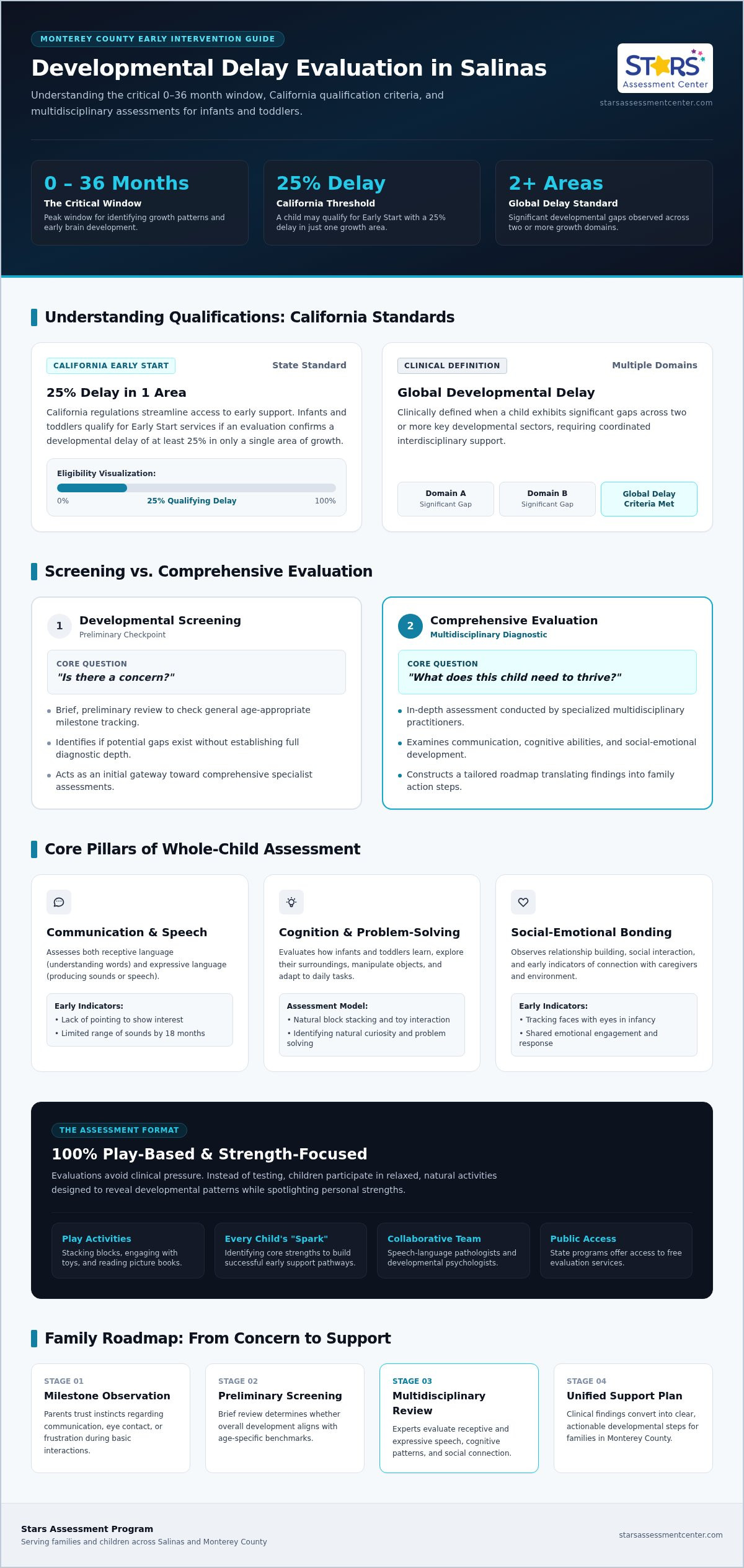
In clinical terms, a child might be experiencing a Global developmental delay if they show significant gaps in two or more developmental areas. For families here in the Salinas Valley, the goal of an evaluation is to provide clarity and hope. By identifying these gaps early, we can unlock the right support systems during the most critical period of brain development: birth to age three. California law now makes it easier to qualify for help, as infants and toddlers may be eligible for Early Start services if they show a delay of at least 25 percent in just one area of growth. This shift reflects a commitment to getting children the help they need as soon as a need is identified.
Early Signs that Warrant a Professional Evaluation
Often, the first signs aren't dramatic. You might notice your baby doesn't track your face with their eyes, or your toddler seems frustrated when trying to communicate simple needs. These subtle shifts in social bonding or physical milestones are easy to miss in a busy household. Tracking milestones from birth to three requires a specialized pediatric perspective that understands the wide range of healthy growth. If your gut tells you something is different, trust that instinct. You know your child best, and seeking an expert opinion is a proactive act of love that leads to better long-term outcomes.
Screening vs. Comprehensive Evaluation: What is the Difference?
Not every concern requires a deep dive immediately. Many parents start with a developmental screening. This is a brief, preliminary check to see if a child is generally on track for their age. If that screening shows potential gaps, it leads naturally into a formal, comprehensive evaluation. While a screening asks "Is there a concern?", a comprehensive evaluation asks "What does this child need to thrive?" This in-depth process uses a team of specialists to look at communication, cognitive skills, and social-emotional health, creating a tailored roadmap for your family's next steps.
Core Components of a Multidisciplinary Developmental Assessment
When you seek a developmental delay evaluation Salinas, you aren't just looking for a score or a label. You're looking for a complete picture of who your child is. A multidisciplinary team approach is the gold standard because it brings together experts from different fields, such as speech-language pathology and developmental psychology. This collaboration ensures that no single observation is taken out of context. Instead of getting fragmented pieces of information from separate appointments, you receive a unified report that connects the dots between how your child moves, speaks, and interacts with their world.
A thorough assessment isn't just about identifying what a child isn't doing yet. It's equally focused on their unique strengths. We believe every child has a "spark," and finding those strengths is what helps us build a successful path forward. To make this process as stress-free as possible, evaluations are entirely play-based. Your toddler won't feel like they're being "tested" in a clinical way; they will simply be engaging in natural activities like stacking blocks, looking at picture books, or playing with toys. If you're just starting this journey, you can often access a free evaluation from the state to begin understanding your child's needs.
Evaluating Communication and Speech Development
Communication is one of the most complex areas of early growth. Specialists look at two distinct sides: receptive language, which is how well your child understands what you say, and expressive language, which is their ability to use sounds or words to share their thoughts. Early indicators of a delay might include a lack of pointing to show interest or a limited range of sounds by 18 months. Integrating these speech insights into the broader developmental picture is vital. For a closer look at how these assessments work for toddlers, you may find our toddler speech evaluation guide helpful for understanding the specific milestones we track.
Assessing Social-Emotional and Cognitive Skills
Cognitive evaluations focus on how your child processes the world around them. This includes memory, problem-solving, and how they use objects during play. At the same time, we look at social-emotional development, observing how your child reacts to new people, seeks comfort, or engages in "joint attention" with a caregiver. This holistic view is necessary for accurate screenings for conditions like Autism or Down syndrome. By looking at all these domains together, a developmental delay evaluation Salinas provides the clarity you need to move from uncertainty to action. If you're ready to start, our team at the Stars Assessment Program is here to guide you with warmth and expertise.
Navigating Evaluation Pathways in Monterey County
Finding the right path for a developmental delay evaluation Salinas can feel like a maze of acronyms and agencies. In Monterey County, families have access to several pathways, primarily centered around California's Early Start program. This state initiative ensures that infants and toddlers with a 25 percent delay in at least one developmental area receive the support they need. Because Salinas is a diverse community, it's vital to find a provider who understands the cultural nuances of our valley and provides care that feels like a partnership rather than a transaction. You aren't just looking for a service; you're looking for a community advocate who respects your family's unique journey.
The Role of San Andreas Regional Center (SARC)
The San Andreas Regional Center (SARC) serves as the primary hub for state-funded early intervention in our region. When you contact them, they begin an intake process to determine if your child is eligible for services. By law, this evaluation and the development of a service plan must be completed within 45 days of your initial referral. SARC often coordinates with independent specialized teams to conduct these assessments, ensuring that the clinical findings are accurate and thorough. This is especially important if you are worried about specific milestones or do you think your child might have autism, as specialized teams provide the depth needed for a clear, diagnostic picture.
When to Choose a Specialized Assessment Program
While the regional center is the starting point for many, choosing a specialized assessment program offers distinct advantages for your family's peace of mind. These programs focus exclusively on the birth-to-three age group. This means every tool, toy, and interaction is designed for the unique dynamics of toddlers. Instead of a sterile medical environment, these centers prioritize a supportive, low-stress atmosphere where your child can simply be themselves. A dedicated multidisciplinary team acts as your ally, guiding you through the results without the confusion of medical jargon. This specialized expertise ensures that the roadmap created for your child is both actionable and compassionate, giving you the confidence to take the next step in your child's growth.
How to Choose the Right Assessment Team for Your Child
Selecting the right partner for a developmental delay evaluation Salinas is one of the most significant steps you'll take for your child's future. It isn't just about finding a clinic with the right equipment; it's about finding a team that recognizes your child's potential. You need a team that specializes exclusively in the birth-to-three window, as the needs of a two-year-old are vastly different from those of a school-aged child. A specialized team understands the nuances of toddler behavior and knows how to distinguish between a temporary late bloom and a developmental gap that requires support.
A unified, multidisciplinary approach is essential. Instead of visiting different specialists on different days, look for a program where experts in communication, cognition, and social-emotional health work together. This collaboration prevents fragmented results and ensures the final report is a cohesive story of your child's profile. You should feel like a partner in this process, not just an observer. The best teams prioritize empathetic communication, translating complex clinical findings into clear, actionable steps that you can actually use at home.
Questions to Ask a Potential Evaluation Provider
Before you commit to a provider, don't hesitate to ask detailed questions about their process. You might ask: "Which specific specialties are represented on the team?" A well-rounded team should include experts in speech and language, cognitive development, and social-emotional health. It's also helpful to ask how they ensure a comforting experience for anxious toddlers. If a center describes their process as play-based, ask for examples of how they keep the environment natural and low-stress. Finally, ensure they explain how the final report will help you qualify for Early Start resources or other community supports.
Preparing Your Family for the Evaluation Day
Preparation can significantly lower the stress levels for both you and your child. Try to schedule the appointment during a time when your toddler is usually most alert and well-rested, typically after a morning nap. Bring familiar snacks and a favorite toy to help them feel at ease in a new environment. Gathering your child's medical history and a list of milestones you've noticed ahead of time will also help the team get a head start. If you've recently completed an early childhood developmental screening, bring those results along to share. View this day as a supportive partnership designed to unlock your child's potential. If you're ready to take the next step, you can contact the Stars Assessment Program to speak with a compassionate specialist who understands your journey.
The Stars Assessment Program: Partnering with Salinas Families
Every family in the Salinas Valley deserves a clear understanding of their child's unique growth. The Stars Assessment Program provides this clarity through a process rooted in professional warmth and deep expertise. As part of the Stars Behavioral Health Group (SBHG), we've been serving families since 1988, establishing a legacy of trust and reliability. We don't just provide a medical service; we act as a steady ally for parents during a time that can often feel uncertain. Our team understands the weight of your concerns and is here to provide the reassurance you need.
Our developmental delay evaluation Salinas is designed to be a "safe harbor" for your family. We know that the cold, clinical feel of a standard medical environment can be intimidating for a toddler and stressful for a parent. That's why we prioritize a setting that feels welcoming and family-centered. Our multidisciplinary teams work together to create a unified profile, ensuring that your child's strengths are celebrated while their needs are clearly identified. This collaborative approach ensures that you walk away with a complete picture of your child's social-emotional and communicative development.
Our Specialized Birth-to-Three Evaluation Focus
We've chosen to focus exclusively on the birth-to-three age group because these years represent the most critical window for developmental growth. Our team specializes in the specific dynamics of infants and toddlers, evaluating cognitive, communication, and social-emotional domains with gentle care. Whether you have concerns about early milestones or are seeking a specialized assessment for conditions like Autism or Down syndrome, our approach remains play-based and natural. We believe that by providing a specialized focus, we can offer more precise insights that general pediatric providers might overlook, ensuring your child receives the most accurate assessment possible during their earliest years.
Empowering Your Next Steps Toward Support
An evaluation is only the beginning of the journey. The real value lies in how those findings translate into support. Our detailed multidisciplinary reports are designed to assist you in coordinating with local resources, such as the San Andreas Regional Center (SARC). We provide the documentation and professional insights needed to qualify for early intervention services, making the transition from assessment to action as smooth as possible. Our goal is to demystify the process and provide a clear roadmap that empowers you to advocate for your child's needs.
We remain committed to serving families across Salinas and neighboring Monterey County communities with patience and cultural sensitivity. Our role is to be your ongoing advocate, helping you navigate the system so your child can reach their full potential. Ready for clarity? Contact the Stars Assessment Program today to learn more about our supportive evaluation process and how we can partner with your family to secure the best possible start for your child.
Taking the Next Step for Your Child’s Growth
Seeking a developmental delay evaluation Salinas is a courageous first step toward ensuring your child has every opportunity to thrive. You've learned how a multidisciplinary approach provides a complete picture of your child's profile and how to navigate the specific pathways available in Monterey County. The first three years are a unique window for growth; acting now provides the strongest foundation for the years ahead.
The Stars Assessment Program is dedicated to walking this path with you. Our specialized multidisciplinary teams focus exclusively on children from birth to age three, ensuring your toddler receives care tailored to their developmental stage. Backed by Stars Behavioral Health Group's legacy of care since 1988, we proudly serve Salinas and surrounding Monterey County communities with a heart for every family. You don't have to navigate these systems alone.
Connect with the Stars Assessment Program today for expert, compassionate developmental guidance for your child. Your child's potential is waiting to be unlocked, and we're here to help you every step of the way.
Frequently Asked Questions
What is a developmental delay evaluation for infants and toddlers?
It is an in-depth process where specialists observe how a child is growing compared to typical pediatric milestones. The goal is to determine if a child needs extra support to reach their full potential during the critical first three years. For families in Monterey County, this evaluation identifies specific needs in areas like communication, cognition, or social bonding, providing a clear starting point for early intervention services.
How do I know if my child under age three needs a professional assessment?
You should consider a professional assessment if your child isn't meeting key marks like pointing to objects, making eye contact, or using simple words by 18 to 24 months. Trust your instincts if their play or social interactions seem different from their peers. A developmental delay evaluation Salinas provides clarity by comparing your child's unique profile against specialized standards, ensuring you don't miss the vital early intervention window.
What happens during a multidisciplinary developmental evaluation?
A team of experts, including speech-language pathologists and developmental specialists, observes your child through play-based activities. They look at the whole child rather than just one isolated skill. You'll participate by sharing your child's history and your daily observations. This collaborative approach ensures that the final report is comprehensive and accurate, covering cognitive, communicative, and social-emotional domains to create a unified roadmap for your family's next steps.
How does the Stars Assessment Program coordinate with San Andreas Regional Center?
The Stars Assessment Program acts as a specialized partner that conducts evaluations for children referred through the San Andreas Regional Center (SARC). We work closely with SARC coordinators to ensure our findings meet California's eligibility criteria for Early Start services. Our team provides the detailed documentation needed to help families access funded resources, acting as a supportive bridge between the state system and your child’s specific developmental needs.
Will an early developmental assessment label my child permanently?
No, an early assessment is a snapshot of your child's current growth, not a permanent label. Its primary goal is to unlock resources and support that can help your child catch up or build vital skills. Because toddlers grow and change so rapidly, these evaluations are meant to guide current intervention. Many children who receive early support show significant progress, often reducing the need for specialized services as they enter school.
How can a Salinas family prepare for a toddler milestone evaluation?
Preparation starts with ensuring your child is well-rested and fed before the appointment. Bring familiar items like a favorite toy or a snack to help them feel secure in the new environment. It's also helpful to have your child's medical records and a list of your specific concerns ready. Viewing the developmental delay evaluation Salinas as a partnership rather than a medical test helps keep the atmosphere calm for your toddler.
What areas of growth are measured during an early childhood screening?
Screening focuses on five key domains of development to identify potential gaps. These include:
- Cognitive skills like problem-solving and memory
- Communication, including understanding and speaking
- Social-emotional health and how they interact with others
- Adaptive skills like feeding or dressing
- Physical growth, including fine and gross motor movements


