
You're sitting at the park, watching your two-year-old play near a group of children. While the others are beginning to notice each other, your little one seems content to stay in their own world, and you wonder if you should be concerned. It's common to feel a rush of anxiety when comparing your child to others, especially when online advice feels contradictory. This toddler social emotional milestones checklist is designed to replace that uncertainty with a sense of calm and clear direction.
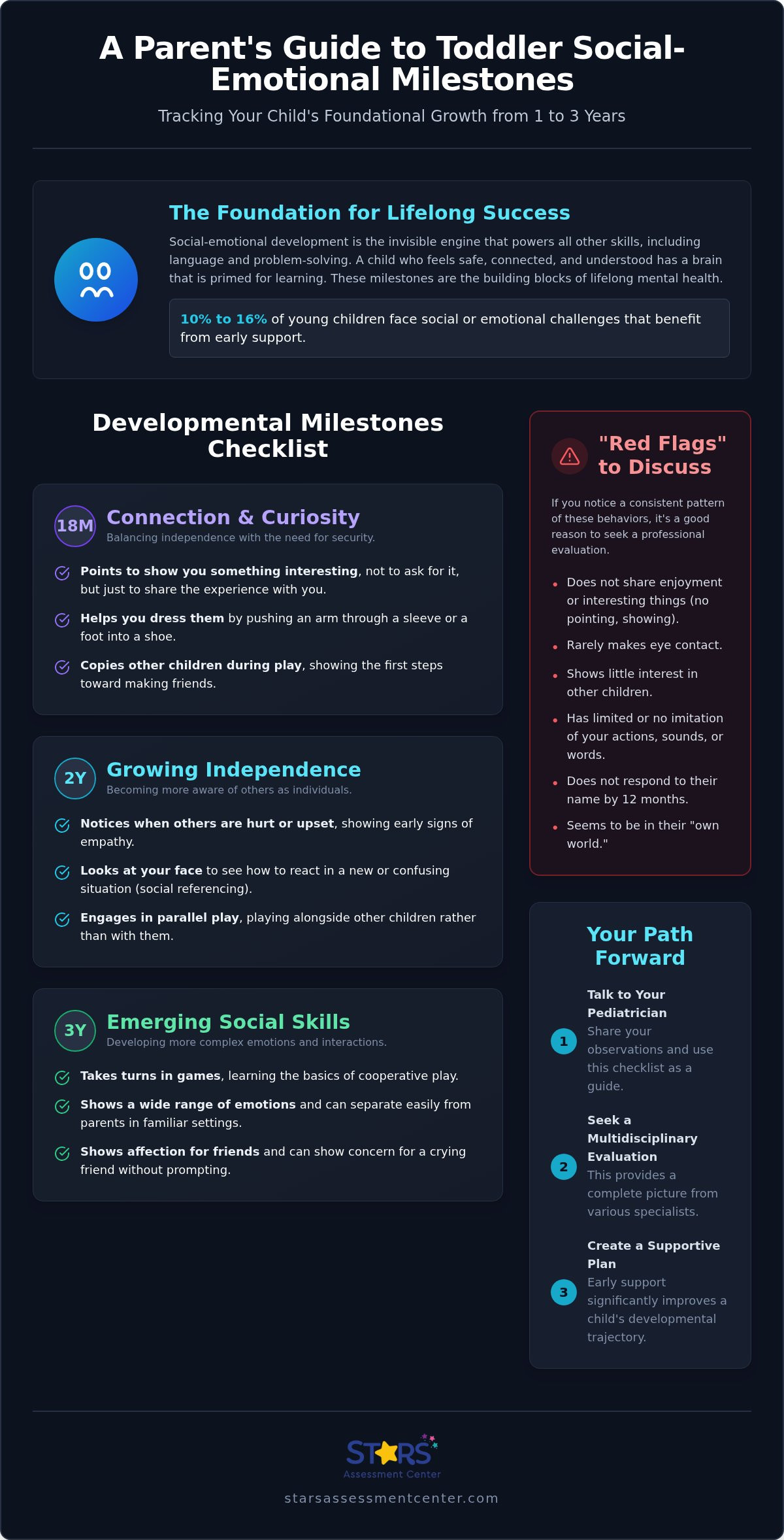
We understand that the fear of a "label" can make you want to wait and see, especially since between 10% and 16% of young children face social or emotional challenges that benefit from early support. You'll discover the specific social and emotional markers your child should reach by age three and learn how to seek supportive, multidisciplinary evaluations if you notice delays. This guide breaks down the latest 2026 developmental standards and explains how families in the San Jose area can find specialized support.
Key Takeaways
- Understand why social-emotional growth serves as the essential foundation for your child's future language and cognitive success.
- Use our toddler social emotional milestones checklist to track age-appropriate behaviors like joint attention and shared joy from ages 12 to 36 months.
- Identify specific "red flags" that signal a need for professional evaluation, helping you move confidently beyond the "wait and see" approach.
- Learn the exact steps to begin a developmental evaluation in the San Jose area and how to prepare for your first specialist visit.
- Discover how a multidisciplinary assessment provides a complete, supportive picture of your child's unique personality and developmental needs.
Understanding Social-Emotional Development in Your Toddler
Social-emotional development is the invisible engine that powers every other skill your child learns. While parents often celebrate a first step or a first word, the ability to form secure relationships and manage the "big feelings" of toddlerhood is what allows those other milestones to flourish. When a child feels safe, connected, and understood, their brain is better primed for language and complex problem solving. Social-emotional milestones are the building blocks of a child’s lifelong mental health.
Much of this growth happens through what developmental experts call "serve and return" interactions. Think of it like a game of tennis; when your toddler points at a dog (the serve) and you look and comment on it (the return), you are literally building the neural pathways for social connection. Tracking these moments with a toddler social emotional milestones checklist helps you see beyond simple behaviors to the deep emotional foundation your child is building with you every day.
The Difference Between Personality and Milestones
It's natural to wonder if your child’s behavior is just a part of their unique personality or a sign of a developmental delay. A "slow to warm up" temperament or a preference for quiet play is often just a personality trait. However, a consistent lack of interest in shared joy or "joint attention" may indicate a need for extra support. The social-emotional development stages provide a clear framework for what 75% or more of children can typically do by a certain age. If your child seems to struggle with these foundational connections, it isn't a reflection of your parenting; it's simply a sign that they might need a different approach to thrive. Using a toddler social emotional milestones checklist can help you distinguish between a shy personality and a delay that warrants a professional conversation.
Why Early Identification Matters for Families
The first three years of life represent a peak period of neuroplasticity, where the brain is at its most flexible and responsive to intervention. Acting early isn't about rushing to find a diagnosis; it's about providing the right environment while your child's brain is growing most rapidly. Research shows that early support can significantly change a child's developmental trajectory, often reducing the need for more intensive services later in life. For families in San Jose, accessing these answers quickly can lower stress and replace fear with a proactive plan. Programs like the Stars Assessment Program ensure that the process from your first call to a clear, multidisciplinary plan happens within 45 days, giving you the clarity you deserve without the anxiety of a long wait.
Social-Emotional Milestones Checklist: Ages 1 to 3
As your child transitions from infancy into toddlerhood, their world expands from a focus on basic needs to a deep desire for connection. These years are marked by "joint attention," which is the magical moment when your child points at a passing airplane and looks at you to make sure you saw it too. Shared joy is the fuel for their developing brain. This toddler social emotional milestones checklist provides a window into how your child is learning to navigate the complex world of human feelings and relationships.
18-Month Milestones: Connection and Curiosity
By 18 months, your toddler is beginning to balance their need for independence with their need for safety. You might notice them wandering toward a toy at the park, only to stop and look back to ensure you're still there. This "social tethering" is a healthy sign of secure attachment. According to the CDC's updated social-emotional milestones checklist, you should also look for these specific behaviors:
- Pointing to show you something interesting just to share the experience.
- Helping you dress them by pushing an arm through a sleeve or a foot into a shoe.
- Copying other children during play, which is often the first step toward making friends.
2-Year Milestones: Growing Independence
At two years old, your child is becoming more aware of the people around them as individuals with their own feelings. You might see them pause what they're doing to look at a crying peer, or even offer a toy as a gesture of comfort. This is the very beginning of empathy. They also rely heavily on your reactions to understand new situations. If they trip and fall, they'll likely look at your face before deciding whether to cry or get back up. Key markers at this age include:
- Noticing when others are hurt or upset and showing a visible reaction.
- Looking at your face to see how to react in a new or confusing situation.
- Engaging in parallel play, where they play next to others and occasionally interact.
3-Year Milestones: The Social Explorer
By age three, your child is becoming a more active participant in social groups. While "sharing" is still a work in progress, they're beginning to understand the concept of taking turns. They're also developing better emotional regulation. While childcare drop-offs can still be tough, a three-year-old should generally be able to calm down within 10 minutes after you leave. They should also be able to:
- Join other children in play and follow simple group routines or rules.
- Show a wide range of emotions, from pure excitement to frustration, and name some of them.
- Spontaneously show affection for friends and caregivers without being prompted.
If these milestones feel out of reach for your little one, a gentle developmental assessment can provide the clarity and peace of mind you need to support their growth. Understanding where your child stands today is the first step in helping them reach their full potential tomorrow.
Recognizing Signs of Social-Emotional Delay
It's completely normal to feel a surge of protectiveness when you notice your child isn't following the same path as their peers. While a toddler social emotional milestones checklist serves as a helpful roadmap, it's often the subtle deviations that tell the most important story. Recognizing a delay isn't about looking for what's "wrong" with your child; it's about identifying where they need a more specialized kind of support to thrive. Trusting your parental intuition is often the most powerful tool you have. If something feels off in how your child connects with you or others, that feeling is worth exploring with a professional.
Examples of Social-Emotional Red Flags
A red flag is more than just a missed milestone; it's a persistent pattern of behavior that suggests a child is struggling to navigate their social world. These signs often appear across different environments, whether at home, at a playgroup, or during a family gathering. Some specific indicators that warrant a closer look include:
- A consistent lack of eye contact or not responding to their name by 12 months of age.
- Showing little to no interest in playing with or even noticing other children in their environment.
- Extreme difficulty with transitions, resulting in "meltdowns" that feel significantly more intense or prolonged than a typical toddler tantrum.
- A rare display of "shared joy," such as not looking at you to share a smile when they accomplish something new.
When "Late Blooming" is Actually a Delay
Many well-meaning friends or family members might suggest that your child is just a "late bloomer" and will catch up on their own. However, social and emotional skills are built on specific brain-wiring that develops most rapidly during the first three years. Waiting for a child to "grow out of it" can sometimes mean missing the window where intervention is most effective. Viewing an evaluation as a proactive, positive step can change your perspective from one of fear to one of empowerment. You aren't seeking a label; you're seeking a bridge to help your child reach their full potential. Organizations like ZERO TO THREE offer excellent resources for supporting social-emotional growth, but these tools work best when paired with professional clarity.
Social-emotional delays don't happen in a vacuum. They often overlap with communication challenges or sensory processing needs. For example, a child who seems "withdrawn" might actually be overwhelmed by the sounds in a room. A multidisciplinary approach ensures we see the whole child, not just a single behavior. Consulting a toddler social emotional milestones checklist can help you organize your observations before speaking with a specialist. By acting now, you're providing your child with the steady ally they need to navigate their feelings and build lasting relationships.
Next Steps: Evaluation and Local Resources in San Jose
Moving from observing your child at home to seeking professional input is a significant step, and it is often the moment when parents begin to feel a sense of relief. Taking action replaces the heavy weight of "not knowing" with a clear, supportive plan. In California, our developmental support system is designed to be accessible and family-centered, ensuring that you have a steady ally throughout the entire evaluation process. You aren't just looking for a diagnosis; you're looking for a roadmap that honors your child's unique personality while providing the support they need to thrive.
Navigating the California Early Start Referral
For families living in San Jose and throughout Santa Clara County, the San Andreas Regional Center is the gateway to California's Early Start program. This program is specifically designed for children from birth to age three who may have developmental delays. Under current California guidelines, infants and toddlers are eligible for services if they show a 25% or greater delay in one or more areas, including social-emotional or communicative growth.
You have the legal right to request an evaluation at no cost to your family. Once you make the initial contact, the state requires that the assessment and the creation of an Individual Family Service Plan (IFSP) be completed within 45 days. This quick turnaround is vital because it respects the rapid pace of your child's brain development and ensures you don't spend months on a waiting list during these formative years.
How to Talk to Your Pediatrician
Your pediatrician is a key partner in your child's health, but office visits are often short. To make the most of your time, bring your completed toddler social emotional milestones checklist to the appointment. Providing concrete examples, such as "my child doesn't look at my face to see how to react in new situations," is much more effective than a general statement of concern. It helps the doctor see the specific patterns you are noticing every day at home.
Ask specifically for a "standardized screening tool" rather than a general opinion. If a medical provider suggests a "wait and see" approach but your parental intuition tells you something is off, remember that you can self-refer to the Regional Center at any time. You are your child's most important advocate. Seeking a second opinion from a multidisciplinary team is a proactive way to gain the clarity you deserve. Using a toddler social emotional milestones checklist as your guide ensures that no detail is overlooked during these important conversations.
A multidisciplinary team provides a "whole child" perspective that a single specialist might miss. By combining expertise in social-emotional growth, speech, and overall development, these specialists can see how different areas of growth influence one another. If you're ready to move toward clarity, you can request a multidisciplinary developmental assessment to begin building a supportive path forward for your family.
The Stars Assessment Program: A Safe Harbor for Families
When you have spent weeks or even months reviewing a toddler social emotional milestones checklist, the weight of uncertainty can feel heavy. You deserve a partner who sees your child's unique strengths as clearly as their developmental challenges. The Stars Assessment Program acts as a compassionate guide for families in San Jose, Santa Cruz, and Salinas. We transform that sense of "not knowing" into a clear, empowering path forward. Our program is designed to be a steady ally, providing the professional expertise and gentle heart your family needs during this time.
We understand that the idea of "testing" a toddler can feel intimidating. That is why our approach is rooted in partnership and professional warmth rather than clinical detachment. By focusing on children from birth to age three, we specialize in the most critical window of growth. In partnership with the San Andreas Regional Center, we provide these essential developmental assessments at no cost to families, ensuring that every child has the opportunity to receive the support they need as early as possible.
Our Multidisciplinary Evaluation Process
We do not believe in isolated testing that only looks at one piece of the puzzle. Our multidisciplinary team evaluates social-emotional growth, communication, and play skills simultaneously. This "whole child" perspective is vital. For instance, a child who appears to have a social delay might actually be struggling with receptive language. Having multiple specialists observe your child in a single, cohesive program allows us to see these connections clearly. We create a supportive, play-based environment where your toddler feels safe to be themselves, allowing us to gather the most accurate and authentic picture of their development.
Supporting Your Family Beyond the Assessment
Clarity is the first step toward hope, but it is only the beginning of our journey together. After the evaluation is complete, we sit down with you to explain the results in everyday language that makes sense for your family. We help you understand exactly what these findings mean for your child's future and how to navigate the next steps. Whether your child is eligible for California’s Early Start services or simply needs targeted home strategies, we are here to help.
We take pride in connecting families with the right early intervention resources throughout Santa Clara County. You don't have to navigate this complex system alone. If you are ready to move from a place of worry to a place of action, we invite you to Learn more about our Social-Emotional Assessments. Our goal is to ensure that by the time you leave our program, you feel heard, understood, and equipped with a toddler social emotional milestones checklist that has been transformed into a personalized plan for success.
Empowering Your Child’s Social Journey
Navigating the path of early childhood development is a journey that no parent should have to walk alone. By using a toddler social emotional milestones checklist, you've already taken a vital first step in advocating for your child's future. You now understand that social-emotional health is the engine for language and cognitive growth, and you know how to identify the subtle red flags that suggest a need for extra support. Whether your child is hitting every marker or needs a little more guidance to bridge a gap, having professional clarity is the most powerful tool you can possess.
Our multidisciplinary team of specialists has been dedicated to serving San Jose and Santa Clara County since 1988. We specialize exclusively in children from birth to age three, providing a safe harbor where your family's concerns are met with expertise and heart. You don't have to wait for answers when a supportive plan of action is within reach.
Request a Compassionate Developmental Evaluation Today
Your commitment to your child's growth is their greatest asset. We are here to help you turn uncertainty into a bright, connected future for your little one.
Frequently Asked Questions
What is the most important social milestone for a 2-year-old?
The most critical social milestone at age two is joint attention, which is your child's ability to share an interest or experience with you. This happens when they point at a dog in the park and look back at your face to ensure you've seen it too. Shared joy and seeking your reaction in new situations are the foundational building blocks for all future relationships.
Can a toddler have a social-emotional delay but still be smart?
Yes, a child can be highly intelligent or even advanced in cognitive areas like puzzles or numbers while still experiencing a social-emotional delay. The brain pathways used for logic and memory are distinct from those used for emotional regulation and social connection. Identifying a delay doesn't mean your child isn't "smart"; it simply means they need different tools to navigate their social world.
How do I know if my child is just shy or has a social delay?
Shyness is a personality trait where a child takes longer to "warm up" to new people but eventually engages and shows shared joy with familiar caregivers. A social delay is different because it involves a persistent struggle to use social tools, such as avoiding eye contact or not noticing when others are upset. Comparing your child's behavior to a toddler social emotional milestones checklist can help you see if they're missing specific skills or just have a quiet temperament.
What happens during a social-emotional evaluation for a toddler?
During a multidisciplinary developmental assessment, a team of specialists observes your child through play to understand how they interact, communicate, and manage their feelings. It isn't a "test" with right or wrong answers; instead, it's a gentle observation in a safe environment. In California, this process is designed to be family-centered and must be completed within 45 days of your initial contact with the Regional Center.
Does a social-emotional delay mean my child has Autism?
A social-emotional delay does not automatically mean your child has Autism, though these delays are often the first signs that lead to a specialized screening. Many children experience delays due to sensory processing needs, speech challenges, or other developmental factors. An evaluation provides the clarity needed to understand your child's unique profile rather than relying on a general label.
How can I help my toddler with social-emotional development at home?
The best way to support your child at home is through "serve and return" interactions, where you respond enthusiastically to their babbles, gestures, or facial expressions. You can also help by labeling emotions during daily activities, such as saying, "I see you're feeling frustrated that the block fell." Consistently responding to their needs for comfort builds the secure attachment they need to explore the world confidently.
Is a referral required for a developmental assessment in San Jose?
No, a doctor's referral is not required to begin the assessment process in San Jose or surrounding Santa Clara County. Parents have the right to self-refer by contacting the San Andreas Regional Center directly if they have concerns about their child's growth. Using a toddler social emotional milestones checklist to document your observations can be very helpful when you make that first call to explain why you're seeking support.


