
You are at a playdate in San Jose, watching other toddlers exchange babbles and words while your little one relies on pointing or tugging at your hand to be understood. That quietness can feel heavy, and it's normal to feel a mix of worry and confusion about whether your child is just a late bloomer or needs a professional late talker assessment. You want the best for your child, and the uncertainty of not knowing where they stand is often the hardest part of parenting. It's important to remember that you're not alone, and seeking clarity is a brave first step toward supporting their growth.
This article will show you exactly how these evaluations work, the vital difference between speech and language delays, and how a multidisciplinary evaluation in Santa Clara County can unlock your child's unique voice. We'll guide you through the local referral process and explain how a team of specialists looks at the "whole child" to provide the steady, compassionate support your family deserves. By the end of this post, you'll have a clear roadmap for your next steps and the reassurance that comes from having a professional plan in place.
Key Takeaways
- Understand the vital distinction between speech delays, which involve physical sound production, and language delays, which affect how a child understands and uses meaning.
- Identify specific communication milestones for toddlers at 12, 18, and 24 months to better gauge your child's unique developmental window.
- Learn how a multidisciplinary late talker assessment provides a holistic view of your child’s growth by involving a team of speech, cognitive, and social-emotional specialists.
- Navigate the local support landscape in Santa Clara County with a clear roadmap for accessing services through the Regional Center in San Jose and surrounding areas.
- Discover how specialized screenings for Autism or Down syndrome offer the clarity and professional guidance your family needs to move forward with confidence.
Understanding 'Late Talkers': Why Your Child Might Not Be Speaking Yet
It can feel incredibly isolating when you notice your toddler isn't hitting the same verbal milestones as their peers. You might find yourself comparing your child to others at the park or feeling a pang of worry when a younger cousin starts putting sentences together. First, please know that noticing these differences isn't about being overprotective; it's a proactive act of love. In professional circles, we often use the term Late Language Emergence (LLE) to describe children who are slow to start talking. If you've been wondering, What is a late talker?, the term typically describes a toddler who has a limited vocabulary but is meeting other developmental milestones on time.
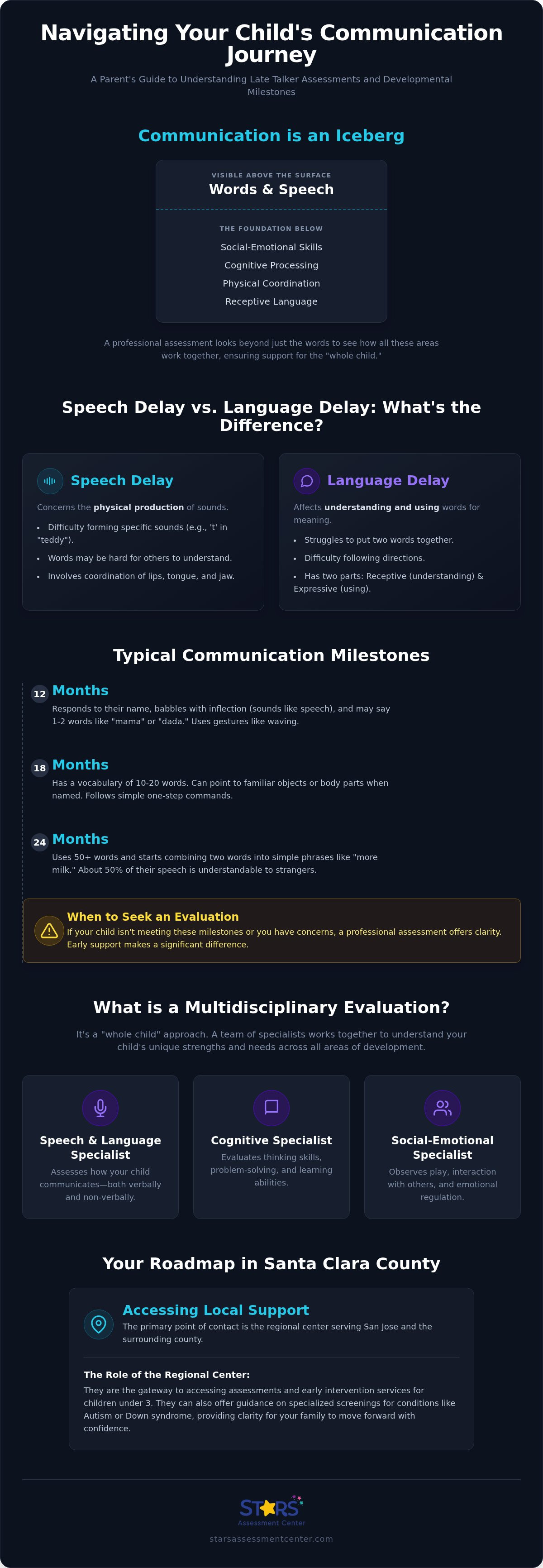
Think of your child's communication as an iceberg. The words you hear are just the tip, visible above the water. Beneath the surface lies a vast foundation of social-emotional skills, cognitive processing, and physical coordination. When a child isn't talking yet, it's often a sign that we need to look deeper to see what's happening underneath. Scheduling a late talker assessment isn't about looking for a label; it's about getting a clear picture of your child's unique strengths and identifying where they might need a little extra nudge to find their voice.
Communication as a Developmental Foundation
Speech and language don't exist in a vacuum. They are the building blocks for how your child learns to solve problems, make friends, and manage their emotions. During the first three years of life, the brain is incredibly flexible, a quality known as plasticity. This is why we focus on this "window of opportunity." When a child has a delay in communication, it can sometimes create a ripple effect, making it harder for them to engage in social play or follow simple directions. A comprehensive late talker assessment looks beyond just the words to see how these different areas of development are working together. By addressing delays early, we can support the "whole child" and ensure their social and cognitive growth stays on track.
The Emotional Journey for Families
Many parents carry a quiet weight of guilt, wondering if they didn't read enough books or if they should've limited screen time more strictly. We want to reassure you that a delay is not a reflection of your parenting. Every child follows their own path, and some just need a more specialized map to find their way. Our goal is to move away from the "wait and see" approach, which can often increase parental anxiety, and move toward a model of partnership. Early support is about empowering you with tools to help your child thrive. You're the expert on your child, and developmental specialists are here to be your steady allies, providing a safe harbor as you navigate these next steps together.
Speech Delay vs. Language Delay: Understanding the Key Differences
Imagine your toddler happily follows a command like "Go get your teddy bear" but struggles to make the "t" sound in "teddy" or simply points instead of naming the toy. This distinction is crucial for parents to understand. Speech refers to the physical act of making sounds, involving the complex coordination of the lips, tongue, and jaw. Language, however, is much broader. It's the system of symbols and meanings we use to communicate thoughts and feelings. A late talker assessment helps untangle these two threads to see exactly where your child needs support.
At home, you might notice these differences in small, everyday moments. A child with a speech delay might know exactly what they want to say but struggle to form the specific sounds, making their words hard to understand. A child with a language delay might have perfect pronunciation for the few words they do have, but they may struggle to put two words together or understand a new direction. These areas often overlap, which is why a professional evaluation is so valuable for providing clarity.
Receptive Language: The Hidden Half of Communication
Receptive language is often called the "hidden half" of communication because it happens inside your child's mind. It's how they process gestures, your tone of voice, and simple instructions. You might notice your child has excellent "joint attention," meaning they look at what you're pointing to and share an interest in an object with you. Even if a child seems to understand everything you say, a delay in verbal output still suggests a need for professional insight. You can review the developmental speech and language milestones to see how comprehension typically builds before a child ever says their first word.
Expressive Language and Speech Production
Expressive language is the ability to put thoughts into words and sentences. This journey starts with rhythmic babbling and moves toward first words and two-word phrases like "more juice." Sometimes, a child knows the word they want to say but has trouble with motor planning, a condition known as apraxia. In other cases, physical factors like a "tongue tie" or undiagnosed hearing loss might be the primary hurdle. Because these areas are so interconnected, a multidisciplinary developmental assessment is the most effective way to see how your child's physical abilities and language skills are growing together. If you're noticing these patterns, it's a great time to reach out for a late talker assessment to ensure your child has the tools they need to connect with the world around them.
When to Seek an Evaluation: Milestones and Red Flags
Think of developmental milestones as a wide, sunny window of time rather than a single, rigid deadline. Every child has a unique internal clock, and it's perfectly normal for one toddler to start walking early while another focuses their energy on babbling. However, these windows exist to help us understand when a child might benefit from a little extra support. If you find yourself consistently worried that your child is falling behind these general timeframes, a late talker assessment can provide the clarity you need to move forward without the weight of uncertainty.
Professional guidance isn't about checking boxes on a pass or fail test. Instead, it's about looking at the whole picture of how your child interacts with their world. When you schedule a comprehensive speech and language assessment, specialists look at both verbal and non-verbal cues to see if a child's communication trajectory is on a healthy path. Early intervention takes advantage of the brain's natural ability to learn and adapt during these formative years.
Communication Milestones for Toddlers Under Three
While every child is different, there are key benchmarks that clinicians look for during the first few years of life. By 12 months, most babies are actively pointing at things they want, waving "bye-bye," and turning their heads when they hear their name. Once they reach 18 months, we typically look for a vocabulary of 10 to 20 words and the ability to follow simple, one-step directions like "pick up the ball." By the time your child reaches their second birthday, the expectations shift toward using about 50 words and starting to combine them into short phrases like "more milk" or "mama go." If your child hasn't reached these markers, it's a gentle sign that a professional check-in might be helpful.
Behavioral Red Flags That Warrant Action
Sometimes the most important signs aren't about words at all. You should consider a late talker assessment if your child shows limited interest in social games like peek-a-boo or struggles to make consistent eye contact during play. Another significant sign is extreme frustration. When a child has big ideas but lacks the tools to express them, it often leads to intense tantrums or "shutting down" because they don't feel understood. Additionally, if a child isn't using any gestures like pointing or reaching to show you their needs by 15 months, it's worth investigating. Perhaps most importantly, if your child ever experiences a "regression"-meaning they suddenly lose words or social skills they once had-it is a critical sign to seek a professional evaluation immediately.
What to Expect During a Multidisciplinary Developmental Evaluation
Entering a late talker assessment might feel like a high-stakes event, but the reality is designed to be gentle and supportive. A multidisciplinary approach means we don't just look at words in isolation. Instead, a team of specialists collaborates to understand how your child learns, moves, and connects with others. This "whole child" perspective is essential because communication is often influenced by cognitive development, motor skills, and social-emotional comfort. We believe that looking at these interconnected pieces is the only way to truly understand your child's unique voice.
The Evaluation Team: Who Is Involved?
A typical team includes several experts working together to support your family. The speech-language pathologist focuses on how your child produces sounds and processes language, but they also look at feeding skills, as the same muscles are used for both. Developmental specialists assess cognitive milestones, like how your child solves a puzzle or follows a sequence. Social-emotional experts observe how your child expresses feelings and interacts with you. This collaborative model is far more accurate than a single-specialist visit because it identifies if a delay is purely language-based or if it's connected to other areas of growth.
The Assessment Day: From Play to Results
On the day of the assessment, you won't see your child sitting at a desk with flashcards. Instead, it looks like a structured play session. Specialists use toys, games, and bubbles to observe how your child solves problems and seeks interaction. While they play, the team will talk with you. Your insights are the most valuable data we have. You see your child every day, and your observations about their routines and frustrations provide the context we need to build a complete picture. This partnership ensures that the evaluation reflects your child's true abilities in a comfortable setting.
After the observation, the team translates their findings into a detailed final report. This document isn't just a list of scores; it's a roadmap for support. It determines eligibility for Early Intervention services and outlines the specific strategies that will help your child thrive. If you're ready to start this journey, you can schedule a multidisciplinary developmental assessment to get the professional guidance your family deserves. This process is the first step in turning uncertainty into a clear, actionable plan for your child's success.
Getting Help in Santa Clara County: Your Local Roadmap
Finding the right path for your child can feel overwhelming, but you don't have to navigate the system alone. In California, the Early Start program provides a coordinated system of services for infants and toddlers with developmental delays. For families living in San Jose, Milpitas, or Gilroy, the primary gateway to these services is the San Andreas Regional Center (SARC). This organization acts as a steady ally, ensuring that every child has access to the support they need during the critical first three years of life. Whether you're just starting to notice delays or you're ready for a formal late talker assessment, understanding the local landscape is the first step toward clarity.
Navigating the Regional Center Referral Process
The referral process is designed to be accessible and family-friendly. You don't need a formal diagnosis or even a doctor's note to begin. While many parents start by talking to their pediatrician, you can also initiate a referral yourself by contacting SARC directly. Once you reach out, an intake coordinator will guide you through an initial interview to learn about your concerns and your child's history. This system serves a wide geographic area, providing essential resources to families from the bustling streets of San Jose to the communities of Salinas, Morgan Hill, and beyond. After the intake, the next step is typically a multidisciplinary evaluation to determine if your child is eligible for services under IDEA Part C.
To help you stay organized, here is a quick checklist for your next steps:
- Contact SARC: Reach out to the San Andreas Regional Center to start the intake process.
- Gather Observations: Note specific examples of how your child communicates at home or during play.
- Prepare for Intake: Be ready to discuss your child's medical history and developmental milestones.
- Schedule the Assessment: Confirm the date for your child's late talker assessment with the assigned team.
The Stars Assessment Program Approach
At Stars Assessment Program, we're proud to partner with local families to provide comprehensive, multidisciplinary evaluations. We focus exclusively on children from birth to age three, recognizing that this is a unique and precious window for growth. Our team doesn't just look for speech delays; we provide specialized screenings for Autism, Down syndrome, and social-emotional challenges to ensure no part of your child's development is overlooked. We believe in a "safe harbor" approach where parents are heard and children are supported with dignity and expertise. Once the evaluation is complete, we help you transition from understanding the delay to implementing a personalized intervention plan that fits your family's life. If you're ready to find answers, schedule a consultation with our San Jose-based specialists today.
Empowering Your Child's Communication Journey
Navigating the path when your child isn't talking yet can feel like a lonely experience, but it's important to remember that you've already taken the most significant step by seeking information. Understanding the nuance between speech production and language comprehension helps you see the "whole child" beyond just their vocabulary. By recognizing developmental windows and local resources in Santa Clara County, you're moving from a place of uncertainty to one of proactive support. A professional late talker assessment isn't just about identifying delays; it's about building a foundation for your child's long-term social and emotional success.
Our specialized multidisciplinary team in San Jose is dedicated to infants and toddlers, offering expert evaluations and comprehensive screenings for Autism and social-emotional delays. We're here to act as a safe harbor for your family, providing the clarity and guidance needed to unlock your child's unique voice. Contact Stars Assessment Program for a Multidisciplinary Evaluation today to start this partnership. You don't have to walk this road alone, and with the right tools, your child's growth can truly flourish.
Frequently Asked Questions
Is it normal for a 2-year-old to understand everything but not talk?
While it's a positive sign that your child has strong receptive language, a two-year-old should typically have a vocabulary of about 50 words and start combining them. If they understand everything but aren't speaking, it suggests a gap in expressive language that warrants professional attention. Addressing this early helps prevent frustration and ensures their social development stays on the right track.
What is the difference between a late talker and a speech delay?
A late talker is a child who has a limited vocabulary for their age but is meeting other developmental milestones. A speech delay refers specifically to challenges with sound production and articulation, making a child's words difficult to understand. A late talker assessment helps determine if the hurdle is the physical act of speaking or the way your child processes and uses language.
How do I know if my child needs a speech evaluation vs. a full developmental assessment?
You should consider a full developmental assessment if you notice delays in more than one area, such as social play, motor skills, or following directions. A speech evaluation focuses solely on communication, but a multidisciplinary approach looks at the "whole child." This broader view is essential for understanding how different areas of growth, like cognitive or social-emotional skills, might be impacting your child's ability to talk.
What happens if my child is diagnosed with a communication delay?
A diagnosis isn't a label; it's a roadmap that opens the door to personalized early intervention services. You'll work with a team to create a plan that includes specific goals and strategies to support your child's growth. This support often involves play-based therapy sessions that empower you with tools to encourage your child's communication during your everyday routines at home.
How much does a multidisciplinary developmental evaluation cost in California?
The cost of an evaluation can vary depending on the provider and the specific screenings your child needs. In California, many families are eligible to receive these assessments at no cost through their local Regional Center if the child is under age three. If you choose a private evaluation, it's a good idea to check with your insurance provider to see what portion of the service they might cover.
Can a speech delay be an early sign of autism in toddlers?
A delay in communication can sometimes be an early indicator of autism, but clinicians look for a cluster of signs rather than just one. These might include limited eye contact, a lack of social gesturing like pointing, or a preference for playing alone. A late talker assessment that includes specialized screenings can help distinguish between a standalone language delay and a broader developmental path like autism.
Will my child 'catch up' if they are a late talker?
Some children do catch up on their own, but it's impossible to know which ones will bridge the gap without help. Waiting too long can lead to missed opportunities during the brain's most flexible years of learning. Early intervention is the most effective way to ensure your child doesn't struggle later with reading, writing, or making friends as they enter preschool and beyond.
How can I support my child's language development at home while waiting for an evaluation?
You can support your child by narrating your day and using simple, repetitive language during activities like bath time or meals. Focus on following your child's lead during play and naming the objects they find interesting. Singing songs and reading books together every day creates a warm, language-rich environment that encourages your child to experiment with new sounds and words at their own pace.


