
What if that nagging feeling that your baby isn't hitting their milestones on time isn't a source of stress, but a powerful signal from your parental intuition? It's completely natural to watch your little one and wonder if they're developing at the right pace, especially when clinical jargon makes everything feel more complicated than it needs to be. Choosing a professional physical development evaluation infants isn't about looking for problems. Instead, it's a way to partner with experts who can provide the clarity and support your family deserves.
We understand that you want a clear path forward and true peace of mind. In this guide, you'll discover exactly what happens during a physical development evaluation infants and how it helps your child reach their full potential. We will break down the California Early Start eligibility criteria, including the 25 percent delay threshold, and explain how families in Santa Clara County can access these vital services. By the end, you'll have a practical roadmap for your child's growth and the confidence to take the next step for your family through a specialized physical development evaluation infants.
Key Takeaways
- Physical growth serves as the essential foundation for your child's cognitive and social-emotional success.
- Understand how a professional physical development evaluation for infants assesses gross and fine motor skills through gentle, play-based observation.
- Learn why a multidisciplinary team is vital for seeing the "whole child" and identifying how physical delays might overlap with other developmental areas.
- Discover the specific steps to qualify for California Early Start services and how to navigate the referral process in Santa Clara County.
- Gain a clear roadmap for interpreting clinical reports so you can transform technical results into a supportive action plan for your family.
Why Physical Development Evaluations Matter in the First Three Years
The first 36 months of life represent a period of incredible transformation. Every time your baby kicks their legs, rolls over, or reaches for a colorful rattle, they're building the vital infrastructure for all future learning. A professional physical development evaluation infants offers a detailed map of this progress. It isn't just a simple growth chart. Instead, it's a comprehensive look at how muscle tone, coordination, and purposeful movement work together to support your child’s journey. Understanding these early physical foundations helps ensure your child has the stability they need to explore their environment with confidence.
The Connection Between Physical and Cognitive Growth
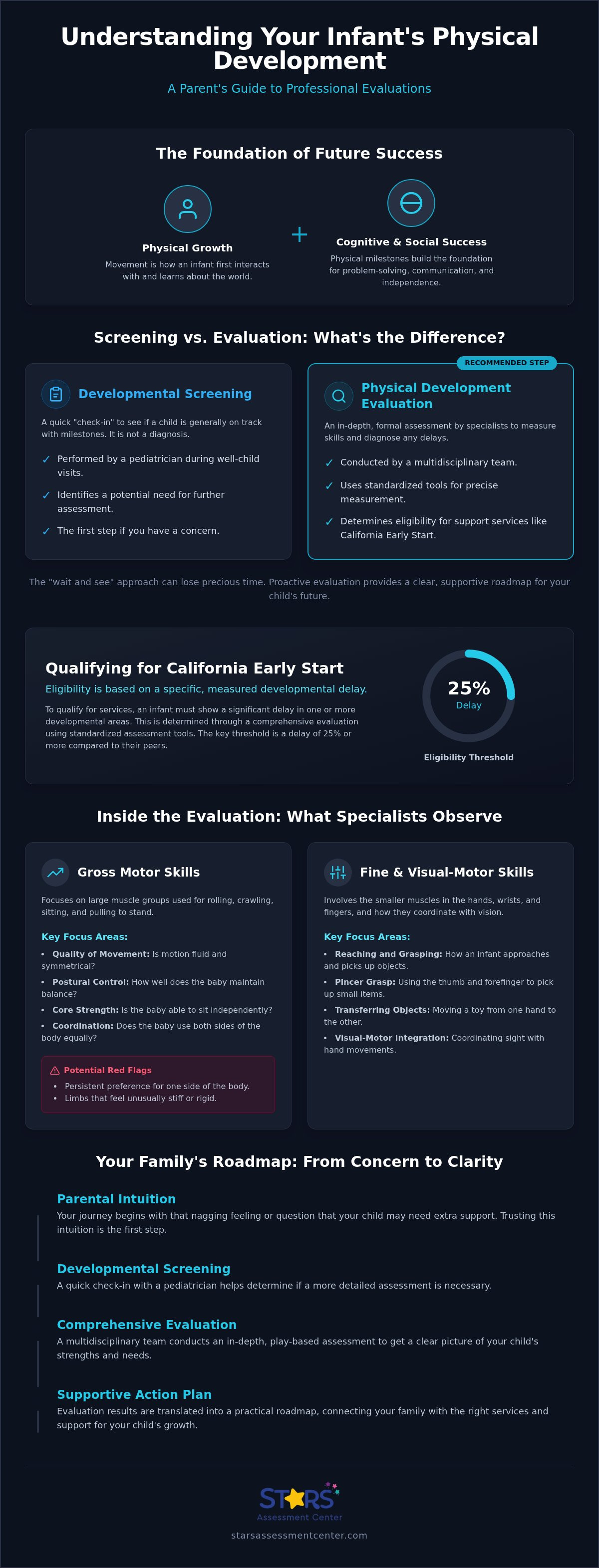
Movement is the primary way an infant interacts with and learns about the world. When a baby masters the pincer grasp, they aren't just picking up a small object. They're learning about cause and effect, spatial awareness, and independence. These child development stages show that physical progress is deeply intertwined with other areas of growth. If a delay occurs in movement, it can ripple into how a child communicates or interacts socially. Developmental domains are the distinct areas of a child’s growth, such as physical movement or social interaction, that work together to shape their overall ability to learn and thrive. A physical development evaluation infants helps specialists see these connections clearly.
Screening vs. Evaluation: What’s the Difference?
Many parents start their journey with a developmental screening. This is a quick "check-in" often performed by a pediatrician during a well-child visit to see if a child is generally on track. However, a screening is not a diagnosis. If a screening suggests a potential delay, the next step is a formal physical development evaluation infants. This is a deep dive conducted by a multidisciplinary team of specialists. Unlike a quick screening, an evaluation uses standardized tools to measure if a child has a 25 percent delay or more in a specific area. This specific measurement is the threshold used to determine eligibility for the California Early Start program.
It's common to feel tempted to "wait and see" if a child will simply catch up on their own. However, the "wait and see" approach often loses precious time during a window when the brain is most adaptable. Acting early is the most effective way to improve long-term outcomes. In Santa Clara County, the Early Start program provides a "safe harbor" for families, offering assessments to help identify needs early. Proactive assessment transforms your parental intuition into a clear, supportive roadmap. By identifying a need before age three, you're giving your child the strongest possible start for the years ahead.
What Specialists Look for During a Physical Evaluation
When you step into a professional physical development evaluation infants, the process looks much like a structured play session. However, beneath the toys and gentle interactions, specialists are carefully observing how your baby’s body works as a whole. While many parents are familiar with the basic newborn development milestones found in parenting books, a clinical assessment investigates the "how" behind every movement. This detailed observation helps identify subtle patterns that might indicate a need for extra support, giving you the clarity you need to move forward with confidence.
Gross Motor Milestones and Quality of Movement
Specialists focus on large muscle groups used for rolling, crawling, and eventually pulling to stand. However, the quality of these movements is just as important as the milestone itself. For example, a specialist doesn't just check if a baby is crawling; they observe if the movement is symmetrical. Does the baby use both sides of their body equally? Is there a fluid rhythm to their motion? They also assess postural control and balance as part of a comprehensive physical development evaluation infants. A baby who struggles to sit independently or seems to "wobble" excessively may need a closer look at their core strength. Red flags that experts watch for include a persistent preference for one side of the body or limbs that feel unusually rigid.
Fine Motor and Visual-Motor Integration
Fine motor skills involve the smaller muscles in the hands and wrists. During the evaluation, specialists watch how an infant reaches for, grasps, and transfers toys between their hands. They look for the progression from a whole-hand "palmar grasp" to the more precise "pincer grasp," where the baby uses their thumb and forefinger to pick up small objects. This process is rarely just about the hands. It also involves visual-motor integration, which is how the eyes guide the hands. If a baby has trouble tracking a toy with their eyes, it can directly impact their ability to reach for it. This is why a multidisciplinary developmental assessment is so valuable; it ensures that vision, movement, and coordination are all considered together.
Evaluators also examine muscle tone and sensory processing. They look for signs of hypotonia (low muscle tone, often described as "floppiness") or hypertonia (high muscle tone, where muscles feel stiff). These physical traits influence how a child responds to their environment. Sensory processing is another key factor. A specialist observes how a baby reacts to different textures, sounds, and movements. Some infants may be over-sensitive to touch, while others might seek out intense movement to feel grounded. Understanding these unique sensory profiles based on findings from a physical development evaluation infants is a vital part of providing a "safe harbor" for your child's growth and development.
The Multidisciplinary Approach: Evaluating the Whole Child
When a child struggles to roll over or reach for a toy, it is rarely just an isolated physical challenge. Development is a complex, interconnected web where one area of growth directly supports another. A professional physical development evaluation for infants is most effective when it doesn't just look at legs and arms, but at the "whole child." By using a multidisciplinary approach, we can see how a physical delay might be impacting a baby's ability to communicate or engage with their world socially. This perspective ensures that no part of your child's journey is overlooked.
At the Stars Assessment Program, we view the parent as the most essential member of the assessment team. You provide the context that a clinical observation alone cannot capture. You know what your baby’s "best day" looks like and how they behave in the comfort of their own home. This partnership between parents and specialists creates a safe harbor, where technical expertise meets a family’s deep, personal knowledge. Together, we move beyond simple checklists to build a complete picture of your child's strengths and needs.
Who is in the Room? Meeting the Team
In a multidisciplinary setting, you aren't just meeting with one doctor. Instead, you're working with a team of developmental specialists who observe your child through the lens of play. While one expert focuses on physical movement, others, such as speech and social-emotional specialists, look at how that movement influences communication and bonding. By combining these diverse perspectives, the team creates a single, cohesive report that provides a clear roadmap for your child's unique needs. This collaborative effort ensures that every observation is cross-referenced, leading to a much higher level of accuracy.
Why a Comprehensive View Prevents Misdiagnosis
A comprehensive view is vital because it helps distinguish between a pure motor delay and a broader developmental condition. Sometimes, what looks like a physical struggle is actually rooted in a vision or hearing issue. For instance, if a baby doesn't reach for a toy, it might be because they can't see it clearly rather than a lack of muscle coordination. By using CDC's developmental milestones as a foundational guide, the team can use data-driven insights to determine if a child is simply a "late bloomer" or if they truly require early intervention.
This thoroughness is especially important for families in Santa Clara County who are seeking clarity. Relying on a single symptom can lead to unnecessary worry or, conversely, a "wait and see" approach that misses the window for early support. A physical development evaluation for infants that includes multidisciplinary input provides the evidence needed to access California Regional Center services with confidence. It transforms uncertainty into an actionable plan, ensuring your child receives the specific type of support that will help them thrive.
What to Expect During Your Infant's Evaluation Appointment
Walking into a clinical setting with a young child can feel overwhelming. You might worry about how they'll behave or if they'll "perform" on command. We want you to know that a professional physical development evaluation for infants is designed with your baby’s comfort as the top priority. It doesn't look like a typical medical checkup. Instead, the room is filled with age-appropriate toys and soft surfaces. To your child, the entire process feels like an engaging playtime. To our specialists, every reach, roll, and smile provides essential data about their growth and neurological progress.
The evaluation begins with a collaborative interview. This is your time to share the daily observations that only a parent can see. We'll talk about your child's routines, what they enjoy, and any specific areas where you feel they might need extra support. We use standardized assessment tools to measure progress against expected milestones. These tools help us translate what we see during play into a clear, objective report. Your input is the foundation of this process, ensuring the final results reflect your child’s true abilities in a natural environment.
Step-by-Step: The Day of the Assessment
We start with a gentle warm-up period. This allows your child to acclimate to the new environment and the specialists in the room. Once they feel settled, we move into guided activities. These are specific tasks, such as encouraging your baby to reach for a colorful toy or navigate a small obstacle, designed to elicit motor responses. We watch how they use their muscles and coordinate their movements. After the play session, we'll hold a brief debriefing. We will share our initial impressions and explain the timeline for your final, comprehensive report, so you never leave with unanswered questions.
Creating a Stress-Free Experience for Your Baby
Our facilities in San Jose and Santa Clara are intentionally designed to be "safe harbors" for families. We know that infants don't follow a strict schedule. If your baby needs a nap, a snack, or a diaper change during the appointment, we simply pause. There is no "wrong" way for your child to behave during an assessment. Crying, shyness, or even a sudden burst of energy are all normal parts of being a baby. We encourage you to bring along a few favorite toys or a familiar blanket to help your little one feel at home. If you are ready to gain clarity on your child’s progress, you can request a multidisciplinary developmental assessment to begin your journey toward peace of mind.
After the Evaluation: Turning Results into Action in Santa Clara County
Receiving the results of a physical development evaluation for infants is a significant milestone for your family. It marks the moment where uncertainty begins to transform into a clear, actionable plan. The report you receive isn't just a collection of scores and clinical observations. Instead, it serves as a detailed roadmap that explains your child's current strengths and identifies specific areas where they may need extra support. Understanding these findings is the first step toward helping your baby reach their full potential.
In California, the evaluation plays a critical role in accessing public services. For an infant or toddler to qualify for the Early Start program, they typically must show a developmental delay of 25 percent or more in a specific area, such as motor skills or communication. Your evaluation report provides the objective evidence required to meet these criteria. It moves the conversation from "wait and see" to a proactive strategy focused on early intervention. This data-driven approach ensures that your child receives the right level of care at the right time.
Navigating Local Resources in San Jose and Beyond
For families living in San Jose, Milpitas, and the surrounding communities, the San Andreas Regional Center is often the primary entry point for services. Our multidisciplinary report acts as a "passport" within this local system. It provides the comprehensive documentation that regional centers and local school districts need to determine eligibility and authorize support. Navigating these resources can feel complex, but having a professional evaluation in hand simplifies the process. We also encourage families to seek out support groups in Santa Clara and Salinas, where you can connect with other parents who are navigating similar journeys.
A Partner in Your Child's Journey
The Stars Assessment Program is more than just a diagnostic center; we are your dedicated advocate in the local developmental system. We stay involved beyond the initial appointment to help you understand the next steps. Whether your child qualifies for Regional Center support or requires a referral to a specific specialist, we provide the guidance you need to move forward. Our team is committed to being a safe harbor for your family, offering the professional warmth and expertise that makes the transition from assessment to action as smooth as possible.
Your child's growth is a journey, and you don't have to walk it alone. With the right information and a supportive team, you can feel confident in the path ahead. Schedule a consultation with the Stars Assessment Program today to begin creating a clear roadmap for your child’s physical development and overall success.
Empowering Your Child's Journey Toward Growth
Your intuition as a parent is one of your child's greatest assets. When you choose a professional physical development evaluation for infants, you're turning that intuition into a concrete roadmap for future success. We've explored how physical milestones are more than just movement; they are the essential building blocks for how your child learns, communicates, and connects with the world. By choosing a multidisciplinary approach, you ensure that every aspect of your baby's growth is seen and supported by experts who care deeply about your family's progress.
At the Stars Assessment Program, we provide a specialized birth-to-three focus within a compassionate, family-centered environment. Our expert multidisciplinary team is here to guide you through every step, helping you navigate local resources in Santa Clara County with clarity and confidence. You don't have to navigate these early years alone. We're here to be your steady ally and a safe harbor for your family.
Request a Comprehensive Developmental Assessment for Your Child today to gain the peace of mind you deserve. Every small step your child takes today is a giant leap toward a bright and thriving future.
Frequently Asked Questions
What are the first signs of physical developmental delay in an infant?
Early signs often include limbs that feel unusually stiff or floppy, or a baby who consistently favors one side of their body. You might notice your child isn't reaching for toys by four months or has difficulty holding their head up. These subtle indicators are often what lead parents to seek a professional physical development evaluation for infants to gain a clearer picture of their child's needs.
How long does a multidisciplinary physical evaluation take?
A typical multidisciplinary assessment usually lasts between 60 and 90 minutes. This timeframe allows our team to observe your child through play while ensuring they don't become overly tired. We move at your baby's pace, allowing for breaks if they need a snack or a nap. This methodical approach ensures we gather accurate information while keeping the experience positive for your family.
Does my child need a referral for a physical development evaluation in Santa Clara County?
No, you don't necessarily need a doctor's referral to begin the process through the California Early Start program. Parents, caregivers, or healthcare providers can all initiate a referral by contacting the San Andreas Regional Center directly. Once the referral is made, the regional center has 45 days to complete the necessary assessments and determine if your child qualifies for support services.
Will my baby be stressed during the assessment?
Most babies find the evaluation process enjoyable because it's designed to feel like a play session. We use colorful toys, soft mats, and engaging activities to encourage natural movement. Our specialists are experts in infant behavior and know how to create a "safe harbor" environment. If your baby becomes fussy, we simply pause the session to let them settle, ensuring their comfort remains our priority.
What is the difference between a physical evaluation and occupational therapy?
A physical evaluation is a diagnostic tool used to identify specific developmental delays and determine eligibility for services. It focuses on assessing a child's current abilities in areas like muscle tone and coordination. Occupational therapy is a separate therapeutic service that helps children develop skills for daily activities. While we provide the physical development evaluation for infants, we don't offer occupational therapy services directly.
How do I know if my 6-month-old is meeting their physical milestones?
At six months, most infants should be able to roll in both directions and begin to sit with brief support. You'll likely see them reaching for objects with both hands and transferring toys from one hand to the other. If you notice your child isn't attempting these movements or seems exceptionally stiff, it's a good idea to discuss these observations with a developmental specialist for peace of mind.
What happens if the evaluation shows my child is behind?
If the assessment identifies a 25 percent delay or more, your child will likely qualify for California Early Start services. We'll help you understand the results and work with the regional center to develop an Individualized Family Service Plan (IFSP). This plan serves as a roadmap for support, connecting you with the specific interventions that will help your child reach their full potential.
Are the evaluations at Stars Assessment Program covered by insurance?
For families eligible for the California Early Start program, evaluations and assessments are provided at no cost. If you're pursuing a private evaluation outside of this public program, coverage varies significantly depending on your specific insurance provider and plan. We recommend contacting your insurance company directly to verify your benefits or checking with the regional center for guidance on the publicly funded process.


