
You’re watching your toddler play at a park in San Jose, noticing they aren't quite following the same patterns as their peers. It's a quiet worry that sits in the back of your mind, making you wonder if you should be doing more. It is completely natural to feel a sense of hesitation or even fear when considering a cognitive delay screening for toddlers. You want to protect your child from labels while ensuring they have every tool they need to thrive. We understand that this journey can feel overwhelming, but you don't have to navigate it alone.
We believe that a screening isn't a test to pass, but a collaborative partnership to unlock your child's potential. This guide will walk you through exactly what to expect during an evaluation so you can walk into the room with confidence. You’ll find a comprehensive preparation checklist, a clear look at the updated 2026 CDC developmental milestones, and a roadmap for accessing local support in Santa Clara County. By the end of this article, you'll have a concrete plan for evaluation day and a deeper understanding of how to support your child's unique growth journey.
Key Takeaways
- Learn the vital differences between monitoring your child's growth at home and undergoing a professional cognitive delay screening for toddlers.
- Identify key problem-solving and pretend play milestones using our targeted checklist designed to help you spot early signs of developmental progress.
- Prepare for the evaluation day by gathering home videos and choosing the best time to help your child feel comfortable and successful.
- Gain clarity on what screening results actually mean and how a multidisciplinary team approach provides a supportive roadmap for your family's next steps.
Understanding Cognitive Delay Screening for Toddlers
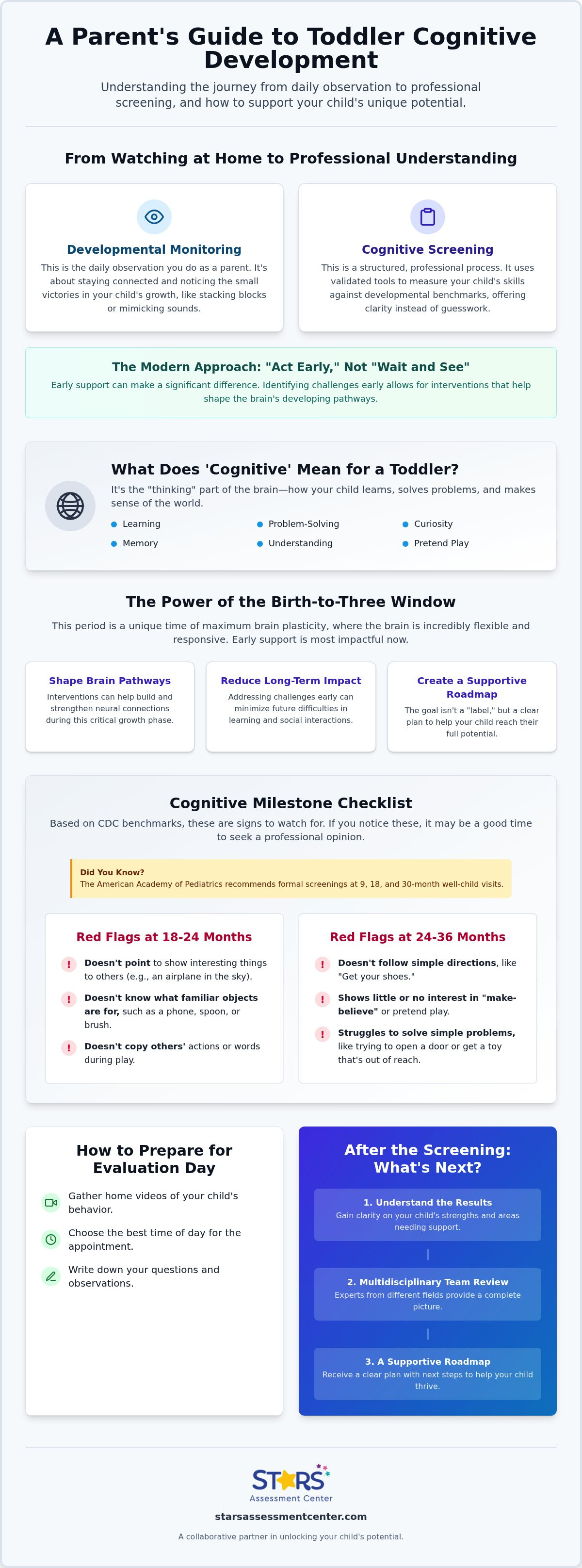
You know your child better than anyone else. You notice the small victories, like the first time they stack three blocks or finally mimic a "choo-choo" sound. This daily observation is what we call developmental monitoring. It's a wonderful way to stay connected to your child's growth. However, a formal cognitive delay screening for toddlers is a different, more structured process. While monitoring is about watching, screening is about measuring. It uses validated tools to see how your toddler's skills compare to typical developmental benchmarks.
In the past, many families were told to "wait and see" if a child would eventually catch up. Today, we focus on "acting early" because we understand how much a little support can do. If you have questions about your child's progress, a screening offers clarity rather than guesswork. While your pediatrician provides essential care, a specialized center like Stars Assessment Program offers a multidisciplinary team. This means you get a complete picture of your child's strengths from several different expert perspectives at once.
What Does 'Cognitive' Mean for a Toddler?
When we talk about cognitive skills, we are referring to the "thinking" part of your child's brain. This domain includes how they learn, solve problems, and make sense of the world around them. It's the curiosity that drives them to look under a blanket for a hidden toy or the memory that helps them remember where the snacks are kept. These thinking skills are deeply connected to other areas, such as speech and movement. If a child is struggling to process information, it might also affect how they communicate or interact with others. During a screening, professionals often use tools like the ASQ-3 or Bayley Scales to observe these interactions. Identifying a potential Global Developmental Delay early ensures that your child receives the right kind of encouragement for their specific needs.
Why Early Screening Matters (Birth to Three)
The window between birth and age three is a unique time of maximum brain plasticity. During these years, the brain is incredibly flexible and responsive to new learning experiences. This is why early cognitive delay screening toddlers is so impactful. When we identify a delay during this period, we can provide interventions that actually help shape the brain's developing pathways. By addressing challenges now, we can reduce the long-term impact on your child's future learning and social experiences. It’s not about finding a "label" for your child. It’s about creating a roadmap that helps them reach their full, wonderful potential.
The Cognitive Milestone Checklist: Signs to Watch For
Watching your toddler discover the world is a series of "lightbulb" moments. Maybe they finally realized that pushing a button on their toy makes it sing, or they’ve started handing you a toy phone when it "rings." These aren't just cute behaviors; they're vital indicators of cognitive health. As of February 2026, the CDC updated its benchmarks to reflect what 75% of children can do by a certain age. This shift helps parents and providers identify when a child might benefit from a cognitive delay screening for toddlers sooner rather than later. The American Academy of Pediatrics also continues to recommend formal screenings at the 9, 18, and 30-month well-child visits to ensure no child falls through the cracks.
Cognitive milestones focus on how a child thinks, learns, and solves problems. We look for specific behaviors that show their brain is busy making connections. For example, problem-solving begins when a child can find an object you’ve hidden under a blanket. It shows they understand that things still exist even when they can't see them. Pretend play is another major marker. When your child uses a block as a "phone" or "feeds" a teddy bear with a plastic spoon, they're demonstrating symbolic thought. They are beginning to understand that one thing can stand for another, which is a foundational skill for later reading and math.
Cognitive Red Flags at 18-24 Months
During this stage, children are usually becoming active explorers. It's a time of rapid growth in curiosity and imitation. You might want to seek a professional opinion if your child does not point to show things to others, as this "joint attention" is a key part of social learning. Other signs include not knowing what familiar objects like a spoon or phone are for, or showing no interest in copying the actions or words of those around them. Engaging in regular Developmental Monitoring and Screening helps you track these subtle shifts in behavior with confidence rather than worry.
Cognitive Red Flags at 24-36 Months
As toddlers approach their third birthday, their ability to follow directions and engage in "make-believe" should increase significantly. A primary concern at this age is a difficulty following simple two-step commands, such as "Get your shoes and put them by the door." You should also watch for a lack of simple pretend play or, most importantly, any loss of previously acquired skills. This type of regression is always a reason to talk to a specialist. If you've noticed these signs, a multidisciplinary developmental assessment can offer a clear, supportive picture of your child's unique needs and strengths.
How to Prepare for Your Toddler's Developmental Screening
Preparing for a cognitive delay screening for toddlers doesn't have to be a source of stress. Think of it as preparing for a specialized playdate where the goal is simply to see how your little one interacts with the world. One of the most helpful things you can do beforehand is gather "evidence" of your child's behavior at home. Specialists often appreciate seeing short videos of your child playing, eating, or attempting to solve problems in their natural environment. These clips provide a window into skills that might not be visible in a new clinic setting where a child might feel shy.
When you book the appointment, timing is everything. Try to pick a window when your child is usually at their best, typically after a morning nap and a good meal. A hungry or tired toddler won't be able to show off their true abilities. During the session, your role is to be a supportive observer. It's tempting to "coach" your child to perform, but it's better to let them respond naturally. This helps the team get an accurate baseline. For more detailed information on why these assessments are structured this way, you can review these Developmental and Behavioral Screening Tests from MedlinePlus. Don't forget to bring along their medical and birth history records, as well as a few familiar toys to help them feel at home.
The 'Day-Of' Preparation Checklist
To ensure the morning goes smoothly, follow these simple steps to prepare your child and yourself:
- Step 1: Explain the visit. Use positive, simple language. Tell them they are going to play with some new friends and some fun toys. Avoid using words like "doctor" if that causes them anxiety.
- Step 2: Pack a 'comfort kit'. Bring a favorite blanket, a stuffed animal, and plenty of familiar snacks. These items can help a child feel safe and grounded in a new space.
- Step 3: Arrive early. Plan to get there at least 15 minutes before your scheduled time. This allows your toddler to acclimate to the environment before the actual cognitive delay screening for toddlers begins.
Managing Your Own Expectations and Anxiety
It's completely normal to feel anxious about what the results might show. Remember that this screening is just a snapshot of one day in your child's life. It isn't a final judgment on their future or your parenting. To stay focused, write down your top three concerns before you arrive. This ensures that you don't forget to mention a specific behavior that's been on your mind. Your input as a parent is the most valuable data point the specialists have. You are the expert on your child, and your daily observations are a critical part of this collaborative partnership.
After the Screening: Understanding Results and Local Next Steps
Receiving the results of a cognitive delay screening for toddlers can bring up a mix of emotions. It's helpful to remember that these results are not a final label or a prediction of your child's entire future. If the results suggest your child is "at risk" or in the "monitor" category, it simply means they would benefit from extra support or a closer look. A "monitor" result usually implies that while your child is meeting many goals, there are specific areas where we want to check back in a few months to ensure they stay on track. An "at risk" result is a signal that it's time to move toward a more comprehensive Multidisciplinary Developmental Assessment.
If you feel the results don't quite match the child you see every day, don't be afraid to speak up. You are your child's most important advocate. Sometimes a child might have an "off" day during the screening, or they might perform differently in a clinical setting than they do at home in Morgan Hill. Providing the specialist with the home videos you gathered during your preparation can help bridge this gap. Your insights are a vital part of the "complete picture" we strive to build for every family.
Local Resources in San Jose and Santa Clara
In California, we are fortunate to have the Early Start program, which is specifically designed for children from birth to age three. For families in San Jose, Milpitas, and Morgan Hill, the San Andreas Regional Center (SARC) is the primary point of contact for these state-funded services. Under the Individuals with Disabilities Education Act (IDEA), your child has a legal right to a timely evaluation and appropriate support. Stars Assessment Program works as a dedicated partner in this community, helping you navigate the referral process and providing the expert evaluations required to access these local services. We focus on making the transition from screening to support as seamless and stress-free as possible.
Creating an Action Plan
Once you have the results, the next step is to create a manageable action plan. Rather than trying to fix everything at once, we recommend prioritizing the most critical areas of need. For many toddlers, this might mean focusing on communication or social-emotional skills first, as these often serve as the foundation for other types of learning. Set small, measurable goals for your child, such as pointing to three different objects by next month. It’s also helpful to find local parent support groups in Santa Clara County. Connecting with other parents who are on a similar journey can provide the emotional reassurance and practical tips that only another parent can offer. If you're ready to take the next step toward clarity, you can schedule a multidisciplinary developmental assessment with our compassionate team today.
Multidisciplinary Evaluations at Stars Assessment Program
When you're looking for answers about your child's growth, a single perspective often isn't enough. At Stars Assessment Program, we believe a team approach offers the clearest path forward. Our multidisciplinary developmental assessments bring together specialists in speech, social-emotional health, and cognitive skills. This collaborative effort ensures that a cognitive delay screening for toddlers isn't just an isolated data point, but a piece of a larger, more accurate picture. We specialize in working with children under age three, particularly those who may need screenings for Autism or Down syndrome. Our goal is to provide clarity while maintaining a gentle, family-centered heart that puts your child's comfort first.
This team-based model is especially effective because development doesn't happen in a vacuum. A child's ability to solve a puzzle is often linked to their ability to follow a verbal instruction or their comfort level in a social setting. By having multiple experts observe these interactions simultaneously, we can identify the root of a challenge rather than just the symptoms. We serve families across the greater South Bay area, including those in Salinas and Santa Cruz, ensuring that high-quality, specialized care is accessible to our local community.
The Stars Assessment Experience
Our San Jose center is designed to be a welcoming space where toddlers can feel safe to explore and play. During a multidisciplinary evaluation, our specialists observe your child in a natural, play-based environment. We don't just look at what a child can't do; we look at the whole child, celebrating their unique strengths while identifying where they need a helping hand. Once the evaluation is complete, we don't just hand you a report full of jargon. We translate our clinical findings into a supportive roadmap that makes sense for your daily life. This plan is designed to empower you with specific strategies and connections to local resources that will help your child reach their next milestone.
Getting Started with Stars
We know that the referral and evaluation process can feel like a maze, especially when you're already feeling anxious about your child's progress. That's why we act as a "Safe Harbor" for families in Santa Clara County, guiding you through every step of the journey with patience and reliability. If you suspect your child could benefit from a cognitive delay screening for toddlers, you can reach out to us directly to discuss your concerns. Many families also come to us through a referral from their pediatrician or the San Andreas Regional Center. We're here to listen, to validate your observations, and to help your child thrive in their own unique way. Schedule a consultation with our developmental specialists today to begin building your family's plan for success.
Taking the Next Step Toward Your Child's Bright Future
Walking the path of parenthood often means balancing deep love with the desire for clear answers. By learning about cognitive delay screening toddlers, you've already taken a vital step in advocating for your child's growth and well-being. You now understand that these screenings are helpful snapshots that allow us to celebrate your toddler's strengths while identifying exactly where they might need extra support. Whether it's practicing new problem-solving skills or preparing for a clinical visit, your proactive approach is the greatest gift you can give your little one during these formative years.
At Stars Assessment Program, we've been a steady ally for Santa Clara County families since 1988. Our multidisciplinary team of specialists maintains a specialized focus on birth to age three, ensuring that every evaluation is conducted with professional warmth and precision. We don't just provide scores; we provide a compassionate roadmap for your family's unique journey. If you're ready for clarity and a partner who truly hears your concerns, we are here to help. Request a Comprehensive Developmental Assessment for Your Child today. Your child has a world of potential, and we're honored to help you unlock it.
Frequently Asked Questions
Is a cognitive delay the same as an intellectual disability?
A cognitive delay is not the same as an intellectual disability. A delay refers to a child reaching thinking milestones later than 75% of their peers. An intellectual disability is a more permanent diagnosis that involves significant limitations in both mental ability and everyday life skills. Early support can often help bridge the gap for children experiencing a lag in their thinking development during these early years.
Can a toddler 'grow out' of a cognitive delay?
Children rarely "grow out" of a delay without support, but they can catch up with the right help. Early intervention is designed to take advantage of high brain plasticity during the first three years of life. By addressing a lag early, we can often reduce the long term impact on a child's learning journey and help them reach their full potential through targeted, play-based strategies.
What if my child is too shy to perform during the screening?
It's completely normal for a toddler to feel shy in a new environment. Our specialists use a gentle, family-centered approach to help your child feel comfortable. We also encourage you to bring home videos of your child's behavior. These clips provide valuable evidence of their skills in a familiar setting, ensuring the cognitive delay screening toddlers is as accurate as possible for your child.
How long does a formal cognitive screening usually take?
A formal screening is typically a brief process that lasts between 30 and 60 minutes. It's designed to determine if a more in depth evaluation is necessary. If your child moves forward with a multidisciplinary developmental assessment, that process is much more thorough. It involves several specialists and may take a few hours to ensure we get a complete and accurate picture of your child's unique needs.
Does a screening result of 'delay' mean my child has Autism?
A result of "delay" does not automatically mean your child has Autism. While cognitive delays can be associated with Autism, they can also occur on their own or alongside other conditions. A screening is simply a tool to identify if your child needs more specialized support. A full evaluation by a multidisciplinary team is the best way to determine the specific cause of any developmental lags.
How much does a developmental assessment cost in California?
The cost of an assessment depends on your specific insurance coverage and the type of evaluation required. Many families in Santa Clara County access services through the California Early Start program, which provides state-funded support for those who qualify. We recommend contacting your insurance provider or the San Andreas Regional Center to understand the specific options and coverage available for your family's current situation.
Do I need a doctor's referral to visit the Stars Assessment Program?
You don't always need a formal doctor's referral to begin the process, although many families arrive this way. If you have concerns about your child's development, you can reach out to us directly. We are a community oriented advocate for families in San Jose and Morgan Hill. We can help you understand the next steps for a cognitive delay screening toddlers and how to navigate local support.
What happens if my child is over age three?
Stars Assessment Program specifically serves children from birth to age three. If your child is already three years old, their developmental needs are usually addressed through your local school district. This transition is part of the Individuals with Disabilities Education Act (IDEA). We can help guide you toward the right school district contacts in Milpitas or Morgan Hill to ensure your child continues to receive necessary care.


