
You're sitting on a playmat at a local San Jose park, watching other babies reach for toys or push up on their tiny arms. While the other parents chat about sleep schedules, you're quietly wondering why your little one hasn't quite hit those same marks yet. If you're worried about your infant not meeting developmental milestones, that quiet concern can quickly turn into an overwhelming sense of anxiety. It's exhausting to scroll through conflicting online charts while wondering if your child needs extra help or just a little more time.
We understand that this uncertainty feels heavy. You deserve to move from a place of worry to a place of proactive support. This article provides a professional checklist to help you determine if a delay exists and offers a clear roadmap for accessing services in Santa Clara County. You'll learn how a multidisciplinary assessment works, what to expect from the California Early Start program, and how to partner with experts who view your child's growth as their top priority. Let's replace confusion with a steady path forward for your family.
Key Takeaways
- Understand that developmental milestones are functional "check-ins" rather than rigid deadlines, helping you view your baby's progress with clarity instead of judgment.
- Identify specific red flags in communication and motor skills that may suggest an infant not meeting developmental milestones requires a professional evaluation.
- Learn why a multidisciplinary assessment-combining experts in speech, cognition, and social-emotional health-is the gold standard for getting clear answers.
- Navigate the Santa Clara County early intervention system with a step-by-step roadmap for documenting observations and seeking a formal referral.
- Discover how partnering with a specialized team can turn your concerns into a proactive plan that supports your child's unique growth journey.
Understanding Infant Developmental Milestones: More Than Just a Timeline
Milestones are functional skills and age-specific behaviors that most children reach by certain ages. These include everything from a first social smile to the complex coordination required for crawling. If you are concerned about an infant not meeting developmental milestones, it helps to start with a clear definition. These markers aren't rigid pass/fail tests or high-stakes deadlines. Instead, think of them as "check-in" points that help parents and providers monitor a child's unique growth trajectory.
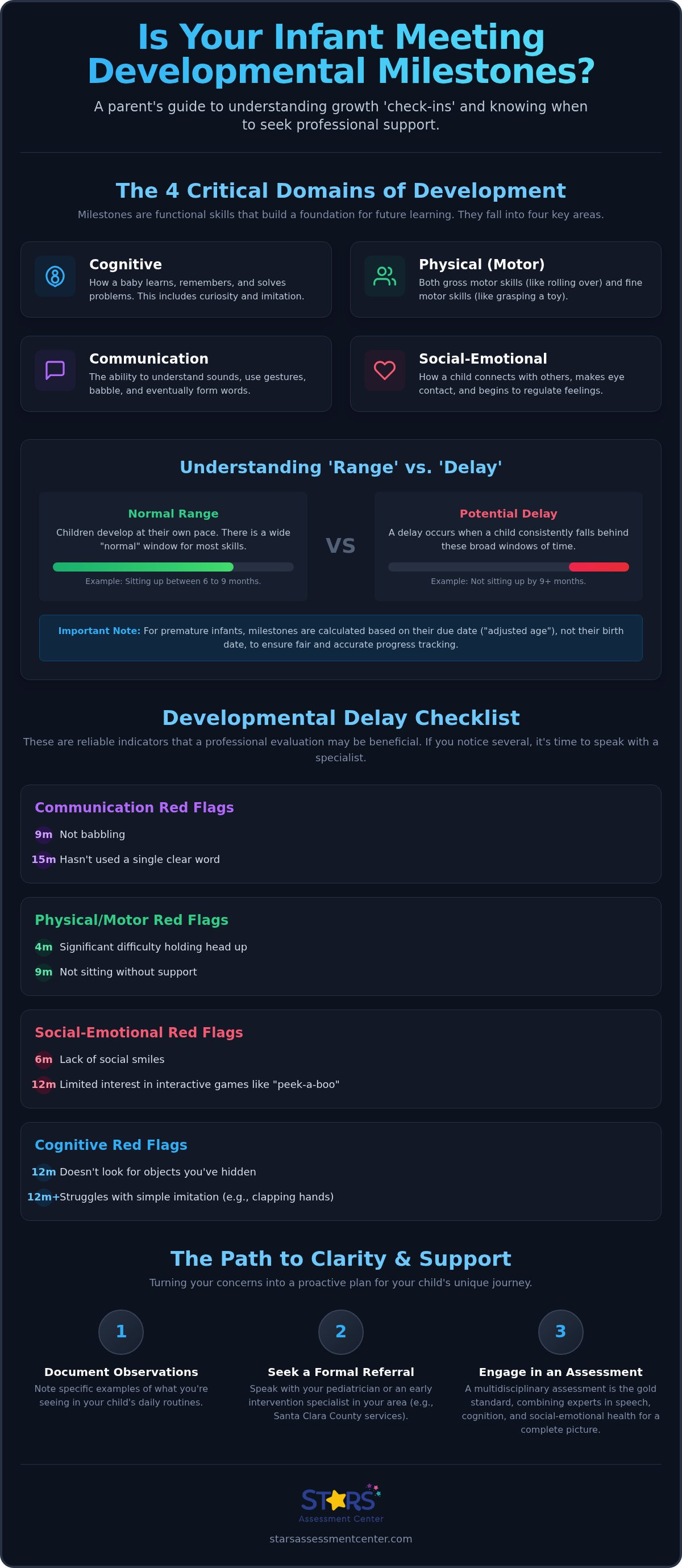
Developmental progress generally falls into four critical domains. Each area supports the others, creating a foundation for future learning and independence. These domains include:
- Cognitive: How a baby learns, remembers, and solves problems.
- Physical: Both gross motor skills, like rolling over, and fine motor skills, like grasping a rattle.
- Communication: The ability to understand sounds and eventually use gestures or words.
- Social-Emotional: How a child connects with others and begins to regulate their own feelings.
While it's tempting to "wait and see" if a child catches up, early identification is your most powerful tool. The brain grows more rapidly between birth and age three than at any other time in life. Addressing a concern early doesn't mean something is "wrong"; it means you're giving your child the specialized support they need during their most flexible stage of development.
The Difference Between a 'Range' and a 'Delay'
Every child develops at an individual pace. There is a wide "normal" window for almost every skill. For example, one baby might sit up at six months while another waits until nine months. A developmental delay occurs when a child consistently falls behind these broad windows across one or more domains. It's also vital to consider "adjusted age" for infants born prematurely. We calculate milestones based on the child's due date rather than their birth date to ensure we're measuring their progress fairly and accurately.
Why Social-Emotional Milestones Matter Early
While physical milestones like walking often get the most attention, social-emotional health is the quiet engine of development. By six months, most infants should be making steady eye contact, responding to their name, and offering social smiles to their caregivers. These early bonds aren't just sweet moments; they are the literal building blocks for communication and cognitive growth. If an infant not meeting developmental milestones seems disinterested in social interaction, it's a sign that their social-emotional foundation may need a bit of extra nurturing from a professional team.
The Developmental Delay Checklist: Domain-Specific Signs to Watch For
Identifying an infant not meeting developmental milestones often starts with quiet observations made during daily routines. While every child grows at their own pace, certain behaviors act as reliable indicators that a professional check-in might be beneficial. By using the CDC’s developmental milestones as a helpful guide, you can look at your child's progress through the lens of specific functional domains. If you notice several of these signs, it's a good time to document what you see and speak with a specialist.
- Communication: Your baby isn't babbling by 9 months or hasn't used a single clear word by 12 to 15 months.
- Physical/Motor: There is significant difficulty holding the head up by 4 months or the child isn't sitting without support by 9 months.
- Social-Emotional: You notice a lack of social smiles by 6 months or a limited interest in interactive games like "peek-a-boo" by 12 months.
- Cognitive: Your child doesn't look for objects you've hidden by 12 months or struggles with simple imitation, like clapping hands.
Checking these lists can feel stressful. Remember that these markers are designed to help you advocate for your child, not to create a sense of alarm. If you feel uneasy about your child's progress, a multidisciplinary developmental assessment can offer the comprehensive answers you need to move forward with confidence.
Communication and Speech Red Flags
Language development is a complex journey that begins long before a first word is spoken. It starts with cooing and babbles, then moves into intentional gestures like pointing, waving, or reaching. If a toddler isn't using these non-verbal cues to communicate their needs by 12 months, it may indicate a delay. Specialists often distinguish between expressive language, which is what a child says, and receptive language, which is what they understand. A child might understand complex directions but struggle to form words. A gap in either area is a valid reason to seek a professional evaluation.
Social-Emotional and Behavioral Indicators
Social-emotional markers are the foundation of how a child relates to the world. One of the most critical behaviors we look for is "joint attention." This occurs when a child shares an interest in an object, like a passing bird or a new toy, by looking back and forth between the object and their parent. A lack of this shared connection or a general disinterest in social engagement can be early signs of Autism or other social-emotional delays. While all toddlers have big feelings, a total lack of engagement or extreme difficulty with simple social transitions suggests that a specialized screening could be helpful.
Why a Multidisciplinary Assessment is the Gold Standard for Clarity
While your pediatrician is your first line of defense, a routine check-up often lasts only 15 minutes. This brief window isn't always enough to capture the full picture of an infant not meeting developmental milestones. A multidisciplinary developmental assessment moves beyond quick screenings to offer a comprehensive, team-based evaluation of your child's growth. It's a deep dive that looks at the whole child rather than just one isolated skill.
Instead of relying on a single perspective, you gain the collective wisdom of a collaborative group. This team typically includes speech specialists, social-emotional experts, and cognitive evaluators. Each professional looks at your child through a different lens. This approach allows the team to identify the actual root of a delay. For instance, if a child isn't responding to their name, the team determines if the cause is a hearing issue, a motor coordination challenge, or a social-emotional delay.
Parents often bring their completed checklists of CDC's developmental milestones to these appointments to show exactly where their concerns began. Having this data-driven foundation helps the team focus their evaluation on the areas that matter most to your family. It turns your intuition into actionable information.
What to Expect During a Professional Evaluation
The evaluation process is designed to be a partnership. You are the expert on your child, so your daily observations are the most valuable data points the team has. Assessments are usually play-based; we use toys, games, and gentle interactions to keep children comfortable and engaged while specialists observe their natural behaviors. Specialists use standardized tools alongside these observations to provide objective clarity and create a clear baseline for future progress.
The Benefit of Specialized Screenings
Programs like the Stars Assessment Program provide specialized Autism and Down syndrome screenings that offer specific answers when general milestones aren't being met. An early, accurate diagnosis is the key to unlocking the most effective, tailored intervention strategies for your child's unique needs. By bringing together all necessary specialists under one roof, multidisciplinary teams effectively eliminate the frustrating "referral run-around" that often leaves parents waiting months for separate appointments.
Navigating the Evaluation Process in Santa Clara County
Finding out your child may need extra support is the first step toward a brighter future. If you're worried about an infant not meeting developmental milestones, the process in California is designed to provide clear answers and immediate help. Following a structured path helps reduce the stress of the unknown and ensures your family finds the right resources quickly.
- Step 1: Document your observations. Use a milestone checklist to write down specific behaviors you've noticed at home, such as how your baby plays, moves, or communicates.
- Step 2: Start the conversation. Consult with your pediatrician or contact a specialized assessment center like Stars to discuss your concerns.
- Step 3: Understand the Regional Center's role. In California, the "Early Start" program is managed through Regional Centers, which coordinate services for children from birth to age three.
- Step 4: Schedule a multidisciplinary evaluation. This comprehensive assessment can be conducted in San Jose or surrounding cities to give you a 360-degree view of your child's growth.
- Step 5: Review results and create an IFSP. If your child qualifies for services, you'll work with a team to develop an Individualized Family Service Plan (IFSP) tailored to your family's goals.
Local Resources for San Jose and Santa Clara Families
Families in Milpitas, Gilroy, and Morgan Hill often find that local support networks are their greatest asset. The Stars Assessment Program partners closely with families throughout Santa Clara County to bridge the gap between initial concern and professional services. We help you stay compliant with California-specific regulations for early intervention, ensuring that your child receives the support they're entitled to under the law. Our team understands the local landscape and can guide you through the specific referral requirements for our region.
Overcoming Common Barriers to Assessment
Many Bay Area parents hesitate because of questions about insurance or the fear of a permanent label. It's helpful to remember that an assessment is simply a tool for understanding how your child learns best; it isn't a judgment on your parenting or a limit on your child's potential. Seeking help early is about opening doors to resources rather than checking boxes for a diagnosis. Stars Assessment Program provides a safe harbor for local families in Salinas and Santa Cruz who are looking for clarity and compassion. If you're ready to take the next step, you can contact the Stars Assessment Program to schedule a multidisciplinary evaluation and begin your journey toward support.
Turning Observation into Action: Your Next Steps with Stars Assessment Program
At Stars Assessment Program, we believe that an evaluation is the first step toward empowerment. When you realize your infant not meeting developmental milestones requires professional attention, it's natural to feel a rush of different emotions. We are here to transform those feelings into a structured, empathetic plan. Our team views every family as a partner, ensuring you feel heard and supported throughout the entire process. We don't just provide a report; we provide a dedicated guide for your child's growth.
Waiting for a child to "grow out of it" is a common suggestion, but in the world of early development, time is a precious resource. Early intervention is effective because it takes advantage of the brain's incredible plasticity during the first three years of life. By acting now, you're not just addressing a current delay. You're actively changing the trajectory of your child's future. Most children who receive early, specialized support make significant developmental gains that help them thrive in school and social settings later on.
Preparing for the assessment day doesn't have to be stressful for you or your little one. We recommend scheduling the appointment during a time when your child is usually well-rested and fed. Bring familiar toys, a favorite blanket, or preferred snacks to help them feel at ease in a new environment. For parents, it's helpful to write down specific questions or observations beforehand. This ensures you feel prepared to advocate for your child's needs while our team handles the technical details of the evaluation.
Partnering with the Stars Assessment Team
Our commitment to cultural sensitivity means we respect and value the diverse backgrounds of families across Santa Clara County. We understand that every family has unique goals and concerns. Whether you need a specialized Social-Emotional Assessment or a comprehensive Multidisciplinary Developmental Assessment, our roadmap is designed to be clear and accessible. We handle the complexities of the evaluation so you can focus on what matters most: supporting your child's unique journey. Our team is ready to help you bridge the gap between noticing a delay and accessing the services your child deserves.
Contact Us Today for Peace of Mind
If you live in San Jose, Santa Clara, or the surrounding local cities, expert help is just a phone call away. You don't have to navigate the early intervention system alone. Our specialists are here to provide the clarity you need to move forward with confidence. Whether you are seeking a Speech and Language Evaluation or specialized screenings for Autism or Down syndrome, we offer a safe harbor for your family. Taking action today is the best way to ensure your child has the tools they need to succeed tomorrow.
Schedule a Developmental Assessment with Our Team to begin your journey toward clarity and support.
Empowering Your Child's Future Through Proactive Support
You now have the tools to move from a place of uncertainty to one of clear, purposeful action. By understanding that milestones are flexible guides rather than rigid deadlines, you can advocate for your child's unique needs with confidence. If you're concerned about an infant not meeting developmental milestones, remember that early intervention is the most effective way to support long-term growth and success.
Our expert multidisciplinary team of specialists is here to provide a safe harbor for families in San Jose, Santa Clara, and the Greater Bay Area. We offer specialized social-emotional and autism screenings designed to give you the objective clarity you've been looking for. You don't have to navigate the California early intervention system alone; our team is ready to partner with you every step of the way.
We invite you to Request a Professional Developmental Evaluation for Your Child today to gain the peace of mind you deserve. You are your child's best advocate, and with the right roadmap, you can turn today's worries into a proactive plan for their bright future.
Frequently Asked Questions
What should I do if my child isn't meeting milestones but my doctor says to 'wait and see'?
Trust your intuition and seek a specialized second opinion if you feel uneasy. While pediatricians are excellent generalists, they only see your child for a few minutes during a check-up. You don't need a referral to contact an early intervention program for an initial screening. Taking proactive steps now ensures your child receives support during their most critical window of brain development.
Is an evaluation the same as a diagnosis for my baby?
No, an evaluation is a comprehensive process used to understand your child's current strengths and challenges, while a diagnosis is a formal medical identification of a condition. The primary goal of an assessment is to determine if a child qualifies for support services. Many children receive help for a developmental delay without ever receiving a lifelong medical diagnosis.
How long does a multidisciplinary developmental assessment take?
A typical multidisciplinary developmental assessment usually lasts between two and four hours. We intentionally keep the environment relaxed and include plenty of breaks for play, snacks, and rest. This methodical pace allows our team of specialists to observe your child's natural behaviors and skills while ensuring they remain comfortable and engaged throughout the entire session.
What are the earliest signs of autism in infants under 18 months?
Early signs often involve social-emotional markers, such as a child not consistently responding to their name by 12 months or a lack of "joint attention." You might also notice an infant not meeting developmental milestones related to gestures, like pointing at a bird or waving goodbye. These subtle indicators are best identified through specialized screenings that focus on social engagement and communication.
Will my child be labeled for life if they have a developmental delay?
Identifying a delay early is about providing a roadmap for support, not creating a permanent label. Many children who receive early intervention make such significant progress that they no longer require services by the time they enter kindergarten. The goal is to provide the right tools at the right time to change your child's long-term developmental trajectory.
Can a speech delay be a sign of other developmental concerns?
Yes, a delay in speech can sometimes be a window into other areas, such as hearing, cognitive growth, or social-emotional health. Because communication is a complex skill, it often relies on multiple developmental domains working together. A multidisciplinary evaluation helps determine if the challenge is strictly language-based or if your child would benefit from a broader support plan.
Does Stars Assessment Program serve families in Salinas and Santa Cruz?
Yes, Stars Assessment Program serves families in Salinas, Santa Cruz, San Jose, and the surrounding local cities within Santa Clara, San Benito, and Monterey counties. We are dedicated to acting as a community-oriented advocate for parents across the Central Coast and Greater Bay Area. Our local presence makes it easier for families to access high-quality, multidisciplinary evaluations close to home.
What is the difference between a screening and a comprehensive evaluation?
A screening is a brief "snapshot" used to identify if a child is at risk for a delay and needs further testing. In contrast, a comprehensive evaluation is a deep dive into all developmental domains conducted by a team of experts. Think of a screening as a quick check-in that determines if you need the detailed, actionable roadmap provided by a full assessment.


