
When you first notice your toddler isn't reaching their milestones as quickly as their peers, the world can suddenly feel very loud and confusing. You might find yourself wondering if you're overreacting or if your child needs extra support. It's completely natural to feel overwhelmed by the complex early intervention system in California. You likely want answers, but the difference between educational testing and clinical assessments isn't always clear.
If you're asking, "what is the stars assessment program," you've already taken a brave first step toward supporting your child's growth. This guide will show you how the program provides the multidisciplinary evaluations infants and toddlers need to access vital services in Santa Clara County. We'll walk through each stage of the assessment process, from the initial referral to the family-centered evaluation. You'll gain a clear roadmap for accessing services after the evaluation is complete, giving you the reassurance that you're not walking this path alone. By the end, you'll understand exactly how this supportive environment helps your family find clarity and hope for the future.
Key Takeaways
- Understand what is the stars assessment program and how this clinical evaluation focuses specifically on the critical developmental window for children from birth to age three.
- Learn about the multidisciplinary team approach that brings together various specialists to provide a comprehensive view of your child’s unique strengths and needs.
- Find out how the structured, play-based assessment process is designed to be a gentle and non-intimidating experience for both you and your little one.
- Discover how specialized screenings help identify early markers for Autism and speech delays, providing a clear path toward the right early intervention services.
- Follow a straightforward roadmap for navigating the Regional Center system in Santa Clara County to ensure your child receives the support they deserve.
Defining the Stars Assessment Program: Clinical Evaluation for Infants & Toddlers
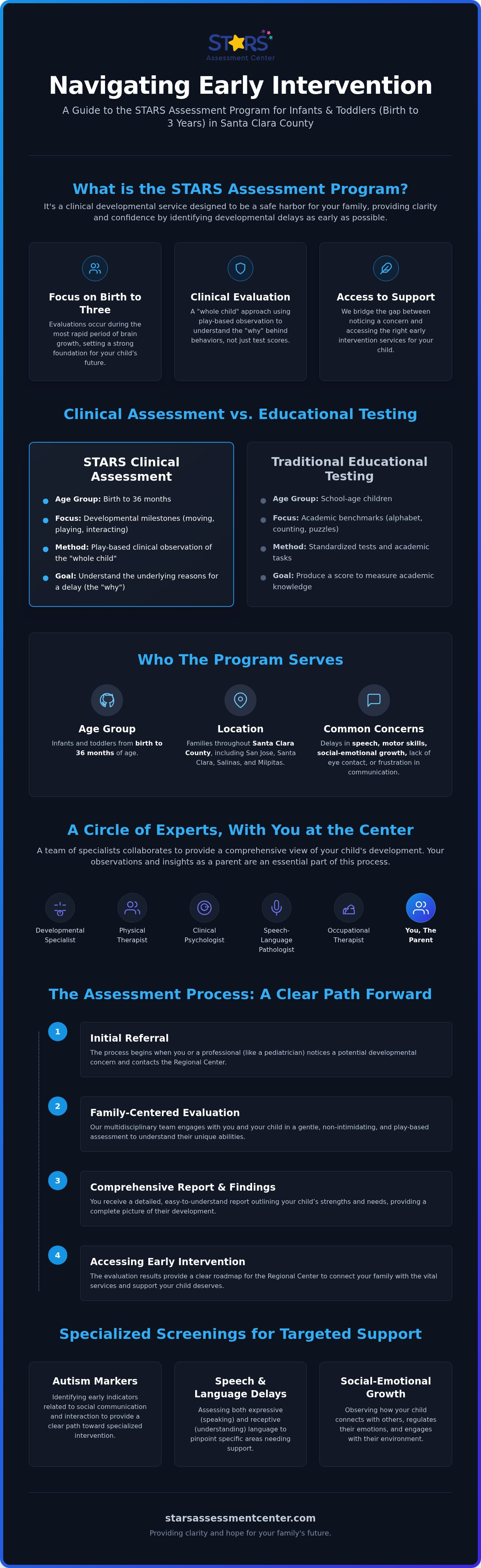
When you start searching for support for your child, you might feel a mix of hope and confusion. If you've been asking what is the stars assessment program, it's helpful to first clarify what it isn't. Many online searches point toward standardized reading or math tests used in elementary schools. Our program is fundamentally different. We are a clinical developmental service focused exclusively on the "Birth to Three" window. This specific timeframe is the most rapid period of brain growth in a human life. Our mission is to act as a safe harbor for your family, providing a calm and expert space where you can find the answers you need about your child's growth.
The program's primary role is identifying developmental delays as early as possible. We don't just look at what a child can't do; we look at how they are currently experiencing their world. By providing a comprehensive evaluation during these first 36 months, we help families bridge the gap between noticing a concern and accessing the right support. We believe that clarity brings peace of mind. Knowing exactly where your child stands allows you to move forward with a clear, confident plan.
Clinical Assessment vs. Educational Testing
Infants and toddlers don't need to be tested on their ability to recite the alphabet or solve puzzles. They need a clinical assessment that focuses on how they move, play, and interact with the people they love. While school-age testing focuses on academic benchmarks, a clinical evaluation at Stars focuses on developmental milestones. We use specialized clinical observation to understand the "whole child." This means our experts watch how a child stacks blocks, responds to their name, or uses gestures to communicate their needs. These observations help us understand the underlying reasons for a delay. We look for the "why" behind the behavior, which is much more valuable than a simple test score.
Who the Program Serves in Santa Clara County
Our program is specifically designed for children from birth to 36 months of age. If your child is under three and you have concerns about their speech, motor skills, or social-emotional growth, we are here to help. We primarily serve families throughout San Jose, Santa Clara, Salinas, and Milpitas. As a key partner in California's Early Start program, we work closely with local regional centers to ensure that infants and toddlers get the help they need before they reach preschool age.
Common reasons for a referral include a child not yet walking, a lack of eye contact, or a delay in first words. You might notice your child isn't responding to sounds or seems frustrated when trying to communicate. These are valid reasons to seek an evaluation. Identifying these needs early allows for more effective intervention, setting a stronger foundation for your child's future. We are dedicated to supporting families across the South Bay, providing local expertise that understands the unique needs of our community.
The Multidisciplinary Team: Who Evaluates Your Child?
Understanding what is the stars assessment program begins with meeting the dedicated team behind the process. We don't believe a single lens can capture the vibrant, complex nature of a child's development. Our multidisciplinary approach brings together a circle of experts who look at every facet of your child's growth. This team-based model is a core requirement of California's early intervention program, ensuring that families receive a comprehensive picture rather than a fragmented one. When specialists collaborate, they catch the small details that might be missed in a standard checkup. This collective expertise provides a level of accuracy that a single practitioner simply cannot match.
You are the most important member of this team. Nobody knows your child's personality, favorite toys, or daily routines better than you do. We treat parents as essential partners throughout the entire evaluation. Your observations are just as valuable as our clinical tools. This partnership ensures the evaluation feels like a conversation rather than a cold medical procedure. We value your input because it helps us see how your child functions in their most comfortable environment. It's about working together to create a roadmap for your child's success.
Specialists Involved in the Evaluation
The specific team members assigned to your child depend on your primary concerns. Most evaluations include a combination of these dedicated professionals who work in harmony:
- Speech and Language Pathologists: These experts assess how your child expresses needs and understands language. They look at early babbling, gestures, and how your child follows simple directions.
- Developmental Specialists: They focus on cognitive development. By watching your child play with blocks or puzzles, they see how your little one processes information and solves problems.
- Social-Emotional Experts: These specialists observe how your child interacts with others. They look at bonding, eye contact, and how your child regulates their feelings during play.
The Role of the Assessment Coordinator
The evaluation process can feel like a lot to manage. That's why every family is paired with an assessment coordinator. They serve as your steady ally and primary point of contact. The coordinator ensures the process flows smoothly, handling the logistics so you can focus on your child. Most importantly, they act as a translator. They help you understand technical clinical findings in everyday language. If you're feeling anxious, they are there to provide a calming presence and clear answers. You can learn more about how we support families by exploring our multidisciplinary developmental assessments.
Step-by-Step: What to Expect During the Assessment Process
The journey from noticing a developmental delay to receiving support is a structured path designed to provide your family with total clarity. We understand that the "unknown" is often the most stressful part for parents. Our process moves at a pace that respects your child's comfort, ensuring that we gather the most accurate information possible. Unlike standardized tests for older children that might feel rigid or rushed, the process within the Stars Assessment Program is rooted in play and observation. This gentle approach helps transform a time of uncertainty into a clear roadmap for your child's future.
If you've been wondering what is the stars assessment program, the answer lies in its commitment to a non-intimidating environment. A child who feels safe and engaged will show their true abilities. The entire timeline, from the initial intake to the final summary report, is handled with professional warmth. We prioritize your child's emotional well-being because we know that a happy, relaxed toddler provides the most reliable clinical data. You won't find computer-adaptive tests here; instead, you'll find specialists who know how to sit on the floor and engage with your child at their level.
The Intake and Observation Phase
Everything begins with a thorough intake process. We take the time to listen to your story, gathering family history and specific developmental concerns you've noticed at home. This is followed by naturalistic observation. Naturalistic observation is the systematic process of watching a child’s behavior and interactions in their everyday environment or a play-based setting without adult interference. By watching how your child explores toys or looks to you for comfort, we gain insights that a formal test might miss. This phase is about seeing your child as an individual, not just a set of milestones.
The Evaluation and Feedback Sessions
During the evaluation, we use specific, play-based activities to screen for various conditions, including Autism and Down syndrome. These activities are designed to feel like fun games to your child, but they allow our specialists to observe communication patterns, motor skills, and social responses. Once the evaluation is complete, we hold a "Feedback Meeting." This is a dedicated time to discuss results with your family in real-time. We create a supportive environment where you can ask as many questions as you need. We don't just hand you a report and send you on your way; we walk through the findings together, ensuring you feel empowered and ready for the next steps in your child's care.
Specialized Screenings: Autism, Speech, and Social-Emotional Growth
The core of our clinical work involves looking deeply into specific developmental domains that define early childhood. When families ask what is the stars assessment program, they're often seeking clarity on how we identify specific conditions like Autism or Down syndrome. Our specialists are trained to spot early markers that might be subtle to the untrained eye. For example, we look at joint attention, which is a child's ability to share an interest in an object with another person. We also monitor motor development and social responses that can indicate a need for specialized support. Early identification isn't about labels; it's about opening doors to the right resources at the right time.
Social-emotional growth serves as the foundation for every other milestone. A child who can regulate their feelings and bond securely with caregivers is better equipped to learn and explore. We prioritize these assessments because they provide a window into your child's internal world. By addressing concerns early, we help prevent small frustrations from becoming larger obstacles as your child nears preschool age. Our goal is to ensure every toddler in Santa Clara County has the emotional resilience they need to thrive in a classroom setting and beyond.
Speech and Language Evaluation Basics
Communication is a complex two-way street. During an evaluation, we look at both expressive language, which is how your child uses sounds and words, and receptive language, which is how they understand what's being said to them. Many parents worry about "late talkers," but a professional clinical evaluation can determine if a child's progress is within a typical range or if they need a boost. For our youngest infants, we focus on non-verbal communication. We watch for gestures like pointing, waving, and the way a baby uses eye contact to get your attention. These early building blocks are essential for future speech development. If you've noticed your little one struggling to express themselves, you can start by requesting a speech and language evaluation.
Social-Emotional Assessment for Toddlers
Our social-emotional screenings evaluate how your child interacts with their world and the people in it. We look at self-regulation, which is a child's ability to manage their reactions to different environments and stimuli. This assessment is particularly vital for children who may have experienced early childhood trauma or show significant developmental delays. In a culturally rich area like San Jose, our team is sensitive to the fact that developmental milestones can be influenced by family traditions and language. We don't use a "one size fits all" approach. Instead, we honor your family's unique background while ensuring your child receives the clinical support necessary for healthy social engagement and bonding.
Next Steps: Accessing Early Intervention in Santa Clara County
Completing a developmental evaluation is a significant milestone for your family. It marks the moment you move from questioning and uncertainty to having a clear, actionable plan. The assessment acts as a vital bridge, connecting your child to the specific early intervention services they deserve. By the time the process is finished, you won't just have a document; you'll have a professional roadmap designed to support your child's unique growth. Whether you are in San Jose, Salinas, or Morgan Hill, these findings provide the clinical foundation needed to advocate for your little one's future.
When you reflect on what is the stars assessment program, it's helpful to see it as the key that unlocks state-funded support. Our findings are designed to be shared with local agencies to ensure your child meets the eligibility criteria for specialized care. We understand that the transition from assessment to treatment can feel like another hurdle. Our team remains a steady ally during this phase, helping you understand how to use the evaluation results to secure the best possible outcomes for your toddler.
Connecting with the Regional Center
In California, the primary gateway for early intervention is the Regional Center system. For families in our area, the San Andreas Regional Center is the essential partner for accessing services. Your Stars Assessment provides the professional clinical data required to qualify for these programs. These results directly inform the creation of an Individualized Family Service Plan (IFSP). This plan is a collaborative agreement between your family and service providers; it outlines the specific goals and therapies your child will receive. Having a comprehensive, multidisciplinary report makes you a much stronger advocate during these meetings, as you have expert evidence to support your requests.
Transitioning to Treatment and Support
Once the IFSP is in place, the focus shifts toward finding the right local providers. This might include speech therapy or behavioral health services tailored to your child's needs. The Stars Behavioral Health Group (SBHG) offers a broad ecosystem of care, ensuring that the transition from evaluation to intervention is as seamless as possible. We value personal connection and cultural sensitivity, which is why we work closely with community resources throughout the South Bay. You don't have to navigate this complex system alone. If you're ready to find the answers your family needs, you can Schedule a consultation with the Stars Assessment Program today.
Finding the Path Forward for Your Family
Gaining a clear understanding of what is the stars assessment program is often the moment when the weight of uncertainty begins to lift. We've seen how our multidisciplinary team of clinical specialists works in partnership with you to create a complete and compassionate picture of your child's developmental health. By focusing on a gentle, play-based environment, we ensure that the evaluation process remains a supportive experience for both you and your little one. This family-centered approach has been a cornerstone of our local expertise, serving families across Santa Clara and Salinas since 1988.
Your child's early years are a season of incredible potential. While the intervention system can feel complex, you don't have to navigate these steps alone. Our team is here to act as your steady ally, providing the professional insights needed to unlock vital services and specialized care. You have the power to turn today's questions into a clear roadmap for your child's success. Begin your child’s journey toward growth with the Stars Assessment Program today. Together, we can build a stronger foundation for your child's future, one milestone at a time.
Frequently Asked Questions
How do I know if my child needs the Stars Assessment Program?
If you notice your child isn't meeting milestones like first words or walking by expected ages, it's a good time to reach out. Many parents contact us when they feel their child's play or social bonding seems different from their peers. Trusting your intuition is the best guide. We specialize in the 0 to 36 month window, helping you determine if a delay is temporary or requires specialized support.
Is the Stars Assessment Program free for California residents?
Yes, the initial evaluation is free for children under age 3 who meet eligibility criteria in the Early Start Program. This includes those with a 33% delay in one or more developmental areas or an established risk condition. When asking what is the stars assessment program, it's helpful to know it's a state-supported clinical service designed to remove financial barriers for local families.
What is the difference between a multidisciplinary evaluation and a pediatrician visit?
A pediatrician provides a high-level wellness check, while a multidisciplinary evaluation is a deep dive into specific developmental domains. Our team includes specialists in speech, cognitive growth, and social-emotional health who observe your child through play for an extended period. This team-based approach offers a more detailed picture of your child's whole development than a standard 15 minute office visit can provide.
How long does a full developmental assessment take for a toddler?
The actual evaluation session typically lasts between one and two hours to ensure your child doesn't get too tired. We move at your toddler's pace, allowing for breaks and play to keep the environment low-stress. While the observation is brief, the full process from your initial intake to the final feedback meeting usually concludes within a few weeks, giving you timely answers and a clear plan.
Can the Stars Assessment Program help diagnose Autism in children under three?
Yes, the Stars Assessment Program is specifically designed to identify early markers of Autism and Down syndrome in children under 36 months. Our multidisciplinary team looks for social indicators like joint attention and communicative gestures. Identifying these needs early is essential because it allows you to access specialized behavioral health services during the most critical window of your child's brain development.
Do I need a doctor’s referral to contact the Stars Assessment Program?
You don't need a formal doctor's referral to begin the process. California's system allows parents, caregivers, and family members to self-refer if they have concerns about a child's development. While pediatricians often suggest our services, you have the right to contact us or your local Regional Center directly. We are here to listen to your concerns and guide you through the first steps.
What happens if the assessment identifies a developmental delay?
If a delay is identified, the assessment serves as the foundation for your child's Individualized Family Service Plan (IFSP). This plan outlines the specific therapies and supports your child will receive through the San Andreas Regional Center. We don't just provide a diagnosis; we give you a roadmap. Our team helps you understand the findings so you can confidently access the state-funded services your child deserves.
Are the assessments available in languages other than English in San Jose?
We are committed to serving the diverse community of San Jose and the surrounding South Bay by offering assessments in multiple languages. We understand that a child's development is best evaluated in the language they hear most at home. When you first ask what is the stars assessment program, we'll discuss your family's linguistic needs to ensure the evaluation is culturally sensitive and accurate for your little one.


